

The UK Department for Environment, Food & Rural Affairs (Defra) has become the latest high‑profile example of how procurement timing, vendor lifecycles and parliamentary oversight can collide: a reported £312 million IT modernisation programme that removed 31,500 Windows 7 laptops and standardised a large fleet on Windows 10 drew scrutiny when it emerged the department’s written update to Parliament misstated its operating system timeline — and, according to later reporting, was followed by a rapid move to Windows 11 that pre‑dated Microsoft’s Windows 10 end‑of‑support milestone. The episode highlights real security wins, awkward procurement timing, and a set of practical governance lessons any public‑sector IT leader should absorb.
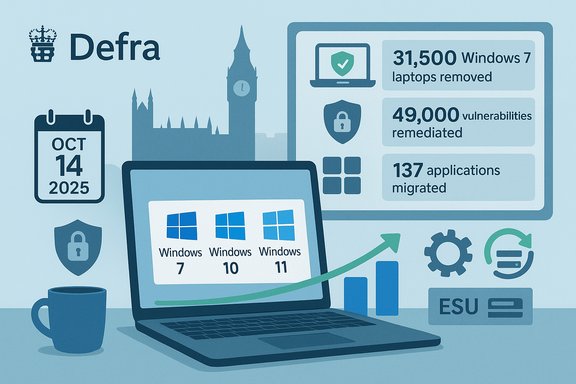
Defra told parliamentary overseers that, across the 2022–23 to 2024–25 spending review period, it spent roughly £312 million on estate modernisation: device refreshes, vulnerability remediation, application migration and datacentre consolidation. The department’s update documented three headline figures that matter for both security and procurement analysis: 31,500 laptops removed from Windows 7, roughly 49,000 critical vulnerabilities remediated, and 137 legacy applications migrated to modern platforms. Those numbers represent substantive operational progress for services that include flood management, animal health and farming payments.
What triggered broader scrutiny was the interaction between that programme and Microsoft’s publicly announced lifecycle for Windows 10. Microsoft fixed 14 October 2025 as the end of mainstream servicing for Windows 10; after that date routine security updates ceased for most editions unless devices were enrolled in Extended Security Updates (ESU) or otherwise covered by a supported migration path. Because Defra’s update described a large device refresh to Windows 10 late in the spending review window, commentators and auditors questioned whether the department had effectively standardised on an OS that was at, or rapidly approaching, its vendor sunset — creating the risk of “buying obsolescence.”
Separately, media reporting later stated that a revised version of Defra’s letter to the Public Accounts Committee (PAC) corrected a factual inaccuracy in the original submission and clarified that the department subsequently moved laptops to Windows 11, asserting that “all laptops were upgraded to Windows 11 by March 2025.” That revision, if accurate, recasts the timing risk — from a procurement timing error to an administrative error in communications to Parliament — but the claim about the March 2025 Windows 11 cut‑over is not clearly corroborated in the public correspondence available to date. Independent reporting and public documents available to this review confirm the £312m spend and the Windows 7 → Windows 10 component, while details about the revised PAC letter and the March‑2025 Windows 11 milestone remain reported but not fully independently verifiable in the documents reviewed here.
Source: theregister.com Defra moved thousands of PCs to Windows 11, not Windows 10
 Background
Defra told parliamentary overseers that, across the 2022–23 to 2024–25 spending review period, it spent roughly £312 million on estate modernisation: device refreshes, vulnerability remediation, application migration and datacentre consolidation. The department’s update documented three headline figures that matter for both security and procurement analysis: 31,500 laptops removed from Windows 7, roughly 49,000 critical vulnerabilities remediated, and 137 legacy applications migrated to modern platforms. Those numbers represent substantive operational progress for services that include flood management, animal health and farming payments.What triggered broader scrutiny was the interaction between that programme and Microsoft’s publicly announced lifecycle for Windows 10. Microsoft fixed 14 October 2025 as the end of mainstream servicing for Windows 10; after that date routine security updates ceased for most editions unless devices were enrolled in Extended Security Updates (ESU) or otherwise covered by a supported migration path. Because Defra’s update described a large device refresh to Windows 10 late in the spending review window, commentators and auditors questioned whether the department had effectively standardised on an OS that was at, or rapidly approaching, its vendor sunset — creating the risk of “buying obsolescence.”
Separately, media reporting later stated that a revised version of Defra’s letter to the Public Accounts Committee (PAC) corrected a factual inaccuracy in the original submission and clarified that the department subsequently moved laptops to Windows 11, asserting that “all laptops were upgraded to Windows 11 by March 2025.” That revision, if accurate, recasts the timing risk — from a procurement timing error to an administrative error in communications to Parliament — but the claim about the March 2025 Windows 11 cut‑over is not clearly corroborated in the public correspondence available to date. Independent reporting and public documents available to this review confirm the £312m spend and the Windows 7 → Windows 10 component, while details about the revised PAC letter and the March‑2025 Windows 11 milestone remain reported but not fully independently verifiable in the documents reviewed here.
Timeline and the disputed facts
What Defra reported (initial update)
- Defra submitted a formal update to the PAC describing a multi‑year IT modernisation effort across the 2022–23 to 2024–25 spending review window.
- The update listed device replacement figures, vulnerability remediation totals and application migration counts — including the removal of 31,500 Windows 7 laptops that were upgraded to Windows 10 during the programme.
What raised alarm bells
- Windows 10’s vendor lifecycle is a fixed calendar event: 14 October 2025 was the last day of mainstream servicing for many Windows 10 editions.
- Standardising a large fleet on Windows 10 in 2024–25 without a documented, funded migration plan created a narrow support runway and potential follow‑on cost exposures (ESU, hardware replacement, or cloud replatforming).
The revised letter claim (reported)
- Subsequent reporting said Defra issued a corrected letter clarifying the initial statement and confirming a move to Windows 11, including the line that “all laptops were upgraded to Windows 11 by March 2025.” That correction, if authenticated, reduces the procurement timing worry but raises questions about why the original submission contained a factual inaccuracy and why parliamentary oversight received a delayed or erroneous account. This specific claim has been widely reported in commentary but could not be directly validated against the PAC‑facing correspondence available in the materials reviewed here; it should therefore be treated as reported and flagged for verification.
What was actually delivered: tangible wins
The programme — regardless of the OS messaging confusion — appears to have generated measurable improvements:- Immediate risk reduction: Replacing thousands of Windows 7 laptops closed a clear, easily‑exploitable risk corridor. Unsupported Windows 7 endpoints are high‑value targets; removing them materially reduces attack surface.
- Vulnerability remediation: The remediation of roughly 49,000 critical vulnerabilities is a concrete cyber‑hygiene achievement that reduces the number of priority exposures across platforms and services.
- Application rationalisation: Migrating 137 legacy applications and closing datacentre capacity starts to reduce the operational fragility that comes from long tails of unsupported infrastructure.
The downside: lifecycle mismatch, ESU economics and hardware gating
Lifecycle and the short support runway
Choosing Windows 10 as a standard image late in a multi‑year refresh creates a timing mismatch when the vendor sets a hard lifecycle cutoff. That mismatch forces organisations into three practical choices: migrate to Windows 11, buy Extended Security Updates (ESU), or accept unsupported risk and rely on compensating controls. Each path carries clear trade‑offs and costs.How ESU scales and why it’s a bridge, not a solution
- Microsoft’s ESU programme was explicitly structured as a time‑boxed, commercial bridge. For consumer devices, a low‑cost one‑year ESU bridge was available; for organisations, multi‑year commercial ESU was offered through volume licensing at per‑device pricing that industry reporting shows to be deliberately back‑loaded.
- Market reporting cited an approximate Year‑One list price of ~$61 per device for commercial ESU, with prices commonly doubling in Year Two and again in Year Three. At enterprise scale this escalation is designed to favour migration over long‑term ESU dependence. For 31,500 devices, Year‑One ESU at $61/device would be roughly $1.92 million — modest relative to a £312m capital outlay but rapidly material if extended across multiple cohorts and years.
Hardware gating for Windows 11
- Windows 11 requires a stricter hardware baseline (TPM 2.0, UEFI Secure Boot, supported CPU families, minimum RAM/storage thresholds). A meaningful share of older devices are not upgradeable in place, forcing replacement rather than an in‑place OS update.
- That means a department may face either extra capital outlay to replace non‑upgradeable devices or have to accept ESU costs on those devices while replacements are scheduled. Either route increases total cost of ownership and complicates procurement planning.
Governance and oversight problems
Delayed parliamentary reporting
The PAC had requested a follow‑up by May 2024; Defra’s formal update arrived significantly later. Delayed responses to parliamentary oversight bodies frustrate transparency and increase the political and audit risk when vendor lifecycles are time‑bound and public funds are material. The late arrival of the department’s letter reduced the time available for parliamentary scrutiny and for the PAC to assess whether the programme had budgeted downstream migration costs.The factual inaccuracy and its optics
If a subsequent revision to the department’s letter corrected a statement about the OS baseline — changing an account of a Windows 10 standardisation to a Windows 11 migration claim — that is a serious communications error with practical consequences. Parliamentary oversight relies on precise, auditable submissions. A factual inaccuracy in a letter to the PAC undermines confidence and requires explanation: why did the error occur, who authorised the text, and what checks failed? These questions matter for both ministerial accountability and future procurement approval. The reporting around the revised letter is notable, but the claim that all laptops were upgraded to Windows 11 by March 2025 should be verified in the PAC record or Defra’s formal correspondence before being treated as established fact.Risk assessment and worst‑case scenarios
- ESU dependency across a large fleet
- If Defra were to cover a broad cohort with commercial ESU for multiple years, the per‑device escalation schedule would quickly produce a recurring revenue pressure that competes with other transformation funding.
- Reliance on ESU for non‑upgradeable, mission‑critical devices is defensible as a short bridge, but dangerous as a multi‑year strategy.
- Hardware incompatibility forcing repeated capital cycles
- If thousands of devices cannot be upgraded to Windows 11 in place, Defra faces either immediate replacement costs or protracted ESU bills — both costly and politically sensitive.
- The residual backlog (reported at 24,000 end‑of‑life devices and 26,000 smartphones) indicates the scale of continued capital planning required.
- Application certification friction
- Domain‑specific applications (border controls, agricultural IT, animal‑health systems) may require revalidation on Windows 11; suppliers may need time and money to certify compatibility, extending migration timelines and operational risk.
- Reputation and audit risk from inaccurate parliamentary reporting
- A corrected letter to PAC that reverses or materially amends OS statements raises audit and accountability concerns. Ministers and accounting officers must be able to show traceable decisions and funding lines for each stage of a multi‑year programme.
Practical steps Defra (and similar organisations) should take now
- Publish a clear, time‑boxed 36‑month migration roadmap that clarifies:
- Which device cohorts are eligible for in‑place Windows 11 upgrades.
- Which devices will be replaced and on what timeline.
- Which devices will be covered by ESU and for how long, with explicit cost projections.
- Use ESU strategically and narrowly, not as a default. Document the business justification for each device included and set firm sunset dates tied to migration milestones.
- Prioritise mission‑critical, externally exposed and border‑facing applications for early migration and testing. Use cloud desktop alternatives (Windows 365 / Cloud PC) where appropriate to reduce per‑device migration pressure and absorb ESU coverage where entitlements permit.
- Accelerate application modernisation where possible — containerisation, refactoring and rehosting can reduce dependency on local device OSes and shorten the window of exposure for Windows 10 endpoints.
- Adopt circular procurement and sustainability practices: mandate trade‑in, refurbishment and certified recycling to reduce e‑waste and lower net capital costs for replacement. Large refresh programmes should incorporate certified refurbishers and reuse pathways.
- Strengthen governance: tie transformation milestones to measurable KPIs (vulnerability counts, device replacement rates, app migration completions) and commit to quarterly public reporting to the PAC and NAO to rebuild oversight confidence.
Procurement design lessons: avoid buying yesterday’s solution
- Anchor procurement calendars to vendor lifecycle dates. When vendors announce EOL or end‑of‑service windows, those dates must be treated as immovable facts and used to schedule funding and delivery.
- Use ESU only for narrow, mission‑critical exceptions and budget it as a bridge, not a long‑term fix. The commercial design of ESU deliberately discourages multi‑year reliance.
- Maintain an authoritative asset register. A centralized inventory that tracks hardware capability (TPM, Secure Boot, CPU family) is essential to assess upgradeability and plan realistic migration cohorts. Procurement leverage and budgeting depend on accurate counts.
- Bake in application certification time. Specialist suppliers may take months to deliver Windows 11‑compatible releases; budget and schedule accordingly.
Strengths, weaknesses and the balanced verdict
- Strengths:
- The programme delivered measurable security improvements: removal of thousands of Windows 7 endpoints and remediation of tens of thousands of critical vulnerabilities are not symbolic gestures; they materially reduce risk for services citizens rely on.
- Application migration activity and datacentre consolidation are durable improvements that lay the groundwork for cloud‑native resilience.
- Weaknesses:
- The choice to standardise a large refresh on Windows 10 late in the vendor lifecycle created a narrow support runway and significant follow‑on risk — either ESU bills or rapid hardware replacements.
- The delay and apparent inaccuracy in the PAC communication damaged transparency and increased political exposure. The corrected letter narrative (as reported) should be verified against PAC records to confirm whether the switching to Windows 11 occurred as claimed.
What to watch next
- Publication of the revised PAC letter or the underlying Defra correspondence that explicitly confirms the Windows 11 migration timeline and the March 2025 claim — this is the primary document that will settle whether the issue was a procurement timing error or a communications error. The March‑2025 claim has been reported but should be corroborated by PAC records.
- Confirmation from Defra about ESU purchases (if any): whether commercial ESU was procured, how many devices were covered, and the expected spend profile. This determines whether the department has bought a time‑boxed bridge or committed to recurring costs.
- Publication of a detailed, time‑boxed migration roadmap with named milestones and KPIs, and quarterly updates to the PAC showing progress against those milestones.
- Evidence of accelerated hardware replacement budgets or cloud‑desktop contracts that materially reduce the dependency on per‑device ESU.
Conclusion
Defra’s modernisation programme shows how complex and interdependent public‑sector IT transformation can be: the right tactical decisions (replace thousands of Windows 7 laptops; remediate tens of thousands of vulnerabilities) can be undermined by calendar misalignment with vendor lifecycles and by lapses in communications to oversight bodies. The headline £312 million investment produced durable security benefits — but the subsequent controversy underlines that modernisation must be planned end‑to‑end, not as a sequence of isolated purchases. Where vendor lifecycles impose hard deadlines, procurement, funding and governance must be synchronized to avoid paying twice: once to remove immediate risk and again to fix the timing mismatch created by buying the wrong OS baseline at scale. Defra’s next steps — a clear roadmap, narrow ESU use, transparent quarterly reporting and expedited application modernisation — will determine whether the investments deliver sustainable value for taxpayers or become the latest example of “buy today, fix again tomorrow.”Source: theregister.com Defra moved thousands of PCs to Windows 11, not Windows 10
