

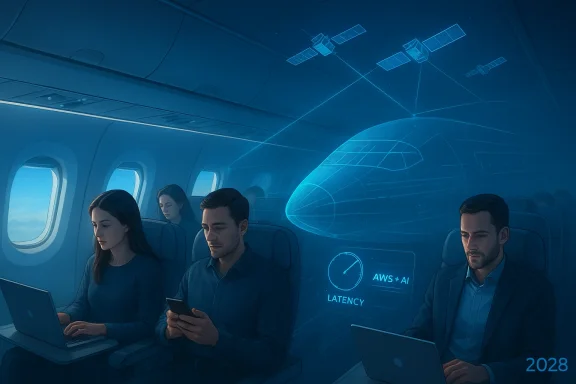
Amazon and Delta have turned in-flight Wi‑Fi into a high-stakes competitive play, and the timing matters almost as much as the technology. Delta says it will begin rolling out Amazon Leo on 500 aircraft in 2028, with the service expected to deliver high-speed, low-latency gate-to-gate connectivity and remain free for SkyMiles members, extending Delta’s broader free Wi‑Fi strategy already underway across much of its fleet. Amazon’s own announcement frames the partnership as both a connectivity upgrade and a deeper integration of AWS, AI, and other Amazon technologies into the travel experience.
The move lands at a moment when airline connectivity is shifting from a perk to a strategic differentiator. For years, in-flight internet was defined by trade-offs: slow speeds, spotty coverage, expensive access, and enough latency to make simple tasks feel cumbersome. The rise of low-Earth-orbit satellite networks changed that equation, and Amazon’s announcement is best understood as part of a broader race to make airline Wi‑Fi feel normal rather than exceptional.
Amazon’s satellite project also entered this partnership with a fresh identity. The company recently renamed Project Kuiper as Amazon Leo, making the brand easier to connect with the low-Earth-orbit architecture beneath it. That rebranding matters because aviation is a visibility game: airlines want names passengers recognize, and tech providers want proof that their systems can scale beyond laboratory tests and ground terminals.
Delta, meanwhile, has been pushing aggressively on connectivity for years. The airline’s own materials say it already offers fast, free Wi‑Fi on more than 900 aircraft domestically and is expanding free connectivity internationally and across regional jets. In other words, Delta is not starting from zero; it is upgrading a customer experience it has already made central to its brand.
That history is why the Amazon deal feels bigger than a simple vendor swap. Delta is not merely buying bandwidth; it is aligning itself with a broader Amazon ecosystem that already touches its cloud infrastructure through AWS. Amazon says the two companies plan to integrate AWS, Amazon Leo, artificial intelligence, and other Amazon technologies to enhance the travel journey, suggesting the connectivity layer may become a gateway to more ambitious digital services.
The technical logic is straightforward. LEO satellites orbit far closer to Earth than geostationary systems, which reduces latency and typically improves the responsiveness of web browsing, video calls, cloud apps, and file transfers. Amazon says Leo satellites operate roughly 370 miles above the planet, more than 50 times closer than legacy geostationary systems used by older in-flight networks. That shorter distance is the core reason these systems can feel dramatically better even before raw throughput is considered.
Amazon’s own materials say Leo currently has more than 200 satellites in orbit and more than 20 full-scale missions planned over the next year. That is serious momentum, but it remains well behind the operational depth of established rivals. The airline deal therefore matters not just as revenue, but as a public validation of Amazon’s ability to compete for premium customers before its constellation is fully mature.
The airline also has an established relationship with Amazon Web Services, which reduces the friction of deepening the partnership. Amazon says the two companies already work together on technology infrastructure, and the new agreement extends that cooperation into the air. That sort of continuity matters because airline IT is notoriously complex, and airlines tend to prefer vendors that can plug into existing operational and data environments.
The phrase “gate-to-gate” matters because it suggests continuity. Instead of connecting after takeoff and losing service during parts of the flight, passengers can expect a more seamless experience from the moment they board. That continuity is a practical benefit for remote workers, frequent flyers, and families who now expect the same always-on behavior they get on the ground.
Amazon says Leo currently has more than 200 satellites in orbit and more than 20 missions planned over the next year. That is a strong start, but aviation customers want scale, reliability, and global coverage, not just prototype success. The longer runway before deployment is therefore both a strength and a warning sign: the market is reserving judgment until the constellation proves itself.
Free access, however, does not mean free economics. Delta still has to pay for hardware, integration, operations, and service contracts, while Amazon has to justify the cost of serving a highly demanding mobile platform. The business case likely depends on a mix of customer retention, brand lift, and cross-sell potential rather than direct Wi‑Fi fees alone.
The aviation segment is especially attractive because it combines recurring service demand with highly visible brand value. An airline deployment offers a captive audience, measurable performance metrics, and a recurring cycle of fleet updates and renewals. It is one of the clearest ways for a satellite provider to show that its network is not merely functional, but commercially indispensable.
It will also be worth watching whether the partnership expands beyond basic connectivity. The mention of AWS, AI, and other Amazon tools suggests Delta sees this as part of a larger digital architecture, not just a network contract. If that vision takes hold, the deal could shape everything from passenger engagement to operations, and it may become a template for how airlines buy technology in the next phase of connected travel.
Source: BlogNT Delta choisit Amazon Leo pour un Wi-Fi 1 Gb/s en plein vol
 Background
The move lands at a moment when airline connectivity is shifting from a perk to a strategic differentiator. For years, in-flight internet was defined by trade-offs: slow speeds, spotty coverage, expensive access, and enough latency to make simple tasks feel cumbersome. The rise of low-Earth-orbit satellite networks changed that equation, and Amazon’s announcement is best understood as part of a broader race to make airline Wi‑Fi feel normal rather than exceptional.Amazon’s satellite project also entered this partnership with a fresh identity. The company recently renamed Project Kuiper as Amazon Leo, making the brand easier to connect with the low-Earth-orbit architecture beneath it. That rebranding matters because aviation is a visibility game: airlines want names passengers recognize, and tech providers want proof that their systems can scale beyond laboratory tests and ground terminals.
Delta, meanwhile, has been pushing aggressively on connectivity for years. The airline’s own materials say it already offers fast, free Wi‑Fi on more than 900 aircraft domestically and is expanding free connectivity internationally and across regional jets. In other words, Delta is not starting from zero; it is upgrading a customer experience it has already made central to its brand.
That history is why the Amazon deal feels bigger than a simple vendor swap. Delta is not merely buying bandwidth; it is aligning itself with a broader Amazon ecosystem that already touches its cloud infrastructure through AWS. Amazon says the two companies plan to integrate AWS, Amazon Leo, artificial intelligence, and other Amazon technologies to enhance the travel journey, suggesting the connectivity layer may become a gateway to more ambitious digital services.
Why this partnership stands out
The announcement is notable because it gives Amazon a marquee aviation customer at a time when Starlink has become the default reference point for fast satellite internet in mobility markets. Delta’s choice signals that Amazon is no longer just building infrastructure in the background; it is now making a visible push into one of the most commercially important consumer use cases for LEO satellites.- Delta is treating connectivity as part of the premium cabin experience, not an add-on.
- Amazon is using aviation to validate a broader satellite broadband business.
- The partnership extends beyond Wi‑Fi into cloud and digital services.
- The deal creates a direct competitive narrative against Starlink.
What Amazon Leo Brings to the Cabin
Amazon says each Delta aircraft will receive a purpose-built phased array antenna designed to support download speeds up to 1 Gbps and upload speeds up to 400 Mbps. That is an important claim, but it should be read as a capability target rather than a guarantee for every user on every flight. Real-world performance will depend on aircraft type, coverage, congestion, gateway architecture, and how Delta manages traffic inside the cabin.The technical logic is straightforward. LEO satellites orbit far closer to Earth than geostationary systems, which reduces latency and typically improves the responsiveness of web browsing, video calls, cloud apps, and file transfers. Amazon says Leo satellites operate roughly 370 miles above the planet, more than 50 times closer than legacy geostationary systems used by older in-flight networks. That shorter distance is the core reason these systems can feel dramatically better even before raw throughput is considered.
The difference latency makes
For passengers, latency often matters more than headline speed. A service can advertise impressive bandwidth and still feel sluggish if every click, login, or handshake takes too long to complete. LEO’s value proposition is that it improves the responsiveness of the connection, which is exactly what makes work, streaming, messaging, and cloud collaboration less frustrating at cruising altitude.- Lower latency should improve everyday browsing and conferencing.
- Higher throughput helps with streaming and large uploads.
- Cabin Wi‑Fi performance will still vary by load and route.
- The user experience depends as much on airline network design as satellite capacity.
The Competitive Battlefield
The most obvious implication is competitive pressure on Starlink. SpaceX has built a major aviation presence and has become the benchmark for satellite-based in-flight internet, while Amazon is still scaling its constellation and launch cadence. Delta’s decision does not erase Starlink’s lead, but it does show that airlines are willing to hedge their bets and treat the market as a long-term supplier race rather than a winner-take-all contest.Amazon’s own materials say Leo currently has more than 200 satellites in orbit and more than 20 full-scale missions planned over the next year. That is serious momentum, but it remains well behind the operational depth of established rivals. The airline deal therefore matters not just as revenue, but as a public validation of Amazon’s ability to compete for premium customers before its constellation is fully mature.
Why Delta matters more than a smaller carrier
A deal with a large flagship airline has an outsized signaling effect. Delta serves more than 200 million customers a year, flies to more than 300 destinations, and carries a premium brand identity that other airlines watch closely. When a carrier of that size commits to a satellite platform, it gives the provider an industry reference point that can be more valuable than several smaller wins combined.- Delta offers Amazon instant credibility in premium aviation.
- The deal supports Amazon’s go-to-market story against Starlink.
- Airlines may use the competition to negotiate better terms.
- The result could accelerate satellite internet adoption across fleets.
Delta’s Broader Digital Strategy
Delta has been one of the most aggressive U.S. airlines in turning connectivity into brand value. Its free Wi‑Fi rollout has already become part of the airline’s customer proposition, and the company has framed digital service as part of the premium travel experience rather than a cost center. That strategic posture makes the Amazon deal easier to understand: Delta is trying to own the passenger relationship end-to-end, from booking through landing.The airline also has an established relationship with Amazon Web Services, which reduces the friction of deepening the partnership. Amazon says the two companies already work together on technology infrastructure, and the new agreement extends that cooperation into the air. That sort of continuity matters because airline IT is notoriously complex, and airlines tend to prefer vendors that can plug into existing operational and data environments.
From connectivity to personalization
The most interesting part of the deal may be what comes after basic internet access. If Delta and Amazon really do integrate more AI layers, passenger data services, and operational intelligence, the aircraft could become a richer digital environment than today’s cabin. That would create room for more relevant offers, better troubleshooting, smarter crew workflows, and a more personalized travel journey. If the execution is disciplined, that is a meaningful upgrade.- Faster Wi‑Fi is the visible benefit.
- Better analytics may be the long-term business win.
- AI-powered service layers could reshape the travel flow.
- Integration depth will matter more than the marketing headline.
What Passengers Actually Gain
For travelers, the promise is simple but powerful: fewer compromises. A connection that supports streaming, video calls, cloud editing, and rapid file sharing turns flight time from dead time into usable time. That may sound incremental, but in business travel especially, incremental improvements in reliability can have an outsized effect on perceived value.The phrase “gate-to-gate” matters because it suggests continuity. Instead of connecting after takeoff and losing service during parts of the flight, passengers can expect a more seamless experience from the moment they board. That continuity is a practical benefit for remote workers, frequent flyers, and families who now expect the same always-on behavior they get on the ground.
Consumer vs enterprise impact
The consumer story is obvious: entertainment, messaging, and social sharing become much easier in the air. The enterprise story is subtler but arguably more important, because a reliable airborne connection can support productivity, collaboration, and time-sensitive communications on long-haul routes. Airlines that win business travelers often win on exactly these details.- Streaming should be smoother and more consistent.
- Upload-heavy tasks may become more practical.
- Video calls could become less frustrating, though not perfect.
- Business travelers may notice the biggest productivity gains.
Why the 2028 Timeline Matters
A launch timeline beginning in 2028 means the story is still years away from its final test. That delay gives Amazon time to scale satellites, increase launch cadence, and refine terminal hardware before the system faces the pressure of airline operations. It also gives Delta time to integrate the service into fleet planning without disrupting current connectivity rollouts.Amazon says Leo currently has more than 200 satellites in orbit and more than 20 missions planned over the next year. That is a strong start, but aviation customers want scale, reliability, and global coverage, not just prototype success. The longer runway before deployment is therefore both a strength and a warning sign: the market is reserving judgment until the constellation proves itself.
Delivery risk is built into the schedule
A 2028 target also creates room for competitive and regulatory surprises. Launch schedules can slip, avionics integrations can take longer than expected, and airline fleet refresh cycles rarely stay perfectly on script. By the time the first 500 aircraft are scheduled for installation, the in-flight internet market may look different again, with rivals having added capacity, lowered prices, or improved their own systems.- Launch execution remains a critical dependency.
- Aircraft installation schedules can slip.
- Competing satellite systems may advance in the meantime.
- Customer expectations will rise faster than engineering timelines.
The Business Model Behind Free Wi‑Fi
One of the most important details in the announcement is that Leo-powered in-flight Wi‑Fi will be free for SkyMiles members. That keeps Delta aligned with its existing customer-friendly connectivity posture, and it prevents the company from undermining the premium promise with a paywall. In practice, it also turns connectivity into a loyalty lever rather than a transactional add-on.Free access, however, does not mean free economics. Delta still has to pay for hardware, integration, operations, and service contracts, while Amazon has to justify the cost of serving a highly demanding mobile platform. The business case likely depends on a mix of customer retention, brand lift, and cross-sell potential rather than direct Wi‑Fi fees alone.
Why airlines like “free” even when it’s expensive
Airlines increasingly treat connectivity as a way to drive customer satisfaction and loyalty. Free Wi‑Fi can encourage more engagement with the airline’s digital products, better app usage, and stronger attachment to the brand. That makes the service a strategic investment rather than a pure utility expense.- Free access supports Delta’s premium positioning.
- Loyalty benefits may outweigh direct service economics.
- Passenger satisfaction can improve without changing seat class.
- Better connectivity can make ancillary digital services more effective.
The Broader Satellite Market
This deal should also be read as a signal to the rest of the satellite broadband market. LEO connectivity is no longer just about remote villages or fixed broadband substitutes; it is now about delivering premium service to a moving, high-density, high-expectation environment. That widens the addressable market and raises the bar for technical performance.The aviation segment is especially attractive because it combines recurring service demand with highly visible brand value. An airline deployment offers a captive audience, measurable performance metrics, and a recurring cycle of fleet updates and renewals. It is one of the clearest ways for a satellite provider to show that its network is not merely functional, but commercially indispensable.
What rivals will likely do next
Competitors will not sit still. Expect more aggressive pricing, more airline partnerships, and more claims around speed, latency, and service quality as the satellite internet market narrows into a credibility contest. The companies that can prove stability under aviation conditions, not just laboratory benchmarks, are likely to win the next round.- More airline partnership announcements are likely.
- Hardware integration will become a key differentiator.
- Service reliability will matter more than marketing claims.
- Multi-provider strategies may become common across fleets.
Strengths and Opportunities
The Amazon-Delta partnership has several clear advantages. It aligns a strong airline brand with a high-profile satellite network, it reinforces Delta’s premium customer experience, and it gives Amazon a real-world proving ground for Leo at a moment when market visibility matters almost as much as orbital capacity. If the execution matches the promise, this could become one of the most important commercial validations in the satellite connectivity market.- Brand credibility: Delta is a marquee airline, not a niche customer.
- Premium positioning: free connectivity fits Delta’s service strategy.
- Technical upside: LEO architecture should reduce latency substantially.
- Ecosystem depth: AWS and AI integration open new revenue paths.
- Market signaling: Amazon gains a headline win against Starlink.
- Passenger value: travelers get a more usable, less frustrating connection.
- Enterprise leverage: the same platform can support operations and analytics.
Risks and Concerns
For all the excitement, this is still a promise with a long lead time. The biggest risks are execution, scale, and expectations: Amazon must keep launching satellites, Delta must integrate the hardware into a moving fleet without service degradation, and both companies must resist overpromising on what “1 Gbps” means in real cabin conditions. The farther away the rollout, the more time rivals have to improve their own offers.- Timeline slippage: 2028 leaves plenty of room for delays.
- Performance variability: cabin load can reduce real-world speeds.
- Coverage gaps: global consistency may take time to mature.
- Competitive pressure: Starlink and others will keep advancing.
- Integration complexity: airline networks are notoriously difficult.
- Expectation risk: passengers may expect home-like performance in the sky.
- Commercial uncertainty: free Wi‑Fi still has to pay for itself indirectly.
Looking Ahead
The next two years will be about proving that Amazon Leo is more than a branding exercise and that Delta can turn future capacity into a differentiated passenger product. The most useful indicators will not be glossy claims about speed, but concrete signs of launch progress, satellite scale, terminal readiness, and the extent to which Delta continues expanding its broader free Wi‑Fi footprint while preparing for the 2028 transition. Amazon’s satellite business is gaining momentum, but aviation is a brutally honest environment where marketing dies quickly if the service underperforms.It will also be worth watching whether the partnership expands beyond basic connectivity. The mention of AWS, AI, and other Amazon tools suggests Delta sees this as part of a larger digital architecture, not just a network contract. If that vision takes hold, the deal could shape everything from passenger engagement to operations, and it may become a template for how airlines buy technology in the next phase of connected travel.
- Amazon must keep building out the constellation.
- Delta will likely continue expanding free Wi‑Fi on current systems.
- Rival airlines may revisit their satellite vendor strategies.
- Hardware certification and fleet retrofits will be crucial.
- Passenger feedback will determine whether the promise becomes a habit.
Source: BlogNT Delta choisit Amazon Leo pour un Wi-Fi 1 Gb/s en plein vol