

GitHub’s platform suffered a multi-service disruption on 9–10 February 2026 that left Actions queues stalled, pull‑request pages slow or erroring, notifications delayed by up to an hour, and parts of Copilot operating with policy propagation delays — a messy reminder that even the dominant code-hosting platform is fallible, and that enterprises should design for downtime as deliberately as they do for features.
GitHub is the central collaboration hub for an enormous portion of the software industry: source control, pull requests, code review, Actions CI/CD, Codespaces, and increasingly AI‑assisted coding via Copilot. That concentration of developer workflows makes any platform incident disproportionately painful: a delay in notifications, queued Actions jobs, or a feature flag failing to propagate becomes a production blocker, an interrupted release, or a build farm sitting idle.
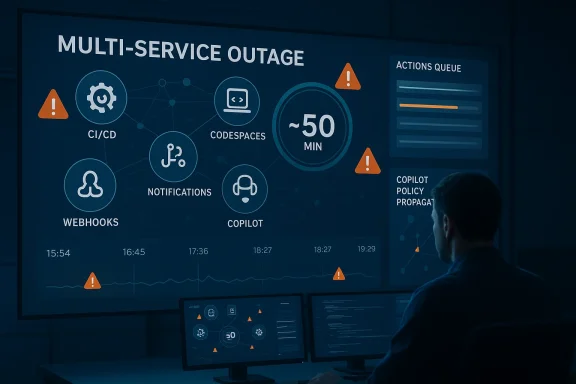
On 9 February 2026 GitHub posted a cascade of incident updates describing exactly that kind of multi-component impact. The status timeline shows an initial investigation into impacted performance for some GitHub services beginning at 15:54 UTC; by 16:12 UTC the company had confirmed notification delivery delays — reporting an initial average latency of about 50 minutes — and then published a sequence of recovery updates through the evening. Notifications were reported as recovered and the incident marked resolved at 19:29 UTC that same day. Separately, GitHub recorded a Copilot policy propagation problem that was first investigated on 9 February in the mid‑afternoon UTC window and continued to receive updates into the early hours of 10 February, ultimately being marked resolved on 10 February at 09:57 UTC.
Those timestamps and the recovery narrative are not speculation: they come from GitHub’s own incident messages on its status page and the Copilot incident timeline. Outside aggregators and mirrors that reconstruct historical status feeds show the same sequence of incidents and amplify a broader point made by commentators: the platform has seen a higher frequency of incidents over recent months, and GitHub’s publicly visible uptime history is now more difficult to consume in aggregate than it used to be.
To put that number in plain terms:
Two important caveats apply:
Still, the observed symptoms point to a few plausible causes and patterns to consider:
The trend matters for architects: reliance on a single vendor for CI, code hosting, artifact hosting, and developer tools concentrates risk. Many large organizations are explicitly diversifying tooling or building internal backup channels to reduce the operational impact of third‑party outages.
Good status practices include:
The responsible posture is simple and concrete: design systems and workflows around the assumption of temporary, partial outages. Automate fallbacks, diversify critical paths, insist on contractual transparency where necessary, and run the drills that prove your team can continue to ship even when your primary collaboration platform is recovering. That combination — realistic expectations plus deliberate redundancy — is what separates a painful outage from a damaging one.
Source: theregister.com GitHub seems to be struggling with three nines availability
 Background
GitHub is the central collaboration hub for an enormous portion of the software industry: source control, pull requests, code review, Actions CI/CD, Codespaces, and increasingly AI‑assisted coding via Copilot. That concentration of developer workflows makes any platform incident disproportionately painful: a delay in notifications, queued Actions jobs, or a feature flag failing to propagate becomes a production blocker, an interrupted release, or a build farm sitting idle.On 9 February 2026 GitHub posted a cascade of incident updates describing exactly that kind of multi-component impact. The status timeline shows an initial investigation into impacted performance for some GitHub services beginning at 15:54 UTC; by 16:12 UTC the company had confirmed notification delivery delays — reporting an initial average latency of about 50 minutes — and then published a sequence of recovery updates through the evening. Notifications were reported as recovered and the incident marked resolved at 19:29 UTC that same day. Separately, GitHub recorded a Copilot policy propagation problem that was first investigated on 9 February in the mid‑afternoon UTC window and continued to receive updates into the early hours of 10 February, ultimately being marked resolved on 10 February at 09:57 UTC.
Those timestamps and the recovery narrative are not speculation: they come from GitHub’s own incident messages on its status page and the Copilot incident timeline. Outside aggregators and mirrors that reconstruct historical status feeds show the same sequence of incidents and amplify a broader point made by commentators: the platform has seen a higher frequency of incidents over recent months, and GitHub’s publicly visible uptime history is now more difficult to consume in aggregate than it used to be.
What happened: a concise incident timeline
9 February — initial detection and cascading impacts
- 15:54 UTC: GitHub begins investigating reports of impacted performance across some services.
- ~16:12 UTC: Notification delivery delays are observed; GitHub reports the delivery latency is about 50 minutes and that they are working on mitigation.
- Mid‑evening: Further updates show notification delays decreasing through 1 hour 20 minutes → ~1 hour → ~30 minutes → ~15 minutes.
- 19:29 UTC: GitHub marks the notification incident resolved.
Copilot: policy propagation disruption
- 16:29 UTC (9 Feb): GitHub begins investigating degraded Copilot performance.
- 17:24 UTC onward: GitHub identifies a problem where Copilot policy updates are not propagating correctly for a subset of users; the symptom described: newly enabled models may not appear when users try to access them.
- Multiple updates were posted overnight as the engineering teams worked through mitigations and verification.
- 09:57 UTC (10 Feb): GitHub marks Copilot policy propagation issue as resolved.
Broader multi‑service incident on 9 February
- Later on 9 Feb GitHub reported impact to Actions, Codespaces, Git operations, Issues, Pages and Webhooks, with recovery markers posted between ~19:02–20:09 UTC as mitigations were applied and systems recovered.
Why this matters: operational and business impact
A single large vendor outage has ripple effects far beyond the vendor’s own status page. For software teams that assume continuous, near‑instantaneous CI/CD, a one‑hour notification delay or a queued Actions job becomes a blocker:- Developer productivity stalls: code review, automated gating, and merging are slowed. For teams that gate releases on CI green checks, this delays delivery.
- Release windows slip: when Actions queues stall, scheduled production deployments may miss windows, increasing operational risk and business cost.
- Compliance and policy enforcement gaps: Copilot policy propagation delays mean model selection and usage policies — especially enterprise restrictions — may not be enforced in real time, creating potential compliance or IP control exposure.
- Incident response friction: status updates are the primary source of truth during an outage. When they are fragmented or historical aggregated views are harder to obtain, incident retros and SLA calculations become harder.
The SLA reality: what “99.9%” means in practice
GitHub’s enterprise offerings include explicit service commitments for paying enterprise customers. The platform documentation and plan descriptions list a monthly Service Level Agreement commitment in the high‑nineties (the standard enterprise tier language references a 99.9% monthly uptime target for Enterprise Cloud plans). That figure is frequently cited in vendor comparisons and contractual addenda.To put that number in plain terms:
- 99.9% uptime (monthly) allows roughly 43 minutes of downtime per 30‑day month.
- 99.99% uptime allows roughly 4 minutes 19 seconds of downtime per 30‑day month.
- 99.999% uptime (the “five nines” ideal) would allow about 26 seconds of downtime per 30‑day month.
Transparency and status history: a new challenge
Several maintainers and independent projects rebuilt earlier GitHub status archives to produce aggregated “last 90 days” uptime dashboards. These reconstructions — which parse the public status feed and recompute component tagging and minute‑level windows — show trends that some commentators have interpreted as stability slipping. One reconstruction even indicates a period in 2025 where reconstructed per‑component uptime dipped below 90% for the platform as a whole; that is an alarming figure if taken at face value.Two important caveats apply:
- Those reconstructions are derived from the public status feed and non‑official mirrors; they are not canonical GitHub metrics. They can surface trends and be a useful “reality check,” but they must be treated as unofficial and, in some cases, incomplete.
- GitHub changed its status presentation at some point, removing or deprioritizing historical aggregate uptime numbers from its main display. That makes it harder for downstream users and enterprises to quickly assess long‑term reliability trends from the official page alone.
Root causes and technical patterns (what likely went wrong)
GitHub’s incident messages described direct symptoms — notification delivery delays, propagation issues for Copilot policies, and broad degraded performance — but stopped short of a full technical root cause timeline in the initial incident posts. That’s normal practice: status pages prioritize user-facing impact details and mitigation updates; detailed RCA (root cause analysis) writeups often come later.Still, the observed symptoms point to a few plausible causes and patterns to consider:
- Control‑plane propagation failure: the Copilot problem was explicitly framed as policy propagation — signal that configuration/state changes weren’t reaching all control plane nodes or downstream caches. In distributed control planes, a single region or an indexing/replication pipeline bottleneck can prevent newly enabled features from being visible to some users.
- Backpressure and queueing in notification pipelines: long notification delays indicate a backlog in the delivery pipeline (either internal message queues or downstream push providers). Backlogs can be caused by transient storage or rate‑limiting problems, infrastructure throttling, or misrouted traffic during partial infrastructure failures.
- Cascading dependency failures: Actions jobs, Git operations, Pages, Webhooks and Codespaces are all functionally connected — an underlying storage, database, or API gateway problem can surface as multiple higher‑level component degradations. Once one subsystem slows, dependent systems queue and time out.
- Operational changes and rollout errors: if a configuration change or deployment went awry, it could have introduced instability across a set of services simultaneously. The presence of propagation issues suggests an attempted change or feature rollout could have interacted poorly with propagation logic.
Practical mitigation for customers (what teams should do now)
Enterprises and teams that depend on GitHub for mission‑critical workflows should treat the platform as essential but not infallible. Practical mitigations include:- Infrastructure and CI redundancy
- Use self‑hosted runners for critical Actions jobs so builds can continue when the hosted runner pool or Actions service is degraded.
- Maintain policies to allow local, on‑premises CI runners to take over key pipelines.
- Repository resilience
- Mirror important repositories to an alternate git host (private GitLab, Bitbucket, or a self‑hosted Git server) and maintain an automated failover process for urgent releases.
- Keep release‑critical binaries and artifacts in internal artifact registries (proxied npm/nuget/maven registries), not reliant solely on public GitHub Packages.
- Reduce blast radius and single points of failure
- Avoid monolith CI workflows that brood entire releases; split long pipelines into smaller independent stages that can be retried or run locally.
- Keep a manual fallback path for critical merges and hotfixes so teams can continue without normal automation.
- Observability and alerting
- Subscribe to GitHub status feeds and regional status pages; automate alerts to on‑call teams when specific components (Actions, Git Operations, Copilot) degrade.
- Monitor Action runner startup latencies and job queue depths to detect early signs of platform pressure.
- Contractual and support strategy
- If the platform is business‑critical, evaluate premium support tiers (Premium, Premium Plus, CRE involvement) that provide guaranteed response times and incident coordination.
- Verify SLA terms in your enterprise agreement and know how to request credits or escalation.
- Policy and security controls
- For Copilot and policy‑driven systems, have compensating technical controls (local policy enforcement) that can step in if central policy propagation lags.
- Maintain an audit trail of policy changes and feature flags so you can identify timing mismatches during a propagation outage.
Broader industry context: is this unique to GitHub?
No. The past few years have seen frequent incidents across major cloud vendors and platform providers. Large scale SaaS platforms continue to push complex features and global distribution, which increases the potential surface for partial failures and propagation inconsistencies.The trend matters for architects: reliance on a single vendor for CI, code hosting, artifact hosting, and developer tools concentrates risk. Many large organizations are explicitly diversifying tooling or building internal backup channels to reduce the operational impact of third‑party outages.
The transparency debate: status pages and trust
There is a real tension between the detail shown on incident pages (granular, component‑level updates) and the need for aggregate, historically digestible metrics that customers can use for SRE benchmarking and contractual oversight. When platforms remove or obscure historical aggregate uptime, users are left to reconstruct the history from feeds — possible, but burdensome and error prone.Good status practices include:
- Publishing both real‑time incident updates and rolling aggregate uptime per component for the last 30/90/365 days.
- Maintaining an accessible archive of past incidents and the final RCA.
- Providing machine‑readable feeds and official mirrors so third parties do not need to reverse‑engineer archives.
Risks and trade‑offs GitHub brings to the table
GitHub is simultaneously indispensable and complex. Key risk vectors:- Operational concentration: consolidating source control, CI, packages, and AI assistants increases operational risk when a single vendor experiences multi‑component incidents.
- Policy propagation mismatch: centralized policy gating for AI tools like Copilot is powerful — but delayed propagation introduces windows where policy differs between users, creating legal/compliance risk.
- Opaque historical metrics: harder to get an apples‑to‑apples view of uptime undermines risk calculations and SLA claims.
- Vendor lock‑in: the convenience of platform‑native integrations (Actions, Codespaces, Copilot) makes multi‑vendor migration costly, increasing dependency.
Practical checklist for a reliability‑first approach
- Maintain at least one automated, internal mirror of your most critical repos.
- Run self‑hosted CI runners for release‑blocking jobs.
- Proxy and cache external dependencies (artifacts, packages) internally.
- Subscribe to GitHub’s status feeds (regionally) and wire them into your incident management.
- Include status transparency and incident reporting cadence in vendor evaluation and procurement.
- Perform regular failover drills: simulate GitHub degradations and validate your fallback steps.
- Evaluate premium support if the platform outage cost to your business justifies it.
Conclusion
The 9–10 February 2026 incidents are a terse, practical reminder: even platforms at the center of the software ecosystem will degrade, and increasingly complex control planes and AI feature sets make propagation and delivery pipelines new Achilles’ heels. Enterprises should not interpret occasional outages as evidence that cloud providers are unreliable per se, but they must treat outages as inevitable.The responsible posture is simple and concrete: design systems and workflows around the assumption of temporary, partial outages. Automate fallbacks, diversify critical paths, insist on contractual transparency where necessary, and run the drills that prove your team can continue to ship even when your primary collaboration platform is recovering. That combination — realistic expectations plus deliberate redundancy — is what separates a painful outage from a damaging one.
Source: theregister.com GitHub seems to be struggling with three nines availability