

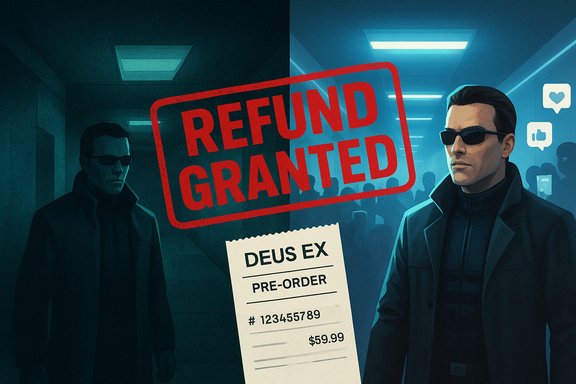
Aspyr has announced that Deus Ex Remastered will no longer launch on February 5, 2026, citing community feedback, and the studio says it will fully refund all existing pre-orders while it reworks the project and reassesses its approach.
Deus Ex Remastered was unveiled during a high-profile announcement earlier in 2025 as a fidelity-focused revival of Ion Storm’s 2000 classic. The remaster promised updated lighting, dynamic shadows, upscaled textures, rebuilt character models with improved lip-sync, physics fixes, and a grab-bag of modern quality-of-life features such as autosaves, faster loading, cloud saves, and controller support across PlayStation 5, Xbox Series X|S, Nintendo Switch and PC. The remaster was listed at a $29.99 suggested price and carried a February 5, 2026 release window. The reaction to the reveal trailer and early promotional materials was unusually negative for a remaster. Fans, commentators and even members of the original development community criticized the visual direction, suggesting it altered the original’s distinctive aesthetic and, in places, produced visuals that felt worse than the original or mismatched with the game’s tone. That backlash coalesced into sustained social-media commentary and press coverage — and, according to Aspyr, prompted the studio to pause the planned launch.
At the same time, the lack of a follow-up plan in the announcement leaves many important questions unanswered — about scope, timeline, technical approach, and whether the rework will satisfy the specialized, vocal core audience that made Deus Ex a cult classic. The involvement of the original title’s creators in public criticism amplifies reputational risk: winning them back will not be trivial.
For players and observers, the healthiest outcome would be a transparent, community-informed rework that preserves the original’s spirit while bringing technical improvements that truly enhance gameplay and accessibility. Until Aspyr provides that plan and demonstrates progress, the project remains in a fragile, speculative state.
Key facts recap:
Source: TechPowerUp Aspyr Postpones Launch of Deus Ex Remastered, Refunds Existing Pre-orders | TechPowerUp}
 Background
Deus Ex Remastered was unveiled during a high-profile announcement earlier in 2025 as a fidelity-focused revival of Ion Storm’s 2000 classic. The remaster promised updated lighting, dynamic shadows, upscaled textures, rebuilt character models with improved lip-sync, physics fixes, and a grab-bag of modern quality-of-life features such as autosaves, faster loading, cloud saves, and controller support across PlayStation 5, Xbox Series X|S, Nintendo Switch and PC. The remaster was listed at a $29.99 suggested price and carried a February 5, 2026 release window. The reaction to the reveal trailer and early promotional materials was unusually negative for a remaster. Fans, commentators and even members of the original development community criticized the visual direction, suggesting it altered the original’s distinctive aesthetic and, in places, produced visuals that felt worse than the original or mismatched with the game’s tone. That backlash coalesced into sustained social-media commentary and press coverage — and, according to Aspyr, prompted the studio to pause the planned launch. What Aspyr said — the official message
Aspyr posted a brief public update to communities and social platforms explaining the decision:- “Thank you to the community for your feedback following the reveal of Deus Ex Remastered.”
- “We’ve listened to what you had to say, and in order to better meet fan expectations and deliver the best possible experience for players, Deus Ex Remastered will no longer launch on Feb. 5, 2026.”
- “We look forward to sharing more updates with you when the time comes. All existing preorders will be fully refunded. Thank you again for your patience and support.”
Why this matters: a succinct summary
- The February 5 release date has been removed and no new target date has been provided; the delay is open-ended.
- Aspyr is refunding all pre-orders — an unusual step for a delay and a sign the studio is treating the reaction as substantive enough to warrant a full reset for buyers who committed under the prior assumptions.
- The controversy centers on visual direction and fidelity choices made for the remaster, with critics arguing the changes undermine the original game’s atmosphere rather than modernizing it. Even the game’s original art director expressed sharp disappointment in early reactions.
Historical context: remasters, community expectations, and the "too much / too little" dilemma
Remasters sit on a delicate line. They are ostensibly about preservation — bringing a game forward so it runs reliably on modern hardware while keeping the core experience intact — but they also invite modern sensibilities and technical upgrades. The tension is simple:- If a remaster changes too little, it risks being a high-price repackaging of legacy assets.
- If a remaster changes too much, it risks alienating players who remember the original’s look and feel as essential parts of its identity.
The immediate fallout: what players, critics and the original team said
Community reaction rapidly clustered around three themes:- Visual direction: commentators argued that lighting, model rework and texture updates produced a muddled, overly bright or generic aesthetic that erased the original’s atmosphere.
- Value proposition: the remaster’s suggested $29.99 price prompted questions about why players should buy a new edition when the original Game of the Year edition is regularly available for a few dollars on PC storefronts. Critics framed the remaster as an expensive repack if it couldn’t convincingly justify the price with demonstrable improvements.
- Source authenticity: even Jerry O’Flaherty, the original Deus Ex art director, publicly expressed dismay at what he had seen, an unusually blunt rebuke that amplified the negative narrative. His remarks were widely quoted and underscored how the remaster’s look had failed to persuade the series’ creators it respected the source aesthetic.
Refunds and storefront mechanics — what to expect
Aspyr’s statement committed to "fully refunding" existing pre-orders. That pledge raises several practical questions for buyers and platform operators:- Where refunds originate: refunds will generally be processed by the storefront where the pre-order was placed (Steam, PlayStation Store, Xbox Store, Nintendo eShop), even when the publisher initiates the refund program. Each platform has its own refund mechanics and timeframes. Aspyr’s message indicates the intent to refund but does not provide a precise timeline or method for execution. This is typical but requires clarity for affected customers.
- Regional differences and payment methods: depending on payment method, currency, and regional rules, refunds sometimes take multiple billing cycles to appear. Players should monitor the account used to pre-order and retain receipts/screenshots until the refund is confirmed.
- Store listings may persist: some storefronts cached the original listing at the time of writing, causing confusion for users who saw purchase buttons even after the announcement. Publishers and platforms often remove or amend listings after coordinated announcements, but propagation can lag. Monitor official channels for confirmation that the store pages have been updated or delisted.
- Keep your purchase receipts and the account information used for the purchase.
- Watch the official Aspyr account and your platform’s support channels for refund timelines and confirmation.
- If a refund does not appear within a plausible window (e.g., 7–14 business days after Aspyr’s announcement), open a support ticket with the store and reference Aspyr’s public statement.
- If you bought a physical pre-order through a retail partner, follow the retailer’s returns/refund policy and Aspyr’s guidance for physical editions specifically.
The reputational and commercial stakes for Aspyr (and its parent company)
Aspyr is not an unknown studio; it has long-standing experience in remastering and porting legacy titles and is part of the broader corporate structure owned by Embracer Group. That corporate context matters for two reasons:- Operational expectations: Aspyr has a history of handling legacy IPs and ports across platforms, which gives it institutional knowledge but also high expectations from passionate fanbases.
- Corporate optics: the company’s parent and investors will be watching cost, timeline and reputational fallout. A full refund and open-ended delay can protect buyers in the short term, but it also incurs additional development cost, schedule slippage, and potential brand damage if follow-up adjustments are slow or unsatisfactory.
Technical and creative diagnosis — what likely went wrong
Based on public signals and the nature of the criticism, the problems likely span both creative and technical domains:- Art direction vs. fidelity: the team appears to have prioritized technical enhancements (lighting, texture resolution, particle systems) without sufficiently recalibrating the art direction to preserve the original's emotional tone. This mismatch can make a modernized model or texture feel out of place in an older level geometry and layout, producing the uncanny effect fans noticed.
- Scope and tooling: remasters that rebuild assets while keeping original level design often need bespoke tools to harmonize lighting, material response and character models. If the toolchain or artistic pipeline was rushed to meet a commercial date, the result can look half-finished.
- Expectations management: the community expected either a faithful restoration that keeps the original’s vibe or a full-on reimagining that justifies the price and visible differences. The studio delivered neither clearly enough to satisfy the core audience.
Strengths in Aspyr’s response — and missed opportunities
Strengths:- Rapid acknowledgement: Aspyr’s public acknowledgement and immediate refund offer avoided a prolonged period of customers feeling misled or left in limbo; that responsiveness is preferable to silence.
- Risk containment: issuing refunds and delaying removes a worst-case outcome — a widely panned launch — that could have incurred much larger reputational damage and lower lifetime revenue.
- Lack of detailed road map: the statement lacks specifics about what will be changed, how feedback will be incorporated, and what consumers should expect next. Vague “when the time comes” language leaves stakeholders guessing.
- No community-engagement plan: given the specific nature of the complaints (art direction), an articulated plan for community consultation (e.g., preview builds, toggle options for classic visuals, or an art-polish livestream) could have restored confidence more quickly.
- Pricing defensibility: the $29.99 MSRP questioned the project’s value in the eyes of many players; clearer messaging about what the price included—or optional legacy toggles—might have reduced friction at announcement.
Broader implications for the remaster economy
This episode highlights four general lessons for publishers and studios handling beloved IPs:- Community-first previews matter: fans of classic titles have high sensitivity to tone and authenticity; early, transparent engagement can catch missteps before marketing campaigns scale.
- Dual-mode releases reduce friction: offering an optional “classic visuals” toggle at launch preserves fidelity for purists while allowing a reworked visual layer for newcomers. That option has become a best practice for controversial visual upgrades.
- Price vs. baseline availability: when an original is still widely available at low cost, remasters must clearly demonstrate distinct value—either in technical depth or content additions—to justify mainstream pricing.
- Platform coordination: if a publisher chooses refunds, they must execute them cleanly across multiple storefronts — a logistical non-triviality that requires detailed coordination with platform holders.
Risks and unanswered questions
There are risks and open items that observers should watch for:- Project scope creep and cost: an indefinite delay could balloon development time and costs, especially if significant asset rework is required. That could pressure the publisher to cut features or reduce polish elsewhere.
- Cancellation risk: while Aspyr framed the move as a rework, the combination of refunding pre-orders and removing a release date leaves open the possibility of eventual cancellation or transfer to another studio — an outcome that, if realized, would be costly for stakeholders. This remains speculation until formally confirmed.
- Consumer trust: even with refunds, a poorly managed follow-through (slow timeline, lack of demonstrable progress) could corrode trust in both Aspyr and the handling of other legacy IPs within its corporate family.
- Platform friction: if storefront records continue to show purchasable listings or delayed propagation of delists, consumer confusion and support load will increase.
What would success look like from here?
A constructive recovery path would have several elements:- Transparent roadmap: publish a concrete plan that explains what will change (art direction, lighting passes, model updates), a high-level schedule, and key mileposts.
- Early community validation: share targeted developer diaries, in-engine comparisons, or limited public playtests so the community can see progress and provide specific feedback.
- Feature parity and toggles: commit to preserving the original’s option set—most crucially, an in-game toggle for “classic” visuals—so purists can opt-in and casual players can use the modernized presentation.
- Clear refund communication: publish precise timelines and processes for refunds across storefronts, with customer support contact points and expected completion windows.
- Post-mortem learning: once the project is back on track, publish a frank post about what went wrong and what was learned, which can restore credibility and help other teams avoid similar missteps.
Final assessment
The decision to delay Deus Ex Remastered and refund pre-orders is a bold, defensive move that buys Aspyr the time to address the clear mismatch between their presentational choices and fan expectations. It is also an admission of responsibility: a publisher willing to take money back and step away from a near-term release demonstrates that it values long-term brand capital over short-term receipts. That is both morally and commercially defensible.At the same time, the lack of a follow-up plan in the announcement leaves many important questions unanswered — about scope, timeline, technical approach, and whether the rework will satisfy the specialized, vocal core audience that made Deus Ex a cult classic. The involvement of the original title’s creators in public criticism amplifies reputational risk: winning them back will not be trivial.
For players and observers, the healthiest outcome would be a transparent, community-informed rework that preserves the original’s spirit while bringing technical improvements that truly enhance gameplay and accessibility. Until Aspyr provides that plan and demonstrates progress, the project remains in a fragile, speculative state.
Key facts recap:
- Aspyr has delayed Deus Ex Remastered from its February 5, 2026 release date and will no longer launch on that date.
- The studio says it will fully refund all existing pre-orders.
- The delay follows intense community criticism — particularly over art direction and visuals — and even drew public rebuke from the original game’s art director.
Source: TechPowerUp Aspyr Postpones Launch of Deus Ex Remastered, Refunds Existing Pre-orders | TechPowerUp}
