

The push for “DIY AI” — where employees and small teams build their own copilots, automations, and agents using low-code tools — is rapidly reshaping how organizations think about productivity and flexibility, turning once-experimental automation into a mainstream operational strategy. A recent industry commentary argues that when workers are empowered to build the tools they need, flexibility stops being a trade-off and becomes a competitive advantage, a claim reinforced by contemporary surveys showing broad enthusiasm for AI-enabled remote and hybrid work.
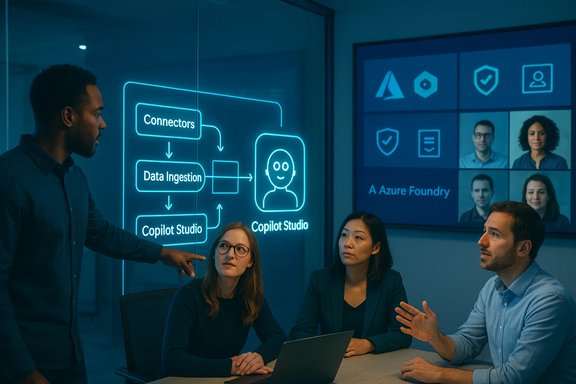
DIY AI is shorthand for a set of overlapping trends: low-code/no-code builders (Power Platform, Copilot Studio), tenant-aware copilots (Microsoft 365 Copilot), and platform-level services that let organizations stitch models, connectors, and governance into production-grade agents (Azure AI Foundry, Azure AI Agent Service). These technologies shorten the time from idea to working automation from months to days, letting domain experts — not just software engineers — assemble solutions that remove repetitive work and standardize outcomes. Microsoft’s official tooling and documentation highlight this shift toward citizen development and agentization as a central pillar of modern productivity stacks. The practical effect is simple: when people who know the process build the automation, the automation is more relevant, quicker to adopt, and often more secure than shadow-tooling created without governance. At the same time, the rise of DIY AI brings a fresh set of operational and security risks that IT leaders can’t ignore.
Source: SmartBrief How DIY AI unlocks productivity and flexibility - SmartBrief
 Background / Overview
DIY AI is shorthand for a set of overlapping trends: low-code/no-code builders (Power Platform, Copilot Studio), tenant-aware copilots (Microsoft 365 Copilot), and platform-level services that let organizations stitch models, connectors, and governance into production-grade agents (Azure AI Foundry, Azure AI Agent Service). These technologies shorten the time from idea to working automation from months to days, letting domain experts — not just software engineers — assemble solutions that remove repetitive work and standardize outcomes. Microsoft’s official tooling and documentation highlight this shift toward citizen development and agentization as a central pillar of modern productivity stacks. The practical effect is simple: when people who know the process build the automation, the automation is more relevant, quicker to adopt, and often more secure than shadow-tooling created without governance. At the same time, the rise of DIY AI brings a fresh set of operational and security risks that IT leaders can’t ignore.Why DIY AI now? The data that matters
Two large-scale industry signals illustrate why the DIY wave has traction today.- A 2025 survey commissioned by GoTo and conducted with Workplace Intelligence found that roughly half of respondents across roles and regions believe AI could eventually render physical offices obsolete — a striking data point that underscores how AI is seen as an enabler of remote productivity, not merely an incremental convenience.
- Microsoft’s Work Trend Index (2024) and related research show that AI power users — employees who use generative and assistant-style tools frequently — report measurable time savings (on average about 30 minutes per day, or roughly 10 hours per month) and routinely rework their workflows around AI capabilities. These “power users” are the natural builders and adopters of DIY copilots.
How DIY AI unlocks productivity — practical patterns
1) Replace rote steps with reliable automations
DIY AI targets the mundane: meeting summaries, email triage, invoice extraction, proposal generation. When these tasks are automated safely, human time moves toward higher-impact work. Microsoft and partner case studies show dramatic task-time reductions when domain-tuned agents are deployed. For example, a large entertainment company reduced support handling times from many minutes to roughly 30 seconds per request by coupling Power Automate flows with a Copilot Studio conversational front end. Similarly, Fujitsu’s sales-proposal agent built with Azure AI Agent Service and Foundry tools produced a reported 67% improvement in proposal productivity for thousands of sellers. These are not hypothetical gains; they are concrete improvements companies are measuring in production.2) Localize and personalize workflows at scale
DIY AI makes it practical for teams to tailor assistants to their context: legal teams can define citation and approval rules, support teams can ground responses in internal KBs, and finance teams can automate reconciliations that used to require manual intervention. Low-code tools, templates, and reusable connectors mean these bespoke copilots can be published and governed centrally while still reflecting local nuance. Microsoft’s Copilot Studio and Power Platform explicitly position themselves for this “citizen developer” use model.3) Speed experimentation, measure ROI, scale fast
The recommended adoption pattern is narrow pilots with focused KPIs: time saved per task, error rate vs. human edits, or days‑past‑due reductions for invoice chasing. Successful pilots then scale through governance templates, tenant policies, and monitoring. Practical playbooks — inventory workflows, pick top-3 pilots, instrument usage, set cost alerts — convert early wins into repeatable programs that IT can manage without choking innovation. This is the institutional recipe for turning disposable bots into maintainable assets.Platforms: What’s enabling DIY AI today
Microsoft Copilot Studio (and Microsoft 365 Copilot)
Microsoft positions Copilot Studio as the low-code gateway for building chat agents and automations that plug into Microsoft 365, Teams, SharePoint, and tenant data. It includes governance controls, DLP hooks, customer-managed keys, and admin features to disable publishing or restrict geographic data movement — essential controls for regulated environments. Copilot Studio is sold both as a tenant-included experience for certain Microsoft 365 Copilot licenses and in credit packs or pay-as-you-go models for broader deployments.Azure AI Foundry and Azure AI Agent Service
Azure AI Foundry is the developer- and enterprise-grade platform for composing models, tools, and agent runtimes. The Agent Service is the runtime for deploying multi-step, event-triggered, or autonomous agents at scale. Foundry emphasizes model choice (Microsoft/OpenAI/third-party), model switching, SDKs, and observability — features enterprises need to operate dozens or hundreds of agents without rebuilding when a new model or capability emerges. These platforms represent the industry’s attempt to balance empowerment and control: makers get building blocks and templates, while IT gets policy hooks, telemetry, and contractual assurances.Verified wins — real company examples
- Cineplex (Canada) built a guest-services copilot that integrates Power Automate with Copilot Studio. The pilot reduced handling time from 5–15 minutes to under a minute and typically to about 30 seconds, processing thousands of refund and booking requests while improving CSAT. This is an example of a focused operational pilot delivering measurable throughput gains.
- Fujitsu used Azure AI Agent Service to automate sales proposal creation, integrating dispersed knowledge and internal systems; Microsoft’s customer story reports a 67% increase in productivity across sales teams numbering in the tens of thousands. This showcases how an agent that consolidates domain knowledge and automates document composition can free sellers for higher-value work.
The flexibility dividend: why DIY AI matters for hybrid work
The argument linking DIY AI to remote/hybrid flexibility rests on two mechanisms:- AI-first tools reduce the need for co-location by embedding context, summarization, and action into the flow of asynchronous work.
- When employees build the assistants they need, they remove the “coordination tax” that often makes distributed work slower than co-located alternatives.
Governance, security, and the real risks of DIY AI
DIY AI’s promise comes with real, material hazards. The most urgent:- Shadow agents and data leakage. Employees building their own assistants without proper controls can expose sensitive data to models, connectors, or third-party services. Microsoft’s guidance for Copilot Studio emphasizes DLP, tenant controls, and customer-managed keys precisely to mitigate this risk. But tooling alone is not enough — programmatic governance is required.
- Credential and token abuse. Security researchers have flagged attacks that specifically target agent builders: social-engineering patterns that trick makers into granting OAuth permissions or consenting to malicious apps. Recent industry disclosures highlight a tactic called “CoPhish” that abused Copilot Studio topics to harvest tokens; Microsoft has acknowledged the tactic and is issuing mitigations, but the episode underscores how agent ecosystems expand the attack surface in novel ways. Tight admin controls, conditional access, and MFA are practical mitigations.
- Governance scale and model drift. When dozens or hundreds of bespoke agents are in use, keeping track of provenance, training data, and model behavior becomes an observability challenge. Azure AI Foundry and some vendor tools offer audit trails, model inventories, and red-teaming features, but organizations must commit people and process to ongoing monitoring, not just a one-time approval.
- Accuracy, hallucinations, and liability. Even well-constructed agents can hallucinate or misapply rules. For outward-facing use (customer advice, legal or financial guidance), organizations must require human approval steps and provenance tracking to avoid reputational and regulatory harm. The best practice is a tiered risk model: internal content generation can tolerate higher false-positive rates when humans review, while customer- or regulator-facing outputs need stronger grounding and verification.
A governance checklist for Windows IT teams and CIOs
- Inventory initial use cases and classify data sensitivity.
- Start with 2–4 narrow pilots and define a single KPI (time saved per task or reduction in cycle time).
- Require least-privilege access for agents (folder-level or calendar-only scopes instead of full mailbox access).
- Use tenant-level policies to block publishing until an app review is passed.
- Adopt conditional access, MFA, and admin approval for third-party app consents.
- Insist on contractual non-training clauses or on-premises/in-region processing for regulated workloads.
- Archive AI outputs and maintain versioned copies for auditability.
- Provide structured training and prompt-design libraries for makers.
Where DIY AI works best: five pilot projects that deliver measurable value
- Email triage and templated responses — measure edits per draft and time-to-send reduction.
- Receipt capture and bank reconciliation — measure month‑end close time saved.
- Customer refund and booking flows — measure average handling time and CSAT improvements.
- Invoice-chase agent — measure days‑past‑due and cash recovery improvement.
- Meeting summarization and action‑item extraction — measure task completion ratio and meeting follow-up time.
Critical analysis: strengths, blind spots, and where to be cautious
Strengths- Rapid impact: Low-code agents can convert obvious friction into saved hours in days, not quarters. Verified customer stories show measurable throughput gains in support and sales where the workflows are well-understood.
- Democratized innovation: When subject-matter experts build their own tools, adoption is faster and the output fits actual work patterns.
- Platform convergence: Integrated platforms (Copilot Studio + Azure Foundry) give enterprises the ability to centralize governance while enabling distributed creation.
- Security is an afterthought unless sponsored by IT: Makers are not attackers, but without controls they create attack vectors; admin policies, token controls, and conditional access must be enabled from day one. Research into “CoPhish” attacks demonstrates how agent platforms can be abused via social engineering.
- Vendor-driven case studies can overstate generalizability: Many publicized wins come from carefully scoped pilots with vendor support. Enterprises should verify assumptions in their own contexts before large rollouts; not every workflow scales the same way. Where possible, validate vendor numbers against internal pilot metrics.
- Governance complexity grows non-linearly: Hundreds of agents mean non-linear increases in audit burden. Observability, lifecycle management, and model inventories are operational investments that organizations must budget for.
- Human skills and role redesign are essential: Productivity gains are real but uneven. Organizations that do the hard work of re-designing roles and training staff in prompt engineering, review workflows, and exception handling capture disproportionate value.
How to operationalize DIY AI responsibly: a step-by-step starter plan
- Map the top 50 repetitive tasks across the organization and rank by frequency, sensitivity, and potential ROI.
- Select top 3 pilot workflows that are low-risk but high-frequency. Assign a sponsor, an owner, and an IT guardrail group.
- Build with a maker + IT partnership, instrument usage, and require an audit-able review checklist before publishing.
- Measure: time saved, human interventions, error rates, cost per automation. Run for a defined period and iterate.
- Scale with policy templates, model inventories, and a lifecycle schedule (red-team yearly, model re-evaluation every 90 days).
Final verdict: practical optimism with guardrails
DIY AI is not a silver bullet, but it is a transformational acceleration of a familiar pattern: decentralize discovery, centralize control. When organizations pair employee empowerment with rigorous governance, the result is a productivity multiplier that also supports more flexible, distributed work. The data and customer stories show real gains in handling time, proposal throughput, and routine task automation; the tools to do this (Copilot Studio, Azure AI Foundry, Power Platform) are mature enough to be useful in production. Caveats remain. Security incidents that target agent ecosystems and the complexity of managing many tenant‑scoped agents mean that IT leaders must be proactive, not reactive. The most consistent lesson from pilots and case studies is that governance and measurement are not optional — they are the difference between a few clever experiments and sustainable, enterprise-grade productivity gains.Takeaway for Windows IT professionals and leaders
- Treat DIY AI as a program, not a project: invest in tooling, people, and processes for the long term.
- Start with a handful of high-value, low-risk pilots; instrument everything and measure before scaling.
- Insist on least-privilege connectors, conditional access, and multi-factor authentication for any agent that touches corporate data.
- Use tenant-level policy and DLP features in Copilot Studio and Power Platform to manage exposure.
Source: SmartBrief How DIY AI unlocks productivity and flexibility - SmartBrief
