

The United States’ late‑2025 strategic reset — and the dramatic U.S. military operation in Venezuela that followed — have forced a blunt reappraisal of how Washington now defines its national interests, how it intends to secure them in the Western Hemisphere, and what that means for long‑standing allies such as the Kingdom of Denmark and Greenland. DIIS Senior Researcher Rasmus Sinding Søndergaard framed the shift as a decisive break from the post–Cold War, rules‑based approach: the new U.S. strategy (publicly issued in late 2025) privileges territorial control, resource access and unilateral instruments of power over multilateral problem‑solving, and the recent events in Caracas appear to be the clearest demonstration yet of that doctrine in action.
The Trump administration’s 2025 National Security Strategy (NSS) marks a visible departure from the prevailing consensus of the past three decades. The document reorders priorities toward the Western Hemisphere, narrows the stated purpose of global engagement to narrowly defined U.S. interests, and signals a willingness to use coercive instruments — including direct military action — to secure those interests. Analysts and think tanks describing the paper note both its speed of release and the unusual emphasis on hemispheric dominance as a central organizing principle. Almost immediately after the strategy’s formal release, Washington executed a high‑risk military operation in Venezuela that resulted in the capture and fast transfer of President Nicolás Maduro to U.S. jurisdiction and subsequent federal narcotics indictments. The U.S. government framed the action as law‑enforcement against narco‑trafficking leadership; international bodies, human‑rights organizations and many states described it as an extraordinary use of force raising fundamental international‑law questions. Rasmus Sinding Søndergaard’s short Q&A — the prompt for this analysis — reads these moves as part of a coherent new doctrine: a revived, more coercive form of the Monroe Doctrine that places hemispheric control and resource access at the core of U.S. strategy. He warns this version abandons long‑standing norms and places allies — including Denmark and Greenland — in a new strategic calculus where U.S. demands for access and alignment may be non‑negotiable. The rest of this piece summarizes those claims, verifies factual anchors against independent reporting, and offers a critical analysis of strategic strengths, political risks, and practical implications for Danish and Greenlandic policy choices.
Source: DIIS Rasmus Sinding Søndergaard on Venezuela, Greenland and the new U.S. Strategy
 Background / Overview
The Trump administration’s 2025 National Security Strategy (NSS) marks a visible departure from the prevailing consensus of the past three decades. The document reorders priorities toward the Western Hemisphere, narrows the stated purpose of global engagement to narrowly defined U.S. interests, and signals a willingness to use coercive instruments — including direct military action — to secure those interests. Analysts and think tanks describing the paper note both its speed of release and the unusual emphasis on hemispheric dominance as a central organizing principle. Almost immediately after the strategy’s formal release, Washington executed a high‑risk military operation in Venezuela that resulted in the capture and fast transfer of President Nicolás Maduro to U.S. jurisdiction and subsequent federal narcotics indictments. The U.S. government framed the action as law‑enforcement against narco‑trafficking leadership; international bodies, human‑rights organizations and many states described it as an extraordinary use of force raising fundamental international‑law questions. Rasmus Sinding Søndergaard’s short Q&A — the prompt for this analysis — reads these moves as part of a coherent new doctrine: a revived, more coercive form of the Monroe Doctrine that places hemispheric control and resource access at the core of U.S. strategy. He warns this version abandons long‑standing norms and places allies — including Denmark and Greenland — in a new strategic calculus where U.S. demands for access and alignment may be non‑negotiable. The rest of this piece summarizes those claims, verifies factual anchors against independent reporting, and offers a critical analysis of strategic strengths, political risks, and practical implications for Danish and Greenlandic policy choices.What changed in the 2025 U.S. National Security Strategy?
A re‑ordered strategic hierarchy
The 2025 NSS recasts the Western Hemisphere as a primary theatre for U.S. geopolitical competition and national interest projection. That reprioritization is not merely rhetorical: the document endorses stepped‑up naval and military posture in the Caribbean and nearby Atlantic approaches, and repeatedly links regional stability to American security. Analysts who reviewed the NSS see it as an ideological and operational turn away from the post‑Cold War emphasis on global public goods and multilateral institutions. This matters because strategy normally guides force posture, force planning, basing rights and diplomatic posture. When a government explicitly makes control of a region central to national strategy, it incentivizes a set of instruments — sanctions, interdiction, special operations, blockade, and political interventions — that can be used in pursuit of narrowly defined ends.A return to hemispheric primacy — but different
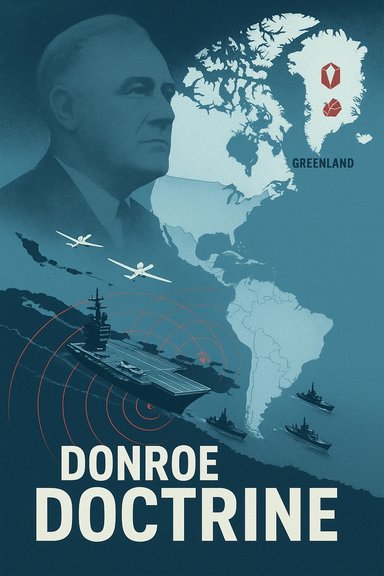
Observers have compared the doctrinal turn to historic formulations of U.S. hemispheric policy, most notably the Monroe Doctrine. Yet the 2025 NSS resembles the aggressive corollary used by Theodore Roosevelt rather than James Monroe’s original warning to European great powers. Commentators have adopted the shorthand “Donroe Doctrine” to underline how this iteration marries unilateral assertiveness with modern political nationalism. This is not an academic quibble: the practical implication is a willingness to enforce U.S. preferences militarily in its perceived sphere.The Venezuela operation: demonstration, justification, and controversy
What happened — facts on the ground
In early January 2026 U.S. forces conducted a high‑profile operation in Venezuela that resulted in the apprehension of Nicolás Maduro and his wife, who were subsequently flown to and arraigned in a U.S. federal court on narco‑trafficking and related charges. The U.S. government presented the arrests as the enforcement of longstanding indictments and part of its effort to disrupt narcotics networks. Independent reporting confirms the arrests, the indictment, and the arraignment proceedings in New York.Official rationale and the counter‑argument
U.S. officials pointed to narcotics prosecutions and an indictment as the legal basis for the operation. The Manhattan indictment and the Justice Department’s narrative detail alleged ties between senior Venezuelan officials and organized trafficking networks; major outlets have summarized these claims and the scope of allegations. Yet critics — including international‑law scholars and several UN spokespeople — quickly questioned whether the magnitude and timing of the military operation align with classic law‑enforcement norms and argued the action raised grave questions under the UN Charter and customary international law. The UN Secretary‑General’s office characterized the operation as a “dangerous precedent” and urged respect for international law. Rasmus Sinding Søndergaard’s interpretation is that the drug‑trafficking rationale is a legal fig leaf for a strategic imperative: seizing control of a resource‑rich, geopolitically positioned state perceived as aligned with strategic competitors, notably China and Russia. That reading is an analytic judgment, and it is consistent with public signals in the NSS that prioritize resource and territorial control, but it remains an interpretation rather than a conclusive legal fact. Where possible, it should be treated as a hypothesis that links political intent (NSS language) with operational behavior (the Venezuela operation).Legal and practical implications
Legal scholars pointed to potential violations of Article 2(4) of the UN Charter and to the lack of Security Council authorization as generating serious legal risk for the United States. U.S. officials counter that the operation constitutes law enforcement in furtherance of criminal charges rather than an act of interstate aggression. The public international debate now centers on whether an extra‑territorial law‑enforcement operation, executed with military force inside the territory of a sovereign government, can be reconciled with established legal standards; many experts say it cannot, absent consent or an accepted self‑defense justification. This is a central point of controversy with real diplomatic and institutional costs.The Monroe Doctrine revisited — “Donroe” as doctrine and practice
What the phrase captures
Calling the new policy a revival of the Monroe Doctrine is analytically useful insofar as it captures the hemispheric focus and the American insistence that external powers not gain leverage in the Americas. The more loaded, contemporary moniker “Donroe Doctrine” signals a further nuance: this is a Monroe Doctrine practiced through a nationalist, unilateral, and at times militarized playbook tied to a particular U.S. domestic political agenda. Several major outlets and analysts have used this framing to describe the synthesis of nationalist policymaking and hemispheric security emphasis in the 2025 NSS.Differences from historical precedent
Two clear differences separate this iteration from past Monroe‑like assertions. First, the operational emphasis now includes aggressive use of law‑enforcement framed as military action and direct seizure of regime leaders. Second, the strategy places raw resource access and control at the forefront rather than broad ideological confrontation with European powers. The result is a doctrine that privileges immediate geostrategic gains and resource security over multilateral order or institutional legitimacy.Greenland: why it matters, and why Denmark must pay attention
Greenland’s strategic value
Greenland’s strategic value is multifold: it sits astride trans‑Atlantic air and sea routes; it opens access to Arctic maritime approaches increasingly relevant as ice retreats; and it possesses mineral and potential hydrocarbon resources that are becoming geopolitically salient for high‑tech supply chains. President Trump’s renewed public insistence that the United States “needs” Greenland reflects a view of Arctic geography as a geopolitical chessboard in which control of territory translates into power projection and resource security. International reporting has documented the renewed U.S. overtures and the Greenlandic and Danish resistance to ideas of sale or transfer.Rasmus Sinding Søndergaard’s reading
Søndergaard argues that the Venezuela operation is a signal of intent: the United States is prepared to take forceful measures to secure what it defines as core hemispheric interests. He cautions that Greenland, although part of a NATO ally and a democratic partner, could find itself the object of heightened U.S. pressure to secure basing, access, or even political realignment — albeit through far subtler tools than were used in Venezuela (diplomatic coercion, economic leverage, basing negotiations, or exceptional security agreements). That assessment stresses process and posture: a U.S. policy that normalizes coercive measures in the hemisphere raises the bar on political risk for allied territories. The factual backbone of Søndergaard’s concern is the explicit strategic elevation of the Arctic in U.S. planning and the explicit public claims by the President.Practical implications for Denmark and Greenland
- Denmark, as part of the Kingdom that includes Greenland, faces immediate diplomatic friction: public Danish and Greenlandic statements rejecting any sale or transfer have already been necessary and prominent.
- Greenlandic autonomy and domestic law place strong legal barriers against outright transfer, but political pressure — including carrots such as security guarantees or economic investment tied to U.S. demands — could test those institutions.
- NATO allies must now reckon with a United States that is less constrained by multilateral process and more willing to unilaterally rewire regional security arrangements to fit its strategic design.
What this means for allied security relationships — strengths, weaknesses, and risks
Strategic strengths visible in the new posture
- Clarity and decisiveness: the NSS and the action in Venezuela demonstrate that the United States will act swiftly where it perceives critical national interests, potentially deterring hostile incursions or strategic encroachments in the hemisphere.
- Operational reach: the Venezuela operation showed integrated intelligence, special‑operations capability and logistical reach — a signaling of capability that can change adversary calculations regionally.
Political and institutional weaknesses
- Erosion of legal and normative foundations: sustained unilateral uses of force risk undermining the international order the United States historically led, making diplomatic cooperation harder and increasing the costs of coalition building. The UN Secretary‑General’s alarm and broad international criticism illustrate the reputational price.
- Alliance strain: allies who rely on U.S. security guarantees but who value international law and multilateralism will face a governance dilemma — continue necessary security cooperation in contexts like Ukraine, while distancing from unilateral regional tactics that appear illegal or politically toxic.
Risks specific to Denmark and Greenland
- Sovereignty pressure: even without a legal sale, Greenland could face intensified diplomatic lobbying, basing negotiations or economic inducements that increase Copenhagen’s political costs.
- Security dependence: Denmark’s historic reliance on U.S. military support remains useful but more precarious if U.S. policy shifts impose strategic choices that conflict with Danish legal or normative commitments. Rasmus Sinding Søndergaard recommends Denmark and its European partners build more autonomous military capacity to reduce dependence over time. This is a prudent strategic hedging recommendation given the new posture.
Recommendations for Danish and Greenlandic policymakers
- Reaffirm legal positions and public clarity. Denmark and Greenland should publicly and unequivocally restate Greenland’s sovereignty and the political impossibility of sale, while ensuring domestic law and procedures are visible and robust. This reduces the chance of misperception and limits political leverage.
- Strengthen defence and civil resilience in the Arctic. Invest in dual‑use infrastructure (airfields, search‑and‑rescue, communications) that enhances local sovereignty while providing practical utility. Prioritise interoperability with European partners to avoid exclusive dependence on the U.S. for Arctic security.
- Deepen European burden‑sharing and operational capacity. Work with EU/NATO partners to develop rapid response and sustained presence capabilities in the North Atlantic and Arctic, reducing the temptation to rely solely on Washington’s strategic choices for regional security.
- Insist on legal accountability and rules of engagement. When cooperating with the United States on interdiction or counter‑narcotics work, require clear legal frameworks, agreed rules of engagement, and transparency measures so partner states can avoid complicity in operations that may violate international law.
- Prepare contingency diplomacy. Build diplomatic coalitions with like‑minded small and medium powers to protect regional norms and to provide alternative cooperation frameworks that do not require wholesale alignment with any single great power’s unilateral actions.
Critical assessment: strengths, evidence gaps and limits of the argument
Rasmus Sinding Søndergaard’s central claim — that the new U.S. strategy is a deliberate pivot toward territorial and resource control, enforced through unilateral coercion — is coherently grounded in two observable facts: the 2025 NSS’s hemispheric reorientation and the rapid, large‑scale U.S. operation in Venezuela. Both facts are publicly documented and have been independently reported. That said, important caveats apply.- Causation versus correlation: the NSS establishes a strategic vocabulary and priorities; the Venezuela operation is an operational decision with many inputs (intelligence, domestic politics, prosecutorial tools). While the two reinforce one another, concluding that the NSS directly caused the operation risks oversimplifying a complex policy ecosystem. The interpretation that resource and anti‑China/Russia competition were the primary motives is plausible and consistent with the NSS but is not conclusively proven in public documents and therefore should be treated as an analytically supported inference rather than an incontrovertible fact.
- Legal and political accountability: the United States faces both international criticism and domestic legal questions. The administration’s public framing rests on criminal indictments; critics point to the operation’s scale and the normative implications for sovereignty. Both sides make arguments rooted in law and geopolitics; at present, much depends on evolving judicial proceedings, congressional oversight and international diplomatic responses. UN statements and allied reactions provide a near‑term evidence base that the operation has cost the U.S. diplomatic capital in measurable ways.
- Long‑term alliance calculus: allies must weigh short‑term operational benefits of U.S. support (e.g., deterrence reassurance, military aid) against long‑term strategic autonomy. Søndergaard’s recommendation that Denmark and its European partners develop greater capacities to act independently remains strategically sound, but it is a medium‑ to long‑run project that requires sustained funding and political consensus.
Conclusion
The United States’ 2025 National Security Strategy and the subsequent operation in Venezuela form a consequential policy tandem: strategy and action reinforcing a renewed emphasis on hemispheric control. Rasmus Sinding Søndergaard’s reading — that the administration’s doctrine revives a Roosevelt‑style Monroe corollary, prioritizing dominance and resource security over a rules‑based multilateral order — is consistent with open‑source evidence and with the public statements that accompanied both the NSS and the Venezuelan operation. For Denmark and Greenland the implications are direct and immediate: diplomatic clarity, legal preparedness, investment in Arctic resilience and a concerted European effort to build complementary defence capacity are prudent responses. The larger strategic lesson is that alliances built on long‑term institutions and shared norms now face a stress test: preserve cooperative security arrangements and the international law framework that sustains them, or defer to the short‑term coercive advantage of a hegemon that increasingly treats regional control as a primary objective. The choice will shape European security, Arctic governance, and the future of transatlantic relations for years to come.Source: DIIS Rasmus Sinding Søndergaard on Venezuela, Greenland and the new U.S. Strategy
