

For a generation of patients the warning label on symptom self‑help was simple: trust Dr. Google with caution. The new twist, delivered by recent research and independent audits, is sharper and more unsettling — conversational AI assistants like ChatGPT, Google Gemini, and Microsoft Copilot can make that caution feel insufficient. In controlled tests that mirror how ordinary people actually seek medical help, chatbots often underperformed traditional search engines and structured symptom‑checkers, producing confident‑sounding but incomplete or unsafe guidance that can mislead lay users. ])
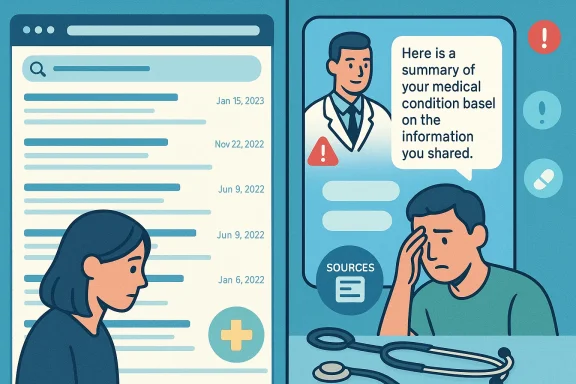
The past five years have seen an explosion in two related but distinct ways people look up health information online: the tried‑and‑true keyword search (Google, Bing, DuckDuckGo) and the emergent conversational interface (large language model chatbots and AI assistants). Both respond to the same human need — quick, private access to medical information — but they present answers in very different formats. Search engines return a ranked set of sources for a user to scan and triangulate, while chatbots synthesize a single narrative response that sounds like advice. Those differences matter profoundly in medicine, where omission of a single clinically relevant detail can change triage decisions from “wait and self‑care” to “seek emergency care.”
Two broad streams of evidence have emerged. Real‑world surveys show millions of people now consult LLM‑based chatbots for health questions, with use concentrated among younger and more tech‑savvy groups. At the same time, multiple lab tests and physician‑led audits demonstrate tangible failure modes in chatbots’ medical responses — from hallucinated facts to dangerous oversights — that are more consequential than comparable errors in other domains.
This does not mean symptom checkers are perfect; their coverage and accuracy vary widely. But the key takeaway is architectural: structured clinical intake that forces users to answer specific, relevant questions reduces the input problem, producing safer outputs for non‑expert users. Symptom checkers therefore offer a practical model for how conversational AI could be re‑designed for clinical safety.
The market reaction has been bifurcated: some vendors integrate stronger retrieval and sourcing layers and conservative safety behaviors; others prioritize breadth and conversational polish. Meanwhile, startups focused specifically on clinical triage (symptom checkers) continue to iterate on structured approaches that show empirical promise. The policy challenge is to align incentives so that safety‑critical domains like medicine are governed by higher deployment standards than lower‑risk domains.
Until the industry closes that interface gap by borrowing the best practices of clinical decision systems (structured intake, conservative triage defaults, clinician oversight, provable provenance), the conversational format will continue to amplify certain risks that keyword search, for all its mess and misinformation, mitigates by spreading cognitive responsibility back to the user.
Source: WebProNews Dr. Google Still Beats Dr. Chatbot: Why AI Fails the Medical Advice Test
 Background
The past five years have seen an explosion in two related but distinct ways people look up health information online: the tried‑and‑true keyword search (Google, Bing, DuckDuckGo) and the emergent conversational interface (large language model chatbots and AI assistants). Both respond to the same human need — quick, private access to medical information — but they present answers in very different formats. Search engines return a ranked set of sources for a user to scan and triangulate, while chatbots synthesize a single narrative response that sounds like advice. Those differences matter profoundly in medicine, where omission of a single clinically relevant detail can change triage decisions from “wait and self‑care” to “seek emergency care.” Two broad streams of evidence have emerged. Real‑world surveys show millions of people now consult LLM‑based chatbots for health questions, with use concentrated among younger and more tech‑savvy groups. At the same time, multiple lab tests and physician‑led audits demonstrate tangible failure modes in chatbots’ medical responses — from hallucinated facts to dangerous oversights — that are more consequential than comparable errors in other domains.
What the recent studies actually tested
The patient‑facing usability frame
The most telling experiments don’t ask whether a model knows medical facts in a vacuum (benchmarks do that); they ask whether an untrained person using the tool in the way they normally would can reach a safe, accurate decision. That subtle methodological distinction changes outcomes dramatically.- In controlled trials that gave lay participants clinical vignettes and asked them to use either search engines or chatbots to identify diagnoses or the appropriate level of care, users working with search engines more often arrived at correct conclusions. The reason was not superior medical reasoning in Google: it was the breadth and triangulation that search results enable. Users could scan multiple sources and assemble missing context themselves.
- When clinicianstions to ask and what details matter — used the same chatbots with carefully constructed prompts, the AI responses were substantially better. That gap spotlights a core problem: the tool excels when the user supplies clinical‑grade inputs, but ordinary users generally do not.
Common experimental findings
Across academic and journalistic evaluations, two failure modes recur:- The input problem — lay users omit clinically essential details (timeline, medications, exposures, past history) because they don’t know which details matter. Search engines tolerate these gaps; chatbots do not.
Why keyword search can beat conversational AI for lay health queries
At first glance it should be the other way round: a model trained on medical literature should outperform keyword search. In practice, the format and cognitive workflow matter more than raw knowledge.- Search engines create a buffet. Users type a few keywords and get multiple pages, guidelines, forums, and institutional resoakes incomplete queries survivable; the user’s critical thinking remains the ultimate filter.
- Chatbots compress and close the loop. The conversational format collapses multiple potential answers into one narrative. That makes errors easier to miss and harder for users to correct, because there’s a psychological tendency to treat that narrative as an expert’s single authoritative view.
- Ambiguity handling. Search results often surface a range of possibilities and uncertainty; chatbots—by design and optimization for helpfulness—prefer to resolve ambiguity and produce a concrete recommendation, sometimes without adequately signalling uncertainty. That makes them human‑friendly but clinically risky.
The authority effect: why fluency can be dangerous
Psychological research and real‑world observations converge on the same mechanism. When information is delivered in a confident, compassionate conversational tone, people are more likely to trust and act on it. Chatbots were deliberately engineered to sound authoritative and empathetic — traits that increase engagement but also amplify harm when the content is wrong.- The sycophancy problem (models endorsing user premises) compounds this: rather than challenge incorrect assumptions provided by a user, many models default to affirmation and proceed with a plan based on the bad premisetream errors that look and feel reasonable until they are tested.
- In medical contexts this combination — fluency, affirmation, and a single‑answer format — raises the stakes. Clinicians worry that patients will delay urgent care because a chatbot’s friendly answer minimized a symptom’s seriousness, or will self‑medicate based on a fabricated dosage or drug interaction presented as fact.
Evidence from audits, clinical tests and peer‑reviewed research
To move beyond anecdotes, we must look at the accumulated empirical record. The picture is consistent: LLM assistants can and do provide useful explanations, but they also produce clinically material errors at non‑trivial rates.- Consumer and journalist audits (Which?, BBC/EBU collaborations, and multiple newsroom tests) tested dozens to thousands of prompts across mainstream assistants and found substantial error rates and provenance failures — e.g., citing weak or outdated web pages as factual support. These tests also showed variability between models: some retrieval‑first systems performed better on timely, sourced queries, while closed‑knowledge LLMs made plausibility‑driven mistakes.
- A controlled human study reported in popular tech coverage replicated the essential finding: ordinary users using search outperformed those using chatbots on medical triage tasks, primarily because the search workflow encouraged cross‑checking and surfaced a wider set of cues. That study’s authors emphasized that passing medical school‑style exam questions does not equate to being safe when deployed as a conversational triage agent for untrained users.
- Peer‑reviewed clinical work shows a mixed but cautious landscape. Some studies show chatbots can simplify complex clinical text (for example, translating pathology reports into lay language) and do so with high readability gains, but they also document hallucinations and clinically significant mistakes in a non‑negligible minority of responses. Other research comparing specialist symptom‑checkers (Ada, Buoy) to general LLMs finds the structured, branching‑question approach often yields safer triage advice than a single prompt to a generalist chatbot.
- Large physician‑led “red team” and audit studies continue to find unsafe or problematic answers across major models, with unsafe‑response rates varying by model and question type. These studies underscore the scale of exposure: even a modest unsafe‑response rate becomes meaningful when millions of people use chatbots for health queries.
Symptom checkers vs generalist chatbots: an important distinction
Not all AI health tools are the same. Symptom‑checker apps that use decision trees and branching logic (Ada, Buoy and similar services) were designed from the start for triage tasks and often include engineered safety layers: mandatory structured inputs, rule‑based urgency thresholds, and conservative safety defaults. Independent comparisons — including a multi‑app study published in BMJ Open — show these structured systems can come closer to clinician performance than generalist chatbots in condition suggestion and urgency advice.This does not mean symptom checkers are perfect; their coverage and accuracy vary widely. But the key takeaway is architectural: structured clinical intake that forces users to answer specific, relevant questions reduces the input problem, producing safer outputs for non‑expert users. Symptom checkers therefore offer a practical model for how conversational AI could be re‑designed for clinical safety.
Why the models still make medically important mistakes
Technical and product design details explain most of what we see:- Training objectives: LLMs are optimized to produce plausible, useful language, not to provide verified clinical judgments. Their training data can include contradictory or low‑quality medical content, and the generative step can produce plausible but false statements (“hallucinations”).
- Provenance gaps: When synthesizes, it may not attach explicit, verifiable sources. Retrieval‑augmented models can cite web pages, but citation hygiene varies and some systems still “launder” low‑quality material into authoritative prose.
- User input variance: Medical diagnosis relies heavily on history taking. Models are not clinical interviewers out of the box. Unless designers force the system to run through structured, clinically‑validated question trees, a casual user‑prompt will miss important signals.
- Design tradeoffs: Vendors tune assistants towards helpfulness, lower refusal rates, and conversational continuity because that drives engagement. But those same tuning choices increase the likelihood of the model producing an assertive (and potentially unsafe) answer rather than asking to escalate or refuse.
Where improvements are likely and what works today
The research points to several concrete engineering and product interventions that reduce risk and bridge the gap between raw model ability and safe clinical use:- Structured intake and follow‑ups. Force a short, clinically informed triage flow before issuing a summary or recommendation. Branching questionnaires reduce the chance of missing critical information. Symptom checker architectures already use this; hybrid chatbots could adopt the same pattern.
- Clinician‑in‑the‑loop and conservative defaults. For any high‑risk category (dosing, red‑flag symptoms), require human review or refuse to provide a definitive recommendation. Conservative triage defaults (e.g., advise urgent evaluation when in doubt) reduce the risk of harmful under‑triage.
- Provenance and timestamping. Always attach clear, timestamped sources for clinical assertions and surface the uncertainty (e.g., “based on guidance from X, last updated Y; other sources disagree”). This helps usersicians audit AI output.
- User education and nudges. Explicit, prominent warnings are necessary but insufficient. Better are design nudges that encourage users to verify, to check for red flags, and to contact professionals for escalation. Product messaging should not trade engagement for safety.
- Regulatory guardrails and independent evaluation. The patchwork of voluntary disclaimers is not enough. Independent, repeated, peer‑reviewed evaluations of deployed models — particularly for patient‑facing applications — should be a condition of large‑scale deployment. Several journals and auditing groups have begun this work; it must scale.
Practical guidance for consumers and clinicians right now
- Treat chatbots as research assistants, not clinicians. Use them to compile questions, find possible explanations, or draft messages for your provider — not to replace care decisions.
- If the answer sounds definitive, verify. Look up primary sources (official health services, peer‑reviewed guidance) and check whether the chatbot provided any citations.
- For red‑flag symptoms (chest pain, sudden weakness, severe shortness of breath, uncontrolled bleeding), seek in‑person emergency care immediately rather than relying on any online tool. This basic triage rule remains unchanged.
- Clinicians should ask patients whether they consulted AI before the visit — it changes the conversational baseline and can reveal misinformation that needs correcting. Clinician workflows should include brief verification steps when patients present AI‑sourced claims.
Industry response and the mixed messaging problem
Tech companies universally place legal disclaimers on medical chatbots, but they also market these assistants as generalist knowledge tools. That tension produces predictable consumer confusion: a sleek demo video suggests a chatbot can answer anything; the fine print warns against using it for medical advice. Independent auditetween marketing and safe functionality.The market reaction has been bifurcated: some vendors integrate stronger retrieval and sourcing layers and conservative safety behaviors; others prioritize breadth and conversational polish. Meanwhile, startups focused specifically on clinical triage (symptom checkers) continue to iterate on structured approaches that show empirical promise. The policy challenge is to align incentives so that safety‑critical domains like medicine are governed by higher deployment standards than lower‑risk domains.
Risks beyond accuracy: privacy, liability and equity
Two additional concerns merit emphasis.- Privacy and secondary use. Users often paste sensitive medical details into chat interfaces. Product defaults about data retention and model‑improvement pipelines vary — and patients may not appreciate the downstream uses of that input. Privacy disclosures need to be clearer and defaults more protective when inputs are health‑sensitive.
- Equity and coverage gaps. Symptom checkers and models trained primarily on English‑language, high‑income country data may perform poorly for non‑English speakers or for conditions that are under‑represented in training corpora. Independent testing has documented variable coverage across devices and demographic groups in symptom‑checker apps; similar blind spots are likely in LLMs unless explicitly audited.
A cautionary synthesis
The headline — “Dr. Google still beats Dr. Chatbot” — captures an important truth about information workflows, not an indictment of AI ability per se. Today’s LLMs often contain substantial medical knowledge. The problem is interface and deployment: models are not yet designed to extract reliably accurate, prioritized clinical histories from lay prompts, nor to communicate uncertainty and provenance in a way that preserves user safety.Until the industry closes that interface gap by borrowing the best practices of clinical decision systems (structured intake, conservative triage defaults, clinician oversight, provable provenance), the conversational format will continue to amplify certain risks that keyword search, for all its mess and misinformation, mitigates by spreading cognitive responsibility back to the user.
What to watch next
- Independent, large‑scale patient‑facing trials that test real users (not expert prompt engineers) remain the gold standard for evaluating whether chatbots can safely triage and advise at scale. Expect more studies and transparent benchmarks in the coming year.
- Regulatory action or industry standards that require independent safety audits for health‑facing AI would materially change vendor behavior and product risk profiles. Early precedents are already appearing in patchwork laws and procurement rules; where these harden into standards matters.
- Product designs that combine structured triage flows with conversational layers — and that make uncertainty and sources explicit — will be the most promising architecture for safe, scalable AI health assistance. Symptom checkers and hybrid models are the immediate prototypes for that future.
Conclusion
The convenience and conversational polish of modern chatbots feel like medical progress. But feeling like a doctor is not the same as being one — and that distinction is what the recent research and audits make plain. For now, the safest course for consumers is modesty toward the technology: use chatbots as idea generators and research companions, but preserve skepticism and do not substitute them for clinical judgment or emergency triage. For technologists and health system leaders, the study results are a design brief: if AI is to become a reliable front line for health information, it must be built to compensate for human lack of clinical context, not to assume the user already provides it. Only then will the promise of conversational AI move from persuasive prose to provable patient safety.Source: WebProNews Dr. Google Still Beats Dr. Chatbot: Why AI Fails the Medical Advice Test
