

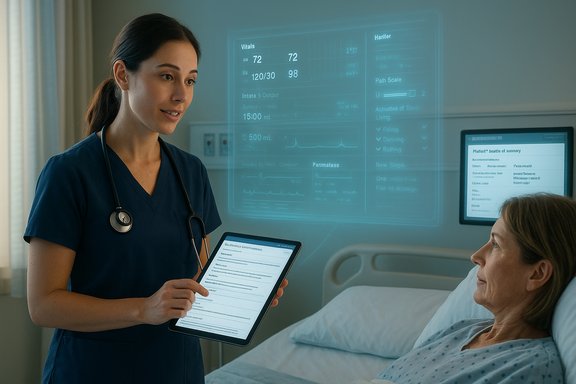
Microsoft’s Dragon Copilot for nurses arrives as an attempt to bend the arc of clinical work away from administrative overload and back toward bedside care, embedding ambient AI inside the Epic Rover mobile workflow to capture spoken observations, draft flowsheet entries and notes, and deliver actionable summaries — all while leaving final sign-off squarely in the nurse’s hands.
Background
Nursing burnout and documentation burden have become central problems for health systems worldwide, driving clinician turnover, patient-safety risks, and rising operational costs. Electronic health records (EHRs) solved many problems but created new ones: fragmented interfaces, repetitive data entry, and long after‑shift charting that pulls nurses away from patients. Microsoft’s Dragon Copilot is positioned as an ambient AI scribe designed to reduce that administrative weight by turning real-time nurse–patient interactions into structured data and draft notes that can be reviewed and accepted into the EHR — rather than adding yet another separate tool to the clinician’s toolbox. The product builds on Nuance’s proven speech‑recognition heritage — Nuance was acquired by Microsoft — and on Microsoft’s Copilot platform. Microsoft frames Dragon Copilot not as a replacement for clinical judgment but as a workflow assistant: ambiently listening through the Epic Rover mobile app, mapping spoken text to specific flowsheet rows and templates, surfacing what needs attention, and enabling nurses to review and approve content before it becomes part of the legal medical record.How Dragon Copilot works: ambient capture, flowsheet mapping, nurse review
Ambient flowsheet capture and the in‑room workflow
Dragon Copilot’s core technical promise is ambient flowsheet capture. Embedded inside Epic Rover, the system listens to nurse–patient conversations or narrated observations at the bedside, converts the audio into structured entries for common nursing flowsheets (intake/output, vitals, pain assessments, daily cares, activities of daily living, head‑to‑toe checks), and presents that content to the nurse for confirmation before it is filed in the EHR. This embedded approach is explicitly intended to reduce device switching and avoid creating a separate “AI app” that nurses must open. Microsoft’s user‑facing documentation and product pages describe a UX with a short preview step so clinicians can pause, preview captured content, edit if necessary, and only then commit entries into the patient’s record. That final review-and-accept model is central to Microsoft’s safety framing: the assistant drafts and suggests, the nurse decides.Vocabulary, templates, and ambiguous speech
A major technical challenge for any ambient scribe is mapping the messy, shorthand language of clinical speech into the rigid, coded fields of an EHR flowsheet. Microsoft says Dragon Copilot was trained and tuned for nursing vocabulary and real‑world documentation patterns; it maps ambiguous utterances to the appropriate flowsheet rows and respects each hospital’s existing templates. The platform also flags administrative issues like duplicate entries and offers organization-provided “cheat sheets” inside the workflow to help standardize documentation. These are not theoretical features — they are documented capabilities in Microsoft’s support and product materials.Drafting notes, concise summaries, and query capability
Beyond flowsheet population, Dragon Copilot provides draft nurse notes and concise interaction summaries, and it supports natural‑language queries of the interaction transcript through a web/desktop app that can be docked alongside the EHR. These capabilities aim to reduce documentation latency — the time between an event and its appearance in the chart — and to speed routine handoffs and after‑visit summaries. Microsoft and early partner health systems report measurable improvements on these metrics in pilot deployments. (See “Early adopters and outcomes” below.Administration and deployment: Dragon Admin Center and governance
Centralized admin and configuration
Dragon Copilot ships with a Dragon Admin Center that centralizes deployment, template configuration, access management, and adoption analytics. Administrators can create environments, provision instances, assign roles and licenses, and configure per‑unit or per‑user settings. This level of administrative control acknowledges that clinical documentation must be curated to local practice, regulatory requirements, and nursing workflows. Microsoft’s Learn documentation describes the admin prerequisites, licensing model, and configuration options in detail.Change management and adoption analytics
Microsoft repeatedly emphasizes that technology alone does not fix workflow problems. Early customers are pairing deployments with formal change‑management programs and training that include nurse informatics, pilot cohorts, and monitoring through adoption analytics. That approach — pairing tech with human factors work — is good practice and helps mitigate the classic failure mode of “another abandoned tool” in clinical settings. Microsoft’s press materials and its health‑system partners note that adoption support is a common component of successful rollouts.Early adopters and claimed outcomes — verified and caveated
Microsoft and partner health systems have published early deployment results and operational metrics. Mercy Health (a major early partner) provided specific operational outcomes: reductions in documentation latency, time saved per shift for higher‑use nurses, reductions in incremental overtime, increased mobile platform use, and improvements in perceived timeliness and patient satisfaction in pilot units. Microsoft’s corporate announcement and Mercy’s press materials report numbers such as a 21% reduction in documentation latency, 8–24 minutes saved per shift for high‑use nurses, and a 4.5% increase in patient satisfaction in initial pilots. At the same time, it is important to flag what is and isn’t independently verified: these outcomes are published by Microsoft and Mercy and reflect early, internal measures. They are compelling but limited to pilot settings and may reflect the local mix of unit types, training intensity, and selection of high‑usage nurse champions. Independent peer‑reviewed evaluation of clinical impact, long‑term safety, or broad labor‑market effects is not yet publicly available. Until unbiased third‑party studies appear, the exact magnitude of system‑wide benefits remains an organization‑reported outcome rather than an industry‑level fact.What Dragon Copilot promises — benefits for nursing and clinical operations
- Reduced documentation time: By turning narration into structured flowsheet entries and draft notes, Dragon Copilot aims to shift charting from after‑shift to point‑of‑care, potentially improving timeliness and reducing overtime.
- Fewer clicks and less context switching: Embedding the assistant inside Epic Rover means nurses don’t need to flip between apps to capture observations, access reference content, or generate summaries.
- Improved data quality and consistency: Mapping to flowsheet rows and hospital templates can standardize entries, reduce duplicate rows, and make data more usable for downstream analytics.
- Faster handoffs and better situational awareness: Concise summaries and interaction transcripts facilitate shift handoffs and multidisciplinary coordination.
- Administrative visibility and governance: The Dragon Admin Center provides operations teams telemetry to measure adoption and address configuration issues proactively.
Real risks, unknowns, and potential failure modes
Privacy, consent, and local wiretapping laws
Ambient listening raises immediate legal and ethical questions. Microsoft’s own guidance for Dragon Copilot best practices explicitly requires obtaining patient consent before recording and recommends verbal or written disclosure and adherence to local hospital policies. This aligns with the legal reality in the U.S.: some states are one‑party consent jurisdictions, while others (including California and Florida) require two‑party consent to record conversations. Hospitals must craft clear, auditable consent workflows that are applied consistently, especially when family members are present. Failure to do so exposes providers to legal risk and patient distrust.Accuracy, mapping errors, and clinical risk
Speech recognition is excellent but not infallible. Mis‑mapped qualifiers (for example, “no shortness of breath” being misrecognized as “shortness of breath”) or misattributed flowsheet entries could create charting errors with clinical implications. Microsoft mitigates risk by requiring nurse review before EHR filing, but human review can be cursory under staffing pressure. Hospitals must design workflows and audit processes that ensure review is meaningful and that errors are corrected proactively. Early‑stage deployments must include measurement of post‑charting error rates and safety incidents.Generative text risks and hallucinations
Dragon Copilot uses generative AI for summaries and draft notes. Generative models can produce plausible but incorrect statements — “hallucinations” — that, if accepted uncritically, could infect the medical record. Microsoft acknowledges these risks and positions the system as “not a medical device” in its press materials, emphasizing clinician oversight. Nonetheless, clinical governance must explicitly track and mitigate hallucination risks, including clarifying which outputs are narrative drafts versus data elements, and instituting checks where decisions depend on model outputs.Data governance, cloud residency, and compliance
Hospitals must confirm how voice data, intermediate transcripts, and model telemetry are stored, for how long, and whether data are used to further train models. Microsoft’s enterprise cloud offerings and Dragon admin docs include compliance controls and environment configuration, but customers must validate data residency and retention against their internal policies and regulatory obligations (HIPAA, state privacy laws, and international rules where applicable). Vendor contracts should include clear terms about secondary use of data, deletion, and model‑training boundaries.Workforce effects and skill shift
AI that reduces documentation may improve nurse satisfaction, but it may also change skillsets and team roles. Documentation tasks that once provided audit trails or nuance may be replaced by concise summaries, and some positions that historically handled documentation workflows could be repurposed. Health systems must plan for training, role redefinition, and transparent communication about what the technology does and does not do. Otherwise, the perceived promise of time savings may not translate into better patient care or retained staff.Vendor lock‑in and interoperability risks
Dragon Copilot is deeply integrated with Epic Rover and Microsoft’s cloud ecosystem. While that integration delivers convenience, it can raise long‑term vendor‑lock concerns. Health systems should demand interoperability assurances, exportable audit trails, and the ability to migrate away from a specific ambient‑scribing vendor without losing the fidelity of historical audio/transcript artifacts. Contract negotiations should explicitly address data portability and exit scenarios.Regulatory environment and safety oversight
Regulators are paying attention. The U.S. Food and Drug Administration and other agencies are increasingly active in AI oversight and internal adoption of generative tools, and public agencies have signaled both opportunity and caution around AI in regulated spaces. Microsoft clearly positions Dragon Copilot as not a medical device, but that label does not remove the requirement for institutions to implement safety governance, incident reporting, and ongoing validation. Organizations should anticipate tightening regulatory expectations for AI performance monitoring, explainability, and post‑market surveillance-like activities in healthcare settings.Implementation playbook: how health systems should approach Dragon Copilot
- Governance first: Establish a multidisciplinary steering committee that includes nursing leadership, informatics, legal/compliance, privacy, and risk management. Define success metrics up front.
- Pilot deliberately: Start in units with engaged nurse informatics partners, measure time saved, documentation accuracy, and patient experience, and iterate on templates and voice prompts.
- Consent and signage: Implement clear, auditable consent procedures that comply with state wiretapping laws and hospital policy. Train staff to obtain consent and document that they did so.
- Audit and quality control: Routinely sample encounters to measure mapping accuracy, documentation errors, and any adverse events traceable to AI outputs.
- Human-in-the-loop requirements: Enforce meaningful nurse review before EHR commit — including workflow design that prevents cursory “approve” behavior when staff are overloaded.
- Data contracts and portability: Negotiate vendor terms that guarantee data residency, prohibit unwanted secondary use for model training, and allow export of raw transcripts and structured outputs.
- Ongoing training and change management: Pair technical rollout with behavior change programs, pocket guides, and clinician champions to accelerate adoption and reduce frustration.
- Transparency with patients: Provide clear information to patients about ambient capture, how data are used, and options to opt out. This preserves trust and reduces legal exposure.
Practical scenarios: where Dragon Copilot will likely help — and where it won’t
Likely wins
- Routine inpatient documentation (vitals, ADLs, intake/output) where structured flowsheets match narrated observations.
- Mobile rounding and admissions where nurses prefer a mobile-first capture method instead of returning to a workstation.
- Handoffs and shift summaries where concise interaction summaries shorten communication friction.
Likely limitations
- Complex clinical reasoning and care-plan decisions that require nuanced judgment and precise clinical language.
- Environments with poor acoustics, multiple simultaneous conversations, or heavy ambient noise where speech‑recognition accuracy declines.
- Situations involving sensitive conversations where patients decline recording; protocols must default to manual charting in these cases.
The bottom line: cautious optimism, rigorous governance
Dragon Copilot represents a meaningful technical step: ambient, flowsheet‑aware documentation embedded inside an EHR mobile app and configured for nursing vocabulary. For hospitals wrestling with nursing burnout and charting overload, the product can help reclaim minutes at the bedside and reduce charting latency — but the scale of benefit depends entirely on how deployments are governed, audited, and supported by change management. Microsoft and early partners report encouraging pilot metrics, but those figures should be treated as promising early evidence rather than definitive proof of broad, system‑wide impact. The most responsible path forward is not to automate first and ask questions later. It is to pilot deliberately, codify human‑in‑the‑loop safeguards, publicize measurable outcomes, and subject the technology to continuous validation under real clinical conditions. When those conditions are met, ambient AI like Dragon Copilot can help tilt the balance back toward patient care — but without the right governance, it risks adding new clinical, legal, and ethical burdens that could offset its intended gains.Closing thoughts and immediate recommendations for CIOs and nurse leaders
- Treat Dragon Copilot as an enterprise change program, not a purely technical upgrade. Allocate project resources for training, clinical audits, and legal review.
- Insist on concrete SLAs for data residency, retention, and model‑use restrictions in vendor contracts.
- Build measurement into the rollout: document time‑saved metrics, chart error rates, patient satisfaction, and nurse burnout indices pre‑ and post‑deployment.
- Prioritize transparency with patients and staff. Consent is not just a legal checkbox; it is a trust‑building practice that preserves the clinician‑patient relationship.
Source: Windows Report Dragon Copilot is Microsoft’s Latest Bet to Fix Nursing Burnout
