

Capcom announced Dragon’s Dogma 2: Dark Arisen for October 9, 2026, alongside a two-step update plan that began June 10 with major travel and quality-of-life changes and continues in late August with promised performance, save-system, UI, Pawn, enemy, and Dragonsplague adjustments. The pitch is not merely “more Dragon’s Dogma.” It is Capcom admitting, without quite saying so, that Dragon’s Dogma 2’s most interesting ideas were trapped inside a game that often made players wrestle the interface, the frame rate, and the map before they could wrestle a griffin. The expansion may sell the comeback, but the free patches are the real test.
Dragon’s Dogma 2 did not fail because it lacked personality. It failed some players because it had too much personality in the wrong places, insisting that inconvenience was immersion even when the practical result was repetition, dead time, and a creeping suspicion that the game valued its design philosophy more than the player’s evening.
That is why the Dark Arisen announcement lands differently from a routine DLC reveal. Capcom is not simply adding a new region, new dungeons, new cosmetics, and a fresh round of monsters to a successful RPG. It is trying to reopen the argument about what Dragon’s Dogma 2 was supposed to be.
The name is doing a lot of work. Dark Arisen is not just a subtitle for Dragon’s Dogma fans; it is a promise that the sequel may receive the same kind of post-launch correction and expansion that helped define the first game’s legacy. That comparison creates anticipation, but it also creates danger. If the original Dark Arisen became the version people recommended, the sequel’s Dark Arisen now carries the burden of proving Dragon’s Dogma 2 was not merely ambitious, but unfinished in a way Capcom is finally prepared to address.
The October 9 release date gives Capcom a tidy runway. June brings the “we listened” update. August is slated to bring the “we fixed the expensive stuff” update. October brings the paid expansion and a Switch 2 version, turning a battered launch conversation into a relaunch campaign.
The base game treated travel as a system of risk, friction, and scarcity. Ferrystones were consumable. Portcrystals were limited. Oxcarts were useful but unreliable, and the road itself was meant to be an engine for surprise. The idea was coherent: the world should feel large because crossing it should matter.
The problem was that mattering and dragging are not the same thing. A long trek that ends in a cyclops ambush can feel like emergent adventure the first few times. A long trek to clean up a minor objective, chase a riddle, or recover from an inconvenient save can feel like the game is billing you in minutes for daring to play on a schedule.
The Eternal Ferrystone does not erase Dragon’s Dogma 2’s world. It removes the feeling that the world is holding the player hostage. That distinction matters, because the game’s best moments were rarely about walking in a straight line for ten minutes; they were about what happened when a monster, a Pawn, a cliff edge, and a bad decision collided.
Capcom also added Portcrystals to Melve, Checkpoint Rest Town, and Volcanic Island Camp, and made a Portcrystal a reward for “Monster Culling.” That is a more important change than it first appears. Fast travel only becomes a genuine tool when the network has enough useful nodes, and Dragon’s Dogma 2’s original map often felt like it rationed not just convenience, but respect for the player’s time.
Those changes are small individually, but together they show Capcom moving away from purity and toward playability. Dragon’s Dogma 2 can still ask players to travel, camp, improvise, and get ambushed. It just no longer needs to make every errand feel like a referendum on whether you truly understand the series.
The stamina adjustment is part of the same concession. Reduced stamina use while dashing outside combat sounds like a line item from any ordinary patch note, but in this game it cuts directly into the rhythm of play. If you are not fighting, climbing, or fleeing, forcing the player to manage a sprint meter across long distances becomes less survival design than petty interruption.
There is an old tension in role-playing games between friction that produces stories and friction that produces tab-outs. Dragon’s Dogma 2 launched with too much of the second kind. Update 3.1 suggests Capcom now understands that travel can be memorable without being punitive.
Performance was never a side complaint. It shaped the entire experience, especially on consoles where the game’s frame rate could sag when cities, NPCs, monsters, and effects collided. Dragon’s Dogma 2’s combat depends on physicality: the weight of a swing, the timing of a counter, the panic of clinging to a monster as it takes flight. When the frame rate buckles, that physicality becomes sludge.
Capcom’s promise of performance refinements across platforms is therefore more than technical maintenance. It is an attempt to restore the game’s central claim: that its chaos is authored by systems rather than by the engine struggling to keep up. A griffin crash-landing in the middle of a fight is thrilling. A fight becoming unreadable because the simulation is gasping is not.
The timing is also telling. Capcom did not push performance as the first update’s centerpiece. It used June to fix many obvious quality-of-life irritants, while reserving the harder work for August. That may be sensible production scheduling, but it also means players have reason to wait. Anyone burned by the original release will want evidence, not promises, before reinstalling.
That puts the August patch in a strange position. It is free, but it may be more commercially important than the paid expansion. If it lands well, October looks like a revival. If it lands poorly, Dark Arisen risks becoming new content for a game many players still do not trust.
Both readings miss the more interesting truth. Dragon’s Dogma 2 was full of sharp, memorable systems that frequently rubbed against undercooked infrastructure. Pawns could be funny, useful, maddening, and strangely alive. Monsters could turn a routine trip into a slapstick disaster. Quests often trusted players to observe and experiment in ways many big-budget RPGs no longer do.
But the game also shipped with irritations that did not deepen those systems. Limited fast travel did not always make journeys meaningful. A single-save structure did not always make decisions weightier. Performance problems did not make the world more dangerous. Dragonsplague, the infamous Pawn-affliction mechanic, often read less like a clever systemic risk than a punishment waiting to blindside players who had not been trained to read its tells.
That is why the roadmap matters. Capcom appears to be separating the game’s productive friction from its accidental friction. The former is Dragon’s Dogma. The latter is just churn.
That matters because Pawns are the series’ most distinctive feature. They are companions, tutorial system, online social layer, combat assistants, and comic relief all at once. When they work, they create the illusion of shared adventure without requiring co-op. When they fail, they shout useless advice while stepping off cliffs.
Capcom’s patch notes include adjustments meant to make Pawns less prone to falling, more responsive, better at guiding the Arisen, and more accurate in how they mark discoveries. These are not glamorous fixes, but they address the background noise that can turn a lovable system into a nuisance. A Pawn who says something silly is charming. A Pawn who misleads you toward a fully explored cave is wasting your time.
The option to disable unhired Pawns approaching the player is another telling change. Dragon’s Dogma 2 loved having its world talk at you. Sometimes that made the roads feel populated. Sometimes it made the game feel like a fantasy convention hallway where every stranger wanted to hand you a résumé. Giving players a toggle is not a betrayal of immersion; it is an admission that immersion breaks when the simulation becomes nagging.
None of that sounds like a relaunch campaign. All of it matters.
Dragon’s Dogma 2’s interface often felt like it had inherited the game’s suspicion of convenience. Inventory management was more laborious than tactical. Map reading was more fiddly than mysterious. Important information existed, but not always where players needed it, when they needed it, or in a form that respected the cumulative fatigue of a long session.
The best UI is not the one that makes the game easy. It is the one that lets players spend their attention on the intended difficulty. In Dragon’s Dogma 2, the intended difficulty should be monsters, terrain, choices, and preparation. It should not be whether moving items between companions feels like sorting a cabinet through a mail slot.
The patch’s shopping changes point in the same direction. Preventing players from purchasing more of an item than they can hold is not revolutionary. It is just the kind of guardrail a game this large should have had before launch.
This is Capcom revisiting the cost of experimentation. In a game where appearance editing, rest management, and fast travel intersect with survival, questing, and player identity, pricing is not just flavor. It determines how freely players engage with the systems.
Dragon’s Dogma 2 often seemed to confuse expense with consequence. Consequence is interesting when it asks the player to choose between priorities. Expense becomes tedious when it discourages basic interaction with mechanics the game clearly wants you to use.
Lowering fees will not turn the game into a power fantasy. It will make failure and curiosity less punishing at the margins. That is the space where many players decide whether to keep going or drift away.
That is exactly what Dragon’s Dogma 2 needs. The base game’s world was huge, but size alone was not the issue. Players wanted denser reasons to return, harder encounters to master, and content that leaned into the game’s strongest combat systems rather than stretching its travel loop.
The Dark Arisen branding invites comparison to Bitterblack Isle, the original game’s brutal, beloved expansion zone. That comparison is commercially useful because it signals seriousness. It also raises the bar. If the new expansion is merely “more map,” it will disappoint the very audience most excited by the subtitle.
Capcom appears to understand that Dungeon Challenges are central to the pitch. Dragon’s Dogma works best when its systems are forced into tight, dangerous arrangements: limited supplies, surprising enemy combinations, vertical spaces, and the constant possibility that a plan will unravel. The sequel’s open world could be magnificent, but a focused dungeon gauntlet may be the cleaner way to show off its combat.
The Switch 2 version will attract scrutiny for obvious reasons. Dragon’s Dogma 2 was already a demanding game on PS5, Xbox Series X|S, and PC. A new Nintendo platform gives Capcom access to a large audience, but it also forces the company to prove that its optimization work is more than a late apology to existing owners.
If the Switch 2 version runs well, it strengthens the case that the underlying technology has matured since launch. If it struggles, it risks reopening every old complaint at precisely the moment Capcom wants the conversation to move forward. For a game whose reputation was shaped so heavily by performance, a new platform is not just another SKU. It is a public stress test.
There is also a Windows angle here that matters for our audience. PC players have been especially sensitive to performance volatility in recent big-budget games, and Capcom’s recent record has made optimization a live concern rather than a footnote. Dragon’s Dogma 2’s August update will be judged not only by average frame rates, but by frame pacing, CPU behavior in cities, shader behavior, and whether busy combat finally feels as responsive as the combat design deserves.
Players who bounced off the game in 2024 have spent two years filling that space with other releases. Some finished massive RPGs. Some moved to live-service games. Some learned to distrust promises that a troubled launch would eventually be redeemed. Capcom is not asking those players to buy DLC first. It is asking them to reinstall and reconsider.
That is a high bar. A player who quit because travel was tedious may be persuaded by the Eternal Ferrystone. A player who quit because the frame rate damaged combat will wait for August. A player who quit because the quest structure felt opaque or the save system felt hostile may need more than either patch.
This is where the roadmap’s sequencing helps. June offers a reason to test the waters. August offers a reason to reassess performance and systems. October offers a reason to commit. Instead of dropping paid DLC into a cold player base, Capcom is trying to warm the room.
A restrictive save system can support role-playing when the world is legible and outcomes feel earned. It can also magnify bugs, unclear quest logic, performance hiccups, and accidental decisions into long-term frustration. In a systems-heavy RPG, the fewer escape hatches the player has, the more confidence the game must earn.
The June update already adjusts one defeat-related pain point: selecting “Load from Autosave” after defeat no longer causes loss gauge accumulation. That is a good sign because it targets a specific frustration without necessarily dismantling the game’s identity. The question is whether August goes further in a way that broadens the audience without sanding off the game’s edge.
Dragon’s Dogma should not become a save-scummer’s playground. But neither should it treat every misread mechanic or performance-induced mistake as sacred consequence. The right answer is not unlimited undo. It is a save structure that respects the difference between living with choices and being trapped by jank.
Capcom’s roadmap indicates that Dragonsplague adjustments are coming in August. The best version of that change would not simply declaw the mechanic. It would make the danger more readable, more interactable, and more meaningfully tied to player behavior.
Opaque catastrophe is rarely satisfying. A player should be able to miss a warning, make a bad call, and suffer a consequence. But the warning needs to feel like part of the game’s language, not a postmortem explanation discovered online. Dragon’s Dogma 2’s most compelling systems are those you can observe, test, and learn. Dragonsplague should be one of them.
The June update’s decision to reflect Dragonsplague stat boosts on the status screen is a small step toward transparency. It suggests Capcom is willing to expose more of the machinery. That is the right instinct.
A troubled launch no longer ends the story, especially for a single-player game with a strong core and an addressable list of complaints. Publishers have learned that patches can become marketing beats, and expansions can become relaunches. The danger is that this business model can normalize shipping rough and polishing later.
Dragon’s Dogma 2 sits uncomfortably in that tension. On one hand, it is good that Capcom is investing in the game rather than leaving it as a beautiful, frustrating artifact. On the other hand, many of these changes address problems players identified immediately. A reusable Ferrystone, clearer UI, better performance, more forgiving travel, and improved Pawn behavior did not require two years of hindsight to imagine.
Still, the work matters. Players rarely benefit when a publisher decides that an imperfect game is no longer worth touching. If Capcom can turn Dragon’s Dogma 2 into a stronger game in 2026, that outcome is better than preserving the purity of a flawed launch.
That means the late-August patch should be treated as the real pre-order moment. If Capcom demonstrates better frame pacing, improved CPU performance in dense areas, and more stable combat under load, Dark Arisen becomes a much easier recommendation. If the patch notes are vague and the results are uneven, the October expansion will arrive carrying too much old baggage.
Windows players should also watch how Capcom handles graphics settings and scalability. The most useful PC patches do not merely raise performance on high-end machines; they make the game more predictable across a range of CPUs and GPUs. Dragon’s Dogma 2’s simulation-heavy design makes that harder, but that is precisely why clear improvement would matter.
The best outcome is not that every machine suddenly runs the game perfectly. It is that players can tune the game with confidence and trust that the biggest bottlenecks have been addressed. For a game built around chaos, technical predictability is not boring. It is the foundation that lets the chaos sing.
Dragon’s Dogma 2: Dark Arisen now looks less like a victory lap than a repair job with ambition. That is not an insult. Some of the best games in the modern PC and console era became themselves only after developers returned to the scene with tools, money, and a willingness to offend the purists. If Capcom can make travel less punitive, performance less fragile, Pawns less erratic, and dungeons more demanding, October may not just add a new region to Dragon’s Dogma 2. It may finally give the game enough trust to let its weirdness breathe.
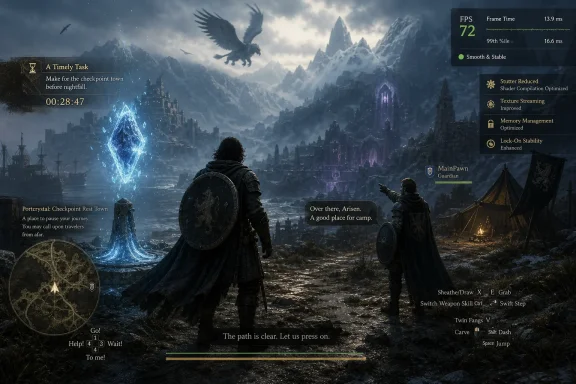 Capcom Is Selling a Second First Impression
Dragon’s Dogma 2 did not fail because it lacked personality. It failed some players because it had too much personality in the wrong places, insisting that inconvenience was immersion even when the practical result was repetition, dead time, and a creeping suspicion that the game valued its design philosophy more than the player’s evening.That is why the Dark Arisen announcement lands differently from a routine DLC reveal. Capcom is not simply adding a new region, new dungeons, new cosmetics, and a fresh round of monsters to a successful RPG. It is trying to reopen the argument about what Dragon’s Dogma 2 was supposed to be.
The name is doing a lot of work. Dark Arisen is not just a subtitle for Dragon’s Dogma fans; it is a promise that the sequel may receive the same kind of post-launch correction and expansion that helped define the first game’s legacy. That comparison creates anticipation, but it also creates danger. If the original Dark Arisen became the version people recommended, the sequel’s Dark Arisen now carries the burden of proving Dragon’s Dogma 2 was not merely ambitious, but unfinished in a way Capcom is finally prepared to address.
The October 9 release date gives Capcom a tidy runway. June brings the “we listened” update. August is slated to bring the “we fixed the expensive stuff” update. October brings the paid expansion and a Switch 2 version, turning a battered launch conversation into a relaunch campaign.
The Eternal Ferrystone Is an Apology Disguised as an Item
The headline change in update 3.1 is the Eternal Ferrystone, a reusable fast-travel item automatically acquired after talking to Brant during “Seat of the Sovran,” or added to the inventory for players who have already passed that point. In a normal open-world RPG, that might sound like a convenience tweak. In Dragon’s Dogma 2, it is a philosophical retreat.The base game treated travel as a system of risk, friction, and scarcity. Ferrystones were consumable. Portcrystals were limited. Oxcarts were useful but unreliable, and the road itself was meant to be an engine for surprise. The idea was coherent: the world should feel large because crossing it should matter.
The problem was that mattering and dragging are not the same thing. A long trek that ends in a cyclops ambush can feel like emergent adventure the first few times. A long trek to clean up a minor objective, chase a riddle, or recover from an inconvenient save can feel like the game is billing you in minutes for daring to play on a schedule.
The Eternal Ferrystone does not erase Dragon’s Dogma 2’s world. It removes the feeling that the world is holding the player hostage. That distinction matters, because the game’s best moments were rarely about walking in a straight line for ten minutes; they were about what happened when a monster, a Pawn, a cliff edge, and a bad decision collided.
Capcom also added Portcrystals to Melve, Checkpoint Rest Town, and Volcanic Island Camp, and made a Portcrystal a reward for “Monster Culling.” That is a more important change than it first appears. Fast travel only becomes a genuine tool when the network has enough useful nodes, and Dragon’s Dogma 2’s original map often felt like it rationed not just convenience, but respect for the player’s time.
The Road Is Still There, but It Finally Has Exits
The update does not turn Dragon’s Dogma 2 into Skyrim with dragons and better climbing. Oxcarts still exist, and Capcom has improved them rather than abandoning them. The doze-off command appears sooner, oxcart icons can now appear on the minimap when one is nearby, and station departure hours have been extended from morning through evening.Those changes are small individually, but together they show Capcom moving away from purity and toward playability. Dragon’s Dogma 2 can still ask players to travel, camp, improvise, and get ambushed. It just no longer needs to make every errand feel like a referendum on whether you truly understand the series.
The stamina adjustment is part of the same concession. Reduced stamina use while dashing outside combat sounds like a line item from any ordinary patch note, but in this game it cuts directly into the rhythm of play. If you are not fighting, climbing, or fleeing, forcing the player to manage a sprint meter across long distances becomes less survival design than petty interruption.
There is an old tension in role-playing games between friction that produces stories and friction that produces tab-outs. Dragon’s Dogma 2 launched with too much of the second kind. Update 3.1 suggests Capcom now understands that travel can be memorable without being punitive.
The August Patch Is the One That Actually Decides the Comeback
The June update makes Dragon’s Dogma 2 easier to recommend. The late-August update, if it delivers, may make it easier to forgive.Performance was never a side complaint. It shaped the entire experience, especially on consoles where the game’s frame rate could sag when cities, NPCs, monsters, and effects collided. Dragon’s Dogma 2’s combat depends on physicality: the weight of a swing, the timing of a counter, the panic of clinging to a monster as it takes flight. When the frame rate buckles, that physicality becomes sludge.
Capcom’s promise of performance refinements across platforms is therefore more than technical maintenance. It is an attempt to restore the game’s central claim: that its chaos is authored by systems rather than by the engine struggling to keep up. A griffin crash-landing in the middle of a fight is thrilling. A fight becoming unreadable because the simulation is gasping is not.
The timing is also telling. Capcom did not push performance as the first update’s centerpiece. It used June to fix many obvious quality-of-life irritants, while reserving the harder work for August. That may be sensible production scheduling, but it also means players have reason to wait. Anyone burned by the original release will want evidence, not promises, before reinstalling.
That puts the August patch in a strange position. It is free, but it may be more commercially important than the paid expansion. If it lands well, October looks like a revival. If it lands poorly, Dark Arisen risks becoming new content for a game many players still do not trust.
Dragon’s Dogma 2 Was Always Better Than Its Reputation and Worse Than Its Defenders Claimed
The loudest arguments around Dragon’s Dogma 2 often flattened the game into caricature. To its defenders, complaints about fast travel and difficulty were evidence that modern players had been softened by convenience. To its critics, the game’s rough edges proved that its design was archaic or careless.Both readings miss the more interesting truth. Dragon’s Dogma 2 was full of sharp, memorable systems that frequently rubbed against undercooked infrastructure. Pawns could be funny, useful, maddening, and strangely alive. Monsters could turn a routine trip into a slapstick disaster. Quests often trusted players to observe and experiment in ways many big-budget RPGs no longer do.
But the game also shipped with irritations that did not deepen those systems. Limited fast travel did not always make journeys meaningful. A single-save structure did not always make decisions weightier. Performance problems did not make the world more dangerous. Dragonsplague, the infamous Pawn-affliction mechanic, often read less like a clever systemic risk than a punishment waiting to blindside players who had not been trained to read its tells.
That is why the roadmap matters. Capcom appears to be separating the game’s productive friction from its accidental friction. The former is Dragon’s Dogma. The latter is just churn.
Pawns Are the Soul of the Game, and Capcom Knows It
Update 3.1 spends a striking amount of attention on Pawns. The new Guardian specialization lets a Pawn prevent oxcart raids while accompanying the Arisen, repel smaller foes at camp, and weaken larger attackers before the player joins the fight. It is a practical addition, but it is also thematically smart: Pawns become not just combat followers, but logistical partners.That matters because Pawns are the series’ most distinctive feature. They are companions, tutorial system, online social layer, combat assistants, and comic relief all at once. When they work, they create the illusion of shared adventure without requiring co-op. When they fail, they shout useless advice while stepping off cliffs.
Capcom’s patch notes include adjustments meant to make Pawns less prone to falling, more responsive, better at guiding the Arisen, and more accurate in how they mark discoveries. These are not glamorous fixes, but they address the background noise that can turn a lovable system into a nuisance. A Pawn who says something silly is charming. A Pawn who misleads you toward a fully explored cave is wasting your time.
The option to disable unhired Pawns approaching the player is another telling change. Dragon’s Dogma 2 loved having its world talk at you. Sometimes that made the roads feel populated. Sometimes it made the game feel like a fantasy convention hallway where every stranger wanted to hand you a résumé. Giving players a toggle is not a betrayal of immersion; it is an admission that immersion breaks when the simulation becomes nagging.
The UI Changes Are Small Because the Irritation Was Constant
Capcom’s update includes a long list of interface and menu improvements that look mundane in isolation. Players can now use a Ferrystone from the map by moving the cursor to a Portcrystal. The player icon on the map is easier to see. Timed quests now display an hourglass icon. Priority quest progress appears after loading saved data. Multiple item types can be transferred at once between the Arisen and Pawns.None of that sounds like a relaunch campaign. All of it matters.
Dragon’s Dogma 2’s interface often felt like it had inherited the game’s suspicion of convenience. Inventory management was more laborious than tactical. Map reading was more fiddly than mysterious. Important information existed, but not always where players needed it, when they needed it, or in a form that respected the cumulative fatigue of a long session.
The best UI is not the one that makes the game easy. It is the one that lets players spend their attention on the intended difficulty. In Dragon’s Dogma 2, the intended difficulty should be monsters, terrain, choices, and preparation. It should not be whether moving items between companions feels like sorting a cabinet through a mail slot.
The patch’s shopping changes point in the same direction. Preventing players from purchasing more of an item than they can hold is not revolutionary. It is just the kind of guardrail a game this large should have had before launch.
Capcom Is Quietly Repricing the Game’s Patience Tax
The economic changes in update 3.1 are easy to overlook, but they speak to the same broader recalibration. Inn fees have been reduced in several locations, barberie services cost less, Ferrystones are cheaper in Normal Mode, and the sale price of Ferrystones has been raised.This is Capcom revisiting the cost of experimentation. In a game where appearance editing, rest management, and fast travel intersect with survival, questing, and player identity, pricing is not just flavor. It determines how freely players engage with the systems.
Dragon’s Dogma 2 often seemed to confuse expense with consequence. Consequence is interesting when it asks the player to choose between priorities. Expense becomes tedious when it discourages basic interaction with mechanics the game clearly wants you to use.
Lowering fees will not turn the game into a power fantasy. It will make failure and curiosity less punishing at the margins. That is the space where many players decide whether to keep going or drift away.
Dark Arisen Arrives With a Name That Cuts Both Ways
The expansion itself is the commercial centerpiece. Capcom is promising a new region, new story content, new armor and weapons, new skills, new enemies, more character customization options, and a set of Dungeon Challenges. Reports and announcement coverage point to a snowy region called Norgan, with new threats designed to broaden the sequel’s monster roster and late-game possibilities.That is exactly what Dragon’s Dogma 2 needs. The base game’s world was huge, but size alone was not the issue. Players wanted denser reasons to return, harder encounters to master, and content that leaned into the game’s strongest combat systems rather than stretching its travel loop.
The Dark Arisen branding invites comparison to Bitterblack Isle, the original game’s brutal, beloved expansion zone. That comparison is commercially useful because it signals seriousness. It also raises the bar. If the new expansion is merely “more map,” it will disappoint the very audience most excited by the subtitle.
Capcom appears to understand that Dungeon Challenges are central to the pitch. Dragon’s Dogma works best when its systems are forced into tight, dangerous arrangements: limited supplies, surprising enemy combinations, vertical spaces, and the constant possibility that a plan will unravel. The sequel’s open world could be magnificent, but a focused dungeon gauntlet may be the cleaner way to show off its combat.
The Switch 2 Launch Makes This More Than a DLC Story
Dark Arisen is also bringing Dragon’s Dogma 2 to Nintendo Switch 2 on the same day the expansion arrives on existing platforms. That matters because it turns October 9 into a platform expansion, a content expansion, and a reputation reset all at once.The Switch 2 version will attract scrutiny for obvious reasons. Dragon’s Dogma 2 was already a demanding game on PS5, Xbox Series X|S, and PC. A new Nintendo platform gives Capcom access to a large audience, but it also forces the company to prove that its optimization work is more than a late apology to existing owners.
If the Switch 2 version runs well, it strengthens the case that the underlying technology has matured since launch. If it struggles, it risks reopening every old complaint at precisely the moment Capcom wants the conversation to move forward. For a game whose reputation was shaped so heavily by performance, a new platform is not just another SKU. It is a public stress test.
There is also a Windows angle here that matters for our audience. PC players have been especially sensitive to performance volatility in recent big-budget games, and Capcom’s recent record has made optimization a live concern rather than a footnote. Dragon’s Dogma 2’s August update will be judged not only by average frame rates, but by frame pacing, CPU behavior in cities, shader behavior, and whether busy combat finally feels as responsive as the combat design deserves.
The Real Competition Is the Player’s Backlog
The Windows Central piece that sparked this discussion frames the question personally: can these patches and the expansion pull a lapsed player back in? That is the right framing because Dragon’s Dogma 2’s enemy in 2026 is not just another RPG. It is time.Players who bounced off the game in 2024 have spent two years filling that space with other releases. Some finished massive RPGs. Some moved to live-service games. Some learned to distrust promises that a troubled launch would eventually be redeemed. Capcom is not asking those players to buy DLC first. It is asking them to reinstall and reconsider.
That is a high bar. A player who quit because travel was tedious may be persuaded by the Eternal Ferrystone. A player who quit because the frame rate damaged combat will wait for August. A player who quit because the quest structure felt opaque or the save system felt hostile may need more than either patch.
This is where the roadmap’s sequencing helps. June offers a reason to test the waters. August offers a reason to reassess performance and systems. October offers a reason to commit. Instead of dropping paid DLC into a cold player base, Capcom is trying to warm the room.
The Save System Remains the Philosophical Fault Line
Capcom’s planned August improvements to the save system may become one of the most important parts of the relaunch. Dragon’s Dogma 2’s save structure was controversial not because players hate consequences, but because the game sometimes blurred the line between consequence and entrapment.A restrictive save system can support role-playing when the world is legible and outcomes feel earned. It can also magnify bugs, unclear quest logic, performance hiccups, and accidental decisions into long-term frustration. In a systems-heavy RPG, the fewer escape hatches the player has, the more confidence the game must earn.
The June update already adjusts one defeat-related pain point: selecting “Load from Autosave” after defeat no longer causes loss gauge accumulation. That is a good sign because it targets a specific frustration without necessarily dismantling the game’s identity. The question is whether August goes further in a way that broadens the audience without sanding off the game’s edge.
Dragon’s Dogma should not become a save-scummer’s playground. But neither should it treat every misread mechanic or performance-induced mistake as sacred consequence. The right answer is not unlimited undo. It is a save structure that respects the difference between living with choices and being trapped by jank.
Dragonsplague Needs Clarity More Than Mercy
Dragonsplague became infamous because it converted the Pawn system’s charming unpredictability into dread. The concept was strong: your companions are not merely tools, and the wider Pawn network can carry risks. The execution, for many players, felt too opaque and too punitive.Capcom’s roadmap indicates that Dragonsplague adjustments are coming in August. The best version of that change would not simply declaw the mechanic. It would make the danger more readable, more interactable, and more meaningfully tied to player behavior.
Opaque catastrophe is rarely satisfying. A player should be able to miss a warning, make a bad call, and suffer a consequence. But the warning needs to feel like part of the game’s language, not a postmortem explanation discovered online. Dragon’s Dogma 2’s most compelling systems are those you can observe, test, and learn. Dragonsplague should be one of them.
The June update’s decision to reflect Dragonsplague stat boosts on the status screen is a small step toward transparency. It suggests Capcom is willing to expose more of the machinery. That is the right instinct.
Capcom’s Broader 2026 Strategy Is Reputation Repair at Scale
The timing of this roadmap also fits a larger Capcom pattern. The company used its summer showcase window to put major franchises back in front of players, including Resident Evil and Monster Hunter, while returning to Dragon’s Dogma 2 with both paid content and long-requested fixes. That is a confident slate, but it also reveals how much modern game publishing depends on the second act.A troubled launch no longer ends the story, especially for a single-player game with a strong core and an addressable list of complaints. Publishers have learned that patches can become marketing beats, and expansions can become relaunches. The danger is that this business model can normalize shipping rough and polishing later.
Dragon’s Dogma 2 sits uncomfortably in that tension. On one hand, it is good that Capcom is investing in the game rather than leaving it as a beautiful, frustrating artifact. On the other hand, many of these changes address problems players identified immediately. A reusable Ferrystone, clearer UI, better performance, more forgiving travel, and improved Pawn behavior did not require two years of hindsight to imagine.
Still, the work matters. Players rarely benefit when a publisher decides that an imperfect game is no longer worth touching. If Capcom can turn Dragon’s Dogma 2 into a stronger game in 2026, that outcome is better than preserving the purity of a flawed launch.
The Windows Crowd Should Watch the August Patch Before Opening Their Wallets
For PC players, the sensible move is not cynicism. It is patience. Update 3.1 makes Dragon’s Dogma 2 more humane, but it does not answer the performance question that defined much of the original technical criticism.That means the late-August patch should be treated as the real pre-order moment. If Capcom demonstrates better frame pacing, improved CPU performance in dense areas, and more stable combat under load, Dark Arisen becomes a much easier recommendation. If the patch notes are vague and the results are uneven, the October expansion will arrive carrying too much old baggage.
Windows players should also watch how Capcom handles graphics settings and scalability. The most useful PC patches do not merely raise performance on high-end machines; they make the game more predictable across a range of CPUs and GPUs. Dragon’s Dogma 2’s simulation-heavy design makes that harder, but that is precisely why clear improvement would matter.
The best outcome is not that every machine suddenly runs the game perfectly. It is that players can tune the game with confidence and trust that the biggest bottlenecks have been addressed. For a game built around chaos, technical predictability is not boring. It is the foundation that lets the chaos sing.
Capcom Has Given Lapsed Arisen a Calendar, Not Yet a Verdict
The shape of the next few months is now clear enough for players to make practical decisions.- Players who quit mainly because travel felt tedious have the strongest reason to return now, because the Eternal Ferrystone and new Portcrystal placement directly attack that pain point.
- Players who quit because of frame-rate drops or stutter should wait for the late-August update before judging whether the game has truly changed.
- Players who disliked Pawn interruptions, camp annoyances, and inventory friction will find update 3.1 meaningfully cleaner, though not transformed into a different RPG.
- Players interested in Dark Arisen should treat the subtitle as a promise, but not as proof that the expansion will match the original game’s post-launch legacy.
- PC players should look for real-world testing after the August patch, because Capcom’s roadmap is encouraging but performance claims are only as good as measured results.
Dragon’s Dogma 2: Dark Arisen now looks less like a victory lap than a repair job with ambition. That is not an insult. Some of the best games in the modern PC and console era became themselves only after developers returned to the scene with tools, money, and a willingness to offend the purists. If Capcom can make travel less punitive, performance less fragile, Pawns less erratic, and dungeons more demanding, October may not just add a new region to Dragon’s Dogma 2. It may finally give the game enough trust to let its weirdness breathe.
References
- Primary source: Windows Central
Published: 2026-06-14T11:22:07.551259
Loading…
www.windowscentral.com - Related coverage: techradar.com
Loading…
www.techradar.com - Related coverage: gamesradar.com
Loading…
www.gamesradar.com - Related coverage: gematsu.com
Loading…
www.gematsu.com - Related coverage: gameinformer.com
Loading…
gameinformer.com - Related coverage: psu.com
Loading…
www.psu.com