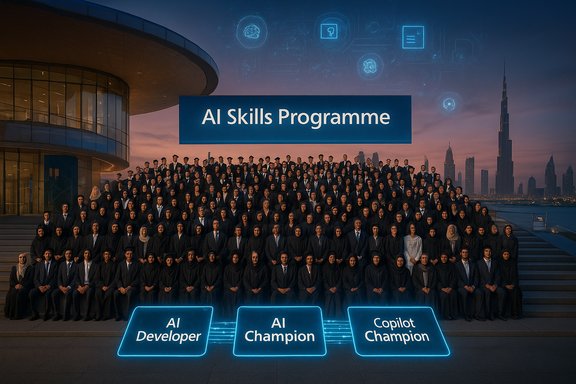
Digital Dubai marked a milestone in its AI skilling push this week with a reported graduation ceremony for participants in the year‑long AI Skills Programme developed in collaboration with Microsoft — a programme that, by design, aims to embed practical AI capabilities across Dubai’s public sector and partner organisations and to accelerate adoption of tools such as Microsoft 365 Copilot across government workflows. According to the dispatch circulating about the event, the cohort included 120 government and private‑sector employees drawn from 36 entities, and the curriculum delivered three specialised tracks — AI Developer, AI Champion, and Copilot Champion — combining technical training with hands‑on implementation projects. The report also quotes Digital Dubai leadership acknowledging the initiative as a core element of Dubai’s AI strategy and human‑capability building agenda. This article summarises the facts that can be independently verified, flags items that remain uncorroborated, and provides a critical analysis of the programme’s potential benefits and risks for government AI adoption and workforce readiness.
Digital Dubai announced a formal partnership with Microsoft earlier in 2025 to design and deliver an AI skilling programme for government employees that spans technical and adoption competencies. The public materials describing the partnership confirm several important points: the programme was conceived as a year‑long initiative with multiple learning tracks to reach technical and non‑technical employees, and it is explicitly aligned with Dubai’s broader AI and digital economy ambitions. These foundational details are stated in Digital Dubai’s programme launch communications. Microsoft, meanwhile, has been publicly investing in large‑scale AI skilling efforts globally and in the UAE region — including a stated commitment to scale AI learning and support local capacity building — positioning itself as both content and platform partner for government upskilling programmes. Microsoft’s regional statements and event coverage from 2025 show the company foregrounding AI literacy, certifications and applied workshops as central pillars of its public‑sector training offers. Separately, Microsoft and its partners have been moving to make Copilot‑style generative AI more usable in regulated environments in the UAE, including announcements about in‑country data processing for Microsoft 365 Copilot — an important infrastructural and compliance milestone for government uses of Copilot tools. That capability strengthens the practical case for a “Copilot Champion” track focused on integrating Copilot into daily workflows while meeting local data residency and governance constraints.
Independent public records from Digital Dubai confirm the programme’s year‑long design and three‑track structure, but do not (as of review) publish a public newsroom announcement that corroborates the specific graduation tally and the ceremonial details. Therefore, the overarching programme architecture and the Microsoft partnership are independently verifiable, while the precise graduation headcount and event outcomes — as reported in the dispatch — currently rest on that specific account and should be treated as reported, not independently verified.
Microsoft’s own regional activity — pushing mass skilling initiatives and local Copilot enablement — complements that public‑sector agenda by supplying validated curriculum, certifications, and platform integrations. The combination of a public partner (Digital Dubai) and a major vendor (Microsoft) gives scale and operational reach to the programme, while also tying the learning to tools that government entities are likely to adopt.
At the same time, the specific graduation figures and ceremony details reported in the dispatch received for this article are not yet independently verifiable from Digital Dubai’s published newsroom items; they should therefore be treated as reported claims pending official confirmation. Even where numbers are accurate, the real test of success will be sustained impact: measurable improvements in service delivery, demonstrable productivity gains from Copilot‑enabled workflows, robust governance of data and models, and the retention and institutionalisation of AI capabilities across government teams.
If executed with balanced vendor engagement, strong governance, and a focus on measurable outcomes, the AI Skills Programme can be the kind of practical, responsible skilling intervention that turns pilot projects into routinely used, value‑adding government services — and moves Dubai closer to its stated goal of being an AI‑ready, innovation‑driven government.
Source: Big News Network.com https://www.bignewsnetwork.com/news...aduation-of-ai-skills-programme-participants/
 Background / Overview
Digital Dubai announced a formal partnership with Microsoft earlier in 2025 to design and deliver an AI skilling programme for government employees that spans technical and adoption competencies. The public materials describing the partnership confirm several important points: the programme was conceived as a year‑long initiative with multiple learning tracks to reach technical and non‑technical employees, and it is explicitly aligned with Dubai’s broader AI and digital economy ambitions. These foundational details are stated in Digital Dubai’s programme launch communications. Microsoft, meanwhile, has been publicly investing in large‑scale AI skilling efforts globally and in the UAE region — including a stated commitment to scale AI learning and support local capacity building — positioning itself as both content and platform partner for government upskilling programmes. Microsoft’s regional statements and event coverage from 2025 show the company foregrounding AI literacy, certifications and applied workshops as central pillars of its public‑sector training offers. Separately, Microsoft and its partners have been moving to make Copilot‑style generative AI more usable in regulated environments in the UAE, including announcements about in‑country data processing for Microsoft 365 Copilot — an important infrastructural and compliance milestone for government uses of Copilot tools. That capability strengthens the practical case for a “Copilot Champion” track focused on integrating Copilot into daily workflows while meeting local data residency and governance constraints. Programme structure and stated outcomes
Three learning tracks: intent and focus
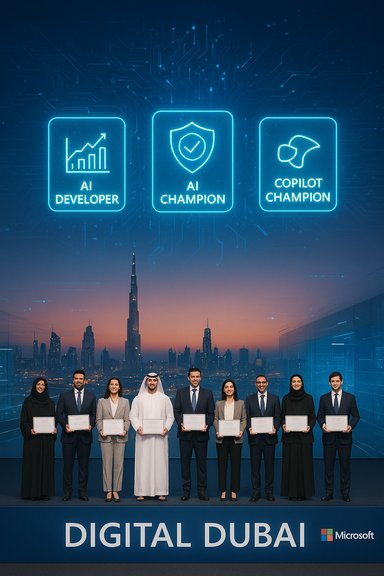
Public descriptions of the programme and the Digital Dubai / Microsoft partnership identify three complementary tracks intended to cover the spectrum from builders to adopters:- AI Developer — technical training for building intelligent solutions using machine learning, data analysis and AI‑enabled software development.
- AI Champion — an organisational leadership track intended to train change agents who can define AI adoption strategies, governance, and roadmaps within their entities.
- Copilot Champion — a user‑facing productivity and adoption track centred on applying Microsoft Copilot tools to boost operational efficiency and creativity.
Participants, duration and claimed outputs
The report circulating about the graduation describes a year‑long course completed by 120 participants from 36 government and private entities, culminating in practical implementation projects and a recognition ceremony where project teams were honoured. Those exact participation numbers and the graduation event date are reported in the dispatch made available to this article.Independent public records from Digital Dubai confirm the programme’s year‑long design and three‑track structure, but do not (as of review) publish a public newsroom announcement that corroborates the specific graduation tally and the ceremonial details. Therefore, the overarching programme architecture and the Microsoft partnership are independently verifiable, while the precise graduation headcount and event outcomes — as reported in the dispatch — currently rest on that specific account and should be treated as reported, not independently verified.
Why this matters: strategic context for Dubai and for government AI
Dubai has articulated an ambitious AI vision for the emirate — one that rests not only on technology procurement and infrastructure but on strengthening human capability and operational adoption across ministries and agencies. Upskilling government staff so they can:- design and deploy AI solutions responsibly,
- evaluate and adopt productivity tools like Microsoft 365 Copilot, and
- lead organisation‑wide AI transformation
Microsoft’s own regional activity — pushing mass skilling initiatives and local Copilot enablement — complements that public‑sector agenda by supplying validated curriculum, certifications, and platform integrations. The combination of a public partner (Digital Dubai) and a major vendor (Microsoft) gives scale and operational reach to the programme, while also tying the learning to tools that government entities are likely to adopt.
Strengths: what the programme gets right
- Practical, role‑based tracks. By separating technical builders, strategic champions, and Copilot users into targeted tracks, the programme recognises that different staff need different capabilities to move from awareness to execution. This increases the likelihood of tangible outcomes beyond certificates.
- Vendor‑aligned skilling. Partnering with Microsoft gives participants access to widely used enterprise tools, formal certification pathways, and applied learning material — meaning learning can map directly onto tools the government will actually deploy. That alignment shortens the time between training and real productivity gains.
- Hands‑on implementation requirement. The reported emphasis on practical projects (training to practice to implementation) is essential; real learning in AI occurs when participants apply models, pipelines or Copilot automations to actual workflows rather than only consuming theoretical modules. The Digital Dubai programme design emphasizes that applied component.
- Data residency and compliance orientation. The recent movement toward in‑country processing for Microsoft 365 Copilot in the UAE makes Copilot adoption more palatable for regulated entities; that infrastructure step addresses a core barrier to government Copilot deployment (data locality, privacy and regulatory compliance). Training staff to use Copilot while the service aligns with local data controls is a pragmatic approach.
Risks and limitations: where caution is required
Despite the clear merits of the skilling push, several practical and governance risks must be managed to ensure this and similar programmes deliver sustainable value.1) Over‑reliance on vendor tooling
Vendor‑led training that heavily focuses on one supplier’s tools (e.g., Microsoft Copilot) can accelerate uptake but risks creating lock‑in if government entities do not also build vendor‑agnostic AI literacy, model governance skills, and procurement discipline. A balanced skilling approach should teach foundational AI concepts and governance that generalise across tools and vendors while also offering hands‑on vendor‑specific training.2) Data governance, privacy and security
Operationalising AI in government raises acute data‑protection questions. Even with in‑country processing promises, proper data classification, access control, retention policies, and audit trails are essential. Training must therefore include robust modules on data governance, threat modelling, and secure ML lifecycle practices — not just tool operation. Rushing Copilot into production without these guardrails can expose sensitive citizen data.3) Measuring actual impact vs. attendance
Certificates and graduations are meaningful milestones, but they are not a substitute for measurable operational impact. Governments must define and measure outcomes such as time saved, error rates reduced, improved citizen satisfaction, or cost avoidance. Without longitudinal impact metrics, skilling risks becoming a superficial compliance exercise rather than a productivity multiplier.4) Talent retention and practical application
Training government employees is only half the battle. Agencies must provide opportunities to apply new skills in meaningful projects, allocate time for experimentation, and create career paths that reward AI‑enabled contributions. Otherwise, trained staff may leave or the learning cannot be translated into institutional capability.5) Ethics, bias and explainability
Generative AI and ML models can introduce bias and opaque decisioning. Training must include ethical AI practices, model auditing, and explainability techniques so staff can responsibly deploy AI systems that affect public services.Recommendations for Digital Dubai, partner entities and CIOs
- Adopt a balanced curriculum.
- Combine tool‑specific labs (e.g., Copilot workflows) with vendor‑neutral modules on ML fundamentals, data lifecycle, privacy law, and AI governance.
- Mandate measurable pilot KPIs.
- For each post‑training project, require clear metrics (time saved, error reductions, service KPIs) and a 3/6/12 month impact review that informs scale decisions.
- Embed governance and security training as mandatory.
- Every Copilot or model deployment should pass a standardised checklist for data sensitivity, access controls, logging, and auditability before production rollout.
- Create a federation of AI champions.
- Use the “AI Champion” track to build an internal network of peer mentors who can accelerate cross‑agency diffusion, troubleshoot adoption blockers, and share reusable patterns.
- Commit to vendor diversification.
- While practical to train on Microsoft tooling where it will be used, parallel investments in open frameworks and vendor‑agnostic governance will reduce strategic lock‑in and promote competition.
- Design retention and career pathways.
- Link skilling outcomes to new role frameworks (e.g., Data Steward, ML Engineer, Automation Lead) and ensure rotation into practical projects that build institutional memory.
- Invest in monitoring and auditing tools.
- Implement model registries, data lineage tools, and Copilot usage auditing to detect misuse, data leakage, or drift and to ensure compliance with public‑sector obligations.
Practical implications for Windows and Microsoft ecosystem users
- Governments that train staff on Microsoft Copilot and Azure‑backed AI capabilities will likely accelerate Copilot adoption across document workflows, data analysis and internal knowledge work — a dynamic that will create downstream demand for Windows‑integrated productivity experiences and enterprise Azure services. Microsoft’s regional emphasis on skilling and localized Copilot processing suggests a coordinated vendor roadmap for public‑sector adoption. That said, IT leaders should plan for integration complexity, identity and access management alignment, and phased rollouts that protect sensitive processes.
Verification status: what is confirmed and what remains reported
- Confirmed and independently verifiable:
- Digital Dubai publicly announced a partnership with Microsoft to launch an AI skills programme with multiple tracks and a year‑long design.
- Microsoft has active AI skilling commitments and regional programmes focused on AI literacy and adoption.
- Microsoft and regional partners have taken steps to enable in‑country processing for Microsoft 365 Copilot in the UAE, an important compliance milestone for government adoption.
- Matar Al Hemeiri is identified in Digital Dubai public communications as a senior executive (Chief Executive) who regularly speaks for the organisation.
- Reported but not independently corroborated:
- The precise graduation event details — specifically the numerical claim of 120 graduates from 36 entities, the event date and the text of the quotes attributed to Digital Dubai leadership in the dispatch — are published in the Big News Network article text provided to this analysis but were not found on Digital Dubai’s public newsroom pages or other independent outlets at the time of review. These reported figures and quotations should therefore be treated as claims reported by the dispatch and await further confirmation from official Digital Dubai communications. Digital Dubai’s overall programme structure and Microsoft partnership remain independently verifiable.
What successful scaling looks like (a short checklist)
- Clear business outcomes defined before training (target KPIs for pilots).
- Mandatory compliance and data‑classification gate before any Copilot or model rollout.
- Post‑training project reviews (3/6/12 months) with public‑sector impact metrics.
- Cross‑agency knowledge base and reusable component library for AI solutions.
- Continuous learning pipelines (refresher courses, advanced certifications).
- Transparent governance: policy, audit logs, and public reporting of non‑sensitive aggregate outcomes.
Conclusion
Digital Dubai’s AI skilling push, co‑designed with Microsoft, is an important step toward operationalising AI within government. The programme’s multi‑track design — spanning developers, champions and Copilot users — aligns with best practice for moving from experimentation to scale. Microsoft’s regional skilling commitments and the emergence of local Copilot processing capability strengthen the practical case for such training.At the same time, the specific graduation figures and ceremony details reported in the dispatch received for this article are not yet independently verifiable from Digital Dubai’s published newsroom items; they should therefore be treated as reported claims pending official confirmation. Even where numbers are accurate, the real test of success will be sustained impact: measurable improvements in service delivery, demonstrable productivity gains from Copilot‑enabled workflows, robust governance of data and models, and the retention and institutionalisation of AI capabilities across government teams.
If executed with balanced vendor engagement, strong governance, and a focus on measurable outcomes, the AI Skills Programme can be the kind of practical, responsible skilling intervention that turns pilot projects into routinely used, value‑adding government services — and moves Dubai closer to its stated goal of being an AI‑ready, innovation‑driven government.
Source: Big News Network.com https://www.bignewsnetwork.com/news...aduation-of-ai-skills-programme-participants/