

Duke’s experience with practical, people-centered AI offers a clear, early blueprint for what the rest of higher education—and many workplaces—will face: rapid gains in everyday productivity and workflow, paired with urgent questions about verification, governance, training, and the preservation of human judgment.
Over the past two years Duke’s classrooms, clinics, and administrative offices have moved quickly from curiosity to operational deployment of generative AI. Staff like Anyssa Queen — an executive assistant who started using Copilot and ChatGPT “as an intern” to draft emails, plan schedules, and translate technical instructions into step‑by‑step guides — show how AI can reduce routine friction in ordinary, non‑technical roles. Faculty leaders such as Provost Alec Gallimore have framed the technology as both an enormous opportunity and a deep responsibility, launching an “AI at Duke” effort that pairs rapid pilot work with cross‑campus governance and research strands.
That programmatic work includes a six‑month leadership “AI bootcamp,” a rolling set of university‑wide pilots (a so‑called “12 in 12” initiative) aimed at delivering a dozen administrative AI projects in one year, and campus provisioning of education‑grade AI services to students and staff. Clinical adoption has been especially visible: Duke Health’s adoption of an AI transcription and summarization tool to automate visit notes is a concrete use case where time saved translates directly into more clinician attention for patients.
This isn’t an academic thought experiment — it’s an institutional choice to fold AI into everyday workflows and ask: how do we get the benefits while protecting safety, privacy, and the pedagogical goals of higher education?
That future requires intentional choices. Universities and organizations that create practical, rights‑respecting, and skills‑focused pathways now will not only protect their missions but also equip students and staff to lead in an AI‑augmented world. The alternative — passive adoption without training, governance, or measurement — risks eroding trust and dissipating the very benefits AI promises to deliver.
The question facing every leader is straightforward: will you shape how AI fits into your institution’s values and work, or will AI slowly reshape those values by default? Duke’s example suggests a third path: use AI to reclaim time and creativity, while investing heavily in the human skills that ensure those gains are real, equitable, and enduring.
Source: Duke Today AI at Work – and What It Means | Duke Today
 Background: a campus learning to use AI, not be ruled by it
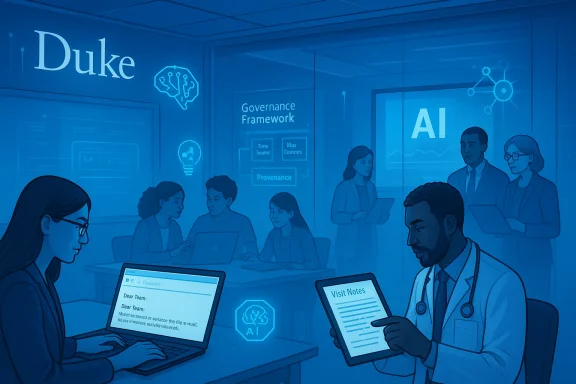
Over the past two years Duke’s classrooms, clinics, and administrative offices have moved quickly from curiosity to operational deployment of generative AI. Staff like Anyssa Queen — an executive assistant who started using Copilot and ChatGPT “as an intern” to draft emails, plan schedules, and translate technical instructions into step‑by‑step guides — show how AI can reduce routine friction in ordinary, non‑technical roles. Faculty leaders such as Provost Alec Gallimore have framed the technology as both an enormous opportunity and a deep responsibility, launching an “AI at Duke” effort that pairs rapid pilot work with cross‑campus governance and research strands.That programmatic work includes a six‑month leadership “AI bootcamp,” a rolling set of university‑wide pilots (a so‑called “12 in 12” initiative) aimed at delivering a dozen administrative AI projects in one year, and campus provisioning of education‑grade AI services to students and staff. Clinical adoption has been especially visible: Duke Health’s adoption of an AI transcription and summarization tool to automate visit notes is a concrete use case where time saved translates directly into more clinician attention for patients.
This isn’t an academic thought experiment — it’s an institutional choice to fold AI into everyday workflows and ask: how do we get the benefits while protecting safety, privacy, and the pedagogical goals of higher education?
How Duke is applying AI across work and learning
Administrative productivity and “AI as intern”
Duke’s administrative teams are using mainstream generative tools to automate repetitive, low‑value tasks: drafting and proofreading emails, generating meeting summaries, outlining agendas, producing Excel tips and pivot‑table formulas, and proposing timelines for complex projects. Those activities are low risk in technical terms but high impact in time saved and reduced cognitive overhead.- Benefits observed:
- Faster first drafts and standardized messaging
- Reduced anxiety for staff with language or learning differences (e.g., proofreading that eases the stress of sending high‑stakes messages)
- Quick, on‑the‑spot troubleshooting (translating opaque printer instructions into a usable checklist)
Classroom transformation: teaching students to verify rather than only to code
Faculty are shifting curriculum priorities. In computer science and engineering courses, instructors report using generative AI daily as a tutor and research assistant for students. The emerging consensus is that while AI can generate syntactically correct code or outline solutions, the real human skill will be specification, verification, debugging, and critical reasoning.- Classroom shifts include:
- Moving away from rote emphasis on syntax to deeper verification and systems thinking.
- Assigning students tasks that require checking AI outputs, constructing tests, and reasoning about failure modes.
- Teaching students how to design prompts, evaluate provenance, and document the limits of machine outputs.
Clinical workflows: reclaiming time and enhancing patient interaction
One of the most persuasive early use cases at Duke Health is automated clinical documentation. AI tools that create visit summaries from clinical conversations have been deployed at scale for thousands of clinicians. The effect is tangible: clinicians report spending more time in face‑to‑face patient care, less time on post‑visit notes, and a feeling of restored interpersonal connection.- Practical gains:
- Reduced administrative load per clinician (notes that once took hours are completed in minutes)
- Improved clinician satisfaction and ability to focus on diagnostic thinking
- Rapid transference of discrete administrative tasks from clinicians to tools, with clinician review before finalizing records
Teaching critical literacy: examples and exercises
At Duke, faculty have created hands‑on courses and demos to train students in the limits of AI. One pedagogical demonstration deliberately programs a chatbot to disagree — a “DisagreeBot” — to show how conventional chatbots tend to be sycophantic and to reveal how prompts and reward frameworks shape behavior. These exercises teach students to expect consensus from models and to design prompts and evaluation strategies that stress‑test systems.Verified trends behind the local story
Two patterns underlie Duke’s microcosm of AI adoption and merit attention when scaling any program.- Rapid growth in workplace AI adoption: major workforce surveys show usage of AI in roles has increased sharply over a short time. Different polls measure slightly different baselines (depending on sample date and definitions), but the consistent story is clear: workplace AI adoption has accelerated substantially since 2023.
- Measurable time savings for users: multi‑institutional surveys and reports find that employees who actively use generative AI report notable time savings, frequently expressed as multiple hours per week. Several large studies conducted in 2024‑2025 indicate average weekly time savings that approach the scale of a partial or full workday for regular users, although the size of those gains depends heavily on role, training, and the quality of AI outputs.
Strengths of Duke’s approach — what other organizations can copy
- People‑first governance: Duke’s AI initiative pairs rapid pilot projects with a steering committee and cross‑disciplinary pillars (ethics, sustainability, discovery, life with AI). That mix prevents pilots from becoming uncontrolled experiments while keeping innovation moving.
- Institution‑level tooling for education: provisioning a campus‑managed education instance of an LLM (an “Edu” offering) gives students and faculty a consistent, privacy‑aware platform for experimentation and instruction.
- Clinically focused pilots with clinician review: deploying documentation assistants that produce draft notes but require clinician verification balances efficiency with safety.
- Curriculum redesign to emphasize verification: shifting assessment and instruction to test human judgment and AI‑evaluation skills preserves learning objectives in the age of generative assistants.
- Rapid iteration (12 projects in 12 months): short, deliverable‑driven projects force pragmatic decisions and help the institution learn what scales.
What to watch — key risks and governance gaps
AI’s potential is real, but so are its failure modes. Duke’s work reveals practical danger zones every organization should address.Hallucinations and trust erosion
Generative models confidently assert false facts. In low‑stakes drafting that’s often tolerable; in research, legal work, or clinical records, hallucinations can damage trust and cause harm. The remedy is rigorous human verification workflows, provenance tools that link outputs to sources, and policies that set minimum review standards.“Workslop” — productivity illusions from low‑quality outputs
Time saved on blunt tasks can be partly eaten by rework. Surveys across industries show a non‑trivial portion of AI‑generated work requires correction — sometimes a large share — particularly when users rely on tools without training. Organizations must measure net productivity gain (time saved minus time spent fixing errors) rather than gross time‑savings claims.Data privacy and legal risk in health and education
The clinical domain is unforgiving. Firms and campuses must manage PHI, consent, data retention, and vendor access to raw audio or records. Even when vendors promise no human review or short retention windows, institutions should demand transparency, independent audits, and technical controls (local processing, secure enclaves) where feasible.Uneven training and an emerging generational gap
Evidence from broad surveys shows trained employees adopt and benefit from AI tools at higher rates than untrained peers. Without broad, role‑appropriate training programs, organizations risk unequal benefit distribution and operational friction when only some teams use AI effectively.Unclear policy for academic integrity and assessment
Bringing AI into teaching means rethinking assessment. Faculty should define acceptable AI uses, redesign assignments to evaluate higher‑order thinking, and explore oral exams or iterative assessments that expose understanding beyond generated content.Practical governance checklist for IT leaders and campus executives
- Define the “human in the loop”: specify which roles must verify AI outputs and what constitutes acceptable review.
- Catalog sensitive data flows: know where PHI, student data, or confidential records might touch AI vendors and apply appropriate controls.
- Deploy institution‑managed AI instances where possible: this centralizes logging, retention policy, and access control.
- Implement role‑specific AI training: practical short workshops tailored to daily workflows outperform generic awareness campaigns.
- Start small, measure net impact: pilot, measure gross time saved, measure rework time, and calculate net productivity and quality outcomes.
- Maintain an “AI red team” for high‑risk deployments: simulate failures, probe hallucination cases, and stress test security assumptions.
Where Duke’s examples illuminate broader strategy
Duke’s experience is useful because it spans multiple domains: administrative offices, classrooms, and clinical operations. That breadth yields three durable lessons for other institutions and mid‑size organizations.- Use cases drive governance, not the other way around. Practical, high‑value pilots reveal the type of governance needed (e.g., privacy controls for health, attribution and academic integrity for classrooms).
- Invest in verification skills. Teaching students and staff to audit and interrogate AI outputs produces durable capacity that outlives any single model or vendor.
- Think beyond time saved. Time freed by AI must be intentionally reallocated through job design, training, and strategic priorities — otherwise efficiency gains simply compress into longer to‑do lists.
The tradeoffs: speed vs. caution
The public narrative around AI swings between two poles: adopt immediately and compete, or pause and regulate until the technology stabilizes. Duke’s middle path — accelerate targeted pilots while building governance and critical thinking — is instructive.- Rapid adoption risks: token governance, uneven protections, overreliance on unvetted outputs.
- Excess caution risks: missed opportunities to reduce administrative burden, falling behind peers in learning and research productivity, and failing to train the next generation to work with AI.
Recommendations for IT, academic leaders, and clinicians
- Treat AI as an institutional change program, not just a technology procurement. Allocate budget for training, governance teams, and technical integration.
- Create clear service‑level agreements and data processing addenda with vendors that cover retention, human review, security, and breach notification timelines.
- Redesign assessments and job descriptions to surface human judgment: make the “value added” of humans explicit and measurable.
- Measure “net time saved” and quality outcomes, not just usage metrics. Establish KPIs that capture rework and verification burden.
- Foster cross‑disciplinary dialogue: ethics, law, IT, faculty, and frontline staff must co‑design acceptable uses and safeguards.
Conclusion: a human‑centered AI future is an achievable — but active — choice
Duke’s evolving deployment of generative AI shows how institutions can seize near‑term productivity wins while building the literacy and guardrails needed for longer‑term safety and academic integrity. The story is not that AI will simply replace human work, but that it will change what human work looks like: less drudgery, more verification, and a premium on judgment and oversight.That future requires intentional choices. Universities and organizations that create practical, rights‑respecting, and skills‑focused pathways now will not only protect their missions but also equip students and staff to lead in an AI‑augmented world. The alternative — passive adoption without training, governance, or measurement — risks eroding trust and dissipating the very benefits AI promises to deliver.
The question facing every leader is straightforward: will you shape how AI fits into your institution’s values and work, or will AI slowly reshape those values by default? Duke’s example suggests a third path: use AI to reclaim time and creativity, while investing heavily in the human skills that ensure those gains are real, equitable, and enduring.
Source: Duke Today AI at Work – and What It Means | Duke Today
