

Duroflex’s latest move — a full visual and strategic refresh under the banner “Designed to De‑Stress” — recasts the six‑decade mattress maker from a sleep‑innovation company into an explicit wellbeing brand focused on stress relief through restorative sleep.
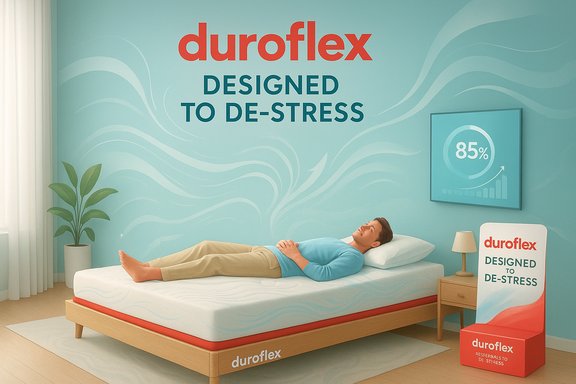
Duroflex Limited, a long‑standing Indian sleep and comfort solutions company, announced a refreshed brand identity and positioning in early November 2025 that centers stress reduction as its primary consumer promise. The rollout includes a new logo, an updated colour palette that retains a brighter shade of the brand’s signature red, a reworked visual language described as “soft, fluid, and rejuvenating,” and an advertising film to introduce the idea to consumers. Company spokespeople frame the repositioning as the result of extensive consumer research that found stress has become a daily, physical problem for many people—manifesting as muscle tension, fatigue and sleeplessness—and position restorative sleep as the remedy Duroflex will now prioritise. Duroflex’s leadership is explicit about the intent: Sridhar Balakrishnan, Chief Executive Officer, described the change as a move from “sleep‑first mattress company” to a “comfort partner,” and Ullas Vijay, Chief Marketing Officer, emphasised that the category’s traditional product talk (foam layers, fabric counts) misses the larger consumer problem—modern stress—and that the company wants to build products that work on what stress does to your body. These direct statements frame the rebrand as both strategic repositioning and product‑level recommitment.
Brands that transition from product descriptions to health and wellbeing claims must manage three interlocking obligations: deliver measurable outcomes, communicate transparently, and accept accountability (via trials, warranties, and independent validation). Without those, even the most beautifully designed logo and campaign film will feel ephemeral in a consumer marketplace that increasingly prizes proof.
Key immediate indicators to watch: published evidence of sleep/stress outcomes, product design disclosures, and retail trial performance. These will determine whether “Designed to De‑Stress” becomes a meaningful wellbeing proposition or a marketing‑first repositioning.
Source: Storyboard18 Duroflex rebrands with ‘Designed to De-Stress’ focus
 Background
Duroflex Limited, a long‑standing Indian sleep and comfort solutions company, announced a refreshed brand identity and positioning in early November 2025 that centers stress reduction as its primary consumer promise. The rollout includes a new logo, an updated colour palette that retains a brighter shade of the brand’s signature red, a reworked visual language described as “soft, fluid, and rejuvenating,” and an advertising film to introduce the idea to consumers. Company spokespeople frame the repositioning as the result of extensive consumer research that found stress has become a daily, physical problem for many people—manifesting as muscle tension, fatigue and sleeplessness—and position restorative sleep as the remedy Duroflex will now prioritise. Duroflex’s leadership is explicit about the intent: Sridhar Balakrishnan, Chief Executive Officer, described the change as a move from “sleep‑first mattress company” to a “comfort partner,” and Ullas Vijay, Chief Marketing Officer, emphasised that the category’s traditional product talk (foam layers, fabric counts) misses the larger consumer problem—modern stress—and that the company wants to build products that work on what stress does to your body. These direct statements frame the rebrand as both strategic repositioning and product‑level recommitment. What changed: the visible identity and the strategic claim
Visual and creative updates
- A redesigned logo and wordmark described by the brand as embodying ease, motion and rejuvenation, with softer shapes and an upward, flexible feel.
- A refreshed colour palette that retains red as a heritage anchor but brightens it to communicate vitality and optimism.
- A new visual language across packaging, point‑of‑sale, digital channels and an ad film intended to evoke calm, comfort and emotional restoration.
- A staged rollout planned across retail stores, the company website, and marketing touchpoints.
Strategic repositioning — “Designed to De‑Stress”
- The central marketing proposition now reads as a behavioural and functional promise: help consumers manage stress better via deep, restorative sleep and comfort solutions.
- Internally, Duroflex frames this as a movement from feature‑first product messaging to outcome‑focused wellbeing communication — from foam specifications to stress‑relief outcomes.
Why this matters: market context and category dynamics
The mattress category is maturing into wellness
The mattress business has historically been a conversation dominated by materials science — memory foam densities, coil counts, latex blends and cover fabrics. That technical focus makes sense for product engineers, but it often fails to connect with a broader trend: consumers increasingly purchase sleep products to solve health and wellbeing problems, not merely to chase incremental comfort metrics. The reframing of mattresses as wellness devices has been visible globally for years — firms bundling sleep coaching, smart sensors, and claims tied to stress, recovery, and daytime performance have nudged the category toward outcomes rather than layers. Duroflex’s repositioning places it squarely in that movement.The business logic
- Outcome‑led messaging (stress reduction, restorative sleep) can increase purchase relevance and justify premium positioning.
- A wellbeing positioning broadens potential product adjacencies (pillows, bedding, sleep accessories, services, even content/telehealth tie‑ins).
- A heritage brand (six decades of market presence) gains credibility if it can credibly translate its engineering credentials into measurable health outcomes.
Strengths of the rebrand
1) Rooted in consumer insight (if the research is robust)
The company says the repositioning is built on consumer research identifying stress as an everyday problem. When genuine, insight‑led repositioning lifts a brand from tactical product upgrades to strategic category leadership. The framing of stress as a physical phenomenon (muscle tension, stiffness, fatigue) aligns well with a mattress maker’s competencies, because sleep quality, spinal alignment and pressure relief are plausible mechanisms for physical restoration. By naming the problem explicitly — stress — Duroflex gains a clearer consumer narrative to personalise across segments (urban professionals, caregivers, shift workers).2) Heritage and R&D credibility
A brand with “over six decades” in sleep innovation can credibly claim long experience in ergonomics and orthopaedics — assets that matter if Duroflex pairs its marketing with demonstrable product science (materials, zoned support, clinical studies). Heritage also helps shelf trust in a crowded marketplace where new direct‑to‑consumer entrants often face higher scrutiny.3) Clear product‑to‑purpose alignment potential
If the rebrand is synchronized with product roadmaps — e.g., mattresses designed to reduce pressure points, enhance spinal alignment, or pair with guided‑sleep content — consumers will see the repositioning as substantive rather than cosmetic. This is one of the few category pivots that lets marketing, product and retail operations align around an outcome.Risks, unanswered questions and caveats
Claims vs. clinical proof — a thin line
- The marketing claim that products are “Designed to De‑Stress” is compelling as a positioning statement, but it implies a causal benefit (products reduce stress). That is a clinical claim that requires evidence. The company has not, in the public releases, published peer‑reviewed studies or clinical trial results to substantiate physiological stress reductions tied directly to specific mattresses. Without robust, independent research, the proposition risks being perceived as aspirational marketing rather than proven health benefit. This is especially sensitive when words like “work on what stress does to your body” are used. Consumers and regulators increasingly demand evidence when health claims are made.
Measurement and success metrics
- The announcement does not disclose measurable KPIs for the repositioning (e.g., improvement in Net Promoter Score, reductions in return rates, sales uplift targets, clinical sleep metric changes). A repositioning of this scale should come with a 12–24 month measurement plan that ties creative to business outcomes. Absent such a plan, it is difficult for stakeholders — retail partners, investors, and health‑conscious consumers — to judge success.
Risk of “wellness washing”
- The wellness category is crowded and noisy. Brands that employ wellbeing language without data or meaningful product changes risk being labelled as engaging in wellness washing — riding consumer desire for health outcomes without delivering measurable benefits. This can erode long‑term trust. The remedy is transparency: publish user study designs, disclose methods, and avoid overstated causal claims until validated.
Operational and technical migration costs
- Large brand rollouts come with practical costs: packaging updates, digital asset migrations, SEO and URL changes, point‑of‑sale refreshes, and partner collateral updates. Mishandled cutovers can cause temporary traffic or sales dips. The company must manage the technical roll (digital redirects, certificates, inventory labelling) as an IT program as much as a creative one.
Regulatory sensitivity
- If Duroflex markets products with direct health claims (e.g., improves physiological stress markers), it may trigger regulatory scrutiny in some jurisdictions that govern health claims on consumer goods. Clarity in claims and evidence is essential to avoid legal exposure.
What the repositioning means for consumers
- Expect refreshed in‑store experiences and product identity: shops will likely highlight the “Designed to De‑Stress” line with new merchandising cues and sensory staging (calmer lighting, guided demo tools).
- Product descriptions may shift from foam/coil specs to outcome language: sleep quality, pressure relief, and restorative claims will appear alongside technical specs.
- Bundled experiences are probable: sleep pillows, bedding, calming soundscapes or app partnerships (guided breathing or sleep meditations) could appear as add‑ons to substantiate the wellbeing positioning.
- Pricing and segmentation: outcome messaging often supports premium tiers; consumers may see clearer tiered offers (everyday comfort vs. stress‑focused restorative ranges).
Competitive implications for the mattress category
- Rival brands that remain foam‑centric may feel pressure to reframe their messaging toward health outcomes, or risk being perceived as function‑only providers.
- International D2C challengers might respond with evidence‑backed studies (sleep labs, polysomnography results) to differentiate themselves from Duroflex’s outcome claim if Duroflex does not supply rigorous evidence.
- Retailers could prioritise Duroflex if the new positioning drives higher AOV (average order value) or margin via premium ranges, but distribution partners will monitor return rates and customer satisfaction closely.
Practical checklist: what to look for next from Duroflex
- Publication of research design and results: proof that the “Designed to De‑Stress” claim has been validated with clear methodologies (sample sizes, controls, objective measures such as sleep duration, sleep efficiency, heart‑rate variability).
- Product transparency: specifics on how designs materially address stress (zoned support, cooling, vibration minimisation, pressure mapping data).
- Retail rollout plans: dates for in‑store identity changes, product labelling updates and customer education materials.
- Measurable business goals: KPIs for brand awareness lift, conversion changes, and retention improvements tied to the rebrand.
- Clinical partnerships: collaboration with sleep clinics, physiotherapists, or accredited research bodies would strengthen the claim.
Recommendations for Duroflex (a practical roadmap)
- Publish a two‑phase evidence plan:
- Phase 1 — short‑term consumer studies (30–90 days) measuring subjective sleep quality and self‑reported stress before/after mattress use.
- Phase 2 — longer objective studies using wearables or clinical sleep studies (actigraphy, heart‑rate variability, polysomnography) to measure physiological changes attributable to the product.
- Avoid overstated health claims until Phase 2 evidence is available; use outcome language that is credible: “designed to support restorative sleep” instead of “reduces stress” where causal evidence is not yet established.
- Align retail training and after‑sales care with the promise: equip sales staff with scripts that explain how products support restoration, plus clear return and trial policies to reduce buyer risk.
- Measure and publish business KPIs quarterly: conversion lifts, return rates, NPS, average order value, and sleep trial satisfaction scores.
- Build partnerships: sleep clinics, physiotherapists, or corporate wellness programs that can extend the product into services (employee stress‑management programmes, DTC sleep coaching).
- Make the rollout an operational program: include IT, legal, supply chain, and SEO owners to prevent collateral damage from technical cutovers (redirects, certificates, inventory SKU syncs).
How to evaluate Duroflex’s progress as a reader or buyer
- Look for published research or third‑party validation in the next 6–12 months.
- Test drive the product with an eye for both subjective comfort and objective claims: does daytime energy or sleep continuity measurably improve during a trial?
- Ask retail staff for the specific design elements claimed to reduce pressure, improve alignment, or enhance restorative sleep, and request product spec sheets.
- Compare return policies and trial windows: outcome‑led positioning is convincing only if the company is willing to back claims with generous trials and clear warranties.
Bigger picture: branding, health claims, and the path ahead
Duroflex’s repositioning is a textbook example of a legacy product brand attempting to join the wellbeing economy. The strategic move makes sense: stress and sleep are modern preoccupations with wide resonance, and aligning product design with a genuine human problem can create durable differentiation. The success of the pivot hinges on execution: creative authenticity, product updates, and—crucially—evidence.Brands that transition from product descriptions to health and wellbeing claims must manage three interlocking obligations: deliver measurable outcomes, communicate transparently, and accept accountability (via trials, warranties, and independent validation). Without those, even the most beautifully designed logo and campaign film will feel ephemeral in a consumer marketplace that increasingly prizes proof.
Conclusion
Duroflex’s “Designed to De‑Stress” repositioning is an ambitious, consumer‑first pivot that leverages heritage and category understanding to stake a claim in the wellbeing economy. Its strengths lie in plausible product‑to‑problem alignment and the marketing clarity of naming stress as the problem to solve. The critical gap is evidence: to move from promising to proving, Duroflex must pair its creative refresh with transparent research, measurable KPIs and operational discipline across retail and digital channels. If it does so, the repositioning could reshape how Indian consumers think about mattresses—not just as objects of comfort, but as tools for restoration and daily resilience. If it fails to deliver evidence and follow‑through, the change risks being remembered as a smart rebrand with shallow impact.Key immediate indicators to watch: published evidence of sleep/stress outcomes, product design disclosures, and retail trial performance. These will determine whether “Designed to De‑Stress” becomes a meaningful wellbeing proposition or a marketing‑first repositioning.
Source: Storyboard18 Duroflex rebrands with ‘Designed to De-Stress’ focus
