

Western Computer and Microsoft will host “Navigate Forward: Business Central & The AI Advantage” on Wednesday, June 17, 2026, at Microsoft’s Downers Grove, Illinois office, targeting manufacturing, distribution, finance, operations, and IT leaders evaluating Dynamics 365 Business Central, Copilot, and ERP modernization. The event is a local partner roadshow, but the timing makes it more than another lunch-and-learn. Microsoft’s old Dynamics NAV customer base is running into support deadlines, cloud pressure, and AI expectations at the same time. That collision is turning ERP migration from a back-office cleanup project into a boardroom decision about how much operational intelligence companies want to hand to Microsoft’s cloud.
For years, the case for moving from Dynamics NAV to Dynamics 365 Business Central was mostly architectural. NAV was familiar, heavily customized, and deeply embedded in mid-market finance and operations, but it belonged to an older software era. Business Central promised a cloud-first successor with better update cadence, Microsoft 365 integration, Power Platform hooks, and less dependence on brittle local infrastructure.
That argument was rational, but not always urgent. Many manufacturers and distributors had tuned NAV around quoting, inventory, warehouse, purchasing, production, and finance workflows that did not break just because Microsoft renamed the future. If the system still closed the books and shipped product, the upgrade could wait.
AI changes the sales motion. Western Computer’s event description makes that explicit: the promise is no longer merely that Business Central is newer than NAV, but that it is the operating layer through which Microsoft Copilot, automation, reporting, and future AI agents can reach business data. ERP is being repositioned as the context engine for AI, not just the database of record.
That is a clever pivot, because most companies do not lack AI curiosity. They lack a credible starting point. The pitch from Microsoft partners is increasingly that ERP modernization supplies that starting point, because AI without clean operational data is mostly a demo.
But the support calendar is narrowing. Older NAV versions have already aged out, NAV 2016 reached the end of extended support in 2026, NAV 2017 and NAV 2018 are also moving toward their final support dates, and Microsoft’s product investment has long since shifted to Business Central. That does not mean every NAV deployment stops working the morning support ends. It means the risk profile changes.
Unsupported ERP is not like running an old media player. It touches tax, audit, customer commitments, vendor payments, warehouse execution, and sometimes regulated data. The longer a company stays put, the more it depends on partner heroics, internal tribal knowledge, and increasingly narrow compatibility windows for surrounding systems.
This is where the Downers Grove event fits into a larger Microsoft pattern. The company and its partners are not simply saying “upgrade because support is ending.” They are saying “upgrade because the next layer of business automation will assume you already moved.” The calendar creates pressure, but AI creates aspiration.
That makes it valuable real estate for Microsoft. A company that runs Business Central is more likely to use Microsoft 365, Power BI, Power Automate, Teams, Entra ID, Azure services, and Copilot experiences. ERP modernization becomes a multiplier for the rest of the Microsoft stack.
The event’s focus on manufacturers and distributors is not accidental. These sectors often have complicated operational data but limited tolerance for massive, multi-year ERP transformations. They need forecasting, purchasing discipline, margin visibility, inventory accuracy, and faster reporting, but they also have shop-floor realities that punish vague digital-transformation language.
Business Central’s appeal is that it can be sold as both pragmatic and strategic. It modernizes an old NAV estate while giving executives a plausible AI story: automate invoice matching, improve analysis, summarize records, generate product descriptions, streamline reporting, and connect workflows across Microsoft tools. The result is less a single product sale than a platform migration.
But that also exposes the uncomfortable part of AI adoption. Copilot is only as useful as the data model, process discipline, and access controls beneath it. A manufacturer with inconsistent item masters, stale vendor records, custom fields nobody understands, and security roles inherited from three controllers ago should not expect a magical productivity dividend on day one.
This is why events like Western Computer’s matter for IT leaders. The useful conversation is not “Does Copilot work?” It is “What must be true inside our ERP environment before Copilot is safe, accurate, and worth paying attention to?” That answer usually involves governance, cleanup, role design, integration review, and user training — the unglamorous work that vendors rarely put on the hero slide.
There is also a trust issue. Finance and operations teams are used to deterministic systems: a posted invoice is posted, a quantity is on hand or it is not, a ledger entry has an audit trail. Generative AI introduces suggestion, summarization, and probability into environments built around accountability. That is not a reason to reject it, but it is a reason to deploy it with boundaries.
Western Computer is leaning into that role. The company’s announcement emphasizes its manufacturing and distribution specialization, its long history in Microsoft business applications, and its status inside the Microsoft partner ecosystem. That is not just credential-stacking; in ERP, partner quality often determines whether the platform’s theoretical advantages survive contact with the business.
The partner channel also has a commercial incentive to frame AI as the modernization accelerant. A customer asking “Should we upgrade NAV?” may defer the project. A customer asking “How do we make our ERP ready for AI?” has already accepted that standing still is not a neutral option.
Still, customers should be clear-eyed. Partner-led events are part education, part pipeline generation. The most valuable attendees will be those who arrive with hard questions about custom code, data migration, licensing, integrations, reporting parity, downtime, change management, and what Copilot features are actually available for their deployment model.
Microsoft’s most ambitious Business Central AI features are tied to the online service. That matters because some organizations still prefer on-premises deployments for control, latency, regulatory comfort, or integration complexity. They may be able to modernize within the Business Central family without fully embracing SaaS, but they should not assume the AI roadmap will treat every deployment model equally.
This is the quiet leverage behind Microsoft’s AI push. The company does not have to force every customer into the cloud by removing all alternatives overnight. It can make the cloud version the place where the most interesting features show up first, work best, and receive the most investment.
For IT administrators, that shifts the risk calculation. Staying on-prem may reduce one category of dependency while increasing another: slower access to new capabilities, more responsibility for infrastructure, and a growing gap between what the vendor markets and what the deployment can consume. Cloud adoption is not automatically correct, but it must be evaluated against the actual roadmap, not nostalgia for server ownership.
An AI-assisted suggestion that saves five minutes in a marketing workflow is one thing. A bad purchasing recommendation, misread invoice, flawed substitute item suggestion, or misleading inventory summary can ripple into production delays and customer misses. In operational businesses, AI must earn trust by reducing exception work without hiding the logic of the exception.
That is why Business Central’s most credible AI uses are initially narrow. Bank reconciliation assistance, record summaries, list analysis, invoice matching, sales line suggestions, and document automation are not science fiction. They are practical attempts to reduce the manual drag around existing business processes.
The danger is executive overreach. A CEO may hear “AI-powered ERP” and imagine autonomous planning. A controller may hear it and worry about audit risk. A warehouse manager may hear it and expect another tool that fails to understand real constraints. The useful middle ground is to begin where human review remains central and the productivity gain is measurable.
The AI angle makes reporting even more important. Copilot-style analysis depends on users trusting the underlying numbers. If Business Central becomes the new source of truth but historical reporting is fragmented, decision-makers will hesitate to rely on AI-generated summaries or natural-language analysis.
This is where finance leaders should push beyond the demo. A live demo can show how Copilot analyzes a list or summarizes a record. It cannot prove that the company’s peculiar margin calculations, rebate structures, item categories, or production variances will survive migration intact. That proof requires discovery work.
Microsoft’s broader platform can help here. Power BI, Dataverse, Power Automate, and Business Central APIs can create a more coherent reporting and automation layer than many NAV-era environments ever had. But only if the modernization project treats reporting as a first-class deliverable, not a cleanup task after go-live.
NAV customers should begin with a ruthless inventory of what they have. Which customizations are essential? Which reports are used? Which integrations still matter? Which workarounds exist only because NAV could not do something Business Central now handles differently? Which processes should be standardized rather than migrated?
AI readiness adds another layer to that assessment. If a company wants Copilot to assist with reporting, documents, approvals, and operational questions, it must examine permissions, master data, process consistency, and exception handling. In other words, the AI project starts before anyone turns on an AI feature.
That may frustrate executives looking for a fast win, but it is also an opportunity. A disciplined Business Central migration can retire technical debt that has quietly taxed the organization for years. If the company merely recreates the old NAV environment in a new place, it may get cloud hosting without cloud leverage.
Microsoft’s advantage is distribution and integration. Business Central sits next to Outlook, Excel, Teams, SharePoint, Power BI, Power Automate, Entra ID, and the broader Dynamics 365 portfolio. If Copilot can move across those surfaces with appropriate permissions and context, Microsoft can offer a version of AI that feels less like another application and more like an overlay on the workday.
That is the dream. The risk is that customers end up with overlapping Copilots, licensing confusion, uneven feature maturity, and a new dependency on Microsoft’s release cadence. IT leaders have seen this movie before: integration convenience becomes platform lock-in when architectural choices are made one small concession at a time.
The practical answer is not to reject the ecosystem. For many WindowsForum readers, Microsoft standardization is already reality. The answer is to document where the organization benefits from tight integration and where it needs escape hatches, clean APIs, independent backups, and clear data ownership.
An in-person event gives Microsoft and Western Computer a chance to make the migration feel concrete. Attendees can ask how a manufacturer with aging NAV customizations should sequence an upgrade, how Copilot fits into a realistic deployment timeline, and how the partner has handled messy data and operational complexity elsewhere. That kind of conversation rarely happens in a polished product video.
It also signals that Microsoft’s AI strategy is moving down-market and into regional business communities. The company’s biggest AI announcements may arrive from global conferences, but adoption will depend on local credibility. A mid-market manufacturer in Illinois may care less about keynote rhetoric than whether someone can look at its process map and say, “Here is the least risky path.”
That is the underappreciated function of the Microsoft partner ecosystem. It translates platform ambition into migration plans, training sessions, configuration decisions, and uncomfortable scope meetings. AI may be the headline, but implementation remains stubbornly human.
The real test begins when attendees return to their companies. A good event should leave them with a sharper map of the problem, not merely a warmer feeling about the Microsoft stack. The next step should be an internal readiness assessment that includes finance, operations, IT, security, and at least one skeptical power user who understands how work actually gets done.
Organizations should also resist treating AI as a separate executive initiative bolted onto ERP. The more sustainable approach is to identify high-friction processes where Business Central modernization and AI assistance reinforce each other. Invoice processing, reconciliation, order entry, inventory analysis, and reporting are better starting points than vague mandates to “use AI.”
That realism matters because failed AI adoption will not always look like catastrophe. Sometimes it will look like indifference: users ignoring suggestions, reverting to Excel, distrusting summaries, and quietly maintaining shadow processes. For Microsoft and its partners, adoption will be measured not by how many features are available, but by how many become boringly useful.
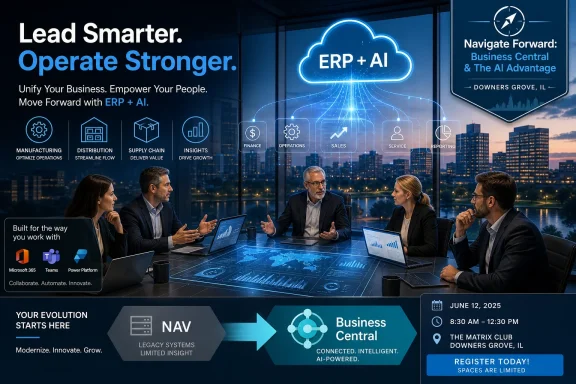 The ERP Migration Pitch Has Become an AI Pitch
For years, the case for moving from Dynamics NAV to Dynamics 365 Business Central was mostly architectural. NAV was familiar, heavily customized, and deeply embedded in mid-market finance and operations, but it belonged to an older software era. Business Central promised a cloud-first successor with better update cadence, Microsoft 365 integration, Power Platform hooks, and less dependence on brittle local infrastructure.That argument was rational, but not always urgent. Many manufacturers and distributors had tuned NAV around quoting, inventory, warehouse, purchasing, production, and finance workflows that did not break just because Microsoft renamed the future. If the system still closed the books and shipped product, the upgrade could wait.
AI changes the sales motion. Western Computer’s event description makes that explicit: the promise is no longer merely that Business Central is newer than NAV, but that it is the operating layer through which Microsoft Copilot, automation, reporting, and future AI agents can reach business data. ERP is being repositioned as the context engine for AI, not just the database of record.
That is a clever pivot, because most companies do not lack AI curiosity. They lack a credible starting point. The pitch from Microsoft partners is increasingly that ERP modernization supplies that starting point, because AI without clean operational data is mostly a demo.
NAV’s Long Goodbye Is Finally Becoming Operationally Awkward
Dynamics NAV has always had one major advantage over its successor: customers already own the pain. Years of customizations, reports, integrations, and department-specific workarounds are sunk costs. Replacing that fabric with Business Central means reopening decisions many companies thought they had settled a decade ago.But the support calendar is narrowing. Older NAV versions have already aged out, NAV 2016 reached the end of extended support in 2026, NAV 2017 and NAV 2018 are also moving toward their final support dates, and Microsoft’s product investment has long since shifted to Business Central. That does not mean every NAV deployment stops working the morning support ends. It means the risk profile changes.
Unsupported ERP is not like running an old media player. It touches tax, audit, customer commitments, vendor payments, warehouse execution, and sometimes regulated data. The longer a company stays put, the more it depends on partner heroics, internal tribal knowledge, and increasingly narrow compatibility windows for surrounding systems.
This is where the Downers Grove event fits into a larger Microsoft pattern. The company and its partners are not simply saying “upgrade because support is ending.” They are saying “upgrade because the next layer of business automation will assume you already moved.” The calendar creates pressure, but AI creates aspiration.
Business Central Is Microsoft’s Mid-Market Cloud Wedge
Business Central occupies a strategic middle ground in Microsoft’s business applications portfolio. It is not the sprawling enterprise footprint of Dynamics 365 Finance and Supply Chain Management, but it is more than accounting software. For many small and mid-sized organizations, especially manufacturers and distributors, it is the place where financial truth, inventory reality, and customer commitments meet.That makes it valuable real estate for Microsoft. A company that runs Business Central is more likely to use Microsoft 365, Power BI, Power Automate, Teams, Entra ID, Azure services, and Copilot experiences. ERP modernization becomes a multiplier for the rest of the Microsoft stack.
The event’s focus on manufacturers and distributors is not accidental. These sectors often have complicated operational data but limited tolerance for massive, multi-year ERP transformations. They need forecasting, purchasing discipline, margin visibility, inventory accuracy, and faster reporting, but they also have shop-floor realities that punish vague digital-transformation language.
Business Central’s appeal is that it can be sold as both pragmatic and strategic. It modernizes an old NAV estate while giving executives a plausible AI story: automate invoice matching, improve analysis, summarize records, generate product descriptions, streamline reporting, and connect workflows across Microsoft tools. The result is less a single product sale than a platform migration.
Copilot Raises the Bar for Data Hygiene
Microsoft’s Copilot story depends on a deceptively simple premise: put AI where people already work. In Business Central, that means surfacing assistance inside ERP tasks rather than making users export data, ask questions elsewhere, and paste answers back into the system. The more useful version of AI is not a chatbot floating outside the business process; it is an assistant with permissioned access to the data and workflow in front of the user.But that also exposes the uncomfortable part of AI adoption. Copilot is only as useful as the data model, process discipline, and access controls beneath it. A manufacturer with inconsistent item masters, stale vendor records, custom fields nobody understands, and security roles inherited from three controllers ago should not expect a magical productivity dividend on day one.
This is why events like Western Computer’s matter for IT leaders. The useful conversation is not “Does Copilot work?” It is “What must be true inside our ERP environment before Copilot is safe, accurate, and worth paying attention to?” That answer usually involves governance, cleanup, role design, integration review, and user training — the unglamorous work that vendors rarely put on the hero slide.
There is also a trust issue. Finance and operations teams are used to deterministic systems: a posted invoice is posted, a quantity is on hand or it is not, a ledger entry has an audit trail. Generative AI introduces suggestion, summarization, and probability into environments built around accountability. That is not a reason to reject it, but it is a reason to deploy it with boundaries.
The Partner Channel Is Where Microsoft’s AI Strategy Gets Real
Microsoft can publish roadmaps, demo Copilot, and describe Business Central as an AI-powered application. But most NAV-to-Business Central migrations will not be executed by Microsoft employees. They will be shaped by partners that understand old customizations, industry-specific process gaps, licensing tradeoffs, and the politics of getting finance, operations, and IT to agree on a cutover plan.Western Computer is leaning into that role. The company’s announcement emphasizes its manufacturing and distribution specialization, its long history in Microsoft business applications, and its status inside the Microsoft partner ecosystem. That is not just credential-stacking; in ERP, partner quality often determines whether the platform’s theoretical advantages survive contact with the business.
The partner channel also has a commercial incentive to frame AI as the modernization accelerant. A customer asking “Should we upgrade NAV?” may defer the project. A customer asking “How do we make our ERP ready for AI?” has already accepted that standing still is not a neutral option.
Still, customers should be clear-eyed. Partner-led events are part education, part pipeline generation. The most valuable attendees will be those who arrive with hard questions about custom code, data migration, licensing, integrations, reporting parity, downtime, change management, and what Copilot features are actually available for their deployment model.
The Cloud Question Is Not Just About Hosting
For some NAV customers, “cloud ERP” sounds like an infrastructure decision: move from servers in a closet or data center to Microsoft’s cloud. That framing understates the shift. Business Central online changes the update model, customization model, integration posture, security assumptions, and feature eligibility.Microsoft’s most ambitious Business Central AI features are tied to the online service. That matters because some organizations still prefer on-premises deployments for control, latency, regulatory comfort, or integration complexity. They may be able to modernize within the Business Central family without fully embracing SaaS, but they should not assume the AI roadmap will treat every deployment model equally.
This is the quiet leverage behind Microsoft’s AI push. The company does not have to force every customer into the cloud by removing all alternatives overnight. It can make the cloud version the place where the most interesting features show up first, work best, and receive the most investment.
For IT administrators, that shifts the risk calculation. Staying on-prem may reduce one category of dependency while increasing another: slower access to new capabilities, more responsibility for infrastructure, and a growing gap between what the vendor markets and what the deployment can consume. Cloud adoption is not automatically correct, but it must be evaluated against the actual roadmap, not nostalgia for server ownership.
Manufacturing and Distribution Need Less AI Theater
The event’s target audience is telling. Manufacturers and distributors are fertile ground for AI claims because their operations generate mountains of structured and semi-structured data: purchase orders, sales orders, bills of material, inventory movements, invoices, forecasts, exceptions, and customer correspondence. But they are also sectors where bad automation creates immediate consequences.An AI-assisted suggestion that saves five minutes in a marketing workflow is one thing. A bad purchasing recommendation, misread invoice, flawed substitute item suggestion, or misleading inventory summary can ripple into production delays and customer misses. In operational businesses, AI must earn trust by reducing exception work without hiding the logic of the exception.
That is why Business Central’s most credible AI uses are initially narrow. Bank reconciliation assistance, record summaries, list analysis, invoice matching, sales line suggestions, and document automation are not science fiction. They are practical attempts to reduce the manual drag around existing business processes.
The danger is executive overreach. A CEO may hear “AI-powered ERP” and imagine autonomous planning. A controller may hear it and worry about audit risk. A warehouse manager may hear it and expect another tool that fails to understand real constraints. The useful middle ground is to begin where human review remains central and the productivity gain is measurable.
Reporting Is the Sleeper Issue
ERP modernization is often sold through workflows, but reporting is where many projects live or die. Companies running NAV frequently have years of custom reports, Excel models, SQL queries, Power BI datasets, and informal month-end rituals built around the old environment. If those outputs disappear or change without explanation, users will declare the migration a failure even if the new system is technically healthier.The AI angle makes reporting even more important. Copilot-style analysis depends on users trusting the underlying numbers. If Business Central becomes the new source of truth but historical reporting is fragmented, decision-makers will hesitate to rely on AI-generated summaries or natural-language analysis.
This is where finance leaders should push beyond the demo. A live demo can show how Copilot analyzes a list or summarizes a record. It cannot prove that the company’s peculiar margin calculations, rebate structures, item categories, or production variances will survive migration intact. That proof requires discovery work.
Microsoft’s broader platform can help here. Power BI, Dataverse, Power Automate, and Business Central APIs can create a more coherent reporting and automation layer than many NAV-era environments ever had. But only if the modernization project treats reporting as a first-class deliverable, not a cleanup task after go-live.
The Cost Question Is Really a Scope Question
Western Computer’s CEO Kristen Sage framed the common AI questions as where to start, what it will cost, and how long it will take. Those are the right questions, but the third one often answers the first two. ERP modernization is expensive when scope is vague, customizations are poorly understood, and every department uses the migration as a chance to rebuild its wish list.NAV customers should begin with a ruthless inventory of what they have. Which customizations are essential? Which reports are used? Which integrations still matter? Which workarounds exist only because NAV could not do something Business Central now handles differently? Which processes should be standardized rather than migrated?
AI readiness adds another layer to that assessment. If a company wants Copilot to assist with reporting, documents, approvals, and operational questions, it must examine permissions, master data, process consistency, and exception handling. In other words, the AI project starts before anyone turns on an AI feature.
That may frustrate executives looking for a fast win, but it is also an opportunity. A disciplined Business Central migration can retire technical debt that has quietly taxed the organization for years. If the company merely recreates the old NAV environment in a new place, it may get cloud hosting without cloud leverage.
Microsoft’s Advantage Is Integration, Not Novelty
None of the individual ideas around AI-assisted ERP are unique to Microsoft. Every major enterprise software vendor is attaching AI assistants, agents, summarization, and automation to its application suite. The market has moved too quickly for novelty to remain a durable advantage.Microsoft’s advantage is distribution and integration. Business Central sits next to Outlook, Excel, Teams, SharePoint, Power BI, Power Automate, Entra ID, and the broader Dynamics 365 portfolio. If Copilot can move across those surfaces with appropriate permissions and context, Microsoft can offer a version of AI that feels less like another application and more like an overlay on the workday.
That is the dream. The risk is that customers end up with overlapping Copilots, licensing confusion, uneven feature maturity, and a new dependency on Microsoft’s release cadence. IT leaders have seen this movie before: integration convenience becomes platform lock-in when architectural choices are made one small concession at a time.
The practical answer is not to reject the ecosystem. For many WindowsForum readers, Microsoft standardization is already reality. The answer is to document where the organization benefits from tight integration and where it needs escape hatches, clean APIs, independent backups, and clear data ownership.
The Local Office Event Still Has a Place in a Cloud Market
It may seem quaint that a cloud ERP and AI event is being held onsite in Downers Grove. But for ERP buyers, geography still matters. These are not impulse purchases made after a webinar; they are trust-heavy projects that affect payroll, orders, inventory, vendors, customers, and financial close.An in-person event gives Microsoft and Western Computer a chance to make the migration feel concrete. Attendees can ask how a manufacturer with aging NAV customizations should sequence an upgrade, how Copilot fits into a realistic deployment timeline, and how the partner has handled messy data and operational complexity elsewhere. That kind of conversation rarely happens in a polished product video.
It also signals that Microsoft’s AI strategy is moving down-market and into regional business communities. The company’s biggest AI announcements may arrive from global conferences, but adoption will depend on local credibility. A mid-market manufacturer in Illinois may care less about keynote rhetoric than whether someone can look at its process map and say, “Here is the least risky path.”
That is the underappreciated function of the Microsoft partner ecosystem. It translates platform ambition into migration plans, training sessions, configuration decisions, and uncomfortable scope meetings. AI may be the headline, but implementation remains stubbornly human.
The Real Test Is After the Demo
The Downers Grove agenda promises guidance for NAV customers, Business Central and Copilot demonstrations, modernization strategies, discussions around automation and reporting, and networking with Microsoft and Western Computer leadership. That is a sensible package. It also compresses a complex organizational decision into an afternoon.The real test begins when attendees return to their companies. A good event should leave them with a sharper map of the problem, not merely a warmer feeling about the Microsoft stack. The next step should be an internal readiness assessment that includes finance, operations, IT, security, and at least one skeptical power user who understands how work actually gets done.
Organizations should also resist treating AI as a separate executive initiative bolted onto ERP. The more sustainable approach is to identify high-friction processes where Business Central modernization and AI assistance reinforce each other. Invoice processing, reconciliation, order entry, inventory analysis, and reporting are better starting points than vague mandates to “use AI.”
That realism matters because failed AI adoption will not always look like catastrophe. Sometimes it will look like indifference: users ignoring suggestions, reverting to Excel, distrusting summaries, and quietly maintaining shadow processes. For Microsoft and its partners, adoption will be measured not by how many features are available, but by how many become boringly useful.
Downers Grove Is a Small Stop on a Much Larger Roadmap
The concrete facts are simple, but the implications are larger than a single event announcement.- Western Computer and Microsoft are using the June 17, 2026, Downers Grove event to target organizations that are simultaneously evaluating ERP modernization and AI readiness.
- Dynamics NAV customers face a shrinking support horizon, which makes migration planning less optional even when the old system still functions.
- Business Central’s strongest modernization pitch is its connection to Microsoft 365, Power Platform, Power BI, Copilot, and Microsoft’s broader cloud ecosystem.
- Copilot in ERP should be judged by specific workflow gains, not by generalized AI enthusiasm.
- Manufacturers and distributors should treat data quality, reporting continuity, permissions, and change management as core AI-readiness requirements.
- The most successful migrations will avoid cloning every NAV-era customization and instead use the project to reduce technical debt.
References
- Primary source: StreetInsider
Published: Tue, 09 Jun 2026 15:30:56 GMT
- Official source: learn.microsoft.com
Ending Support in 2026 - Microsoft Lifecycle
Find out which products will retire, reach end of support or move from mainstream support to extended support in 2026.learn.microsoft.com - Related coverage: prnewswire.com
Loading…
www.prnewswire.com - Related coverage: randgroup.com
Loading…
www.randgroup.com - Related coverage: simplydynamics.com
Loading…
www.simplydynamics.com - Related coverage: iesgp.com

A Complete Guide to Microsoft Dynamics NAV
Microsoft Dynamics NAV is a powerful tool when used right. Read on to learn how to make the best out of NAV with the complete guide to Dynamics NAV. www.iesgp.com
- Related coverage: bc4.com
Loading…
www.bc4.com - Related coverage: advantage.co.uk
Loading…
www.advantage.co.uk - Related coverage: clonepartner.com
Loading…
clonepartner.com - Related coverage: forvismazars.us
Loading…
www.forvismazars.us - Related coverage: navins.eu
Loading…
navins.eu - Related coverage: tipsa.net
Loading…
www.tipsa.net - Related coverage: mercuriusit.com
Loading…
www.mercuriusit.com