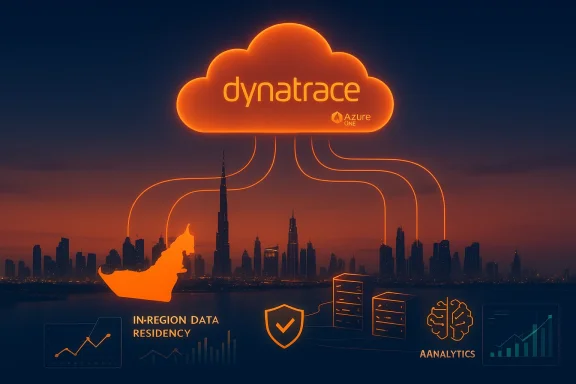
Dynatrace’s SaaS observability platform has won formal certification from the Dubai Electronic Security Center (DESC), clearing a key regulatory hurdle for the vendor’s UAE Microsoft Azure deployment and opening the door for broader adoption across Dubai’s public sector as the emirate accelerates cloud-first, AI-enabled digital transformation.
Dubai’s Digital Government agenda has made cybersecurity and cloud governance central to how public services are modernized. The Dubai Electronic Security Center (DESC) operates a Cloud Service Provider (CSP) Security Standard that maps to international information-security frameworks and is a mandatory baseline for any cloud service provider that wants to supply services to Dubai government and semi-government entities. The standard references ISO/IEC 27001, ISO/IEC 27002 and cloud-specific guidance such as ISO/IEC 27017 and the Cloud Security Alliance Cloud Controls Matrix, and requires periodic third-party assessment and ongoing surveillance. Microsoft operates two Azure regions in the UAE (UAE North for Dubai and UAE Central for Abu Dhabi) and has itself undergone DESC evaluation for those regions; the Azure compliance documentation confirms DESC audit work and the availability of regional attestations through Microsoft’s trust portals. That regional presence and the ability to host SaaS platforms with UAE data residency are critical prerequisites for vendors aiming to support Dubai’s public-sector clouds. Dynatrace’s announcement frames the DESC certification as applying to its SaaS offering operated on UAE Microsoft Azure, highlighting data residency, continuous runtime application security, and AI-powered observability as core selling points for regulated customers in the emirate. Dynatrace positions the certification as a compliance guarantee that shortens procurement timelines and reduces integration friction for government IT teams.
Source: TechAfrica News Dynatrace Earns DESC Certification, Powering Secure Cloud Adoption in Dubai’s Public Sector - TechAfrica News
 Background
Dubai’s Digital Government agenda has made cybersecurity and cloud governance central to how public services are modernized. The Dubai Electronic Security Center (DESC) operates a Cloud Service Provider (CSP) Security Standard that maps to international information-security frameworks and is a mandatory baseline for any cloud service provider that wants to supply services to Dubai government and semi-government entities. The standard references ISO/IEC 27001, ISO/IEC 27002 and cloud-specific guidance such as ISO/IEC 27017 and the Cloud Security Alliance Cloud Controls Matrix, and requires periodic third-party assessment and ongoing surveillance. Microsoft operates two Azure regions in the UAE (UAE North for Dubai and UAE Central for Abu Dhabi) and has itself undergone DESC evaluation for those regions; the Azure compliance documentation confirms DESC audit work and the availability of regional attestations through Microsoft’s trust portals. That regional presence and the ability to host SaaS platforms with UAE data residency are critical prerequisites for vendors aiming to support Dubai’s public-sector clouds. Dynatrace’s announcement frames the DESC certification as applying to its SaaS offering operated on UAE Microsoft Azure, highlighting data residency, continuous runtime application security, and AI-powered observability as core selling points for regulated customers in the emirate. Dynatrace positions the certification as a compliance guarantee that shortens procurement timelines and reduces integration friction for government IT teams. What DESC Certification Means for Dynatrace and Dubai’s Public Sector
The DESC CSP Security Standard is not merely a badge — it imposes concrete requirements and oversight that affect architecture, operations, and contractual terms. For Dynatrace the certification provides three immediate practical outcomes:- Regulatory acceptability: Government and semi-government bodies that must procure only DESC-certified cloud services can now consider Dynatrace for observability and security use cases without additional major compliance work.
- UAE data residency: Running Dynatrace SaaS on Microsoft Azure in the UAE helps satisfy data-location expectations and local privacy frameworks — a decisive factor for regulated sectors such as healthcare, finance, and public administration.
- Operational alignment: Ongoing third-party review and surveillance tied to DESC certification obliges Dynatrace to maintain controls, audit trails, and remediation processes that align with Dubai’s cyber risk posture.
What Was Certified: Capabilities and Scope
Dynatrace’s public statement lists several platform capabilities that are now available within DESC-aligned environments. These claims are consistent with Dynatrace product positioning and with the mechanics of DESC certification, but they also require careful reading for operational teams deciding what to adopt. Key certified capabilities cited by the vendor include:- End-to-end observability — unified telemetry across applications, infrastructure, and digital experience layers spanning hybrid and multicloud topologies.
- AI-powered automation — continuous telemetry analysis, anomaly detection, root-cause attribution and automated remediation workflows to reduce mean-time-to-repair.
- Smart operations — automated responses and orchestration designed to lower manual overhead and operational risk through runbook automation and self-healing capabilities.
- Regional SaaS deployment & data residency — the SaaS offering is operated in the UAE on Microsoft Azure, supporting local data segregation and compliance with UAE-specific governance controls.
Why This Matters Now: Strategic Context
Dubai has set ambitious targets for digitization, smart-city buildout and AI adoption. That strategy depends on software vendors who can operate at cloud scale while meeting stringent local controls. Three contextual drivers make Dynatrace’s DESC certification a meaningful milestone:- Cloud-first modernization: Many Dubai government programs are migrating critical services to cloud platforms for scalability and agility. Vendors who can validate compliance for those clouds remove a major procurement blocker and accelerate project timelines.
- Security-by-design expectations: DESC mandates are evidence that security expectations are baked into procurement and design. Observability platforms are no longer optional: they are foundational for resilience, incident detection and post-incident forensic analysis.
- AI and automation in operations: Dubai’s push for AI-driven public services increases demand for tools that not only monitor but also interpret and automate responses — capabilities Dynatrace emphasizes in its product story.
Independent Precedent: DESC Certifications in Practice
DESC has previously certified major cloud and security vendors, establishing a practical precedent for what certification enables. Examples include:- Qualys — announced DESC CSP certification for its cloud-native security suite, enabling Qualys to offer services to Dubai’s government entities.
- Oracle Cloud Infrastructure (OCI) — completed DESC CSP Security Standard audits for OCI’s Dubai region, reinforcing the model of cloud-region certification and local data centers subject to DESC validation.
Benefits for Government IT Teams
For public-sector IT and security leaders evaluating observability tooling, Dynatrace’s DESC certification offers a series of tangible benefits:- Faster procurement cycles: DESC-certified solutions typically clear an initial compliance hurdle, shortening legal and security reviews.
- Regulatory alignment: Certification signals that the vendor has controls mapped to required UAE and Dubai security regulations, which simplifies evidence collection during audits.
- Data locality and sovereignty: Operating the SaaS instance in UAE Azure helps meet residency requirements that are often prerequisites for public data and sensitiveitive workloads.
- Integrated security telemetry: Combining observability and application-security telemetry helps teams detect threats faster and supports incident response workflows that are often required by DESC.
Caveats and Risks: What Procurement and Security Teams Should Watch
Certification is a significant risk-reduction measure, but it is not an all-encompassing guarantee. Responsible IT leadership will treat DESC certification as one element of a layered due-diligence process. Key caveats include:- Scope limitations: DESC certificates typically cover specific services and deployment models. Confirm whether the certification applies to the exact SaaS plan, geographic boundaries, and optional integrations that your program intends to use. If your architecture requires cross-region backups, third-party integrations, or features released after the certification date, those components may not be covered.
- Shared responsibility: Even with a certified SaaS provider, customers retain responsibilities for secure configuration, access controls, data classification and identity management. Certification does not absolve the agency from implementing sound IAM, least privilege and network segmentation practices.
- Supply-chain and integration risk: Observability platforms ingest vast amounts of telemetry and often integrate with CI/CD, identity providers, and third-party APIs. Each integration adds attack surface and potential compliance complexity; agencies must validate third-party connectors and pipeline security.
- Certification lifecycle: DESC certification involves surveillance audits and re-certification cycles. Vigilance is required to ensure that certificate validity is maintained and that software updates or changes to deployment architecture don’t fall out of scope.
- Vendor lock-in and export controls: Heavy operational reliance on a single vendor’s AI-driven automations and proprietary telemetry models can create lock-in. Agencies should have data export and portability clauses in contracts and test migration paths as part of acceptance criteria.
Practical Checklist: Questions Procurement and Security Teams Should Ask
When considering Dynatrace (or any DESC-certified SaaS) for public sector use, include the following items in RFP evaluations, security questionnaires, and deployment plans:- Confirm certificate scope and expiry: request the DESC certificate copy and ask which services, regions, and deployment models are in scope.
- Validate data flows: map where telemetry, logs and backups are stored and transmitted, and ensure all data classification rules and residency requirements are met.
- Review third-party dependencies: obtain a bill of materials for any third-party services (CDNs, collectors, storage) that Dynatrace uses in the UAE deployment.
- Test role-based access and SSO integration: ensure Dynatrace supports your identity provider, least-privilege roles and audit logging for privileged actions.
- Define incident response and breach notification terms: confirm SLAs, forensics access, and contractual obligations for notifications to governmental authorities.
- Build an exit strategy: confirm data export formats, transfer timelines, and deletion guarantees in case of deprovisioning or contract termination.
Market and Competitive Implications
Dynatrace’s DESC certification strengthens its competitive position in the Gulf Cooperation Council (GCC) and wider Middle East market where public-sector spending and digitalization programs are robust. The certification:- Lowers barriers to entry for Dynatrace in Dubai’s public sector, making it easier to bid on projects where DESC compliance is a gating requirement.
- Intensifies competition with other observability vendors that either already offer local-region deployments (or hold comparable certifications) or those that must now accelerate compliance programs to remain competitive. The market has precedent for this dynamic: other vendors such as Qualys and Oracle completed DESC validations to unlock government opportunities.
- Encourages systems integrators and local partners to embed Dynatrace into modernization programs, especially where service-level outcomes (uptime, responsiveness) are contractually tied to observability-driven KPIs.
Technical Considerations for Implementation
Operational teams preparing to onboard Dynatrace in a DESC-aligned environment should plan for specific technical activities:- Establish secure, dedicated connectivity between agency networks and the UAE Azure regions hosting Dynatrace (express routes or secure VPNs) to minimize exposure of telemetry flows.
- Harden collectors and agents: apply secure configuration standards, patch management and certificate management for any on-prem or edge collectors.
- Tune telemetry retention and access policies to match both operational needs and DESC-guided data minimization principles.
- Integrate observability outputs with SOC tooling and SIEM workflows to ensure that application and infrastructure signals contribute to centralized detection and response.
Governance, Contracts and Performance SLAs
Certification does not replace rigorous contracting. For government buyers, recommended contractual items include:- Evidence of DESC scope and certificate copies incorporated into contract attachments.
- Measurable SLAs for telemetry ingestion, alerting latency, remediation automation reliability and uptime for the SaaS tenancy.
- Clear breach-notification timelines aligned with UAE and Dubai regulatory expectations.
- Audit and right-to-inspect clauses (subject to legal constraints) that permit verification of security controls and configuration drift.
Conclusion
Dynatrace’s DESC certification for its SaaS deployment on UAE Microsoft Azure is a pragmatic milestone with immediate, measurable benefits for Dubai’s public sector: it shortens compliance timelines, supports UAE data residency needs, and brings an AI-driven observability and security toolset within reach of agencies modernizing digital services. That said, certification is not a substitute for thorough governance, careful scope verification, and continued operational discipline. Agencies must validate certificate scope, manage integration risk, and retain robust shared-responsibility practices to ensure that observability tooling delivers the intended resilience and security outcomes. DESC certification opens the door — savvy IT teams still need to walk through it with policy, process, and technical rigor. For vendors and integrators, this development signals a market where regional compliance posture and local deployment footprints increasingly determine competitive positioning. For government technicians and architects, Dynatrace’s certification offers a well-signposted option: powerful capabilities, regional operation, and the compliance stamp required by Dubai’s security framework — accompanied by the usual procurement and operational caveats that accompany any cloud service adoption.Source: TechAfrica News Dynatrace Earns DESC Certification, Powering Secure Cloud Adoption in Dubai’s Public Sector - TechAfrica News