

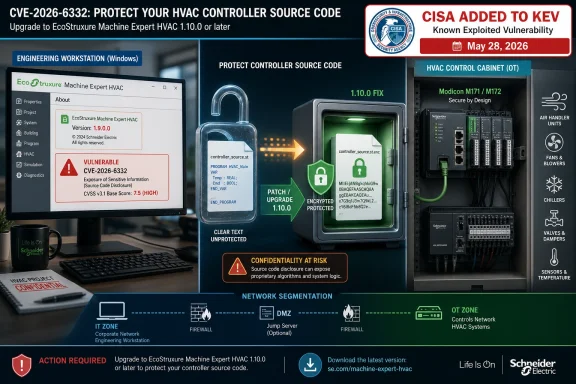
The Vulnerability Is Medium Severity, but the Asset Is High Value
The flaw, tracked as CVE-2026-6332 and Schneider Electric advisory SEVD-2026-132-01, affects EcoStruxure Machine Expert HVAC versions earlier than 1.10.0. Schneider describes the issue as cleartext storage of sensitive information, categorized under CWE-312, with the practical impact being disclosure of protected source code when an authorized attacker accesses code for editing or compiling.
That wording is easy to underestimate. “Authorized attacker” sounds less frightening than “remote unauthenticated attacker,” and a CVSS 3.1 score of 5.5 lands squarely in the medium band. But industrial environments do not grade risk only by exploit drama. They grade it by what the attacker learns.
In this case, the exposed prize is source code for HVAC-oriented logic controllers, specifically Schneider’s Modicon M171 and M172 family. That code may reveal how a building, plant, utility facility, or process environment actually behaves: setpoints, timing logic, alarms, interlocks, failover behavior, manual overrides, and sometimes the operational shortcuts that never make it into formal documentation.
For ordinary desktop software, source exposure can mean intellectual-property loss. In operational technology, it can also mean reconnaissance. A project file for a controller is a map of process intent, and maps are useful long before anyone touches a valve, compressor, pump, chiller, boiler, or air-handling unit.
CISA’s Republication Turns a Vendor Notice Into an Operator Deadline
Schneider Electric released the advisory on May 12, 2026. CISA’s May 28 republication did not create the vulnerability, but it changed the audience. A vendor security notice can be missed by anyone outside the Schneider partner ecosystem; a CISA ICS advisory lands on the desks of security teams, auditors, public-sector operators, insurers, and procurement departments.
That distinction matters because many EcoStruxure Machine Expert HVAC installations live in the awkward overlap between facilities engineering and IT security. The workstation may be Windows. The controller may be industrial. The owner may be a hospital, manufacturer, water utility, university, or energy site. The person who knows how to upgrade the software may not be the person who reads CISA advisories.
CISA’s republication also frames the affected sectors plainly: chemical, critical manufacturing, energy, and water and wastewater. The product is deployed worldwide, and Schneider Electric is headquartered in France. Those facts do not mean every installation is exposed to the same level of risk, but they do mean the affected software sits in environments where confidentiality failures can have operational consequences.
This is the recurring pattern in industrial cybersecurity: the vulnerable component is often not the most visible one. The logic controller in the cabinet looks like the asset. The engineering workstation beside it, the laptop in a contractor’s bag, or the VM image with stale programming tools may be the easier place to steal the blueprint.
Cleartext Storage Is the Boring Bug That Keeps Winning
Cleartext storage vulnerabilities are rarely glamorous. They do not require a speculative side channel, a nation-state implant, or an esoteric memory corruption chain. They are the security equivalent of leaving sensitive material in a drawer marked “sensitive material,” then assuming only the right people will open it.
That makes them especially stubborn in industrial software. Engineering tools tend to prioritize compatibility, offline access, recoverability, and field service convenience. Those priorities are not foolish; a controls engineer on-site at 2 a.m. needs the project to open, compile, and transfer reliably. But when sensitive data is stored in cleartext, convenience becomes a long-term liability.
The Schneider advisory says the risk arises when an authorized attacker accesses the source code for editing or compiling. That is a narrower condition than an internet-exposed exploit, but it fits realistic industrial intrusion scenarios. Contractors, shared engineering stations, compromised Windows accounts, poorly segmented remote-access systems, and reused maintenance laptops all create opportunities for a lower-privileged insider or attacker with foothold access to see more than they should.
The industry often reserves its highest alarm for vulnerabilities that can directly stop production. Yet confidentiality is not a second-class concern in industrial environments. A stolen control project can make later attacks cheaper, safer for the attacker, and harder for defenders to distinguish from legitimate engineering activity.
That is the uncomfortable part of this advisory. It does not say the attacker can seize control of a controller. It says the attacker can learn enough about protected source code to erode the secrecy around how the system is built. In ICS terms, that is not the end of the kill chain. It is often the beginning.
Windows Workstations Remain the Soft Underbelly of Industrial Control
For WindowsForum readers, the most relevant part of this advisory may be where the vulnerable software lives. EcoStruxure Machine Expert HVAC is programming software, not a controller firmware image in isolation. It runs on engineering workstations that, in many plants and facilities, are Windows machines with long lives, specialized vendor stacks, and complicated patch windows.
Schneider’s release notes for EcoStruxure Machine Expert HVAC 1.10.0 describe a maintenance release with software and firmware updates, bug fixes, and cybersecurity improvements. The supported operating systems listed for the release include older Windows versions, which is not surprising in operational environments but should raise an eyebrow for enterprise security teams. OT software often lags behind the mainstream endpoint lifecycle because the cost of change is measured in downtime, validation, and risk to physical operations.
That is why “just update” is the correct answer and an incomplete one. Updating an engineering tool may require checking project compatibility, validating controller communication, ensuring licenses still work, confirming library behavior, and coordinating with vendors or integrators. A Windows admin can push an office productivity patch with a maintenance window and a rollback plan. A controls team may need to prove that a project still compiles and behaves as expected before touching a production-connected workstation.
Even so, the direction of travel is clear. Engineering workstations should be treated as privileged systems, not general-purpose PCs. They hold the keys to controller logic, and they often connect across trust boundaries that ordinary enterprise endpoints never see.
A mature response to this advisory begins with inventory. Which machines have EcoStruxure Machine Expert HVAC installed? Which version? Who logs into them? Are project files stored locally, on shares, in source-control systems, or on removable media? Are old installers and archived project folders scattered across file servers? The vulnerability may be in the application, but the blast radius is determined by Windows hygiene.
The CVSS Argument Misses the Industrial Point
There is an interesting wrinkle in the public scoring. Schneider’s advisory as republished by CISA lists CVSS 3.1 at 5.5, with a local attack vector, low complexity, low privileges, no user interaction, unchanged scope, high confidentiality impact, and no integrity or availability impact. NVD’s enrichment, however, has listed a different CVSS 3.1 assessment with a higher score and a network attack vector.
That disagreement should not become the story, but it should influence how defenders read the advisory. Vendor scoring generally reflects the vendor’s understanding of the product and exploit path. NVD enrichment can differ as analysts interpret public details through a standardized lens. In this case, operators should avoid building policy around the number alone.
If the exploit truly requires local or authorized access, perimeter exposure is not the primary risk. If network-accessible project repositories, shared engineering environments, or remote access tools put those files within reach, the practical exposure could be broader than “local” implies. The gap between those interpretations is not academic; it is where real industrial networks live.
CVSS was never designed to fully capture the value of process knowledge. A medium vulnerability that exposes source code for an HVAC controller may be less urgent than a remote-code-execution flaw in a public-facing service, but it may be more strategically useful to an attacker targeting a particular facility. The score gives a starting point. The environment supplies the meaning.
That is especially true in building automation and HVAC. These systems are often dismissed as comfort infrastructure until they are tied to cleanrooms, pharmaceutical storage, data centers, hospital isolation rooms, manufacturing quality, or wastewater processes. HVAC logic can be safety-adjacent even when it is not formally classified as safety control.
Source Code Is Not Just Intellectual Property in a Plant
The phrase “protected source code” invites a corporate reading: this is about proprietary logic, engineering know-how, and vendor or integrator intellectual property. That is true, but too narrow. In an industrial environment, controller code is also operational intelligence.
A project can reveal which alarms matter and which have been suppressed. It can show where manual modes exist, how startup and shutdown sequences are ordered, whether safety assumptions are enforced in logic or merely in procedure, and where the installation has drifted from design intent. It may also expose naming conventions, networked device relationships, and controller dependencies that make later movement easier.
This is why confidentiality failures deserve more respect in OT than they often receive. Attackers do not need to modify a controller on day one if they can first understand how to modify it later without tripping alarms. They do not need to cause a visible incident if their goal is to copy process knowledge, prepare for sabotage, or sell access and documentation to someone else.
For defenders, source-code exposure also complicates recovery. If a project is known to have leaked, the organization cannot simply change a password. Logic may need to be reviewed for embedded secrets, hidden assumptions, hardcoded references, or workflows that depend on obscurity. Documentation, backup handling, and access controls may all need scrutiny.
That is a bigger task than installing version 1.10.0. The patch closes the known product weakness, but it does not retroactively protect project files that were already copied, archived, emailed, synced, or backed up in unsafe ways.
Schneider’s Fix Is Straightforward; Deployment Is the Hard Part
Schneider Electric says EcoStruxure Machine Expert HVAC version 1.10.0 fixes the vulnerability, and the update is available through the company’s download channel. That is the cleanest and most important remediation. Organizations running versions prior to 1.10.0 should plan an upgrade, validate it, and document the change.
The operational challenge is sequencing. Many facilities cannot treat engineering software like a browser update. They need to know whether existing projects open cleanly, whether libraries migrate correctly, whether controller firmware expectations change, and whether field laptops used by third-party contractors are also updated.
Contractor access is often the neglected corner. A facility may patch its own engineering workstation while an integrator continues to carry an older version on a service laptop. If that laptop stores customer projects in cleartext-exposed form, the organization’s risk has not disappeared; it has merely moved outside the building.
Procurement language should catch up. Maintenance contracts and vendor access agreements should require current engineering software versions, controlled handling of project files, and notification if source code is stored, transmitted, or backed up outside the owner’s environment. In 2026, “the vendor has the project” is not a security model.
The same goes for backups. Industrial teams are right to keep recoverable copies of controller projects, but recoverable does not mean readable by anyone with share access. Project repositories should be permissioned, logged, backed up securely, and reviewed for stale copies. If cleartext storage was part of the toolchain, defenders should assume older project artifacts deserve attention.
The Recommended Practices Are Familiar Because the Weaknesses Are Familiar
CISA’s defensive recommendations are the standard ICS canon: isolate control and safety networks, keep control devices away from the public internet, use firewalls, apply physical controls, scan removable media, use secure remote-access methods, and keep VPNs patched. None of that is surprising, and none of it is obsolete.
The problem is not that defenders have never heard these recommendations. The problem is that industrial environments are full of exceptions that become permanent. A temporary remote-access path stays open after commissioning. A programming laptop connects to both the business network and the control network because someone needed a file. A cabinet remains unlocked because the room is “secure enough.” A controller stays in program mode because the next service visit is soon.
This advisory intersects with all of those habits. If sensitive project information can be exposed through the engineering software, then every casual bridge into the engineering environment becomes more consequential. Removable media is not just a malware vector; it is also a source-code exfiltration vector. A shared workstation is not just an authentication problem; it is a project-confidentiality problem.
The advice to avoid connecting programming software to unintended networks is particularly relevant. Engineering tools should not roam freely between enterprise Wi-Fi, vendor VPNs, hotel networks, and control segments. If the workstation must be mobile, its data handling, disk encryption, endpoint protection, account model, and remote-access posture matter as much as the controller firmware.
Industrial security often focuses on keeping attackers out of the control network. That remains essential. But this case shows why keeping sensitive engineering data contained is equally important. A stolen project can travel long after a firewall rule is fixed.
The Misspelling Is Funny Until It Hits the Asset Register
The advisory text circulating through CISA includes the product name rendered as “Schnieider Electric” in some places, while the vendor is, of course, Schneider Electric. That typo is not the vulnerability, but it is a small window into a larger asset-management problem.
Security programs depend on names matching. If one tool inventories “Schneider Electric EcoStruxure Machine Expert HVAC,” another stores “Ecostruxure Machine Expert - HVAC,” and a third ingests “Schnieider,” automated matching can miss affected assets. Vulnerability management fails surprisingly often on spelling, naming conventions, product rebrands, and vendor taxonomy.
This is not unique to Schneider. Industrial software names are notoriously difficult to normalize, especially when products evolve from older names, regional packaging, or specialized editions. EcoStruxure itself is a broad umbrella, and “Machine Expert HVAC” is a specific branch within a larger family of Schneider engineering tools.
For administrators, the lesson is practical. Do not rely on one string match from a vulnerability scanner or software inventory system. Look for installed executables, publisher metadata, known install paths, package names, license records, engineering-team spreadsheets, and procurement history. Ask the controls team what they actually use, because the answer may not match the software title in a database.
A typo in a public advisory is harmless if humans catch it. It is less harmless if automation quietly drops the record.
The Real Risk Sits Between IT and Facilities
This advisory is exactly the kind that can fall between organizational chairs. IT may see a medium local vulnerability in niche engineering software and rank it below more obvious endpoint threats. Facilities may see a programming-tool update and defer it until the next planned service cycle. Security may file the CISA notice without knowing which building systems use Modicon M171 or M172 controllers.
That gap is where operational risk accumulates. HVAC control is rarely owned entirely by central IT, yet it increasingly depends on Windows hosts, remote access, vendor software, and network segmentation decisions. The people with patching discipline may not understand the process. The people who understand the process may not control the endpoints.
The right response is not to turn every Windows admin into a controls engineer. It is to build a shared operating model. IT should provide hardened workstations, identity controls, endpoint visibility, backup discipline, and vulnerability tracking. OT and facilities should provide application ownership, validation requirements, controller inventories, and maintenance windows. Security should translate advisories into risk scenarios rather than ticket titles.
In this case, the risk scenario is simple: someone with access to an engineering environment may be able to view sensitive controller source code because older EcoStruxure Machine Expert HVAC versions store sensitive information in cleartext. That scenario is specific enough to act on and broad enough to justify cross-team attention.
The patch should be tracked not merely as “installed” but as “validated.” If version 1.10.0 is installed on the primary workstation but the emergency laptop remains on an older build, the exposure persists. If archived projects remain readable in uncontrolled locations, the confidentiality problem may outlive the vulnerable software.
The 1.10.0 Upgrade Should Start a Wider Cleanup
The clean technical answer is to upgrade to EcoStruxure Machine Expert HVAC 1.10.0. The better security answer is to use the upgrade as a forcing function for engineering-data governance.
That begins with finding project files. Many plants have years of controller logic stored in ad hoc folders named after buildings, lines, chillers, contractors, or dates. Those files may have been copied between laptops, emailed during commissioning, placed on USB drives, or uploaded to shared drives for “temporary” access. If protected source code matters, then its storage locations matter too.
Next comes access control. Engineering projects should not be readable by every domain user, every facilities contractor, or every technician account. Least privilege is not just for cloud consoles and Active Directory groups. It applies to the folder where the controller logic lives.
Then comes monitoring. If project files are copied, compressed, renamed, synced, or moved to removable media, that may be legitimate engineering work. It may also be the one observable sign of source-code theft. Windows auditing, endpoint detection, data-loss-prevention tools, and file-server logs can help, but only if someone has decided that these files are sensitive in the first place.
Finally, organizations should review whether source code contains embedded secrets or operational shortcuts. The advisory is about cleartext storage by the product, not necessarily hardcoded credentials inside projects. But source exposure is a good reason to check whether controller logic, comments, configuration files, or project metadata reveal more than intended.
This is the moment to retire the idea that OT project files are self-protecting because only specialists know what to do with them. Attackers can learn. Insiders already know. Competitors and extortion groups understand the value of process documentation. Treat the code accordingly.
The Patch Is Small; the Signal Is Not
The practical actions from this advisory are concrete, but the larger signal is cultural. Industrial organizations need to stop treating engineering software as a trusted window into the control system and start treating it as a privileged asset that can leak, amplify, or preserve risk.
- Organizations using EcoStruxure Machine Expert HVAC should identify every installation and upgrade versions earlier than 1.10.0 after appropriate validation.
- Engineering workstations running the software should be handled as privileged Windows endpoints with strict account control, disk protection, logging, and limited network exposure.
- Project files and controller source-code archives should be inventoried, permissioned, and removed from uncontrolled shares, old laptops, removable media, and contractor handoff folders.
- Facilities and IT teams should verify that third-party integrators and service laptops are also using remediated software, not just the owner’s primary workstation.
- Security teams should treat source-code disclosure as operational reconnaissance risk, even when the CVSS score is medium and no direct integrity or availability impact is listed.
- Asset-management systems should account for product-name variations and even advisory typos so affected software is not missed by brittle searches.
The Schneider advisory is not a reason to panic, and it is not proof of active exploitation. It is a reason to do the unglamorous work that separates resilient industrial environments from lucky ones. Version 1.10.0 fixes the named flaw, but the more durable fix is a change in posture: controller projects, engineering laptops, and Windows-based programming tools belong inside the security boundary, not beside it. The next ICS advisory will have a different CVE and probably a different vendor, but the organizations best prepared for it will be the ones that used this medium-severity bug to tighten the places where operational knowledge quietly lives.
References
- Schnieider Electric EcoStruxure Machine Expert HVAC CISA · 2026-05-28T12:00:00+00:00