

Freiburg Treats School IT as Infrastructure, Not Decoration
For years, education technology has suffered from a mismatch between ambition and plumbing. Schools are asked to prepare students for a digital economy, protect minors’ data, modernize teaching, reduce teacher workload, support hybrid collaboration, and comply with privacy law — often while running on fragmented systems stitched together by overworked IT teams.
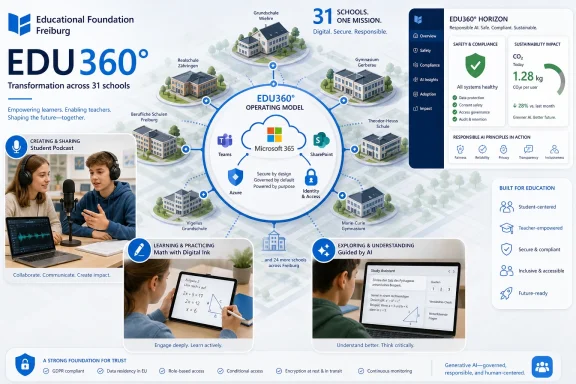
Educational Foundation Freiburg’s EDU360° initiative is a response to that problem. The foundation is not presenting digital transformation as a collection of classroom gadgets. It is building a common foundation across 31 schools, based on a single Microsoft 365 and Azure tenant, with shared governance, administration, identity, and security controls.
That distinction matters. A tablet in a classroom can be a learning tool, a distraction, or a support nightmare depending on the infrastructure around it. Freiburg’s bet is that the real transformation happens when classroom practice, administration, identity management, data protection, and AI access all sit inside one managed environment.
The phrase “single tenant” sounds dry, but in school IT it is the difference between strategy and entropy. A fragmented setup creates inconsistent policies, uneven access, duplicated work, and security blind spots. A unified tenant gives the foundation one place to manage users, devices, collaboration spaces, permissions, and compliance expectations.
The Classroom Examples Are Flashy, but the Operating Model Is the News
The Microsoft customer story leads with appealing classroom scenes: students producing podcasts instead of sitting conventional exams, math pupils using styluses on touch screens, and older students asking generative AI to summarize large document sets while tracking the energy consumption of their AI use. These examples are real and important because they show the cultural shift behind the infrastructure.
But the more consequential move is backstage. Teachers and staff are using the same ecosystem to simplify work that usually hides from public debate: assignment distribution, collaboration, documentation, automation, communication, and administrative workflows. EDU360° is as much about institutional consistency as student creativity.
That is where many education technology projects fail. A promising classroom pilot can win attention, but if the staff room still runs on email chaos, local spreadsheets, paper forms, and incompatible logins, the innovation remains ornamental. Freiburg appears to be trying to avoid that trap by treating the foundation’s schools as a shared digital organization.
This is why Dr. Michael Jülich’s framing is telling. He describes the need for a coherent, secure, scalable operating model that reduces workload, enables collaboration across sites, protects sensitive information, and introduces AI responsibly. That is not the language of a device rollout. It is the language of institutional redesign.
Microsoft’s Education Pitch Has Become Governance First, AI Second
Microsoft’s role in EDU360° reflects a broader shift in the company’s education strategy. The old pitch was productivity: Word, PowerPoint, Teams, OneNote, and cloud storage. The new pitch is governance: secure identity, managed devices, compliance controls, data residency, low-code automation, and AI inside an approved environment.
That shift is especially important in Europe. German schools operate under strict privacy expectations, and the European regulatory environment makes casual adoption of consumer AI tools risky. A teacher who pastes student work into a public chatbot may be trying to help, but the data protection implications are immediate.
Freiburg’s approach tries to solve this by making the approved path more useful than the shadow-IT path. If students and teachers can access capable AI tools, collaboration spaces, and digital assignments inside the managed school environment, they have less reason to improvise with unapproved services.
That is the central lesson for IT administrators. Policy alone rarely works when the sanctioned tool is clumsy and the unsanctioned tool is convenient. Governance becomes credible only when it is paired with usability.
Horizon Shows the Difference Between Using AI and Teaching AI
The foundation’s earlier work with Horizon, an AI-enhanced learning platform built in Azure, gives EDU360° its most interesting dimension. Horizon is not simply a chatbot pasted into school life. It is designed as a controlled environment where students and teachers can experiment with generative AI, compare models, summarize documents, generate content, and examine responsible-use questions.
That matters because schools face two separate AI challenges. They must decide how AI can support learning, and they must teach students what AI is doing. Those are not the same task.
A school can use AI to save teacher time without building student literacy. It can also ban AI in the name of academic integrity while leaving students to learn the technology elsewhere, often without guidance. Freiburg’s model is more ambitious: put AI into the curriculum, but do it inside a platform that makes safety, transparency, and reflection part of the lesson.
The reported inclusion of a CO2 tracker is a particularly sharp touch. AI literacy usually centers on hallucinations, plagiarism, bias, and data privacy. Energy consumption is often discussed at a policy level but rarely made visible to students during use. By surfacing environmental cost, Horizon pushes students to understand AI as infrastructure, not magic.
The European Privacy Context Makes the Project Harder — and More Interesting
It is easy to talk about AI in education as if the only stakeholders are students, teachers, and vendors. In Europe, privacy regulators are also in the room, whether visibly or not. Any system handling student identities, coursework, communications, and AI prompts must account for data minimization, access control, retention, and cross-border processing.
That is one reason the Freiburg case is more relevant than a generic “AI in schools” success story. The foundation is operating in Germany, where institutional trust and data protection expectations are high. Its stated emphasis on EU-aligned data handling and secure architecture is not decorative language; it is a prerequisite for scaling AI use across schools.
This is also where Microsoft has an advantage. The company can sell not just AI capability but the surrounding compliance story: Azure regions, Microsoft 365 administration, identity, security tooling, and enterprise governance. For a school foundation, that integrated story can be easier to defend than a loose collection of specialized tools.
The tradeoff is lock-in. A unified platform reduces friction, but it also concentrates dependency. Once identity, collaboration, content, automation, device management, and AI workflows are all built around one vendor’s stack, leaving becomes more difficult. Freiburg’s bet is that the benefits of coherence outweigh the risks of dependence.
Low-Code Is the Quiet Workhorse Behind the Education Cloud
Power Platform sits in the background of the Microsoft story, but it may be one of the most practical pieces. Schools are full of workflows that are too specific for off-the-shelf software and too small for traditional custom development. Permission forms, equipment requests, onboarding checklists, absence processes, event coordination, and internal approvals all create administrative drag.
Low-code tools promise to turn those pain points into lightweight applications. In theory, staff can build forms, automate routing, connect data, and create dashboards without waiting months for a bespoke development project. In practice, the success of low-code depends on governance as much as enthusiasm.
Without guardrails, low-code can become a new form of sprawl: dozens of fragile apps built by well-meaning staff, with unclear ownership and undocumented dependencies. Freiburg’s partnership with CGI for architecture, automation, governance, and Microsoft platform integration suggests the foundation understands that risk.
The best version of low-code in schools is not “everyone builds whatever they want.” It is controlled empowerment. Central IT provides templates, connectors, permissions, lifecycle rules, and review processes; teachers and administrators solve local problems within that structure.
The Teacher Workload Argument Is the One That Will Decide Adoption
Education technology often overpromises transformation and underestimates teacher time. A new system that requires teachers to rebuild lessons, manage logins, troubleshoot devices, and police AI misuse can quickly become another burden. The decisive question is not whether the technology is impressive. It is whether it makes a school day more manageable.
EDU360° is explicitly framed around reducing workload. That is smart, because teachers are unlikely to adopt platform changes at scale if the primary benefit is abstract modernization. They need visible gains: faster assignment handling, easier collaboration, fewer duplicated tasks, simpler communication, and more reliable access to materials.
The podcast example is useful here. Replacing a traditional exam with a student-produced podcast is not just a novelty; it changes assessment design, student agency, and teacher feedback. But it also requires a stable toolchain. Recording, editing, sharing, assessing, and archiving must be manageable inside the school environment.
The same is true of stylus-based math work. Digital ink in assignments sounds straightforward until a class encounters device inconsistency, file format problems, network issues, or confusing submission workflows. Infrastructure determines whether the digital lesson feels fluid or fragile.
AI in Schools Is Moving From Ban Lists to Managed Sandboxes
The first institutional reaction to generative AI in education was often defensive. Schools worried about plagiarism, unreliable answers, privacy exposure, and the collapse of take-home assessment. Those concerns were reasonable. But prohibition was never going to be a long-term strategy.
Students already use AI tools. The choice facing schools is whether that use happens invisibly through consumer services or visibly inside guided environments. Freiburg’s Horizon model embraces the latter.
A managed sandbox does not eliminate academic-integrity problems. It does, however, give teachers a way to design assignments around AI rather than pretend it does not exist. Students can be asked to compare outputs, critique summaries, inspect bias, document prompts, or reflect on when AI helped and when it misled them.
That is a more mature posture. It treats AI as a literacy domain, not simply a cheating vector. It also aligns with the reality that future workers will need to know when to delegate to AI, when to verify it, and when to avoid it.
The Security Story Begins With Identity
For WindowsForum readers, the most practical part of EDU360° may be the identity and tenant architecture. In a school system, identity is not just a login. It defines which student belongs to which class, which teacher can access which materials, which administrators can see sensitive data, and which external services are allowed to interact with the environment.
A single Microsoft tenant gives the foundation a common control plane. That makes it easier to apply conditional access, manage groups, configure Teams and SharePoint spaces, enforce retention policies, and standardize device access. It also gives IT a clearer audit trail when something goes wrong.
The alternative is familiar to any sysadmin who has inherited an organically grown environment: inconsistent accounts, local admin habits, duplicate directories, unmanaged file shares, forgotten apps, and permissions that nobody wants to touch because nobody knows what they will break.
Schools are especially vulnerable to this because users constantly move. Students graduate, teachers change roles, classes reset every year, and temporary staff need limited access. Without disciplined identity lifecycle management, yesterday’s convenience becomes tomorrow’s exposure.
CGI’s Role Points to the Real Labor Behind “Digital Transformation”
Vendor case studies often make transformation sound cleaner than it is. In reality, moving 31 schools toward a unified platform means migration planning, stakeholder management, governance design, training, support, integration, and endless edge cases. That is where implementation partners matter.
CGI’s role as strategic transformation and implementation partner is therefore not a footnote. The foundation reportedly worked with CGI on architecture design, automation, governance, and Microsoft platform integration. Those are the unglamorous layers that decide whether the program survives contact with everyday school operations.
Education environments are notoriously heterogeneous. One school may be more digitally mature than another. Some teachers may be enthusiastic early adopters; others may be skeptical or overwhelmed. Administrative processes may differ by site for historical reasons that no platform diagram captures.
The challenge is not simply technical migration. It is standardization without flattening local needs. The more ambitious the shared platform, the more carefully the foundation must decide which practices become common and which remain school-specific.
The Microsoft Stack Is Strongest When the Pieces Reinforce Each Other
EDU360° shows why Microsoft’s platform strategy remains powerful in institutional environments. Teams, OneNote, SharePoint, Entra identity, Intune device management, Power Platform, Azure, and AI services are individually replaceable in many scenarios. Together, they become a default operating layer.
That is the strategic logic. A student assignment can live in Teams, connect to OneNote or SharePoint, rely on identity groups, be accessed from a managed device, feed a workflow in Power Automate, and eventually intersect with AI services in Azure. The more these pieces interoperate, the less attractive isolated alternatives become.
For IT teams, integration can reduce support complexity. For teachers, it can reduce the number of systems they must learn. For administrators, it can create better visibility across sites. For Microsoft, it deepens institutional dependency.
This is not inherently bad. Schools need dependable platforms. But the governance question does not end once the vendor is selected. The foundation still needs internal expertise, exit planning, data portability, procurement discipline, and a clear understanding of which capabilities are core and which are optional.
Responsible AI Requires More Than a Responsible AI Page
The phrase “responsible AI” is now so common that it risks becoming a corporate incantation. Freiburg’s project is interesting because it appears to attach responsibility to concrete design choices: approved environments, data sovereignty, content safety, model comparison, AI literacy, teacher guidance, and environmental awareness.
That is the right direction. Responsibility cannot live only in policy documents. It has to show up in product behavior, classroom practice, logging, permissions, and assessment design.
Students need to see AI outputs as claims to be examined, not answers to be copied. Teachers need enough training to understand failure modes without becoming machine-learning experts. IT teams need to know where prompts and files go. Parents need confidence that student data is not being casually fed into opaque systems.
The hard part is sustaining that responsibility as tools evolve. AI models change quickly. Features that are safe in a pilot may behave differently at scale. A framework that works for 200 high school students may need revision when deployed across more ages, subjects, and schools.
The Foundation Is Also Teaching Institutional Behavior
The most overlooked effect of a program like EDU360° may be the behavior it teaches adults. When teachers collaborate in shared digital spaces, when administrators automate routine processes, and when leadership uses common governance models, students see an institution practicing the digital habits it claims to value.
That matters. Schools often teach “digital competence” as a student outcome while leaving institutional workflows untouched. The result is a credibility gap. Students are told to prepare for modern work while watching adults navigate paper forms and email attachments.
Freiburg’s model narrows that gap. If the same environment supports learning, administration, communication, and AI experimentation, digital competence becomes part of the school’s operating culture rather than a separate curriculum strand.
This is not about turning schools into corporations. It is about acknowledging that modern civic, academic, and professional life depends on collaboration systems, data judgment, security awareness, and responsible automation. Schools cannot teach those fluently if their own systems remain incoherent.
The Risk Is That Platform Order Becomes Pedagogical Conformity
A unified platform brings real benefits, but it also carries a subtle educational risk. Standardization can improve security and reduce workload, yet schools are not factories. Good teaching often depends on local context, experimentation, and professional judgment.
If EDU360° becomes too prescriptive, it could make teachers feel that the platform defines the pedagogy rather than supports it. The danger is not Microsoft specifically; it is the institutional temptation to confuse measurable digital activity with meaningful learning.
A podcast assignment may be excellent if it deepens understanding and gives students a richer way to demonstrate knowledge. It may be weak if it merely substitutes production value for rigor. AI summarization may teach critical literacy if students inspect and challenge the output. It may dull comprehension if it becomes a shortcut around reading.
The platform can enable better education, but it cannot guarantee it. That is why Jülich’s line — “Technology is never the goal. Better education is.” — is more than a slogan. It is the test the project has to keep passing.
Windows IT Pros Should Watch the Management Layer
For sysadmins, the Freiburg story is less about education branding and more about the management pattern. Many organizations outside education face the same problem: too many tools, inconsistent identities, uncontrolled AI use, manual workflows, and rising compliance pressure.
The EDU360° pattern is recognizable. Consolidate identity. Standardize collaboration. Move sensitive workflows into governed cloud services. Use low-code automation for local process gaps. Provide approved AI access before shadow AI becomes unmanageable. Train users not just on buttons, but on responsible behavior.
This is the direction Microsoft wants customers to move: from software licensing to platform dependency, from productivity apps to organizational operating systems, from AI experimentation to AI governance. Education is a particularly sensitive proving ground because the users include minors and the workflows include both learning and personal data.
If Freiburg can make the model work, it strengthens Microsoft’s argument that its cloud stack is suitable for high-trust public and nonprofit environments. If the model stumbles, it will likely be for familiar reasons: training gaps, change fatigue, governance drift, unclear ownership, or the gap between vendor narrative and classroom reality.
Freiburg’s Real Test Begins After the Rollout
The first phase of a transformation program is often the easiest to describe and the hardest to judge. Announcements highlight architecture, partners, pilots, and early classroom stories. The real test comes later, when the systems become ordinary.
Do teachers still use the tools after the novelty fades? Do workflows actually reduce administrative burden? Do students become more critical AI users, or just more efficient prompt writers? Are privacy and security controls maintained as new features arrive? Does the foundation continue investing in support and training?
Those questions will decide whether EDU360° is a durable model or a polished case study. Technology programs in schools often suffer from launch bias: lots of energy at the beginning, less attention to maintenance. Freiburg’s emphasis on governance and foundation-wide operating structure suggests it is trying to avoid that pattern.
Scale will also complicate the AI work. A controlled seminar with motivated high school students is one thing. A broad deployment across ages, subjects, and teacher comfort levels is another. Responsible AI becomes harder when it leaves the pilot group and enters the timetable.
The Freiburg Model Gives School IT a More Serious Vocabulary
The most useful thing about EDU360° is that it gives education leaders a more serious way to talk about technology. Instead of asking whether schools should use AI, tablets, Teams, or cloud services, it asks how those tools fit into an operating model that can be governed, secured, taught, and sustained.
That vocabulary is overdue. Too much education technology debate swings between boosterism and panic. One side imagines tools will transform learning by their mere presence. The other imagines schools can preserve old models by banning new ones. Neither position survives contact with students who already live in a digital world.
Freiburg’s approach is more pragmatic. It accepts that AI and cloud collaboration are now part of the educational landscape, but it insists they must be brought inside institutional boundaries. It gives teachers and students room to experiment while trying to keep privacy, security, and ethics from becoming afterthoughts.
For WindowsForum’s audience, that is the broader significance. The future of school IT will not be won by the flashiest classroom demo. It will be won by the institutions that can make secure, usable, AI-aware digital systems feel normal.
The Details That Make EDU360° Worth Watching
Freiburg’s project is still unfolding, and its long-term success will depend on execution rather than architecture diagrams. But several concrete features make it more than another cloud migration story.
- Educational Foundation Freiburg is building EDU360° across 31 schools rather than limiting modernization to isolated pilots.
- The foundation is using a single Microsoft 365 and Azure tenant to create a shared operating model for identity, collaboration, administration, and security.
- Classroom uses include podcast-based assessment, stylus-driven digital math work, and guided generative AI research.
- The Horizon AI platform gives students and teachers a managed environment for experimenting with generative AI while addressing privacy, safety, and ethical use.
- CGI’s involvement signals that the project includes architecture, automation, governance, and integration work rather than just licensing and deployment.
- The strongest measure of success will be whether the platform reduces workload and improves learning after the initial rollout becomes routine.
Freiburg’s EDU360° initiative is a reminder that the next phase of education technology will be less about whether schools use AI and more about who controls the environment in which AI is used. Microsoft is offering the foundation a coherent stack; Freiburg is trying to turn that stack into a governed school operating model. If the project holds together at scale, it may point toward a future where digital learning is not a special project at the edge of school life, but part of the institutional fabric — secure enough for administrators, useful enough for teachers, and transparent enough for students to understand the tools shaping their world.