

The ML services market in 2025 is being shaped by a familiar mix of hyperscale cloud providers, consulting powerhouses, and specialised AI vendors — a group Analytics Insight identified in its “Top 10 ML Development Companies of 2025” roundup — but the story beneath the headline is more nuanced: enterprises are choosing partners for end-to-end MLOps, industry-specific domain knowledge, and the ability to govern, deploy and monitor models at scale rather than for single-tool excellence.
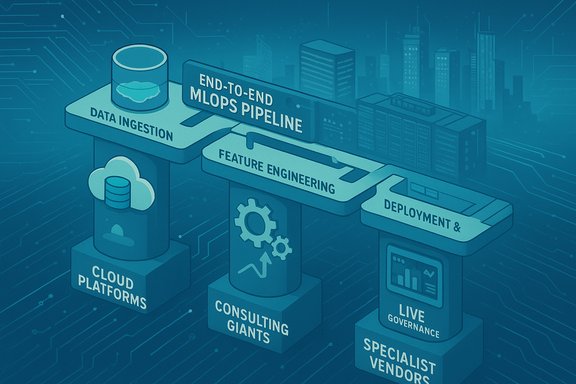
The past two years have accelerated two irreversible trends: first, AI workloads have become dramatically more compute- and data-intensive, and second, business buyers now demand outcomes — measurable ROI, governance, and integration with core enterprise systems — not just model prototypes. Cloud platforms (AWS, Google Cloud, Microsoft Azure) provide the foundational infrastructure and managed services that make training and inference feasible at scale; consulting firms (Accenture, Deloitte, BCG) convert those capabilities into business processes; and specialised platforms (DataRobot, InData Labs, ScienceSoft) focus on verticalised problem solving and automation. Vendor claims in 2025 therefore read less like feature lists and more like service-level promises around model observability, secure data handling, and continuous delivery for ML.
Two external facts frame the market context for ML providers this year. First, infrastructure and enterprise IT spending remains strong where AI is strategic: Gartner and market reporting show India’s IT spend running in the low‑hundreds of billions in 2025, with double-digit growth in AI-enabled software and services — proof that markets are re‑allocating budgets toward AI and cloud investments. Second, compute geography matters: independent analyses of global AI infrastructure put the United States in a dominant position for raw AI compute while China leads in the count of data‑centre clusters — a reminder that access to accelerators, power and network capacity is a strategic advantage for any ML platform provider.
The practical takeaway for decision-makers is simple: match the vendor type to the business objective. Choose hyperscalers when compute scale and integrated cloud services are the priority. Choose consultancies to bridge strategy to production at enterprise scale. Choose specialist vendors when you need bespoke engineering and faster, focused delivery.
Across all choices, insist on demonstrable MLOps practices, governance, and cost transparency. Where public claims are made about compute, spend or adoption, cross‑check with primary vendor documentation and analyst reports; treat headline numbers as directional unless independently auditable. The market’s winners in 2025 will be the providers that combine technical depth with disciplined delivery, measurable outcomes and accountable governance — the capabilities that let enterprises safely and sustainably convert ML into business value.
Source: Analytics Insight Top 10 ML Development Companies of 2025
 Background / Overview
The past two years have accelerated two irreversible trends: first, AI workloads have become dramatically more compute- and data-intensive, and second, business buyers now demand outcomes — measurable ROI, governance, and integration with core enterprise systems — not just model prototypes. Cloud platforms (AWS, Google Cloud, Microsoft Azure) provide the foundational infrastructure and managed services that make training and inference feasible at scale; consulting firms (Accenture, Deloitte, BCG) convert those capabilities into business processes; and specialised platforms (DataRobot, InData Labs, ScienceSoft) focus on verticalised problem solving and automation. Vendor claims in 2025 therefore read less like feature lists and more like service-level promises around model observability, secure data handling, and continuous delivery for ML.Two external facts frame the market context for ML providers this year. First, infrastructure and enterprise IT spending remains strong where AI is strategic: Gartner and market reporting show India’s IT spend running in the low‑hundreds of billions in 2025, with double-digit growth in AI-enabled software and services — proof that markets are re‑allocating budgets toward AI and cloud investments. Second, compute geography matters: independent analyses of global AI infrastructure put the United States in a dominant position for raw AI compute while China leads in the count of data‑centre clusters — a reminder that access to accelerators, power and network capacity is a strategic advantage for any ML platform provider.
How this list was assembled — selection criteria
The companies discussed below are the ones Analytics Insight highlighted as market leaders. To construct an editorially useful feature for WindowsForum readers, the following practical criteria were applied and independently validated where possible:- End-to-end ML capability: data ingestion, feature engineering, training, deployment, and monitoring.
- Scalability: ability to support large models and distributed training or managed inference.
- Enterprise readiness: security, identity, governance, and on‑prem / hybrid deployment options.
- Vertical and consulting capability: industry expertise and integration into business processes.
- Market traction and product maturity: customer case studies, product documentation, and third‑party analyst placements.
The Top 10 — company-by-company analysis
Amazon Web Services (AWS)
AWS remains the largest cloud provider and the default for many organisations building ML pipelines. AWS offers a comprehensive ML stack — from managed APIs and pretrained services to SageMaker for end-to-end model development and Bedrock for foundation-model hosting — plus custom accelerator silicon and a vast global footprint that makes it the pragmatic choice for large-scale training and inference. AWS documentation emphasises integrated services for labeling, model explainability and deployed monitoring, and AWS’s infrastructure scale helps enterprises reduce operational friction for large distributed jobs. Strengths:- Massive compute and global reach, well-suited to high-throughput training.
- Broad catalogue covering vision, language and tabular workloads.
- Mature MLOps tooling (SageMaker Pipelines, Model Monitor).
- Complex pricing and the risk of lock‑in when customers adopt many managed services.
- For buyers prioritising packaged enterprise apps (Copilot-like seat monetization), AWS’s more modular approach can require extra integration work.
Google Cloud AI (Vertex AI)
Google’s Vertex AI is increasingly the technical favourite for data‑centric ML teams. Vertex AI combines a polished model lifecycle platform, access to Google’s Gemini model lineage, and efficient TPU-backed infrastructure for training. Google’s strength is developer-first tooling — BigQuery/Vertex integrations, native model debugging and a strong emphasis on dataset, feature and experiment management — which appeals to teams focused on building custom models and analytics pipelines. Strengths:- Advanced developer tooling and deep integration with data warehouses.
- TPU-backed training options for model efficiency.
- Strong research pedigree and model stack (Gemini).
- Makes the most sense if you’re data‑centric and comfortable with Google’s ecosystem; migrating large legacy estates can be harder.
Microsoft Azure AI
Microsoft’s Azure AI and the broader Microsoft cloud ecosystem deliver a differentiated value proposition for Windows-anchored enterprises. Azure combines a mature set of ML services with deep integrations into Microsoft 365, GitHub, and Copilot experiences. This means organisations that already operate in Microsoft ecosystems can productize AI more quickly through seat-level monetization and packaged app experiences. Azure also focuses strongly on hybrid and on‑prem deployment patterns — an important capability for regulated industries. Strengths:- Tight enterprise integration and hybrid deployment options.
- Strong governance tooling and identity integration (Azure Active Directory).
- Productized user experiences (Copilot) that accelerate adoption.
- Capacity expansion for hyperscale AI can stress regional availability; customers should validate capacity SLAs for heavy GPU work.
IBM (watsonx)
IBM continues to position watsonx as an enterprise-focused AI platform, combining model training and governance with data platform tooling aimed at regulated industries where explainability and on‑prem options matter. IBM’s pitch is clearly oriented to customers who require strong data governance, model lineage, and industry-specific solutions that can run behind corporate firewalls. Public IBM documentation and IBM’s market messaging make governance a central differentiator. Strengths:- Enterprise governance and hybrid deployment options.
- Credible vertical playbooks in regulated sectors (finance, healthcare).
- Historically seen as conservative on cutting-edge model performance; the tradeoff is governance and security.
DataRobot
DataRobot is one of the best-known specialised ML platforms offering automated workflows for model creation, feature engineering, deployment and monitoring. In 2025 it has reoriented aggressively toward agentic/agent‑based automation and enterprise governance, positioning itself as an outcomes-first platform for customers who need fast time-to-value and built-in model management. DataRobot’s platform supports hybrid and multi-cloud deployments and carries references to measurable ROI in operational use-cases. Strengths:- Rapid prototyping to production workflows and strong MLOps features.
- Emphasis on explainability and governance.
- Platform adoption requires careful integration effort for highly custom enterprise workflows.
Accenture
Accenture is a delivery-first heavyweight: its Applied Intelligence practice combines strategy, engineering and large-scale operational transformation. Accenture’s differentiator is not a single product but delivery scale: advisory + systems integration + managed services that can carry multi-year transformation programs. Accenture’s public filings and news coverage show significant bookings for generative AI and enterprise delivery, which supports enterprise-grade rollouts. Strengths:- Global delivery capacity and industry-specific accelerators.
- Ability to package strategy, data-platform engineering, and governance into a single engagement.
- Large engagements carry long timelines and require careful contracting to secure measurable outcomes.
Deloitte
Deloitte’s AI practice focuses on business transformation, data engineering, and AI adoption at scale, often partnering with hyperscalers for technical delivery. Deloitte’s collaborations (for example, with AWS on AI accelerators) underline a strategy of combining consulting with platform partnerships to accelerate real-world deployments. Deloitte’s strengths are program-level governance, regulatory compliance and broad sector experience. Strengths:- Strong governance and risk management capabilities.
- Large-scale systems integration and cloud partnerships.
- Cost and resourcing considerations for smaller organisations seeking quick wins.
Boston Consulting Group (BCG — BCG GAMMA)
BCG’s analytics arm (BCG GAMMA) focuses on strategic AI adoption plus building proprietary analytics products and operational AI. BCG’s approach blends traditional strategy consulting with embedded analytics teams to deliver measurable productivity and performance improvement. BCG’s positioning matters for organisations that need to connect ML to core business strategy and operational change programs. Strengths:- Strategy-first approach that ties AI to measurable KPIs.
- Strong research and product teams for building tailored analytics platforms.
- Premium consulting fees and the need to anchor strategy with fast wins to avoid protracted pilots.
InData Labs
InData Labs is a specialised software engineering and AI consultancy that delivers tailored solutions such as predictive modeling, computer vision and data engineering. For organisations seeking bespoke models and tight engineering ownership (including on-prem or private-cloud deployments), InData Labs offers a pragmatic engineering-first approach with domain-specific connectors and pipelines. Their public service descriptions evidence a focus on applied engineering across multiple verticals. Strengths:- Custom engineering delivery and flexible deployment models.
- Good fit for mid-market customers or enterprises with bespoke requirements.
- As a smaller specialist, large global rollouts require careful resourcing and program governance.
ScienceSoft
ScienceSoft offers a catalogue of AI services — predictive analytics, NLP, computer vision — combined with systems integration and software engineering. While ScienceSoft’s public presence is less prominent than the hyperscalers, it positions itself as a pragmatic partner for enterprises needing tailored AI solutions, often emphasizing iterative delivery and integration into existing systems. Public directory and company pages corroborate their service focus, but vendor claims should be validated with client references for large-scale programs. Strengths:- Practical implementation focus for medium-sized deployments.
- Cross-domain experience across industry verticals.
- Buyers should require references and proof points for scale and governance.
Comparative strengths and practical buyer guidance
What each type of provider is best at
- Hyperscale clouds (AWS, Google Cloud, Azure): scale, accelerator access, managed ML services and integrated data platforms.
- Consulting giants (Accenture, Deloitte, BCG): transformation at scale, governance, and industry playbooks — they turn prototypes into business processes.
- Specialist ML vendors (DataRobot, InData Labs, ScienceSoft): rapid model development, automation and verticalised engineering for bespoke use cases.
Key buyer checklist (practical)
- Inventory data and regulatory constraints (data residency, PII, HIPAA, GDPR).
- Define the expected business outcome (revenue lift, cost reduction, automation hours).
- Choose deployment model: cloud-first, hybrid or on‑prem — validate vendor container or air‑gap support.
- Insist on explicit SLAs for compute availability and model performance metrics.
- Verify governance: versioning, lineage, audit logs, explainability and human‑in‑the‑loop controls.
- Pilot with production‑like data and measure total cost of ownership, including inference, embedding generation and egress.
Technical and business risks to watch in 2025
- Capacity and capital intensity: Hyperscalers have committed record capex to AI infrastructure; if adoption slows or cheaper model efficiency breakthroughs appear, these investments could pressure margins. Independent industry analyses from late 2024–2025 documented capex increases and the risk of underutilization.
- Model and data governance: Faster time-to-value must not come at the expense of explainability and regulatory compliance. Enterprises must build robust model registries and monitoring to avoid model drift and compliance surprises.
- Vendor lock‑in and portability: Managed model hosting and proprietary APIs increase the cost of switching vendors. Architect for portability (containerized inference, model export formats) where possible.
- Token and inference economics: For LLM-based deployments, inference and embedding costs can dominate TCO; plan for caching, batching and efficient retrieval strategies.
- Unverifiable market claims: Pay attention to marketing figures that lack public auditability (private valuations, unverified adoption rates). Where an article repeats a private claim, treat it as indicative and seek corroboration. The Analytics Insight piece, for example, includes several industry claims about market momentum and firm strengths; many are supported by public vendor pages and analyst reports, but some headline numbers in FAQs (e.g., sweeping macroeconomic narratives about “the U.S. economy split”) are anecdotal and require caution.
Validation and cross‑checks
Key claims from the Analytics Insight list were cross‑checked against vendor documentation and independent analyst reporting:- AWS ML and SageMaker capabilities are documented on AWS’s official machine-learning pages and whitepapers.
- Google’s Vertex AI platform and Gemini model availability are described on Google Cloud product pages.
- Microsoft’s hybrid and enterprise AI messaging (Copilot, Fabric, Azure AI) and seat-based monetization are corroborated by recent coverage and Microsoft documentation.
- Gartner forecasts for India’s IT spending and the growth vector of GenAI-enabled software are available in Gartner releases and were reported across mainstream outlets. Note: different outlets round and report numbers slightly differently; where precise budgeting matters, use the original Gartner release for contract negotiation.
- Global AI compute and cluster counts used in some commentary are taken from the TRG Datacenters study and were independently summarised by business press; these numbers illustrate compute concentration rather than exact, audit‑grade tallies. Treat cluster maps as directional indicators.
Practical MLOps checklist for Windows-centric organisations
- If your estate is Microsoft-heavy (Windows Server, Active Directory, Office 365), Azure offers a shorter path to productized AI (Copilot + Fabric + Azure AI) and deeper identity integration; validate regional capacity for heavy GPU workloads before committing.
- Standardise on container formats (ONNX, TorchScript) and automated CI/CD for models. Use managed model registries and experiment tracking across staging and production.
- Measure per-inference cost and track embedding generation budgets. For retrieval-augmented generation, embedding costs can balloon if not batched and deduplicated at the pipeline level.
- Implement layered guardrails: content safety, data policies, and a human-in-the-loop exception queue for low-confidence outputs.
Conclusion
The Analytics Insight roundup reflects a valid industry pattern in 2025: the convergence of cloud-scale infrastructure, consulting delivery capability, and specialist engineering firms has produced a market where outcomes matter more than raw technical novelty. AWS, Google Cloud and Azure continue to supply the infrastructure and managed primitives; IBM and DataRobot provide governance and enterprise-grade platforms; Accenture, Deloitte and BCG bring the transformation engines; while InData Labs and ScienceSoft supply pragmatic, tailored engineering.The practical takeaway for decision-makers is simple: match the vendor type to the business objective. Choose hyperscalers when compute scale and integrated cloud services are the priority. Choose consultancies to bridge strategy to production at enterprise scale. Choose specialist vendors when you need bespoke engineering and faster, focused delivery.
Across all choices, insist on demonstrable MLOps practices, governance, and cost transparency. Where public claims are made about compute, spend or adoption, cross‑check with primary vendor documentation and analyst reports; treat headline numbers as directional unless independently auditable. The market’s winners in 2025 will be the providers that combine technical depth with disciplined delivery, measurable outcomes and accountable governance — the capabilities that let enterprises safely and sustainably convert ML into business value.
Source: Analytics Insight Top 10 ML Development Companies of 2025
