

Wall Street’s AI panic can be boiled down to two simple forces: an enormous surge of expectations about automation and disruption, and a stubborn lack of short‑term proof that those expectations will translate into durable revenue for incumbent tech companies. Wedbush’s Dan Ives argues the panic isn’t immutable — it can be reversed by a handful of concrete headlines that restore confidence in capital flows, chip demand, and the ability of big tech and software companies to monetize AI. Those headlines range from a blockbuster funding round at OpenAI to reassuring guidance from Nvidia, a successful massive capital raise by Oracle, and a string of earnings that show AI is already paying off.
Short, sharp market moves in February exposed how quickly the AI narrative can swing from a story of opportunity to a story of existential threat for whole subsectors. Software, cybersecurity, insurance, wealth management, and logistics names were whipsawed as investors digested announcements from leading AI labs and model vendors that suggested some tasks could be automated faster than many expected. Wedbush’s characterization — that investors are “fighting a ghost” as they punish software names in anticipation of future AI displacement — captured the mood on the trading floor. Those comments, and the market reactions they aim to explain, were widely reported in market press and aggregator pieces in mid‑February.
At root, the sell‑off has been driven by two linked anxieties. First, the fear that specialized AI models (and new startups deploying them) could rapidly replace revenues for legacy software vendors. Second, the question whether the gigantic capital expenditures flowing into AI infrastructure — GPUs, data centers, networking and services — will generate profitable, sustainable business models beyond the raw excitement of the moment. Wedbush and other firms put that cap‑ex number near the upper hundreds of billions for 2026, reinforcing a sense that huge sums are being bet on outcomes that remain uncertain.
Caveat: these funding reports were widely reported as rumors at the time, and numbers vary between outlets. Because different vendors quoted distinct figures, any investor relying on a single number would be reckless; traders would care far more about the substance of the deal (commitments, governance, optionality to public markets) than the rounded headline. Treat funding totals as material only when confirmed in a regulatory filing or an issuer/lead investor press release.
What to watch on the call: guidance (revenue, margins), multi‑quarter orders or inventory commitments from hyperscalers, statements on supply constraints and capacity buildout, and commentary on new architectures or product ramps. A single quarter doesn’t prove a secular story, but consistent multi‑quarter demand signals go a long way toward soothing market fears about sustainability.
Risk: a poorly received raise or one that materially dilutes equity could have the opposite effect: it would highlight how expensive and politically fraught the AI buildout can be. Success is not binary; markets will assess pricing, structure, and whether the proceeds are being deployed into revenue‑generating data center capacity or merely to service borrowing costs.
What to expect: disclosure of AI‑related ARR (annual recurring revenue), development of higher‑margin product tiers tied to AI features, and commentary on customer adoption timelines. Investors will scrutinize both top‑line growth and the margin profiles of AI products.
Tradeoffs: M&A often lags sentiment and moves on cycles. A brief spike in deal volume could be as much about cheap financing as about confidence in AI — and buyers that overpay could set off other worries about capital discipline.
Reality check: the bar for Apple is high. Any Siri rollout must satisfy privacy, latency, and reliability expectations across a billion devices. A buggy or privacy‑compromising release would be a negative catalyst, not a cure.
Caveat: regulatory or security failures at a model provider would also trigger broader sector risk, including calls for tighter governance and slowdown in adoption — an outcome that might hurt both startups and incumbents.
Investors should therefore treat Ives’ framework as a roadmap of things to watch rather than as a promise that any single headline will end the panic forever. The market will respond rapidly to confirmed, high‑quality disclosures; it will respond far less predictably to leaks and rumors. For now, the anxiety that prompted the sell‑off — the fear of unknown, rapid displacement — remains a real, outcome‑dependent thesis. The cure that the market seeks is not a single press release; it is a series of confirmable, revenue‑driven datapoints that collectively demonstrate AI is an engine of growth, not just expense.
Source: AOL.com Here's what an analyst says could end the AI panic that's gripped Wall Street
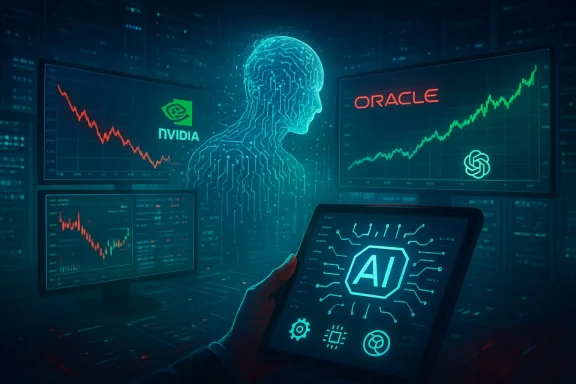 Background: how an optimism wave turned into a "ghost trade"
Short, sharp market moves in February exposed how quickly the AI narrative can swing from a story of opportunity to a story of existential threat for whole subsectors. Software, cybersecurity, insurance, wealth management, and logistics names were whipsawed as investors digested announcements from leading AI labs and model vendors that suggested some tasks could be automated faster than many expected. Wedbush’s characterization — that investors are “fighting a ghost” as they punish software names in anticipation of future AI displacement — captured the mood on the trading floor. Those comments, and the market reactions they aim to explain, were widely reported in market press and aggregator pieces in mid‑February.At root, the sell‑off has been driven by two linked anxieties. First, the fear that specialized AI models (and new startups deploying them) could rapidly replace revenues for legacy software vendors. Second, the question whether the gigantic capital expenditures flowing into AI infrastructure — GPUs, data centers, networking and services — will generate profitable, sustainable business models beyond the raw excitement of the moment. Wedbush and other firms put that cap‑ex number near the upper hundreds of billions for 2026, reinforcing a sense that huge sums are being bet on outcomes that remain uncertain.
What Dan Ives says could stop the panic — and why each item matters
Ives distilled his list of market‑moving headlines into a set of very specific, verifiable milestones. Each one functions as a different kind of credibility proof: funding validates valuations and IPO prospects; earnings and chip guidance validate demand; successful capital markets transactions validate investor appetite for AI infrastructure; M&A activity signals strategic, not destructive, repositioning; and real‑world enterprise deployments reveal where AI helps rather than replaces. Below I take each proposed headline in turn, verify where possible, and analyze the plausible market reaction if — and only if — the events materialize in the way investors hope.1) A large, clear funding round for OpenAI (the $100B / $110B rumors)
Why it matters: a massive, disclosed funding round for OpenAI would do two things simultaneously. It would demonstrate continued deep-pocketed investor belief in frontier models, and it would create secondary market momentum for companies tangentially tied to OpenAI’s stack (cloud vendors, GPU suppliers, enterprise tooling). The theory is that if OpenAI can secure long‑term capital at a sky‑high valuation, markets will stop treating the company as an “uncertain” black box and instead price a clearer path to monetization and liquidity. The rumor mill around a nine‑ or ten‑figure infusion led some outlets to report numbers in the $100 billion neighborhood, while wire reports suggested upwards of $110 billion in fresh capital from a consortium. Those reports, however, were inconsistent on both size and valuation. One major wire reported a $110B infusion putting OpenAI at roughly a $730B pre‑money valuation, while other coverage and earlier rumor threads cited different totals and valuations. The upshot: the headline would be powerful, but the details — who writes checks, what governance strings attach, and the timing of any IPO window — would determine market reaction.Caveat: these funding reports were widely reported as rumors at the time, and numbers vary between outlets. Because different vendors quoted distinct figures, any investor relying on a single number would be reckless; traders would care far more about the substance of the deal (commitments, governance, optionality to public markets) than the rounded headline. Treat funding totals as material only when confirmed in a regulatory filing or an issuer/lead investor press release.
2) A bullish, demand‑confirming Nvidia earnings and commentary from Jensen Huang
Why it matters: Nvidia is the mechanical heart of the current AI investment narrative. Strong revenue, robust guidance, or unambiguously positive commentary from CEO Jensen Huang that customer demand is sustainable would validate the infrastructure side of the AI thesis. In late February, Nvidia delivered headline beating results and management framed the moment as an “agentic AI inflection,” language that helped calm some jittery investors. Analysts and market observers had singled the earnings call out as a likely catalyst because a bullish read would suggest that hyperscalers and cloud providers are still committed to heavy GPU spending.What to watch on the call: guidance (revenue, margins), multi‑quarter orders or inventory commitments from hyperscalers, statements on supply constraints and capacity buildout, and commentary on new architectures or product ramps. A single quarter doesn’t prove a secular story, but consistent multi‑quarter demand signals go a long way toward soothing market fears about sustainability.
3) Oracle’s $45–$50 billion capital‑raise proving successful in the public markets
Why it matters: Oracle’s plan to raise between $45 billion and $50 billion in 2026 to fund cloud expansion is one of the clearest, most tangible examples of an incumbent doubling down on AI infrastructure. Oracle disclosed the program and made the size explicit in a corporate announcement; if Oracle is able to execute that financing with favorable terms, it would show that public markets are willing to fund large, infrastructure‑level bets on AI. That in turn would reassure investors that the financing pathway for datacenter scale — not just VC rounds — is open.Risk: a poorly received raise or one that materially dilutes equity could have the opposite effect: it would highlight how expensive and politically fraught the AI buildout can be. Success is not binary; markets will assess pricing, structure, and whether the proceeds are being deployed into revenue‑generating data center capacity or merely to service borrowing costs.
4) Big‑tech earnings that show AI monetization is already happening
Why it matters: investor anxiety largely boils down to whether AI is a revenue multiplier or simply a cost center. Concrete evidence that Microsoft, Salesforce, ServiceNow, or other software stalwarts are growing AI‑linked revenue, raising margins, or re‑rating their multiples would turn the narrative. Wedbush and other firms explicitly named certain companies as the roster to watch for AI monetization, and CrowdStrike was cited as an example of security software that appears to be benefitting in the transition, not being replaced by it. When those revenue lines show up in GAAP/ec reporting, it’s harder for the market to cling to dystopian replacement scenarios.What to expect: disclosure of AI‑related ARR (annual recurring revenue), development of higher‑margin product tiers tied to AI features, and commentary on customer adoption timelines. Investors will scrutinize both top‑line growth and the margin profiles of AI products.
5) A pickup in software M&A activity, particularly strategic, large public deals
Why it matters: M&A does a narrative job that earnings can’t. When large, strategic buyers pay meaningful premiums for software companies — especially incumbents with AI features — it signals that corporations see AI as an opportunity to acquire capabilities rather than let them be taken away by nimble startups. Bank of America and other investment banks flagged software M&A as a key tell: renewed deal flow would reframe the investor view of AI as a consolidating force rather than solely a destructive one. Successful, high‑profile transactions would also restore confidence in valuations and create comparables for deal math.Tradeoffs: M&A often lags sentiment and moves on cycles. A brief spike in deal volume could be as much about cheap financing as about confidence in AI — and buyers that overpay could set off other worries about capital discipline.
6) Apple shipping a credible, widely‑adopted AI Siri release
Why it matters: Apple controls a massive, monetizable consumer surface through iOS. If Apple ships an AI‑powered Siri that meaningfully engages the installed base, it would mark a milestone for consumer AI and signal that mainstream users are ready to accept AI enhancements inside devices. That would expand the bull case beyond enterprise and infrastructure stories and suggest that monetization is not limited to cloud‑heavy flows. Apple’s slowness so far has created a “here comes the flywheel” expectation — if Apple delivers, it could be the consumer moment investors have been waiting for.Reality check: the bar for Apple is high. Any Siri rollout must satisfy privacy, latency, and reliability expectations across a billion devices. A buggy or privacy‑compromising release would be a negative catalyst, not a cure.
7) Enterprise customers stumble with Claude or other large models (a surprising near‑term boost to software stocks)
Why it matters: This suggestion inverts the usual logic. Wedbush noted that if enterprises trying to replace software with third‑party models like Anthropic’s Claude run into scaling, security, or governance problems, that could reverse the narrative that models will wipe out incumbent software revenues. In short: if Claude or other generalist models prove insufficient to replace domain‑specific software at scale, investors might see software’s competitive moat as more resilient than feared. The market reaction would be nuanced: a temporary win for incumbents, but a long‑term signal that specialized software and composable architectures will continue to have value. Industry status pages and outage logs showed some incidents during rapid expansion of model deployments, and markets certainly priced that uncertainty into short‑term moves.Caveat: regulatory or security failures at a model provider would also trigger broader sector risk, including calls for tighter governance and slowdown in adoption — an outcome that might hurt both startups and incumbents.
Cross‑checking the big claims: what’s verified, what’s rumors
- Oracle’s plan to raise $45–$50 billion is an official corporate announcement; the numbers are company‑disclosed and therefore verifiable. Markets will still judge execution and pricing, but the basic fact is confirmed.
- Nvidia’s February earnings beat and CEO commentary describing an AI “inflection” were widely reported and confirmed in earnings releases and press coverage. Management language and the revenue trajectory were supportive of an infrastructure narrative. However, past beats have not permanently dampened sd sustainability, so one quarter is necessary but not sufficient.
- Reporting around OpenAI’s alleged $100B+ raise was mixed. Several outlets ran large‑figure funding rumors, and some wire services reported figures as high as $110B with large consortium participation. These were major headlines, but the different totals and valuation estimates across vendors mean the claim should be treated as provisional until confirmed in regulatory or issuer filings. That discrepancy is itself market‑relevant: conflicting leaks can create volatility even when the underlying truth is less sensational.
- The claim that Anthropic’s Claude update sparked a sector sell‑off is supported by market reports that linked a wave of cybersecurity and software weakness to investor reaction after model announcements and previews. Operational issues, scaling complaints, and the push of Claude into spreadsheet and finance workflows were explicitly called out in contemporaneous coverage. That linkage shows how product news at frontier AI firms can ripple across unrelated stock groups.
- Dan Ives’ “fighting a ghost” framing and the list of potential catalysts were widely circulated through market notes, social posts and wire coverage; these are accurately characterized as analyst opinion intended to map possible market inflection points. Investors should weigh the credibility of the analyst and the plausibility of each catalyst rather than treating the list as a checklist that guarantees markets will follow.
Critical analysis — why some catalysts are more credible than others
Not all catalysts carry equal probability or impact. Here is a pragmatic ranking and the reasons behind it.- Nvidia earnings and guidance — high credibility, high impact
- Why: Nvidia’s results are audited, public, and tightly tied to the hardware narrative that supports virtually every other AI thesis. Management guidance and multiyear orders move markets immediately.
- Risk: even strong results can be dismissed as “front‑loaded” or one‑off if margin profiles weaken or if buyers signal longer replacement cycles.
- Oracle’s capital‑markets execution — medium‑high credibility, medium‑high impact
- Why: this is a corporate financing program with concrete numbers; success would normalize the financing pathway for large AI infrastructure projects.
- Risk: terms matter, and a high cost of capital or shareholder backlash could transform a supposed vote of confidence into a cautionary tale.
- Big‑tech earnings that show monetization — medium credibility, medium impact
- Why: Microsoft and others already disclose AI‑linked metrics; recurring beats build a narrative. CrowdStrike’s recent results are an example of AI‑driven subscription growth that supports the incumbents‑can‑monetize story.
- Risk: GAAP accounting, allocation of ARR to AI features, and circular language in earnings calls can make it hard to parse true monetization from product mix changes.
- OpenAI mega‑round — low‑medium credibility, very high impact (if confirmed)
- Why: a $100B+ round would be a singular event, reshaping how investors view the competitive landscape and future IPO timing.
- Risk: the reporting was inconsistent across outlets; leaks and rumor cycles around frontier AI firms have produced headline noise before. Unless confirmed by primary documents, the rumor itself is not a stable foundation for a market turn.
- Apple shipping a meaningful Siri AI — low credibility, medium impact for software sector
- Why: Apple’s scale would make this a consumer event, but Apple historically moves cautiously; expectations are high and the company has delayed visible features in prior cycles. A successful, broadly adopted product would be positive, but failure or delay would have limited immediate effect on enterprise software valuations.
- Enterprise trouble with Claude — conditional credibility, contextual impact
- Why: this scenario is plausible and would benefit incumbents, but it is asymmetric: a single operational failure can hurt the provider badly while helping software vendors only indirectly and temporarily. A structural exoneration of incumbents requires repeated, systemic issues with model reliability or security.
Broader market and policy risks that could blunt any headline‑driven rebound
- Concentration risk: The market’s obsession with a few handfuls of companies — Nvidia, OpenAI, Microsoft, and a short list of cloud providers — means that one high‑profile supply shock, antitrust action, or export control could ripple violently across the whole AI stack.
- Regulatory and national security pressure: AI is increasingly a policy subject; export controls, privacy enforcement, or mandatory safety guardrails could slow deployment and lessen near‑term monetization prospects.
- Capital‑allocation fatigue: Even if Oracle raises $50B, continued appetite for multibillion‑dollar datacenter builds depends on visible paths to revenue. If hyperscalers or enterprises pause capex cycles, the nervousness could return quickly.
- Governance and ethics shocks: Model safety incidents, hallucination‑driven litigation, or systemic bias revelations are a qualitatively different category of risk that could depress valuations across the stack — not just for startups but also for incumbents tied to the same models.
Practical takeaways for investors and corporate leaders
- Look past headlines; focus on confirmable metrics. For infrastructure plays, that means multi‑quarter order books, disclosed customer commitments, and capital‑spend guidance. For software, look for explicit AI ARR and margin expansion tied to AI features.
- Differentiate between model makers and solution makers. Model vendors create capability; enterprise software firms stitch capability into workflows and enforce data governance. Both can win — but with different timeframes and risk profiles.
- Expect volatility around leaks and rumor cycles. The OpenAI funding reports highlight how inconsistent leaks can move markets before the facts are confirmed. Treat such reports as catalysts for volatility, not as clean signals that should solely drive portfolio decisions.
- Watch financing execution as a leading indicator. Large, successfully executed capital raises (like Oracle’s announced program) often presage subsequent spending and infrastructure gains; failed or poorly priced raises can be a warning sign.
- For corporate leaders: invest in governance, security, and product integration. Enterprises that demonstrate safe, scalable deployments and clear ROI will be the ones buyers trust — and those are the metrics that will, over time, end the “ghost trade.”
Conclusion — headlines can grease the skids, but fundamental proof will end the panic
Dan Ives’ checklist is useful precisely because it maps sentiment to concrete, verifiable outcomes: a confirmed, large funding round at OpenAI or another frontier player; recurring, demand‑backed earnings from Nvidia and other infrastructure suppliers; successful public market capital raises for cloud builders; demonstrable AI monetization in software earnings; and strategic M&A that signals consolidation rather than destruction. Any one of those events could spark a technical rebound, but a durable re‑rating requires multiple items on the list to line up and, crucially, for the market to see repeatable revenue and margin improvements.Investors should therefore treat Ives’ framework as a roadmap of things to watch rather than as a promise that any single headline will end the panic forever. The market will respond rapidly to confirmed, high‑quality disclosures; it will respond far less predictably to leaks and rumors. For now, the anxiety that prompted the sell‑off — the fear of unknown, rapid displacement — remains a real, outcome‑dependent thesis. The cure that the market seeks is not a single press release; it is a series of confirmable, revenue‑driven datapoints that collectively demonstrate AI is an engine of growth, not just expense.
Source: AOL.com Here's what an analyst says could end the AI panic that's gripped Wall Street
