

Steve Atwater’s short film-room clip of Evan Engram’s 41‑yard catch‑and‑run in overtime against the Washington Commanders does exactly what good team video should: it isolates the teachable mechanics that turned a routine completion into a game‑shifting field‑flip, while reminding coaches and fans that a single play is evidence, not proof. The play — a 41‑yard gain that put the Broncos at the Washington 11 and set up RJ Harvey’s go‑ahead touchdown in a 27–26 overtime win — is documented both in the Broncos’ own “Between the Lines” piece and across national recaps of the game.
Evan Engram’s catch came in Week 13, a sudden‑death sequence that resolved a close Sunday Night Football matchup in Landover. Denver collected the ball to open overtime, and Bo Nix’s pass to Engram turned into a 41‑yard gain — the single biggest play of the drive and a turning point that put Denver in position to score the winning touchdown two plays later. Independent game recaps and box‑score summaries confirm the yardage, the drive result and the final 27–26 scorerline. The Broncos’ “Between the Lines” series, hosted by Hall of Famer Steve Atwater, published a focused breakdown the following day that freezes key frames, adds schematic overlays, and narrates the teachable actions that created the play’s leverage. The video is intentionally short and pedagogical — designed to teach fundamentals rather than inflate a single highlight into a season‑long claim.
Key teaching points and how to practice them:
What the clip credibly supports:
A pragmatic checklist for coaching staffs:
When film and numbers point in the same direction, the narrative is credible; when they diverge, the tape serves as a cautionary lesson about highlight bias. Atwater’s Engram breakdown sits squarely in the first category as a valuable teaching tool — useful for coaches who want a clear practice plan and for fans who want to see, step by step, how inches of technique translate into game outcomes.
Source: Denver Broncos Steve Atwater breaks down Evan Engram's key OT catch-and-run vs. Commanders | Between the Lines
 Background and overview
Evan Engram’s catch came in Week 13, a sudden‑death sequence that resolved a close Sunday Night Football matchup in Landover. Denver collected the ball to open overtime, and Bo Nix’s pass to Engram turned into a 41‑yard gain — the single biggest play of the drive and a turning point that put Denver in position to score the winning touchdown two plays later. Independent game recaps and box‑score summaries confirm the yardage, the drive result and the final 27–26 scorerline. The Broncos’ “Between the Lines” series, hosted by Hall of Famer Steve Atwater, published a focused breakdown the following day that freezes key frames, adds schematic overlays, and narrates the teachable actions that created the play’s leverage. The video is intentionally short and pedagogical — designed to teach fundamentals rather than inflate a single highlight into a season‑long claim. Why Atwater’s format matters: film room as pedagogy
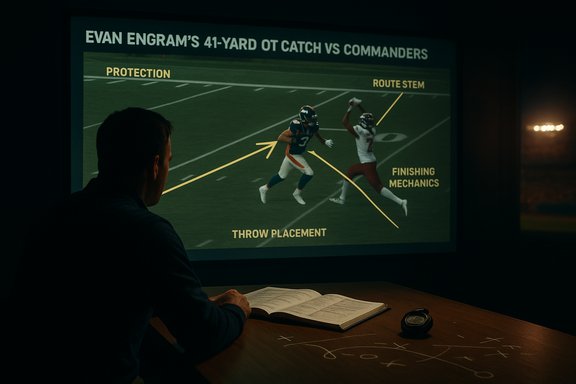
Steve Atwater’s segment follows a widely used, coach‑friendly template: show the full‑speed play for context, then replay with slow‑motion and overlays to isolate mechanics. This format is effective because it turns spectacle into a practice checklist — protection clarity, route stem, contested‑catch technique and immediate finishing mechanics — all of which are repeatable through drills. Team clips like this are valuable for teaching position groups and for giving fans plain language on why a play worked. Strengths of Atwater’s approach:- Focused pedagogy: the segment picks a few discrete, coachable elements instead of a scattershot deep dive.
- Visual clarity: freeze frames, slow motion and overlays reduce abstraction and reveal subtleties like hand placement and leverage.
- Contextual framing: the clip situates the play inside game flow, limiting the temptation to over‑interpret a single successful play.
The play, frame‑by‑frame: what really happened on the field
1. Pre‑snap and protection
Atwater’s breakdown begins at the line. The protection call simplified rush‑recognition, buying quarterback Bo Nix a predictable timing window. In the clip this modest pocket gave Nix the time to deliver a catchable ball into a narrow intermediate lane. The play is a textbook example of protection enabling timing — when the offensive front and chips align, timing concepts become viable.2. Route engineering: the stem and the conflict
The route was not a pure vertical sprint; it used a stem to manipulate linebacker depth. That hesitation from a second‑level defender created a small alley for Engram to exploit. Atwater emphasizes route engineering — creating a choice for the linebacker — over relying purely on separation speed. When the stem works, even contested catchers can convert modest separation into explosive YAC.3. The throw: placement and point of attack
Nix’s throw was an anticipatory, outside‑shoulder delivery into a tight window. Atwater slows the tape to show arm angle and timing relative to Engram’s break; the placement reduced the defender’s chance to make a play on the ball and gave Engram a natural path to the sideline and upfield. The combination of location and timing converted borderline separation into a high‑probability gain.4. The catch and the finish
The most teachable frame is the catch and immediate transition to forward momentum. Atwater highlights:- Hands: securing the ball at the highest point.
- Body positioning: using the body as a shield against the nearest defender.
- Finish: immediate acceleration into open space and decisiveness on the sideline.
Tactical and schematic takeaways for coaches
Atwater’s clip is a compact coaching syllabus. The play’s repeatable elements point to specific practice priorities.Key teaching points and how to practice them:
- Prioritize protection clarity
- Drill: 10‑rep slide protections with RB chip‑and‑release to simulate timing windows.
- Metric: measure clean‑pocket percentage on scripted timing snaps.
- Route stems and linebacker manipulation
- Drill: stem‑and‑break ladder reps for receivers with live linebacker reads.
- Metric: contested‑catch conversion rate after route stems.
- High‑velocity catch and finish
- Drill: contested catch with immediate acceleration — squeeze, turn, and sprint for 10 yards.
- Metric: yards after contested‑catch (YAC per contested catch).
- Two‑play sequencing
- Drill: script the timing pass followed by a downhill run to teach situational muscle memory.
- Rationale: flipping field position with the pass then finishing with a low‑variance run reduces turnover risk.
What the clip proves — and what it does not
Atwater’s clip proves that, on this play, the Broncos executed several fundamentals correctly. But the film room is careful to avoid grand claims.What the clip credibly supports:
- That Engram can secure contested targets and convert them into meaningful YAC when given a clean window. Multiple recaps show Engram finished as Denver’s leading receiver in the game and that the 41‑yard play materially set up scoring in OT.
- That protection clarity and route design can manufacture high‑leverage gains late in tight games. The clip shows the mechanics that created the timing window.
- Consistency: a single successful timing throw does not equal season‑long vertical efficiency. Highlight bias (selecting success) is a known fragility; teams and analysts must combine film with snap‑by‑snap analytics to assess sustainability.
- Systemic dominance: opponents will study the same tape and will design counters — quick‑game releases, max‑protect packages, stunts and overloads — to remove timing windows. If interior protection weakens, the same call can produce sacks or turnovers.
Cross‑verification: corroborating the game facts
Journalistic rigor requires anchoring film claims in factual game data. The play and its impact are corroborated across multiple independent sources:- Reuters and several wire outlets documented the Broncos’ 27–26 overtime victory and described Engram’s 41‑yard overtime gain that set up RJ Harvey’s touchdown.
- Major outlets (NBC Sports, Sports Illustrated and Yahoo Sports) described the same sequence, confirming the yardage, drive context, and final outcome. These independent recaps align with the Broncos’ own video and the game play‑by‑play.
Risk, fragility and what opponents will try next
Any repeatable school of thought that relies on timing throws must be prepared for counters. A few clear opponent adjustments:- Speed up the release game: play quicker 3–5 step concepts to negate a 3.0+ second timing window. If the QB is forced to throw earlier, the engineered stems lose leverage.
- Deploy max‑protect and rollouts to change the pocket geometry and create throw‑away windows for Nix or mobility that removes the timing advantage.
- Simulate linebacker discipline: teach LBs to play the stem more aggressively or maintain outside leverage to shrink the stem’s payoff.
- Interior protection grades and clean‑pocket percentage. Timing concepts are pocket‑time sensitive; a decline here reduces the window from possible to risky.
- Receiver target reliability. Engram delivered on the play, but drop rates or inconsistent contested‑catch conversion across multiple games erode the repeatability thesis.
- Rotation and fatigue. Sustained pass‑rush pressure from opponents can force offensive line rotations or reduce late‑game pocket stability. Keep tracking snap counts and pressure rates.
How coaches and analysts should use the clip
Atwater’s vignette is most valuable when it becomes a reproducible practice plan and a measurable research question.A pragmatic checklist for coaching staffs:
- Watch the play full speed to capture game context (down, distance, clock and score).
- Confirm protection rules and pre‑snap checks by replaying multiple camera angles.
- Measure clean‑pocket percentage on similarly scripted timing plays across the season (set a baseline and track trend).
- Convert the film lessons into locked practice drills: protection clarity reps, stem‑vs‑linebacker drills, contested‑catch finishing reps.
- Pair film with data: contested‑catch success rate, YAC per contested completion, and pressure rate on those specific snaps. Use those metrics to decide whether to feature the concept more often.
Fan and media implications: consumption, privacy and narrative framing
Team video is both content and comms strategy. The Broncos’ “Between the Lines” package is high production and fan‑friendly; it drives engagement and offers an accessible way to teach fundamentals to a broad audience. The team player page and video platform also surface privacy and cookie preferences that fans should be aware of when streaming team media. Practical steps for privacy‑minded viewers include using an InPrivate browser session, toggling the site’s privacy center, or using reputable privacy extensions. From a narrative perspective, clips like Atwater’s shape how fans and casual media tell the season’s story. The responsible approach: use the clip as a positive indicator and complement it with analytics and multiple game samples before drawing identity‑level conclusions about the team.Engram, the Broncos’ offense, and what to watch next
Evan Engram’s 41‑yard OT catch will be remembered as a prime example of impact plays that matter most when the scoreboard is tight. Across outlets he finished the night as Denver’s leading receiver and the play is widely credited as the drive‑starter that led to the decisive touchdown. For the Broncos’ offense, monitor:- Whether Engram’s contested‑catch rate remains high in the coming weeks. If he becomes a reliable outlet, the offense gains a low‑variance third‑down weapon.
- Protection metrics when the team scripts timing concepts. If the clean‑pocket percentage holds, expect more designed stems and catch‑and‑run opportunities.
- Opponents’ defensive adjustments: expect more quick throws and max‑protect looks designed to eliminate the timing window Engram exploited.
Final assessment: tactical value without hubris
Steve Atwater’s breakdown of Evan Engram’s OT catch‑and‑run is a model of modern team film production: short, technically focused and framed around actionable fundamentals. The segment does what a good film room should do — translate a highlight into teachable mechanics for players and coaches while placing appropriate guardrails around interpretation. The play itself is verified across independent game recaps and the Broncos’ own highlights: a 41‑yard overtime gain that materially set up the Broncos’ go‑ahead touchdown in a 27–26 victory. Where Atwater’s clip is strongest is as a practice blueprint: protection clarity drills, stem conceptual work for receivers, and contested‑catch finishing. Where it must be used cautiously is in public narrative construction: highlights are selective, and single‑game evidence requires pairing with snap‑by‑snap analytics to decide whether a moment is an outlier or part of a sustainable trend.When film and numbers point in the same direction, the narrative is credible; when they diverge, the tape serves as a cautionary lesson about highlight bias. Atwater’s Engram breakdown sits squarely in the first category as a valuable teaching tool — useful for coaches who want a clear practice plan and for fans who want to see, step by step, how inches of technique translate into game outcomes.
Source: Denver Broncos Steve Atwater breaks down Evan Engram's key OT catch-and-run vs. Commanders | Between the Lines
