

Microsoft and Ericsson have stitched enterprise-grade 5G control directly into Windows 11, promising IT teams a way to deploy, secure, and optimize always‑connected laptops at scale—complete with automated eSIM switching, Intune integration, and a local AI agent that dynamically steers connections for performance and security.
For the last three years vendors have been quietly building the plumbing that turns cellular‑connected laptops from a niche novelty into a manageable enterprise platform. Early trials showed that laptops can do more than passively accept a mobile signal: they can participate in advanced 5G features such as network slicing, remote policy-driven provisioning, and multi‑SIM management. Ericsson, Microsoft, and several carrier partners have repeatedly demonstrated those capabilities in lab and pilot settings, and the announcement on February 17, 2026 marks the first broad, production‑oriented step to bake those controls into Windows itself.
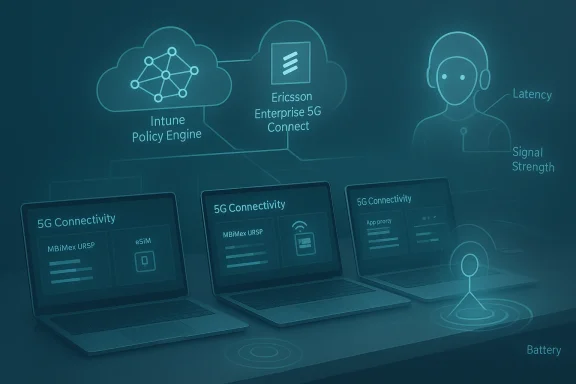
This is not a single‑vendor or single‑feature update. It’s an orchestration layer: Windows 11 (the OS), Microsoft Intune (device and policy management), Ericsson Enterprise 5G Connect (formerly EVCN) and participating communications service providers (CSPs) form a chain that lets IT treat 5G connectivity as another managed resource—like VPN, Wi‑Fi, or anti‑malware. The immediate visible results for IT and users are simpler provisioning, better performance, and fewer help‑desk tickets—but the technical possibilities go deeper.
It also aligns with Microsoft’s broader OS investments: Windows 11 has been progressively expanding its cellular, eSIM, and MBIM capabilities so that the host OS can participate meaningfully in advanced 5G use cases. In parallel, device makers and modem vendors continue to ship more eSIM‑capable devices, and some carriers are packaging laptops and connectivity as a single managed offering.
Meanwhile, Microsoft documentation and vendor driver stacks indicate certain MBIMEx features remain staged and subject to device/driver availability; administrators should expect incremental capability maturation rather than an instantaneous switch‑on of every advanced 5G feature.
However, the real impact will depend on three factors: carrier support and regional availability, device and modem ecosystem readiness, and disciplined enterprise governance around telemetry and cost. If those align, IT teams can expect fewer connectivity headaches and more predictable hybrid work experiences. If they don’t, the technology becomes another partially deployed capability that leaves users and admins confused. Enterprises should therefore pilot conservatively, insist on contractual clarity from vendors, and keep visibility on device and network telemetry.
The transition to managed 5G laptops is no longer a question of “if”; it’s a question of ready, where, and how fast.
Source: Neowin Windows 11 just got a major 5G boost thanks to Ericsson
 Background
For the last three years vendors have been quietly building the plumbing that turns cellular‑connected laptops from a niche novelty into a manageable enterprise platform. Early trials showed that laptops can do more than passively accept a mobile signal: they can participate in advanced 5G features such as network slicing, remote policy-driven provisioning, and multi‑SIM management. Ericsson, Microsoft, and several carrier partners have repeatedly demonstrated those capabilities in lab and pilot settings, and the announcement on February 17, 2026 marks the first broad, production‑oriented step to bake those controls into Windows itself.This is not a single‑vendor or single‑feature update. It’s an orchestration layer: Windows 11 (the OS), Microsoft Intune (device and policy management), Ericsson Enterprise 5G Connect (formerly EVCN) and participating communications service providers (CSPs) form a chain that lets IT treat 5G connectivity as another managed resource—like VPN, Wi‑Fi, or anti‑malware. The immediate visible results for IT and users are simpler provisioning, better performance, and fewer help‑desk tickets—but the technical possibilities go deeper.
What Ericsson and Microsoft announced
The core proposition in plain terms
- Managed 5G for laptops: Ericsson’s Enterprise 5G Connect integrates with Windows 11 and Microsoft Intune so enterprises can provision, monitor, and enforce policies for 5G connectivity across laptop fleets.
- Automatic eSIM switching: Devices can automatically download and switch eSIM profiles based on policy and network quality, reducing the need for users to manually change carriers or swap SIMs.
- Local AI agent for context‑aware optimization: A runtime component on the device evaluates local conditions and applies rules (latency, signal, application priorities) to choose the best network and settings for the task.
- Intune policy enforcement: Connectivity can be governed by Intune so network selection, corporate data limits, and security posture are consistent across devices.
Why this is more than marketing copy
At face value, “automatic eSIM switching” and “AI optimization” can sound like buzzwords. But the underlying elements—eSIM management, MBIM/MBIMEx support, URSP/network slice awareness, and Intune orchestration—are real, standards‑based capabilities that Microsoft and device/CPU/modem partners have been working on for years. Windows already supports eSIMs and has been adding MBIM extension support for 5G‑native capabilities; what Ericsson and Microsoft have done is combine those OS capabilities with a carrier‑facing management plane and device‑side intelligence to make them practical at enterprise scale.Technical underpinnings — how this actually works
eSIM provisioning and Ericsson Enterprise 5G Connect
The key operational piece is eSIM orchestration. Ericsson’s Enterprise 5G Connect provides a cloud service that can order, manage and push eSIM profiles to devices at scale. When combined with Windows 11’s eSIM plumbing, IT can preconfigure devices so they connect securely out of the box and switch CSP profiles automatically when policies or connectivity conditions dictate. This enables zero‑touch provisioning for mobile laptops, similar to how corporate phones are managed today.MBIMEx, URSP, and network slicing support
Windows has been extending its MBIM (Mobile Broadband Interface Model) host interface to support 5G SA features and network slicing. MBIMEx 4.0 introduces URSP handling and multiple concurrent eMBB slices—mechanisms that allow a device to request different network behaviors for different applications (for example, a low‑latency slice for collaboration and a high‑throughput slice for bulk sync). When the OS and modem support these features, an enterprise can map specific app types to slice preferences and have the network honor them. Microsoft’s MBIMEx docs note these capabilities and the dependencies required at host, device and network levels.Local AI agent and policy enforcement
The local agent described in the announcement appears to be a lightweight decision engine that uses telemetry (signal, latency, user activity, battery state, policy) to make per‑connection choices. Because decisions happen on the device, they can be real‑time and context‑aware—crucial for apps like Teams or remote‑access tools that are sensitive to jitter and packet loss. Intune provides the management surface for policies, while Ericsson’s cloud monitors network quality and can feed higher‑level signals back to IT.What this means for IT, end users, and service providers
For enterprise IT
- Simpler onboarding: Zero‑touch eSIM provisioning can drastically reduce manual setup and physical logistics for distributed workforces.
- Centralized compliance: IT can enforce connectivity policies in the same way it enforces OS and app policies through Intune.
- Operational visibility: Ericsson’s cloud telemetry gives visibility into network performance per device and per region, enabling better SLAs for remote work scenarios.
For end users
- Fewer interruptions: Automatic carrier switching and device‑level optimization should reduce the number of times users have to choose networks or call support.
- More predictable collaboration: Apps that need low latency or consistent throughput will benefit from intelligent network pathing and slice awareness where supported.
For carriers and the broader ecosystem
- New enterprise bundles: Carriers can deliver preconfigured 5G laptop bundles (device + connectivity + management) and differentiate with managed services rather than just raw Mbps.
- Private/public network interplay: The same orchestration makes it easier to switch devices between private 5G networks on premises and public networks when users are offsite—useful for manufacturing, healthcare, and retail sectors. Ericsson has shown private/public switching in earlier trials.
Practical benefits and limitations
Benefits (what enterprises are likely to see quickly)
- Reduced time to value for distributed laptop fleets through zero‑touch provisioning.
- Decreased IT help‑desk load because connectivity choices are automated and policy‑driven.
- Improved end‑user experience for collaboration, remote desktop, and data‑heavy workflows via slice and policy optimization.
Short‑to‑medium term limitations and caveats
- Carrier and regional coverage variability: The experience depends on participating carriers and 5G coverage in each market. The initial rollouts are limited to specific CSPs and countries; global parity will take time.
- Hardware requirements: Laptops must include compatible 5G modems and eSIM support. Not all enterprise devices have that today; many Windows laptops still rely on Wi‑Fi only.
- Standards and host support gaps: Some advanced MBIMEx features are optional or pending broader host/device support; Microsoft documentation notes caveats and phased rollouts for full 5G SA phase‑2 features. Administrators should validate modem and driver support before expecting all capabilities.
Security and privacy implications
Positive security capabilities
- Policy enforcement at scale: Using Intune to apply network restrictions and data‑handling rules reduces the chance of insecure connections or data leakage.
- Centralized lifecycle control for eSIMs: IT can suspend, revoke, or reassign eSIM profiles remotely—an improvement over physical SIM management.
Risks and blind spots
- Telemetry privacy: The solution relies on device and network telemetry. Enterprises must evaluate what telemetry is collected, where it’s stored, and whether it aligns with privacy policies and local regulations. The vendor announcements emphasize telemetry for performance and security but stop short of full telemetry schemas; IT teams should demand clear data governance contracts.
- Dependency on operator cooperation: The depth of control (e.g., slice assignment, QoS adherence) depends on CSPs implementing corresponding network APIs and policies. Not all carriers provide the same level of programmability or willingness to expose such controls.
How organizations should evaluate adoption
- Inventory devices for 5G/eSIM readiness. Verify modems, MBIM/driver versions, and firmware support required MBIMEx features.
- Pilot with a limited user group that covers the full range of mobility scenarios (office, transit, remote). Monitor telemetry and user feedback.
- Negotiate operator SLAs and API access for the regions that matter most. Ensure carriers agree to the eSIM and slice behaviors you need.
- Define telemetry and data‑retention policies in the procurement contract with Ericsson/Microsoft and carrier partners. Make privacy and compliance explicit.
Where this fits in the connectivity roadmap
This announcement is the logical next step after prior demonstrations and pilots. Ericsson, Intel, Microsoft and other partners have shown network slicing and eSIM orchestration on Windows laptops in lab settings for several years; the difference now is a productionized orchestration offering tied to real carrier programs and Intune management. That elevates 5G laptop management from experimental to operational for early adopters.It also aligns with Microsoft’s broader OS investments: Windows 11 has been progressively expanding its cellular, eSIM, and MBIM capabilities so that the host OS can participate meaningfully in advanced 5G use cases. In parallel, device makers and modem vendors continue to ship more eSIM‑capable devices, and some carriers are packaging laptops and connectivity as a single managed offering.
Business and operational impacts — what CIOs should know
- TCO tradeoffs: Enterprises may realize lower operational costs (less on‑site IT, fewer managed Wi‑Fi appliances) but should model data costs and carrier pricing for wide roaming. Carrier bundles and Intune integration could simplify procurement and lifecycle costs, but pricing models vary by operator and region.
- Digital‑workplace enablement: For roles that require mobility, predictable connectivity with prioritized application routing removes a major friction point. This can enable new hybrid work patterns and field workflows (inspection, on‑site support, healthcare rounds) that previously required complex VPN/Wi‑Fi setups.
- Vendor lock‑in considerations: While the architecture uses standards (eSIM, MBIM, URSP), the orchestration plane and packaged services are vendor offerings. CIOs should negotiate portability clauses, data access guarantees, and exit strategies when committing to managed 5G bundles.
Realistic timeline and market availability
Ericsson states broad availability will expand through the second quarter of 2026, with early availability in selected markets during initial pilots and operator programs. Enterprises planning rollouts should map their timelines against carrier availability by country and the device refresh cycles for their laptop fleets.Meanwhile, Microsoft documentation and vendor driver stacks indicate certain MBIMEx features remain staged and subject to device/driver availability; administrators should expect incremental capability maturation rather than an instantaneous switch‑on of every advanced 5G feature.
Verdict — why this matters, and what to watch
This development is a meaningful step toward the practical mainstreaming of 5G laptops. By coupling Windows 11’s evolving cellular stack with Ericsson’s orchestration and Intune’s policy fabric, enterprises finally have a vendorized option to treat connectivity as a managed IT asset. For organizations with mobile workforces, regulated data, or use cases that need deterministic network performance, this can reduce friction and enable new productivity models.However, the real impact will depend on three factors: carrier support and regional availability, device and modem ecosystem readiness, and disciplined enterprise governance around telemetry and cost. If those align, IT teams can expect fewer connectivity headaches and more predictable hybrid work experiences. If they don’t, the technology becomes another partially deployed capability that leaves users and admins confused. Enterprises should therefore pilot conservatively, insist on contractual clarity from vendors, and keep visibility on device and network telemetry.
Quick checklist for IT teams (ready to paste into a rollout plan)
- Verify which laptop SKUs in your fleet have eSIM and 5G modem support.
- Confirm MBIM/driver versions and whether MBIMEx features you need are supported by your hardware vendors.
- Identify target pilot users and geographies aligned with participating CSPs.
- Establish telemetry and privacy requirements in your vendor and carrier contracts.
- Design rollback and cost‑control mechanisms for data and roaming charges.
Final thoughts
The industry has been building toward this moment for several years. What was once a series of intriguing demos—network slicing on a laptop, eSIM orchestration across borders, AI‑driven QoS choices—has now been packaged into a vendor solution that integrates with the enterprise management tools many organizations already use. For enterprises that prioritize mobile productivity and predictable connectivity, the Microsoft–Ericsson partnership announced on February 17, 2026 represents a practical, standards‑based path forward. But real gains will require careful piloting, device verification, and carrier negotiations—this is a systems integration challenge as much as it is a feature roll‑out.The transition to managed 5G laptops is no longer a question of “if”; it’s a question of ready, where, and how fast.
Source: Neowin Windows 11 just got a major 5G boost thanks to Ericsson
