

The enterprise AI battleground has entered a new, more concentrated phase: an emerging oligopoly of frontier labs is consolidating usage and spend even as winners jockey by use case, model family, and enterprise distribution. That is the headline from Andreessen Horowitz’s third annual CIO survey of Global 2000 firms — a granular view that finds OpenAI still in front but Anthropic and Google closing fast, Microsoft retaining app-layer dominance, and enterprises broadly hedging across multiple model families and vendors. a16z.com/leaders-gainers-and-unexpected-winners-in-the-enterprise-ai-arms-race/)
Andreessen Horowitz (a16z) surveyed 100 verified VPs and C‑level executives at Global 2000 companies to map adoption, spending, and vendor preferences for LLMs and enterprise AI. Respondents skew large (88% over $1B revenue; >50% with 10,000+ employees) and multinational — a panel designed to capture where the bulk of IT dollars flow. The piece synthesizes that primary survey data wiata (Yipit) and public reporting to draw its conclusions.
A few methodological flags are worth repeating up front. The a16z findings reflect a targeted survey of senior enterprise buyers, not a representative random sample of all companies; they therefore illuminate how the largest buyers are behaving, which can differ materially from mid-market or startup dynamics. a16z explicitly discloses its investor relationship with OpenAI and reports cd‑party panels to mitigate bias. Readers should treat headline percentages as directional and enterprise‑weighted rather than universal.
Two industry forces accelerate winner‑take‑most dynamics in enterprise AI:
Independent corroboration of OpenAI’s major enterprise momentum comes from OpenAI’s own enterprise research and usage reporting, which documents rapid deepening of workplace usage across categories. That said, different surveys (Menlo Ventures, Yipit, industry press) sometimes show variation by sample and time window — underscoring the dynamic nature of market share.
Anthropic’s enterprise traction is particularly notable in token‑intensive workloads (coding, long‑context reasoning, analytical queries) and in cases where newer model families (Sonnet/Opus variants) materially outperformed earlier versions. This token‑heavy focus maps to Anthropic’s product roadmap (Claude Code, Sonnet/Opus families) and its strategic positioning as an enterprise‑grade alternative to earlier OpenAI stacks.
Why? Packaged applications deliver integration, workflow encapsulation, security/harnessing, and change management — the hard parts of enterprise AI. Even in historically DIY areas like knowledge management or workflow automation, respondents expect migration toward packaged, AI‑first applications over time because those apps consolidate connectors, governance, and UI/UX for non‑engineer business users.
That doesn’t mean no build: high‑value differentiated capabilities and domain‑specific IP will still be built in house when the economic upside justifies it. But the signal is clear: apps plus model routing often beat single‑model in‑house builds in time‑to‑value and risk mitigation.
This reflects a pragmatic enterprise calculus: when a closed model meaningfully reduces risk of hallucination, accelerates integration, or reduces overall TCO when matched with managed services, the enterprise buyer often opts for the more mature end‑to‑end offering. That trend has implications for open‑source projects and smaller labs: they must either match closed‑model TCO and integration features or focus on vertical specialization and cost efficiency.
However, reported ROI is positive but measured. Enterprises frequently need partners and packaged apps to translate model capability into workflow outcomes; raw model accuracy alone doesn’t guarantee business impact. The a16z survey highlights an important behavioral fact: enterprises don’t fully know what “good” looks like until they run production pilots. Realized ROI often trails expectations initially, then climbs as organizations learn the operational playbook (data pipelines, observability, guardrails, human‑in‑the‑loop processes).
For CIOs, the imperative is less about picking the one dominant lab and more about building flexible, observable, and governable infrastructure that lets the organization capitalize on whoever wins each specific workload. The enterprise AI arms race has become an arms market: buy the right tool for the job, measure outcomes, and keep portability and trust at the center of your architecture.
Source: Andreessen Horowitz Leaders, gainers and unexpected winners in the Enterprise AI arms race | Andreessen Horowitz
 Background: the a16z CIO survey in context
Andreessen Horowitz (a16z) surveyed 100 verified VPs and C‑level executives at Global 2000 companies to map adoption, spending, and vendor preferences for LLMs and enterprise AI. Respondents skew large (88% over $1B revenue; >50% with 10,000+ employees) and multinational — a panel designed to capture where the bulk of IT dollars flow. The piece synthesizes that primary survey data wiata (Yipit) and public reporting to draw its conclusions. A few methodological flags are worth repeating up front. The a16z findings reflect a targeted survey of senior enterprise buyers, not a representative random sample of all companies; they therefore illuminate how the largest buyers are behaving, which can differ materially from mid-market or startup dynamics. a16z explicitly discloses its investor relationship with OpenAI and reports cd‑party panels to mitigate bias. Readers should treat headline percentages as directional and enterprise‑weighted rather than universal.
Executive summary of the findings
- OpenAI remains the single most deployed frontier lab across Global 2000 enterprises (reported at 78% production usage in the a16z CIO sample), but momentum is shifting toward Anthropic and Google.
- Anthropic has enjoyed the fastest enterprise penetration gains since mid‑2025, with a16z reporting a 25 percentage‑point bump since May 2025 and production usage at 44% (63% if testing included). This surge matches public reporting of large funding rounds that underwrote expansion.
- Wallet‑share concentration still favors OpenAI, but competitive dynamics are fluid: a16z reports OAI with roughly ~56% of enterprise wallet share in the surveyed cohort while Anthropic and Google are steadily grabbing share.
- Microsoft remains the app‑layer winner — Copilot in productivity and GitHub Copilot in developer tooling retain broad enterprise traction, giving Microsoft a durable distribution and procurement advantage. Independent reporting corroborates GitHub Copilot’s massive enterprise penetration.
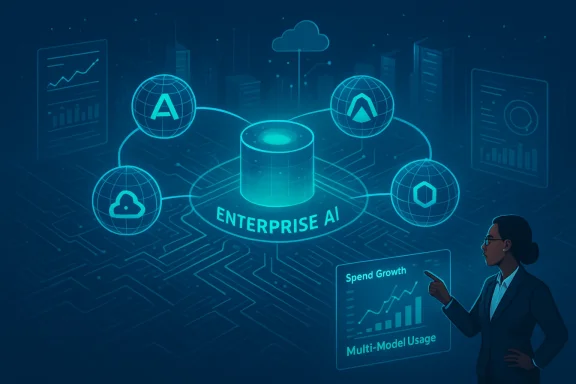
- Enterprises are multi‑model and multi‑vendor: 81% of respondents use three or more model families in testing/production, reflecting a model‑routing, best‑of‑breed posture rather than single‑vendor lock‑in.
- Enterprise AI spend is accelerating: a16z reports per‑company LLM budgets rising from ~$4.5M to ~$7M over two years and expected to hit ~$11.6M in the coming year — a projection that, if directional, underscores the scale of the prize. Independent market surveys also show large and rising enterprise AI budget allocations.
Why this matters: network effects, switching costs and the enterprise feedback loop
Large enterprises buy software and infrastructure differently than startups: procurement cycles, vendor trust, integration costs, and long sales processes favor providers with existing seat density and deep platform hooks. That structural reality — incumbency plus distribution — magnifies small early leads into durable advantages unless a competitor can deliver materially better ROI or integration hooks. a16z’s data illustrate this dynamic: OpenAI’s early deployments are still pervasive, but the rate of switching and multi‑vendor experimentation is increasing as Anthropic and Google push capability improvements.Two industry forces accelerate winner‑take‑most dynamics in enterprise AI:
- Compute and capital scale: building and operating frontier models at enterprise scale demands enormous compute commitments and balance‑sheet endurance. Public coverage of major Anthropic financings and hyperscaler capex underlines the capital intensity behind market share moves.
- Productized distribution (apps, seat‑based monetization): embedding models into high‑penetration seat products (e.g., Microsoft 365 Copilot) converts usage into predictable recurring revenue and simplifies procurement for buyers. Legacy vendors with seat counts can thus convert platform reach into AI consumption.
The leaderboard: leaders, fast gainers and the unexpected winners
OpenAI: incumbent leader, but not unassailable
OpenAI remains the most widely reported model provider in production among the Global 2000 CIO respondents (78% reported usage). That reflects OpenAI’s early mover advantage: ChatGPT and enterprise offerings were widely adopted in 2023–2024 and have since penetrated a broad set of horizontal use cases. But incumbency is not immortality: a16z’s survey shows OpenAI’s absolute dominance being eroded in share metrics even as absolute spend grows. The picture is nuanced — many enterprises continue using older OpenAI model families because they “work well enough,” which raises switching costs even as newer models from competitors shift performance expectations.Independent corroboration of OpenAI’s major enterprise momentum comes from OpenAI’s own enterprise research and usage reporting, which documents rapid deepening of workplace usage across categories. That said, different surveys (Menlo Ventures, Yipit, industry press) sometimes show variation by sample and time window — underscoring the dynamic nature of market share.
Anthropic: the fastest gainer and the enterprise surprise
Anthropic is the clearest “fast gainer” in the a16z narrative. The firm’s reported enterprise penetration jump (a 25‑point increase since May 2025, to 44% production usage) aligns with heavy investment in model R&D and a string of product releases — plus very large funding rounds that enabled commercial expansion. News outlets uniformly reported Anthropic’s sizable fundraises in 2025, providing the capital to scale enterprise GTM, product partnerships, and data center commitments. Those capital moves are visible and corroborated by multiple outlets.Anthropic’s enterprise traction is particularly notable in token‑intensive workloads (coding, long‑context reasoning, analytical queries) and in cases where newer model families (Sonnet/Opus variants) materially outperformed earlier versions. This token‑heavy focus maps to Anthropic’s product roadmap (Claude Code, Sonnet/Opus families) and its strategic positioning as an enterprise‑grade alternative to earlier OpenAI stacks.
Google (Gemini): breadth and integration strength
Google’s Gemini family is reported as a strong cross‑use‑case player in the a16z CIO survey, with particular strength in broad horizontal scenarios but a weaker showing in coding relative to Anthropic and GitHub Copilot. Google’s advantage is deep integration with cloud infrastructure, ownership of TPUs, and expansive product reach — advantages that are playing out in enterprise RFPs and cloud negotiations. Public coverage supports Gemini’s rapid improvement curve and enterprise positioning, even if coding remains a contested battleground.Microsoft: the app‑layer winner
Where the a16z data most sharply contradicts popular “open model vs. lab” narratives is in the app layer: Microsoft still dominates enterprise AI apps. Microsoft 365 Copilot leads enterprise chat and knowledge workflows in many large organizations, and GitHub Copilot remains the de facto enterprise coding assistant in a massive share of Fortune 100 institutions. Independent coverage confirms GitHub Copilot’s wide adoption (20M+ all‑time users and deep Fortune 100 penetration), making Microsoft the default bundler for many enterprise AI buys. This is a distribution and procurement moat that matters as much as raw model performance.Leadership depends on the workload: a use‑case breakdown
Enterprise AI is not a single market; it is a mosaic of distinct workloads that favor different providers.- General purpose chat and knowledge management: incumbency matters here. Early OpenAI and Microsoft Copilot deployments dominate because these were the first, measurable wins enterprises scaled. Enterprises prize integration with existing productivity suites (Teams, Outlook, SharePoint).
- Software development and token‑heavy coding: Anthropic and specialized coding tools (Claude Code, GitHub Copilot) show advantages. Anthropic’s R&D cadence on Sonnet/Opus released models tuned for reasoning and code tasks that appealed to engineering orgs, while GitHub Copilot’s sheer distribution within developer workflows continues to win enterprise deals. Independent developer surveys show Copilot at or near the top of enterprise coding tool usage, even as new entrants gain developer mindshare.
- Data analysis and reasoning tasks: Anthropic’s reasoning gains and the arrival of dedicated reasoning models accelerate adoption in analytic workflows and automated agentic processes. a16z reports that more than half of enterprises said reasoning models sped LLM adoption by improving time to value and reducing prompt engineering overhead.
Build vs. Buy: the app market isn’t dead — it’s evolving
A recurring industry sermon in 2024–2025 proclaimed the demise of third‑party enterprise apps as companies could “just build” on an LLM. The a16z data push back: third‑party enterprise apps remain very much alive and are often the fastest route to production value.Why? Packaged applications deliver integration, workflow encapsulation, security/harnessing, and change management — the hard parts of enterprise AI. Even in historically DIY areas like knowledge management or workflow automation, respondents expect migration toward packaged, AI‑first applications over time because those apps consolidate connectors, governance, and UI/UX for non‑engineer business users.
That doesn’t mean no build: high‑value differentiated capabilities and domain‑specific IP will still be built in house when the economic upside justifies it. But the signal is clear: apps plus model routing often beat single‑model in‑house builds in time‑to‑value and risk mitigation.
Trust, closed source, and hosting: a surprising tilt toward closed labs
One of the more counterintuitive findings in the a16z survey is the growing enterprise preference for closed‑source frontier models. Over a third of respondents now prefer closed models, citing not just rapid model quality improvements but also limits in internal AI talent and, interestingly, data security as drivers of that preference. Concurrently, ~80% of enterprises said they’re comfortable hosting models directly with labs rather than solely through cloud service providers — a marked rise from earlier hesitancy.This reflects a pragmatic enterprise calculus: when a closed model meaningfully reduces risk of hallucination, accelerates integration, or reduces overall TCO when matched with managed services, the enterprise buyer often opts for the more mature end‑to‑end offering. That trend has implications for open‑source projects and smaller labs: they must either match closed‑model TCO and integration features or focus on vertical specialization and cost efficiency.
Money and ROI: the gap between hype and measured value
a16z’s headline spend numbers are eye‑catching: average enterprise LLM spend rising from ~$4.5M to ~$7M over two years, with expectations of ~65% further growth to ~$11.6M. Whether those exact per‑company numbers generalize beyond the Global 2000 sample is debatable, but multiple independent industry surveys and vendor reporting confirm the direction — enterprise AI budgets are expanding rapidly and reallocating from traditional automation/digital modernization buckets.However, reported ROI is positive but measured. Enterprises frequently need partners and packaged apps to translate model capability into workflow outcomes; raw model accuracy alone doesn’t guarantee business impact. The a16z survey highlights an important behavioral fact: enterprises don’t fully know what “good” looks like until they run production pilots. Realized ROI often trails expectations initially, then climbs as organizations learn the operational playbook (data pipelines, observability, guardrails, human‑in‑the‑loop processes).
Risk map: what could flip the leaderboard
- Open model disruption / algorithmic efficiency: a sudden advance in efficient open models that run on commodity hardware or dramatically shrink inference costs would undercut expensive inference economics and reframe hyperscaler monetization. Multiple analysts flag algorithmic efficiency as a structural risk.
- Regulation and procurement constraints: antitrust scrutiny, data‑sovereignty rules, or procurement policies could fragment markets and favor multi‑vendor or sovereign cloud approaches over single‑vendor dominance. These are credible near‑term policy levers that buyers and vendors must plan for.
- Supply chain and capex shocks: GPU/accelerator scarcity, grid or permitting delays, and energy constraints can cause capacity bottlenecks that reshape competitive ability to serve enterprise demand. Reports on hyperscaler capex and accelerator deals underscore this chokepoint.
- Legal exposure on training data: ongoing litigation around model training data and copyrighted material can create financial and operational uncertainty. Enterprises should factor evolving legal regimes into model selection and vendor contracts.
Practical guidance for CIOs and Windows‑anchored IT leaders
- Design for portability: insist on model‑agnostic architectures and containerized inference where feasible; avoid deep lock‑in at the retrieval or orchestration layer. Vendor‑agnostic observability and model routers reduce migration risk.
- Demand measurable outcomes: require pilots with explicit KPIs (time to value, error reduction, throughput gain) and SLAs tied to business metrics rather than abstract accuracy numbers. Treat early pilots as experiments with mandatory exit criteria.
- Prioritize governance and human‑in‑the‑loop controls: agentic and multi‑step workflows scale power and risk simultaneously. Implement mandatory review for high‑impact actions and maintain audit trails for inference decisions.
- Leverage incumbent integration when it helps: if your estate is Microsoft‑centric, Microsoft’s Copilot and Azure AI integrations can shorten time to value — but don’t treat that as an inevitability. Compare TCO, flexibility, and model routing options before defaulting to an incumbent.
- Adopt a multi‑model strategy: route tasks to different models by capability — e.g., use reasoning‑optimized models for analytics, coding specialists for dev workflows, and cost‑efficient base models for high‑volume retrieval tasks. a16z’s survey shows 81% of enterprises already do this.
Critical analysis: strengths, blind spots, and what to watch
Strengths of the a16z analysis- The survey targets the buyer cohort that actually controls the budget — Global 2000 CIOs — giving a high‑signal view into where large enterprise dollars are moving.
- Triangulation with commercial panels (Yipit) and public fundraising/supply reporting strengthens the narrative: Anthropic’s capital inflows and product cadence align with reported share gains.
- Sample bias risk: the Global 2000 CIO sample is powerful for enterprise insight but may over‑represent advanced adopters; mid‑market and startup dynamics differ and multiple independent reports show variance in market share across segments. a16z acknowledges this caveat.
- Timing and rapid change: market share is moving quickly. Menlo Ventures, TechCrunch, and Menlo‑style reports show oscillating top‑line figures depending on the exact survey window — meaning any leaderboard is provisional. Cross‑sectional surveys must be read alongside trend data.
- Unverifiable or rapidly changing dollar figures: the per‑company spend numbers are plausible within the surveyed cohort but should be treated as enterprise‑sample estimates; independent public datasets report rising budgets but different absolute averages. Where exact dollar claims matter to procurement or finance teams, validate with vendor invoices, RFP responses, and internal benchmarking.
- Model routing and orchestration wins: vendors that productize model routers, MLOps for multi‑model stacks, and low‑friction connectors into enterprise systems will capture disproportionate app‑layer value.
- Anthropic’s commercial scale and partnerships: follow Anthropic’s large fund deployment into partnerships and enterprise deals, which have already shifted market share dynamics. Independent reporting of its $13B raise and go‑to‑market expansion is a major structural input.
- Regulatory moves on data & procurement: new rules in major markets could force architectural changes or favor multi‑vendor strategies; monitor trajectory in antitrust and data privacy enforcement.
Conclusion — no single king, but clear winners by role
Andreessen Horowitz’s CIO study gives a high‑value, enterprise‑focused snapshot: OpenAI retains the largest installed base today, Anthropic is the fastest beneficiary of recent capability and capital waves, and Microsoft remains the app‑level anchor for many large buyers. But those are roles, not immutable crowns. The real story for enterprise IT leaders is horizontal: most large organizations are hedging, routing tasks to specialized models, and buying packaged applications to speed time to measurable value. Those pragmatic patterns — multi‑model strategies, emphasis on governance, and vendor selection driven by integration and procurement simplicity — will determine winners in the next 12–24 months more than any single benchmark metric.For CIOs, the imperative is less about picking the one dominant lab and more about building flexible, observable, and governable infrastructure that lets the organization capitalize on whoever wins each specific workload. The enterprise AI arms race has become an arms market: buy the right tool for the job, measure outcomes, and keep portability and trust at the center of your architecture.
Source: Andreessen Horowitz Leaders, gainers and unexpected winners in the Enterprise AI arms race | Andreessen Horowitz
