

The PC market’s 2025 rebound arrived not on the back of flashy on-device generative AI, but because corporate IT finally had no choice: aging fleets, a hard deadline for Windows 10 support, and looming component cost pressures pushed businesses to refresh hardware en masse. Gartner’s preliminary numbers show a clear, conservative recovery — a channel-led PC refresh driven by compliance and lifecycle management rather than a consumer-led “AI PC” spending spree.
But 2025’s market reality is a reminder that upgrade cycles in enterprise environments are rarely emotional or headline-driven. They are driven by compliance windows, security needs, component economics, and TCO calculations. AI will matter — eventually — but its role in replacement cycles will follow a practical adoption curve: pilot, validate, scale. Expect targeted AI-driven refreshes in verticals with clear use cases (media, finance, engineering) before the feature becomes a universal procurement requirement.
Source: theregister.com Windows 11, not AI, kick-started the PC upgrade cycle
 Background
What the numbers tell us
Gartner’s preliminary results for the fourth quarter of 2025 show worldwide PC shipments of approximately 71.5 million units, a year-over-year increase of 9.3%, while the full year finished at more than 270 million units, up 9.1% versus 2024. Those figures mark the strongest rebound the industry has seen since the slump that followed the pandemic boom, but the growth is uneven: it’s concentrated in shipments into distribution channels and the commercial market rather than a consumer frenzy.- Lenovo, HP Inc., and Dell held the top three global vendor positions in 4Q25, with Lenovo shipping about 19.4 million units in the quarter, HP 15.4 million, and Dell roughly 11.8 million. These incumbents benefited disproportionately from the year-end push.
Why this matters now
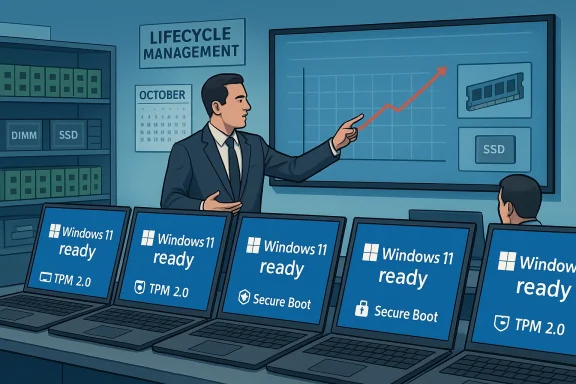
Two structural forces combined to force enterprise buyers’ hands in 2025: Microsoft’s calendar and a supply-chain economics squeeze. Microsoft ended mainstream support for Windows 10 on October 14, 2025, leaving organizations with either a migration path to Windows 11, an Extended Security Updates (ESU) option, or the risk of running unsupported systems. That calendar created a hard compliance deadline for many IT departments and accelerated refresh plans that had been deferred through the pandemic years. At the same time, memoryy and storage supply dynamics — driven by hyperscalers and AI data-center demand — pushed component prices up and created urgency to buy before costs rose further. OEMs and channel buyers moved purchases forward to lock in inventory and avoid higher prices into 2026.Overview: The upgrade was pragmatic, not aspirational
Not an “AI supercycle”
The popular narrative that “AI PCs” would immediately ignite a fresh consumer-led replacement cycle has not materialized in the way many vendors hoped. Instead, the PC upgrade cycle in 2025 was dominated by enterprise replacement programs: fleets that were already overdue for refresh were finally retired because they could not meet Windows 11’s system requirements, and because running unsupported Windows 10 after October 14, 2025 carried unacceptable security and compliance risks for many organizations. Gartner specifically highlights Windows 11 upgrades and inventory stocking ahead of memory price hikes as the major drivers of the quarter’s growth.Buyers still prioritize the basics
Surveys and market research throughout 2025 consistently showed that buyers — both commercial procurement teams and mainstream consumers — continue to weigh price, battery life, and general performance far more heavily than AI feature sets. AI-capable hardware, NPUs, and on-device inference are appealing, but for many procurement teams they remain nice-to-have features behind core requirements like reliability, manageability, warranty terms, and total cost of ownership. This behavioral reality constrained the short-term impact of AI-focused marketing and product introductions.Windows 11: The compliance trigger
How Microsoft’s timeline reshaped refresh plans
Microsoft’s end-of-support date for Windows 10 created a practical deadline for businesses that must remain secure and compliant. After October 14, 2025, Windows 10 stopped receiving mainstream security updates, and Microsoft urged customers to migrate to Windows 11 or enroll in Extended Security Updates where available. For many enterprises, the calculus was straightforward: if a device could not run Windows 11 because of TPM 2.0, Secure Boot, or processor requirements, it became a candidate for replacement rather than an upgrade. Microsoft’s official guidance and the ESU options were instrumental in shaping procurement cycles.The hardware reality
Windows 11’s baseline security and manageability features are built on hardware capabilities that older devices lack. That gap is not just academic: it affects the ability to apply modern management tools, meet corporate security baselines, and deliver consistent user experiences. The result was a high-volume churn of older laptops and desktops that IT teams had been keeping alive with patchwork — but could no longer justify after the EOL date.- The consequence: a refresh program that favored standard commercial SKUs over experimental, AI-premium models.
- The secondary effect: OEMs with deep channel distribution and enterprise services were best positioned to capture that demand.
Memory and component economics: buy now or pay more
Hyperscalers pulled the supply levers
During 2025 the memory market shifted dramatically as AI infrastructure spending by hyperscalers bid up DRAM and HBM demand. Memory suppliers have prioritized high-margin data-center and AI customers, tightening availability for mainstream PC DDR and NAND. That reallocation produced pronounced price increases in consumer-grade memory and SSDs, and prompted OEMs and resellers to push orders forward to avoid higher 2026 costs.What OEMs and channel partners did
OEMs and distributors scrambled to secure inventory ahead of expected component price hikes. The end result was a late-year lift in shipments and an incentive for enterprises to accelerate purchases that would otherwise have been scheduled for later in the refresh cycle.- Benefits for big OEMs: larger scale, stronger supplier relationships, and the ability to offer bundled procurement and logistics services.
- Risk for smaller vendors: margin erosion or supply constraints as memory allocations favored larger enterprise contracts.
Vendor performance and competitive dynamics
Incumbents grabbed the spoils
Large OEMs with established enterprise channels benefited most from this conservative, compliance-driven refresh. Lenovo, HP, and Dell increased shipment share in 4Q25 and posted strong year-over-year growth precisely because their portfolios are tuned to enterprise needs — durability, manageability, trade-in and lifecycle services, and predictable supply. Gartner’s vendor tables make this explicit: Lenovo led Q4 with about 19.4M units, HP shipped 15.4M, and Dell about 11.8M.The AI vendors’ dilemma
Manufacturers that leaned heavily into premium AI features (NPUs, on-device inference stacks, high-end GPU options) saw mixed results. While AI-capable SKUs gained attention from specific verticals (creative pros, developers, research labs), the bulk of corporate procurement prioritized standardization and compatibility.- Short-term impact: AI features did not meaningfully alter the enterprise procurement checklist for 2025.
- Mid-term opportunity: as on-device AI becomes more ubiquitous and software ecosystems mature, AI features could move up procurement priorities — but that transition requires clear, demonstrable productivity or cost-saving gains.
What this means for IT managers and procurement
Prioritize remediation paths now
Organizations that deferred upgrades through 2022–2024 found themselves facing a binary choice in 2025: upgrade to Windows 11-capable hardware or accept the risks of unsupported systems. The sensible procurement playbooks in this environment included:- Conduct a fleet audit to identify end-of-life devices and Windows 11 compatibility.
- Segregate devices that can be upgraded in-place from those that require replacement.
- Prioritize mission-critical endpoints and knowledge-worker laptops for replacement.
- Negotiate multi-quarter supply commitments with OEMs to hedge against memory-driven price volatility.
- Consider cloud-hosted desktops (Cloud PC) as a gap-filling measure for legacy hardware.
Manage expectations on AI benefits
IT and procurement leaders should treat AI hardware upgrades as a separate, value-driven project. That means insisting on measurable outcomes for on-device AI investments — reduced cloud inference costs, improved privacy compliance by keeping-sensitive workloads local, or demonstrable productivity gains in targeted workflows — rather than treating NPU presence as a checkbox for general upgrades.Strengths of the current recovery — and why it’s healthy
Real demand, not speculative buying
The 2025 rebound is built on pragmatic needs: security, manageability, and lifecycle replacement. That kind of demand is sticky; fleets replaced because of compliance or obsolescence are less likely to be returned or resold quickly than consumer impulse purchases. The result is a steadier foundation for vendors and resellers.Channel momentum and inventory discipline
Channel shipments increased because OEMs and distributors executed targeted stocking strategies. For enterprises, that meant access to predictable lead times for standard business SKUs, warranty services, and volume pricing — all important for minimizing disruption during mass upgrades. Gartner highlighted these inventory dynamics as a material driver of the quarter’s growth.Risks and friction points ahead
Memory and component volatility
The very economic pressure that accelerated purchases in 4Q25 could produce turbulence in 2026. Memory price hikes, wafer allocation constraints, and prioritization of AI data-center orders could push up the cost of mid-range and high-end configurations. Manufacturers that did not lock supply now face margin compression or the need to raise prices, which will dampen replacement appetite if budgets tighten.The AI adoption gap
AI features are proliferating, but software and governance lag hardware readiness. Without enterprise-grade management and privacy controls, widespread adoption of local AI agents could introduce security, compliance, and data governance risks. In practice, that means CIOs will move cautiously: AI-capable machines will be adopted where operational value is clear, not simply rolled out as a blanket upgrade.Secondary-market ripple effects
A surge in fleet refreshes creates a secondary-market problem: decommissioned devices either get resold, recycled, or stockpiled. Improper disposal or insecure resale could create data-exposure risks. Additionally, a large influx of refurbished Windows 10-era devices into consumer channels could complicate Windows 11 adoption plans and muddy warranty/ESU expectations.Strategic recommendations for vendors and channel partners
For OEMs
- Focus on enterprise-grade trade-in and lifecycle services that reduce friction for IT teams.
- Offer transparent configuration and pricing to account for component-cost volatility.
- Build clear use-cases and ROI stories for AI features that go beyond marketing claims.
For resellers and distributors
- Strengthen inventory forecasting and finance programs to help buyers manage capex spikes.
- Bundle security, deployment, and training services to accelerate enterprise adoption.
- Educate buyers on ESU timelines, Windows 11 compatibility, and phased migration paths.
For CIOs and IT teams
- Treat Windows 11 migrations as a multi-year program with defined phases: audit, remediation, replacement, and migration.
- Prioritize security-first configurations (TPM, Secure Boot, and management agents) over marginal performance upgrades.
- Evaluate cloud-based endpoint strategies for legacy devices that cannot be replaced quickly.
Looking forward: will AI PCs ever ignite a true supercycle?
The arguments for AI-driven replacement cycles are persuasive over the long term: NPUs and specialized inference hardware will enable new classes of local workloads, reduce cloud egress and inference costs, and improve latency and privacy for certain tasks. Analyst houses differ in timing and scale — some forecast rapid adoption as NPUs standardize, while others point to price and software ecosystem constraints.But 2025’s market reality is a reminder that upgrade cycles in enterprise environments are rarely emotional or headline-driven. They are driven by compliance windows, security needs, component economics, and TCO calculations. AI will matter — eventually — but its role in replacement cycles will follow a practical adoption curve: pilot, validate, scale. Expect targeted AI-driven refreshes in verticals with clear use cases (media, finance, engineering) before the feature becomes a universal procurement requirement.
Conclusion
The 2025 PC rebound is real, but it is emphatically conservative. It was kick-started by Windows 11’s displacement of Windows 10 as the industry baseline and by strategic inventory pushes ahead of memory price hikes — not by a sudden, universal lust for on-device AI. For vendors, the lesson is clear: win the enterprise trust battle first by delivering predictable supply, strong lifecycle services, and clear TCO advantages. For IT buyers, the imperative is also pragmatic: audit fleets, prioritize compliance-first replacements, and treat AI as a staged capability that must demonstrate quantifiable value before becoming the primary driver of refresh cycles. The “AI PC” era is coming, but it will march behind the far more mundane — and more powerful — forces of security, manageability, and economics.Source: theregister.com Windows 11, not AI, kick-started the PC upgrade cycle
