

Enterprise platforms are no longer just the digital places where work gets done; they are increasingly the systems that reveal whether work is being done efficiently at all. As TechTarget’s recent feature argues, enterprise software is becoming a source of operational discipline because it now surfaces signals about cost, workflow friction, and productivity that used to stay hidden inside day-to-day execution. That shift matters because leaders are no longer buying tools only for capability; they are buying measurable infrastructure that can show where value is created and where it leaks away. In practice, that turns familiar systems like collaboration suites, endpoint environments, and SaaS portfolios into management instruments rather than passive utilities. much of the past two decades, enterprise software was framed in relatively narrow terms. A CRM helped sales teams manage customer interactions, ERP handled transactions and finance, and collaboration tools made it easier to coordinate across teams. Those categories still matter, but the conversation has changed: leaders increasingly want evidence that the platforms themselves are helping the business operate more cleanly, with less waste and fewer blind spots. TechTarget’s framing of this evolution is important because it reflects a broader shift in enterprise IT from capability-first purchasing to outcome-first governance.
That transition hasthe rise of enterprise AI, which has forced companies to ask not only what a system can do, but what it delivers in the real world. The language around AI adoption now revolves around KPIs, workflow efficiency, and cost control, which signals a maturing market. Vendors can no longer rely on abstract promise alone; buyers want concrete operational proof that tools improve work rather than simply digitize it.
The same pattern is visible in end-user ces and desktop environments have historically been treated as support layers rather than strategic assets. TechTarget’s companion coverage on EUC describes how endpoints, device management, SaaS usage, and collaboration patterns are increasingly treated as cost-control signals rather than background administration. That is a significant shift because it means the workplace stack is no longer just about access and uptime; it is also about tracing how labor, software, and time interact across the organization.
In that sense, the article sits inside a much larger story abre becoming a measurement plane. Once systems can show how often a license is used, where a workflow stalls, or whether a collaboration tool actually reduces friction, leaders gain a new form of operational visibility. That visibility is the real product, not merely the software functions themselves.
The historical context also explains why this moment feels different from earlier waves of digital transformation. Earlier eras emphasized deployment, standardization, and migration. Today’s priorities are sharper and more financial: executives want to know which platforms save time, which ones create overhead, and which ones can help convert inefficiency into a managed, measurable cost.
The core idea in the TechTarget piece is that enterprise platforms are moving from being work enablers to becoming measurement layers. Instead of simply housing processes, they now expose data about how those processes behave in the wild. That includes who uses what, how often they use it, and what happens when work crosses from one application to another.
This is important because most organizations have long struggled to evaluate productivity in a disciplined way. Traditional reporting often capturhe friction between inputs and outcomes. Modern platforms can now reveal those seams, and that makes them strategically useful to finance, operations, and IT leaders alike.
This also changes vendor competition. If one system can prove that it reduces friction while another merely promises broad functionality, the buyer has a stronger basis for choosing the former. In that environment, vendors are pushed toward telemetry, analytics, and reporting depth, because visibility is becoming part of the product itself.
A useful way to think about this is that enterprise software is now judged on two levels at once: functional performance and operational observability. The second layer is increasingly the more valuable one, because it lets leadersgy to business outcomes instead of relying on anecdote or intuition.
The article’s examples matter because they represent a different kind of enterprise intelligence. Instead of looking only at financial reports or project dashboards, leaders can now infer how work behaves in real time. That is especially useful in hybrid and distributed organizationsrvation has become less reliable and where managers need data to compensate for distance.
Another subtle point is that signals can be misleading if rA low-usage application might indicate waste, but it might also reflect a temporary project, a niche department need, or a compliance requirement. The article’s argument works best when these signals are treated as decision inputs, not as standalone verdicts.
In practical terms, EUC now touches licensing, support ch cycles, and even office footprint decisions. TechTarget notes that the cost stack often hides in software licensing waste, productivity friction, support overhead, hardware lifecycle, and shadow IT sprawl. That list is revealing because it shows how much of enterprise economics can be influenced by endpoint strategy alone.
This is also where executive priorities converge. CIOs care about are about cost control, and security teams care about exposure and compliance. EUC telemetry can help all three by showing where time is lost, where licenses are misallocated, and where device management can eliminate redundant effort.
The challenge, of course, is that measurement can drift into surveillance if it is not carefully governed. That does not make the approach invalid, but it does mean organizations need clear rules abouted and why. Operational discipline should not become a euphemism for uncontrolled monitoring.
A mature EUC strategy therefore has to balance visibility with trust. If employees believe every interaction is being weaponized, adoption can suffer. If leaders use the data to remove friction, simplify support, and reduce repme telemetry becomes an enabler rather than a threat.
In TechTarget’s framing, the emergence of KPIs, productivity language, and cost language in AI discussions signals that organizations are moving beyond shift is subtle but important: AI is becoming less of a novelty and more of a management tool. Once that happens, success is no longer measured by novelty or feature count, but by throughput, savings, and process quality.
The article’s thesis aligns with a broader enterprise trend: AI has to fit into operational systems, not sit beside them. The best AI implementations are increasingly those that can be governed, audited, and tied to process outcomes. That makes AI more useful, but also less forgiving of poocontrols, or vague business cases.
A byproduct of this shift is that AI procurement resembles other infrastructure decisions more than consumer software adoption. Buyers now expect evidence, not excitement. That tends to favor platforms that can integrate with existing systems and show an operational return, which is exactly why enterprise software vendors are racing to add analytics and reporting depth.
That is strategically important because enterprise decision-making has always been constrained by incomplete data. Leaders could see budgets and headcount, but not always the hidden drag of handoffs, duplicated apps, or unmanaged usage. Platforms that fill in those gaps gain influence over resource allocation, process redesign, and even organizational structure.
This is particularly releations where multiple departments buy overlapping tools. Once a platform provides authoritative usage and cost data, it can break through the ambiguity that often protects redundant spend. In other words, visibility can be a weapon against organizational inertia.
There is also a competitive wrinkle here. Vendors that can unify data across workflows, endpoints, and collaboration systems will have a stronger story than vendors that remain narrowly functional. The market is rewarding breadth of insight, not just depth of feature set. That is a meaningful repositioning of the enterprise software stack.
That example is relevant because it shows how platform value often becomes visible only after organizations standardize around it. Once the device, identity, collaboration, and management layers are unified, the organization can start seeing cost and productivity as measurable outputs rather than abstract aspiraticle extends that logic into a broader enterprise context.
This helps explain why the market now talks so much about observability, governance, and analytics. These are not just technical add-ons; they are the mechanisms by which platforms become credible ce a vendor can show the hidden cost of friction, it has entered a far more powerful category of enterprise value.
For Microsoft specifically, this also fits the company’s broader AI and platform strategy, where products are being positioned as operating layers for work rather than standalone utilities. The enterprise does not just want automation; it wants a system that can prove the automation is worth the disruption. That is a much higher bar, but also a much more durable one.
For consumers, the shift mostly means convenience and personalization. For enterprises, it means accountability. The same telemetry that helps a user find a file faster can help a company identify license waste or workflow bottlenecks. That dual-use nature is exactly why enterprises are taking platform analytics more seriously now.
The consumer model often tolerates ambiguity because the stakes are low and the feedback loop is personal. The enterprise model cannot afford that luxury. If a platform can’t show where value is created, it risks being treated as overhead rather than infrastructure.
This distinction is why enterprise adoption cycles are slower but more consequential. Once a platform becomes embedded in operational discipline, it can influence procurement, planning, and workforce design for years. That is why the measurement layer matters so much.
It also puts pressure on point solutions. If a platform can show usage, cost, workflow impact, and productivity outcomes, it may absorb budget that previously went to specialized tools. The vendor that owns the data often becomes the vendor that owns the decision.
It is also likely that AI will become the main interface for this measurement layer. As enterprise systems gain more signals, AI can help summarize anomalies, recommend actions, ands slowing down. But the more AI is used to interpret operations, the more important governance, auditability, and data quality become. The smarter the platform, the more disciplined the operating model must be.
What to watch next:
Source: TechTarget Enterprise platforms help establish operational discipline | TechTarget
That transition hasthe rise of enterprise AI, which has forced companies to ask not only what a system can do, but what it delivers in the real world. The language around AI adoption now revolves around KPIs, workflow efficiency, and cost control, which signals a maturing market. Vendors can no longer rely on abstract promise alone; buyers want concrete operational proof that tools improve work rather than simply digitize it.
The same pattern is visible in end-user ces and desktop environments have historically been treated as support layers rather than strategic assets. TechTarget’s companion coverage on EUC describes how endpoints, device management, SaaS usage, and collaboration patterns are increasingly treated as cost-control signals rather than background administration. That is a significant shift because it means the workplace stack is no longer just about access and uptime; it is also about tracing how labor, software, and time interact across the organization.
In that sense, the article sits inside a much larger story abre becoming a measurement plane. Once systems can show how often a license is used, where a workflow stalls, or whether a collaboration tool actually reduces friction, leaders gain a new form of operational visibility. That visibility is the real product, not merely the software functions themselves.
The historical context also explains why this moment feels different from earlier waves of digital transformation. Earlier eras emphasized deployment, standardization, and migration. Today’s priorities are sharper and more financial: executives want to know which platforms save time, which ones create overhead, and which ones can help convert inefficiency into a managed, measurable cost.
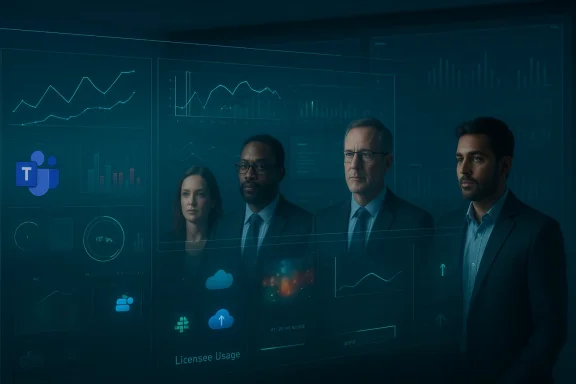 Enterprise Software as a Measurement Layer
The core idea in the TechTarget piece is that enterprise platforms are moving from being work enablers to becoming measurement layers. Instead of simply housing processes, they now expose data about how those processes behave in the wild. That includes who uses what, how often they use it, and what happens when work crosses from one application to another.This is important because most organizations have long struggled to evaluate productivity in a disciplined way. Traditional reporting often capturhe friction between inputs and outcomes. Modern platforms can now reveal those seams, and that makes them strategically useful to finance, operations, and IT leaders alike.
Why measurement changes the buying decision
When a platform can generate visible operational signals, it becomes much easier for executives to justify the investment. That is especially true in budget cycles where software cost, labor cost, and productivity claims all compete for scrutiny. The platform is no longer just something employees use; it is evidence that a certain workflow is, or is not, working.This also changes vendor competition. If one system can prove that it reduces friction while another merely promises broad functionality, the buyer has a stronger basis for choosing the former. In that environment, vendors are pushed toward telemetry, analytics, and reporting depth, because visibility is becoming part of the product itself.
A useful way to think about this is that enterprise software is now judged on two levels at once: functional performance and operational observability. The second layer is increasingly the more valuable one, because it lets leadersgy to business outcomes instead of relying on anecdote or intuition.
The Rise of Operational Signals
TechTarget identifies several places where these signals emerge: SaaS application usage, collaboration friction, device activity, licensing visibility, and the movement of work between applications. Those may sound like technical details, but together they form an evidence trail for how organizations actually function. The insight is less about a single metric and more about the relationship between systems.The article’s examples matter because they represent a different kind of enterprise intelligence. Instead of looking only at financial reports or project dashboards, leaders can now infer how work behaves in real time. That is especially useful in hybrid and distributed organizationsrvation has become less reliable and where managers need data to compensate for distance.
Where the signals show up
Several operational indicators stand out in the article’s logic:- SaaS usage patterns can show whether departments are paying for more software than they actually use.
- Workflow friction can reveal where collaboration tools slow people down instead of helping them move faster.
- Endpoint activity can show whether device environments are supporting productivity or adding overhead.
- Licensing visibility can expose waste across large software estates.
- Cross-application movement candoff delays that are otherwise hard to spot.
Another subtle point is that signals can be misleading if rA low-usage application might indicate waste, but it might also reflect a temporary project, a niche department need, or a compliance requirement. The article’s argument works best when these signals are treated as decision inputs, not as standalone verdicts.
End-User Computing Becomes Strategic
The TechTarget feature on end-user computing reinforceints are no longer just devices; they are a cost-control and operational governance layer. That matters because the workplace economy increasingly lives at the edge of the network, where employees interact with SaaS, identity systems, and collaboration tools through managed devices.In practical terms, EUC now touches licensing, support ch cycles, and even office footprint decisions. TechTarget notes that the cost stack often hides in software licensing waste, productivity friction, support overhead, hardware lifecycle, and shadow IT sprawl. That list is revealing because it shows how much of enterprise economics can be influenced by endpoint strategy alone.
Why endpoint data matters more now
The reason endpoint data has become moe: work increasingly happens in the browser, in a cloud service, or through a mobile device rather than in a single monolithic application. That makes the endpoint the place where usage, friction, and policy enforcement intersect. If you want to understand how the enterprise functions, the endpoint is one of the richest places to look.This is also where executive priorities converge. CIOs care about are about cost control, and security teams care about exposure and compliance. EUC telemetry can help all three by showing where time is lost, where licenses are misallocated, and where device management can eliminate redundant effort.
The challenge, of course, is that measurement can drift into surveillance if it is not carefully governed. That does not make the approach invalid, but it does mean organizations need clear rules abouted and why. Operational discipline should not become a euphemism for uncontrolled monitoring.
A mature EUC strategy therefore has to balance visibility with trust. If employees believe every interaction is being weaponized, adoption can suffer. If leaders use the data to remove friction, simplify support, and reduce repme telemetry becomes an enabler rather than a threat.
AI and the Shift to Outcome-Based Buying
The article’s discussion of AI is especially useful because it illustrates how the market language has changed. Enterprises are no longer satisfied with AI that sounds impressive in demos; they want AI that improveost, and increases productivity. That is the hallmark of a mature buyer market, and it is also a warning sign for vendors that overindex on hype.In TechTarget’s framing, the emergence of KPIs, productivity language, and cost language in AI discussions signals that organizations are moving beyond shift is subtle but important: AI is becoming less of a novelty and more of a management tool. Once that happens, success is no longer measured by novelty or feature count, but by throughput, savings, and process quality.
From promise to proof
This is where many AI projects stumble. Teams often begin with a capability discussion, but enterprise leaders eventually ask a harder question: what measurable change did this create? That question can expose weak use cases quickly, which is healthy for the market but uncomfortable for vendors still selling aspiration.The article’s thesis aligns with a broader enterprise trend: AI has to fit into operational systems, not sit beside them. The best AI implementations are increasingly those that can be governed, audited, and tied to process outcomes. That makes AI more useful, but also less forgiving of poocontrols, or vague business cases.
A byproduct of this shift is that AI procurement resembles other infrastructure decisions more than consumer software adoption. Buyers now expect evidence, not excitement. That tends to favor platforms that can integrate with existing systems and show an operational return, which is exactly why enterprise software vendors are racing to add analytics and reporting depth.
Why Platforms Gain Influence in Decision-Making
One of the strongest ideas in the article is that platforms are becoming influential not because they are louder, but because they are more informative. The more a system can reveal about how work flows, the more it shapes executive judgment. In that way, software becomes a kind of organizational sensor network.That is strategically important because enterprise decision-making has always been constrained by incomplete data. Leaders could see budgets and headcount, but not always the hidden drag of handoffs, duplicated apps, or unmanaged usage. Platforms that fill in those gaps gain influence over resource allocation, process redesign, and even organizational structure.
The politics of visibility
More visible systems often become more politically powerful inside the enterprise. If a platform can prove where work slows down, it can also influence which teams get investment, which processes get redesigned, and which software gets eliminated. That makes the platform not just a tool, but a participant in enterprise governance.This is particularly releations where multiple departments buy overlapping tools. Once a platform provides authoritative usage and cost data, it can break through the ambiguity that often protects redundant spend. In other words, visibility can be a weapon against organizational inertia.
There is also a competitive wrinkle here. Vendors that can unify data across workflows, endpoints, and collaboration systems will have a stronger story than vendors that remain narrowly functional. The market is rewarding breadth of insight, not just depth of feature set. That is a meaningful repositioning of the enterprise software stack.
Historical Parallels in the Microsoft Ecosystem
The article’s logic echoes a pattern that has been visible in the Microsoft ecosystem for years. 365 have long been sold not only as productivity platforms, but as ways to reduce complexity, standardize management, and lower operational costs. TechTarget’s past coverage of Independence Blue Cross described how moving to Microsoft 365 and Windows 10 helped reduce complexity, eliminate third-party tools, and reclaim office space while improving mobility and security.That example is relevant because it shows how platform value often becomes visible only after organizations standardize around it. Once the device, identity, collaboration, and management layers are unified, the organization can start seeing cost and productivity as measurable outputs rather than abstract aspiraticle extends that logic into a broader enterprise context.
What changed over time
The old story was that enterprise software simplified a task. The new story is that enterprise software reveals the economics of the task. That is a much richer proposition, because it connects tactical tooling to strategic planning and financial accountability.This helps explain why the market now talks so much about observability, governance, and analytics. These are not just technical add-ons; they are the mechanisms by which platforms become credible ce a vendor can show the hidden cost of friction, it has entered a far more powerful category of enterprise value.
For Microsoft specifically, this also fits the company’s broader AI and platform strategy, where products are being positioned as operating layers for work rather than standalone utilities. The enterprise does not just want automation; it wants a system that can prove the automation is worth the disruption. That is a much higher bar, but also a much more durable one.
Enterprise vs. Consumer Implications
The article is focused on enterprise software, but the implications spill into consumer expectations as well. People have grown used to software that learns from behavior, adapts in real time, and surfaces signals about usage patterns. In the enterprise, however, those signals carry a far heavier burden because they inform budgets, compliance, and workforce decisions.For consumers, the shift mostly means convenience and personalization. For enterprises, it means accountability. The same telemetry that helps a user find a file faster can help a company identify license waste or workflow bottlenecks. That dual-use nature is exactly why enterprises are taking platform analytics more seriously now.
Two different value models
Consumer software rewards delight, speed, and ease. Enterprise software must also satisfy governance, cost control, and auditability. That means the commercial logic is different, even when the underlying technology looks similar on the surface.The consumer model often tolerates ambiguity because the stakes are low and the feedback loop is personal. The enterprise model cannot afford that luxury. If a platform can’t show where value is created, it risks being treated as overhead rather than infrastructure.
This distinction is why enterprise adoption cycles are slower but more consequential. Once a platform becomes embedded in operational discipline, it can influence procurement, planning, and workforce design for years. That is why the measurement layer matters so much.
Competitive Implications for Vendors
The competitive impact of this shift is easy to underestimate. Vendors that can expose meaningful operational signals are moving into a stronger negotiating position because they are helping buyers just request it. That is especially valuable in a market where software portfolios are under constant review for consolidation and efficiency gains.It also puts pressure on point solutions. If a platform can show usage, cost, workflow impact, and productivity outcomes, it may absorb budget that previously went to specialized tools. The vendor that owns the data often becomes the vendor that owns the decision.
What winners will need
The companies best positioned for this era will likely share several traits:- They will provide high-quality telemetry without overwhelming customers with noise.
- They will connect operational data to financial outcomes in language executives understand.
- They will make governance and reporting core product features rather than afterthoughts.
- They will integrate across apps, devices, and identity systems to reduce blind spots.
- They will help customers remove redundancy, not just digitize it.
- They will support AI use cases that can be tied to measurable process improvement.
Strengths and Opportunities
The strongest opportunity in this trend is that enterprise platforms can now help companies move from intuition-based management to evidence-based operations. That should improve budgeting, planning, and workflow design while making it easier to eliminate waste and focus investment where it matters most. The article is persuasive because it identifies not just a technology shift, but a management shift.- Better cost visibility across software, devices*Sharper productivity analysis** using actual usage data instead of assumptions.
- Improved license governance through more accurate consumption signals.
- Reduced workflow friction by identifying where handoffs break down.
- Stronger executive alignment around KPIs, ROI, and operational discipline.
- Better AI accountability as organizations demand outcomes rather than demos.
- More strategic endpoint management across workforces.
Risks and Concerns
The biggest risk is that more measurement can easily become more confusion if organizations do not know how to interpret the signals they are collecting. Another concern is cultural: if employees believe the enterprise is using telemetry primarily to monitor rather than improve, trust can erode quickly. The promise of operational discipline only works when visibility is paired with credibility.- Surveillance creep if measurement is not governed clearly.
- False positives when usage data is read without business context.
- Tool sprawl if platforms expose signals but do not help consolidate them.
- Vendor lock-in when the system that measures work becomes the system that controls decisions.
- Overreliance on AI before governance and data quality are mature enough.
- Change-management friction if teams see measurement as compliance theater rather than improvement.
- Misaligned incentives when cost reduction is prioritized at the expense of actual worker experience.
Looking Ahead
The next phase of this trend will likely center rises can turn raw telemetry into governed action. The winners will not simplyhey will create clearer operating models around that data. That means tightn IT, finance, and business leadership, because operational discipline is as much about decision rights as it is about dashboards.It is also likely that AI will become the main interface for this measurement layer. As enterprise systems gain more signals, AI can help summarize anomalies, recommend actions, ands slowing down. But the more AI is used to interpret operations, the more important governance, auditability, and data quality become. The smarter the platform, the more disciplined the operating model must be.
What to watch next:
- Whether enterprise software vendors bundle more analytics and cost-control features by default.
- Whether CIOs and CFOs adopt shared frameworks for platform ROI and workflow efficiency.
- Whether AI adoption shifts further toward measurable outcomes rather than experimentatint management becomes even more central to enterprise cost governance.
-gin retiring redundant tools once hidden friction becomes visible.
Source: TechTarget Enterprise platforms help establish operational discipline | TechTarget
