

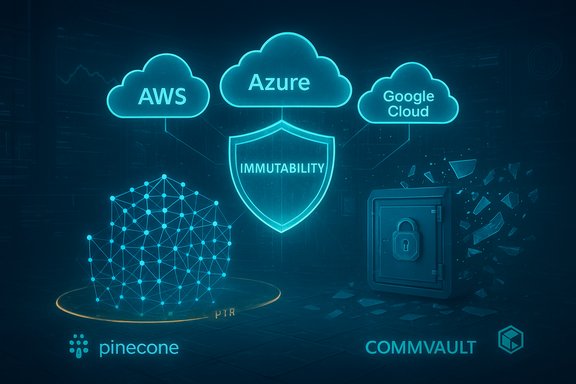
Commvault’s new partnership with Pinecone signals a pivotal shift in how enterprises treat vector data: once an experimental artifact of research labs, embeddings and vector indexes are now being folded into mainstream cyber-resilience strategies with enterprise-grade controls. The integration pairs Commvault’s cloud-native backup and recovery platform with Pinecone’s high-performance vector database to deliver immutable backups, point-in-time recovery (PITR), and extended retention specifically for vector indexes used in retrieval-augmented generation (RAG) and related AI workloads. The capability will be delivered through Commvault Cloud, support multi-cloud deployments across AWS, Microsoft Azure, and Google Cloud, and is targeted for general availability in the first half of 2026.
Vector databases store numeric embeddings—dense, high-dimensional vectors—that encode semantic relationships from text, images, audio, and other data. These embeddings are the foundation of RAG systems and many production AI services: during inference an LLM or other model consults a vector store to retrieve relevant context before generating an answer. Because vectors directly influence model outputs, their integrity, availability, and provenance matter as much as any traditional business dataset. Commvault’s announcement addresses this shift by extending familiar backup constructs—immutability, PITR, encrypted, air-gapped copies, and policy-based retention—to vector indexes that previously operated outside classic backup and governance frameworks.
Commvault’s extension of enterprise-grade resilience to Pinecone vector databases is an important milestone for operational AI maturity: it recognizes that embeddings and vector indexes are now business-critical artifacts that deserve the same governance, auditability, and recoverability as traditional databases and file systems. The integration promises meaningful capabilities—immutable, air-gapped backups; accelerated PITR; and multi-cloud retention—but organizations must validate vendor performance claims, align retention policies to real compliance needs, and treat backups as part of a broader defense-in-depth posture that includes robust ingestion controls and monitoring. When combined with disciplined operational practices and testing, the Commvault–Pinecone pairing can close a major resilience gap for RAG and AI workloads—transforming vector stores from fragile experiment sandboxes into auditable, recoverable components of enterprise production systems.
Source: ChannelE2E Commvault Extends Data Protection to Pinecone Vector Databases
 Background
Vector databases store numeric embeddings—dense, high-dimensional vectors—that encode semantic relationships from text, images, audio, and other data. These embeddings are the foundation of RAG systems and many production AI services: during inference an LLM or other model consults a vector store to retrieve relevant context before generating an answer. Because vectors directly influence model outputs, their integrity, availability, and provenance matter as much as any traditional business dataset. Commvault’s announcement addresses this shift by extending familiar backup constructs—immutability, PITR, encrypted, air-gapped copies, and policy-based retention—to vector indexes that previously operated outside classic backup and governance frameworks. Why this matters now
Enterprises are moving RAG and vector-based inference into production across customer support, regulated document search, compliance workflows, and knowledge automation. As organisations do so, three facts are converging:- Vector stores often accept frequent updates or streaming ingests (increasing corruption risk).
- Vectors are susceptible to adversarial manipulation (data poisoning) that can subtly or overtly change AI behavior.
- Regulators and auditors increasingly expect auditable retention and recoverability for critical datasets used in decision-making.
What the integration delivers
Commvault frames the offering around three headline capabilities that map directly to enterprise resilience and compliance needs:- Immutable backups: Backups that cannot be altered or deleted after creation, providing tamper-evidence and a safe recovery source following corruption or ransomware. Commvault describes storage of backups as encrypted, air-gapped, immutable copies to help ensure clean restores.
- Point-in-time recovery (PITR): The ability to restore an index to a specific prior state, useful where subtle corruption (poisoned vectors) must be undone while preserving other valid updates. Commvault claims accelerated PITR specifically tailored for vector indexes.
- Extended, auditable retention: Policy-driven retention windows and auditable recovery points to meet regulatory or internal governance requirements, including long-term archival for compliance.
How this differs from native vector protections
Pinecone already offers native backup functionality for serverless and pod-based indexes (create/list/restore backups via API/SDK), plus replication across availability zones for resilience. What Commvault adds is an enterprise-class resilience layer that aligns vector index protection with standard corporate backup, audit, and compliance workflows—bringing features like air-gap isolation, long-term policy-driven retention, and Commvault’s unified recovery tooling into play. In short: Pinecone protects availability and durability; Commvault extends governance, immutability, and recovery SLAs.The technical picture: what to expect under the hood
Integration model
The announced solution is delivered via Commvault Cloud, which already provides backup connectors and recovery processes for cloud-native workloads and object storage across major public clouds. The Pinecone integration is described as a tightly engineered data protection adapter that enables backups of vector indexes into Commvault’s immutable storage tiers without adding query latency to live indexes. The integration focuses on being non-invasive to inference paths: backups are taken and retained outside the live serving path so that query performance is not affected.Data flow (high level)
- Vector indexes continue to be hosted and served by Pinecone (pod-based or serverless).
- A Commvault-managed connector invokes Pinecone backup operations and/or captures index state snapshots.
- Backup artifacts are encrypted in transit and at rest, copied to Commvault’s immutable storage (optionally air-gapped), and recorded in Commvault’s catalog for policy-driven retention and recovery workflows.
- If needed, an operator triggers a PITR or restore; Commvault reconstructs the index state and either restores into Pinecone or exports to an importable artifact for re-ingestion.
Supported environments and portability
Commvault’s materials explicitly list support for Amazon Web Services, Microsoft Azure, Google Cloud, and multi-cloud deployments. The multi-cloud model is consistent with Commvault Cloud’s existing capabilities for cross-cloud object storage protection and policy-driven retention. Enterprises can therefore expect to protect Pinecone deployments across major cloud providers while managing resilience from a single console. General availability is targeted for the first half of 2026, according to vendor statements.Why enterprises need vector-aware backups
1) Data integrity affects AI outputs
Vector stores act as a knowledge retrieval layer for LLMs and are directly consulted during inference. A corrupted or poisoned index can produce systemic errors, manipulated outputs, or data leakage. Traditional recovery approaches—restore entire systems or roll back application state—are often too coarse for vector workloads; PITR and index-level immutability let teams surgically revert the embedding state without undoing unrelated changes. Independent security research and operational analyses have documented these poisoning and inversion risks across RAG deployments.2) Compliance and auditability
Regulated sectors (healthcare, finance, legal, government) require auditable retention and the ability to demonstrate recoverability. Vector indexes in production are increasingly treated as business records; long-term, immutable snapshots allow organizations to prove historical state and satisfy forensic or audit requests. Commvault’s approach maps directly to this need by offering auditable, immutable retention for vector data.3) Operational continuity and SLAs
RAG-powered services are integrated into customer-facing and mission-critical systems. Short outages or degraded model quality translate directly to lost revenue or reputation. Faster PITR and validated restores reduce mean time to recovery (MTTR) and help maintain model quality across service-level objectives.Strengths of the Commvault–Pinecone approach
- Brings enterprise backup best practices to a new data class. Applying immutability, air-gaps, and policy governance to vectors removes a major blind spot from many IT resilience programs.
- Multi-cloud management from a single pane. Agencies and global enterprises can keep consistent retention and recovery policies across cloud providers.
- Non-invasive design (claimed). Commvault positions the integration to avoid adding latency to inference queries by keeping backups out of the live serve path. This matters for low-latency production RAG workloads.
- Addresses modern threat models. Air-gapped, encrypted, immutable backups materially reduce the risk that a successful attack on a production Pinecone environment permanently destroys recovery points.
- Leverages existing Pinecone capabilities. The approach builds on Pinecone’s native replication and backup model, layering enterprise governance rather than replacing it. This reduces duplication of effort and helps align operational responsibilities.
Risks, limitations, and unanswered technical questions
While the integration is a logical and needed step, several practical and technical questions remain—and enterprises should weigh these carefully before assuming the integration is a complete solution.Performance and latency claims need independent validation
Commvault and Pinecone both assert the integration can operate without impacting query latency, but those are vendor claims. Neither the announcement nor the public documentation provides independent benchmarks or architecture-level telemetry showing how backup throughput, snapshot frequency, or retention policies behave under production load. Organizations with strict latency/SLO requirements should require performance testing in their own environments before declaring the solution non-disruptive to inference. This is a claim that remains verifiable only through customer pilots or third-party testing.Scope of recovery and restore workflows
Key operational details are not yet public: how granular will PITR be (per-index, per-namespace, per-vector), what RPOs and RTOs should customers reasonably expect, and how will restores synchronize with downstream metadata and application-level consistency checks? Vector indexes are often used together with metadata-rich primary stores; restoring a vector index without reconciling metadata can lead to mismatches. These complexities require careful design and are not fully documented in the initial announcement.Export/import & portability concerns
Pinecone’s SDK supports backups and restore operations for serverless indexes, but enterprise workflows sometimes require export to vendor-neutral formats or movement between accounts. Discussions in community forums suggest more polish is needed for export/import workflows; enterprises that require cross-vendor mobility should probe the supported import/export pipelines and retention portability. If backups are stored in proprietary formats that only Commvault or Pinecone can restore, that can create operational lock-in or complicate disaster recovery in cross-vendor failure scenarios.Cost and storage footprint
Immutable, long-term retention—especially for high-dimensional embeddings at scale—has non-trivial storage costs. Organizations should model the cost of storing backups of large indexes (billions of vectors) across long retention windows. Policy-driven tiering and deduplication can help, but the economics must be calculated against business requirements for retention and retrieval. Commvault’s existing object-storage tiering and dedupe capabilities mitigate but do not eliminate cost concerns.Trust and shared responsibility
Adding another layer (Commvault Cloud) changes the shared responsibility model. Customers must verify encryption key management, access controls, and auditability within Commvault’s storage and ensure it meets the organization’s compliance posture. Questions about where keys are stored, who can initiate restores, and how forensic logs are secured will matter in sensitive environments. Commvault publishes documentation on air-gapped and key management practices, but organizations must validate these controls against internal policy.Practical guidance: how enterprises should approach adoption
For teams planning to adopt the Commvault–Pinecone integration, a staged, test-driven approach will reduce operational surprises and surface real-world constraints.- Start with a focused pilot: Protect a single, non-critical index with representative dimensionality and update cadence. Measure backup window, cataloging time, and any impact on query latency under load.
- Validate restore scenarios: Run PITR tests and full restores regularly. Verify downstream application behavior and metadata synchronization after each restore.
- Define retention policy tiers: Align legal and business retention needs to cost models. Consider shorter hot retention for fast restores and longer cold-retention for audit retention.
- Harden ingestion pipelines: Add provenance, signing, and validation checks to data entering the vector store to reduce the chance of poisoning; backups are last-resort mitigations, not primary defenses.
- Audit keys and access: Ensure encryption keys, restore permissions, and audit logs meet internal security and compliance requirements before enabling long-term retention.
Regulatory and governance implications
For regulated industries, the ability to retain immutable, auditable copies of vector indexes is a significant step forward. Auditors increasingly treat training and inference datasets as governed artifacts, and RAG retrieval context can be subject to data subject requests or records retention laws. Immutable backups provide a defensible chain-of-custody and can simplify forensic workflows after incidents. However, regulators will expect enterprises to show integrated policies—not just technical snapshots—covering ingestion provenance, data minimization, PII handling, and deletion controls. An immutable copy that contains PII without proper redaction may itself be a compliance risk.Competitive and market context
The announcement fits into a broader market trend where data protection and cyber-resilience vendors are extending support to AI-specific artifacts—model registries, feature stores, and now vector indexes. Commvault has been expanding its AI-resilience messaging and capabilities across data lakehouses and cloud-native platforms, while Pinecone has continued to mature its operational features (replication, backups, SDKs). For customers, this coupling offers a rapid on-ramp to enterprise controls without moving away from Pinecone’s managed, high-performance serving layer. Vendors such as Databricks, MongoDB, Qdrant, and other vector providers are also evolving their operational feature sets, which will push the whole market toward stronger governance for AI data.Final assessment — strengths, cautions, and what to watch
- Strengths: The Commvault–Pinecone partnership addresses a clearly articulated enterprise need: protecting the integrity and availability of vector data that now powers production AI systems. By applying immutable backups, PITR, and long-term retention via Commvault Cloud, customers gain a unified resilience posture across clouds and workloads. The approach maps to real threat models (data poisoning, deletion, and ransomware) and regulatory pressures.
- Cautions: Several vendor claims—particularly around no impact to query latency and accelerated PITR—lack independent benchmarks in public materials. Organizations should treat these assertions as vendor guidance until validated in controlled load tests. Additionally, portability, export/import ergonomics, and long-term cost modeling for large-scale embeddings require careful evaluation.
- What to watch next:
- Early GA feedback and published performance benchmarks from Commvault or independent testers.
- Community reports on restore ergonomics—how easily restored indexes reconcile with application metadata.
- Any enhancements from Pinecone to export/import formats that improve portability between providers.
- Regulatory guidance that specifically references retention of AI training and retrieval artifacts.
Practical checklist for IT and security teams
- Confirm the retention and immutability options supported by Commvault Cloud for Pinecone backups and map them to legal/compliance retention schedules.
- Run a latency-sensitive pilot to empirically validate vendor claims about query performance under backup operations.
- Document and test PITR and full-restore procedures—including reconciliation steps for application metadata and downstream caches.
- Ensure encryption keys, IAM controls, and restore authorization workflows meet corporate least-privilege and separation-of-duties policies.
- Update incident response runbooks to include vector-store restore and validation steps as part of AI-system recovery.
Commvault’s extension of enterprise-grade resilience to Pinecone vector databases is an important milestone for operational AI maturity: it recognizes that embeddings and vector indexes are now business-critical artifacts that deserve the same governance, auditability, and recoverability as traditional databases and file systems. The integration promises meaningful capabilities—immutable, air-gapped backups; accelerated PITR; and multi-cloud retention—but organizations must validate vendor performance claims, align retention policies to real compliance needs, and treat backups as part of a broader defense-in-depth posture that includes robust ingestion controls and monitoring. When combined with disciplined operational practices and testing, the Commvault–Pinecone pairing can close a major resilience gap for RAG and AI workloads—transforming vector stores from fragile experiment sandboxes into auditable, recoverable components of enterprise production systems.
Source: ChannelE2E Commvault Extends Data Protection to Pinecone Vector Databases
