

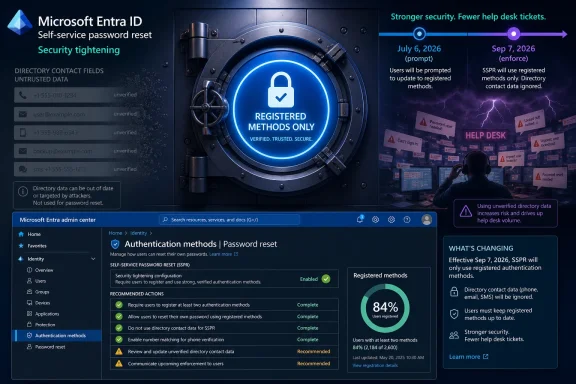
Microsoft will begin changing Microsoft Entra ID self-service password reset on July 6, 2026, and from September 7, 2026, SSPR will require users to have explicitly registered authentication methods instead of relying on unregistered directory contact fields. The shift sounds procedural, but it is really about removing one of identity management’s soft edges. Microsoft is drawing a brighter line between “data the organization has about you” and “proof you have deliberately registered for account recovery.” For admins, the work starts now because the users least likely to notice the warning are also the ones most likely to generate the ticket storm.
Self-service password reset has always lived in an awkward place. It is supposed to reduce help desk dependency, but it also sits directly on the path to account takeover: if an attacker can satisfy the reset flow, the password is no longer a security boundary but an obstacle course with a shortcut.
The old behavior in Microsoft Entra ID blurred that boundary. Some users could reset passwords using contact attributes already stored in their directory profile, such as a mobile number, business phone, or alternate email address. That information might have been imported, synchronized, maintained by HR, edited by an admin, or simply inherited from years of directory hygiene work.
Microsoft’s new rule is simple: if the method was not registered as an authentication method, it will not count for SSPR. A phone number can still be used. An alternate email can still be used. But it must be treated by Entra ID as a registered and trusted method, not merely as a line of profile data.
That distinction matters. Directory attributes are administrative facts. Registered authentication methods are security claims. Microsoft is now saying password recovery must depend on the latter.
The second date is September 7, 2026, when enforcement begins. After that, unregistered contact details will no longer work for password reset verification. General availability is planned for September 2026, which makes this less of a far-off roadmap item and more of a summer change-management problem.
Microsoft says 86 percent of Entra ID SSPR users already rely on registered methods. That number is meant to reassure, and for many organizations it will be accurate. If your tenant has pushed combined security information registration, nudged users toward Microsoft Authenticator, and cleaned up authentication method policies, this will probably be a minor compliance check.
The remaining 14 percent are the story. They are the users whose reset path may depend on legacy contact data rather than a registered recovery method. In a large enterprise, that minority can still represent thousands of accounts; in a smaller business, it may include the one executive, contractor, service owner, or administrator whose lockout becomes everybody’s problem.
But convenience ages poorly in identity systems. A mobile number in a directory is not necessarily a secure recovery factor. It may be stale, mistyped, reassigned, synchronized from an authoritative source that was never designed for authentication, or visible to too many people with delegated administrative access.
An alternate email address has similar problems. It may be personal, unmanaged, shared, abandoned, or compromised. Even when it is valid, the fact that it exists in a directory does not prove the user has recently verified control of it for account recovery.
Microsoft’s move reflects a broader industry shift away from treating profile attributes as security evidence. Modern identity systems increasingly want proof that a user deliberately enrolled a method, that the method is governed by policy, and that admins can report on it as part of authentication posture. In that world, “we had the number on file” is not good enough.
But SSPR is now part of the identity security fabric. It intersects with multifactor authentication, conditional access expectations, privileged role management, password writeback, and the messy operational reality of hybrid Active Directory estates. A bad reset process can undermine good sign-in controls.
That is why this change lands differently from a routine portal update. It is not just Microsoft changing which fields appear in a wizard. It is Microsoft tightening the chain of custody around account recovery.
For Windows admins, the practical implication is direct. A user who cannot reset a password may be unable to sign in to a Windows device, reach Microsoft 365, access VPN, or complete a required password change. If the user is remote, out of hours, or traveling, the help desk becomes the fallback identity provider.
Privileged accounts should already have stronger requirements than ordinary users. In Microsoft’s SSPR model, administrator roles have different reset expectations, and many organizations layer additional operational rules on top: break-glass accounts, phishing-resistant MFA, privileged access workstations, and separate cloud-only emergency identities.
This change should prompt admins to ask whether their privileged recovery story is coherent. Are admin accounts registered with valid methods? Are those methods appropriate for privileged use? Are emergency accounts excluded from brittle dependencies while still protected by strong controls?
The worst answer is not “we need to fix it.” The worst answer is “we don’t know.” SSPR registration coverage is one of those administrative details that feels boring right up until it becomes the reason nobody can recover the account needed to fix something larger.
That sounds simple, but the politics of cleanup can be harder than the technical task. Some users will ignore prompts. Some will not understand why a phone number that “already works” must be registered again. Some will be unable to complete registration because they are rarely interactive, work in constrained environments, or use shared operational accounts that should probably be redesigned rather than patched.
Admins should treat this as a staged campaign, not a September surprise. Identify users who rely on directory-sourced attributes. Communicate the change in plain language. Give help desks scripts that distinguish between registering a recovery method and updating a profile phone number. Track completion before enforcement, not after.
The important metric is not whether SSPR is enabled. It is whether the user population has registered methods that satisfy the actual reset policy. Those are different questions, and September will punish organizations that confuse them.
The failure mode is harsher. A user attempts to reset a password and discovers that the contact data they assumed would work no longer counts. If they are already locked out, they may not be able to register a method without administrator intervention. At that point, the self-service path collapses into the old-fashioned support queue.
That is the operational irony of self-service systems: they require maintenance before the user needs them. Nobody buys a spare key after they are locked out of the building. Nobody registers recovery methods after losing the ability to authenticate unless the organization has planned a way back in.
This is where messaging matters. Users do not need a lecture on Entra ID’s authentication method model. They need to understand that password reset will soon require pre-registered recovery options, and that ignoring the prompt may mean calling IT later.
But Secure Future Initiative changes often arrive in the tenant as chores. Review this setting. Migrate that policy. Replace legacy behavior. Audit coverage. Nudge users. Repeat. The strategic language may come from Redmond, but the execution burden lands on tenant administrators.
That does not make the change bad. It makes it familiar. Microsoft’s cloud security posture increasingly depends on retiring behaviors that were useful when Azure AD was younger, simpler, and less central to enterprise life. Entra ID is now the front door to too much infrastructure for recovery flows to depend on ambiguous data.
The deeper message is that Microsoft is reducing tolerance for implicit trust. A phone number in a profile is not enough. An email field in a directory is not enough. Recovery must be intentional, registered, policy-aware, and reportable.
In those environments, contact information may have been treated as an HR or directory-management concern rather than an authentication concern. A mobile number might exist because payroll needed it. A business phone might exist because the global address list needed it. An alternate email might exist because someone imported it during a migration.
That data may be useful, but Microsoft is now refusing to treat it as sufficient for password reset. Hybrid admins should assume that old correctness does not equal new compliance. A field can be accurate and still not be registered.
This is also a good moment to revisit password writeback and on-premises dependencies. If users reset in Entra ID but still depend on Active Directory credentials in practical ways, a broken or unavailable reset path can ripple through Windows sign-in, VPN access, line-of-business applications, and cached credential scenarios. The SSPR method change is cloud policy, but its consequences will not stay neatly in the cloud.
The help desk is expensive not just because people call it, but because it becomes the exception engine for every neglected identity process. When SSPR fails, support staff must verify the user through some other channel, apply temporary access procedures, update methods, or escalate. Every manual recovery step is both a cost and a potential security risk.
A better approach is to front-load the boring work. Reports before reminders. Reminders before enforcement. Escalation before lockout. The aim is not simply to satisfy Microsoft’s deadline but to reduce the number of identity exceptions the organization must trust under pressure.
Admins should also review the allowed methods themselves. If the SSPR policy permits weak or operationally unsuitable options, registration coverage alone is not a victory. The method must be both registered and appropriate for the risk of the account.
This is visible beyond SSPR. Microsoft has been pushing stronger MFA, passwordless sign-in, passkeys, certificate-based authentication, and more centralized policy controls. The company’s preferred future is one where identity proof is not scattered across old portals, synchronized fields, and feature-specific exceptions.
SSPR is a particularly important test because password reset is where many organizations reveal their real security maturity. It is easy to require strong authentication when everything is working. It is harder to maintain strong authentication when a user is locked out, angry, remote, and blocking a business process.
By requiring registered methods, Microsoft is making recovery look more like authentication and less like directory lookup. That is the right architectural direction, even if it creates short-term friction.
This is the part of cloud administration that still resembles old-fashioned systems work. Inventory the state. Compare it against policy. Fix the exceptions. Communicate before users are surprised. Then verify again.
The difference is that identity mistakes now have wider blast radii. A missed registration can block productivity. A weak recovery path can enable compromise. A privileged account with poor recovery planning can turn a routine lockout into a crisis.
Microsoft’s change is not dramatic because it introduces a new technology. It is dramatic because it removes a convenience that many tenants may have forgotten they were relying on.
That leaves admins with a short, specific action list:
 Microsoft Is Closing the Gap Between Contact Data and Identity Proof
Self-service password reset has always lived in an awkward place. It is supposed to reduce help desk dependency, but it also sits directly on the path to account takeover: if an attacker can satisfy the reset flow, the password is no longer a security boundary but an obstacle course with a shortcut.The old behavior in Microsoft Entra ID blurred that boundary. Some users could reset passwords using contact attributes already stored in their directory profile, such as a mobile number, business phone, or alternate email address. That information might have been imported, synchronized, maintained by HR, edited by an admin, or simply inherited from years of directory hygiene work.
Microsoft’s new rule is simple: if the method was not registered as an authentication method, it will not count for SSPR. A phone number can still be used. An alternate email can still be used. But it must be treated by Entra ID as a registered and trusted method, not merely as a line of profile data.
That distinction matters. Directory attributes are administrative facts. Registered authentication methods are security claims. Microsoft is now saying password recovery must depend on the latter.
The Calendar Gives Admins Time, But Not Much Excuse
The first date that matters is July 6, 2026, when Microsoft says affected users will start seeing prompts to register authentication methods. That is the warning phase, and in a healthy tenant it should be uneventful. Users who already have compliant methods should not notice anything meaningful.The second date is September 7, 2026, when enforcement begins. After that, unregistered contact details will no longer work for password reset verification. General availability is planned for September 2026, which makes this less of a far-off roadmap item and more of a summer change-management problem.
Microsoft says 86 percent of Entra ID SSPR users already rely on registered methods. That number is meant to reassure, and for many organizations it will be accurate. If your tenant has pushed combined security information registration, nudged users toward Microsoft Authenticator, and cleaned up authentication method policies, this will probably be a minor compliance check.
The remaining 14 percent are the story. They are the users whose reset path may depend on legacy contact data rather than a registered recovery method. In a large enterprise, that minority can still represent thousands of accounts; in a smaller business, it may include the one executive, contractor, service owner, or administrator whose lockout becomes everybody’s problem.
The Legacy Convenience Was Also a Security Smell
There is an obvious convenience argument for using existing contact data. If the organization already knows a user’s mobile number or alternate email, why force another registration step? For years, that logic fit the practical needs of IT departments trying to reduce password-reset calls without turning onboarding into a paperwork exercise.But convenience ages poorly in identity systems. A mobile number in a directory is not necessarily a secure recovery factor. It may be stale, mistyped, reassigned, synchronized from an authoritative source that was never designed for authentication, or visible to too many people with delegated administrative access.
An alternate email address has similar problems. It may be personal, unmanaged, shared, abandoned, or compromised. Even when it is valid, the fact that it exists in a directory does not prove the user has recently verified control of it for account recovery.
Microsoft’s move reflects a broader industry shift away from treating profile attributes as security evidence. Modern identity systems increasingly want proof that a user deliberately enrolled a method, that the method is governed by policy, and that admins can report on it as part of authentication posture. In that world, “we had the number on file” is not good enough.
SSPR Is Not a Side Feature Anymore
Self-service password reset used to be framed mostly as a help desk deflection tool. Fewer calls, fewer lockouts, faster return to work. That pitch still matters, especially in hybrid and remote environments where a forgotten password can strand a user outside the network perimeter.But SSPR is now part of the identity security fabric. It intersects with multifactor authentication, conditional access expectations, privileged role management, password writeback, and the messy operational reality of hybrid Active Directory estates. A bad reset process can undermine good sign-in controls.
That is why this change lands differently from a routine portal update. It is not just Microsoft changing which fields appear in a wizard. It is Microsoft tightening the chain of custody around account recovery.
For Windows admins, the practical implication is direct. A user who cannot reset a password may be unable to sign in to a Windows device, reach Microsoft 365, access VPN, or complete a required password change. If the user is remote, out of hours, or traveling, the help desk becomes the fallback identity provider.
Privileged Accounts Deserve the First Audit
Microsoft specifically calls out IT admin accounts, and it is right to do so. Losing reset access for a standard user is an inconvenience. Losing reset access for a privileged account can become an incident response problem, especially if the organization discovers the gap during an outage or compromise.Privileged accounts should already have stronger requirements than ordinary users. In Microsoft’s SSPR model, administrator roles have different reset expectations, and many organizations layer additional operational rules on top: break-glass accounts, phishing-resistant MFA, privileged access workstations, and separate cloud-only emergency identities.
This change should prompt admins to ask whether their privileged recovery story is coherent. Are admin accounts registered with valid methods? Are those methods appropriate for privileged use? Are emergency accounts excluded from brittle dependencies while still protected by strong controls?
The worst answer is not “we need to fix it.” The worst answer is “we don’t know.” SSPR registration coverage is one of those administrative details that feels boring right up until it becomes the reason nobody can recover the account needed to fix something larger.
The Entra Admin Center Becomes the Early Warning System
Microsoft’s recommended admin path is straightforward: review SSPR coverage in the Microsoft Entra admin center, then inspect user registration details under Authentication methods. The goal is to confirm that each user has at least one registered method satisfying the organization’s SSPR policy.That sounds simple, but the politics of cleanup can be harder than the technical task. Some users will ignore prompts. Some will not understand why a phone number that “already works” must be registered again. Some will be unable to complete registration because they are rarely interactive, work in constrained environments, or use shared operational accounts that should probably be redesigned rather than patched.
Admins should treat this as a staged campaign, not a September surprise. Identify users who rely on directory-sourced attributes. Communicate the change in plain language. Give help desks scripts that distinguish between registering a recovery method and updating a profile phone number. Track completion before enforcement, not after.
The important metric is not whether SSPR is enabled. It is whether the user population has registered methods that satisfy the actual reset policy. Those are different questions, and September will punish organizations that confuse them.
The User Experience Will Be Small Until It Is Not
For most users, the visible change may be a prompt. Register a method. Confirm a phone. Add an email. Move on. If Microsoft’s 86 percent figure holds across real-world tenants, many employees will never understand why IT sent a warning at all.The failure mode is harsher. A user attempts to reset a password and discovers that the contact data they assumed would work no longer counts. If they are already locked out, they may not be able to register a method without administrator intervention. At that point, the self-service path collapses into the old-fashioned support queue.
That is the operational irony of self-service systems: they require maintenance before the user needs them. Nobody buys a spare key after they are locked out of the building. Nobody registers recovery methods after losing the ability to authenticate unless the organization has planned a way back in.
This is where messaging matters. Users do not need a lecture on Entra ID’s authentication method model. They need to understand that password reset will soon require pre-registered recovery options, and that ignoring the prompt may mean calling IT later.
Secure Future Initiative Turns Into Tenant-Level Chores
Microsoft is positioning the change as part of its Secure Future Initiative, the company-wide security push that has followed years of escalating scrutiny around cloud identity, token theft, email compromise, and state-backed intrusions. That framing is reasonable. Account recovery is a favorite weak point because it often combines high privilege with inconsistent process.But Secure Future Initiative changes often arrive in the tenant as chores. Review this setting. Migrate that policy. Replace legacy behavior. Audit coverage. Nudge users. Repeat. The strategic language may come from Redmond, but the execution burden lands on tenant administrators.
That does not make the change bad. It makes it familiar. Microsoft’s cloud security posture increasingly depends on retiring behaviors that were useful when Azure AD was younger, simpler, and less central to enterprise life. Entra ID is now the front door to too much infrastructure for recovery flows to depend on ambiguous data.
The deeper message is that Microsoft is reducing tolerance for implicit trust. A phone number in a profile is not enough. An email field in a directory is not enough. Recovery must be intentional, registered, policy-aware, and reportable.
Hybrid Estates Will Feel the Edges First
Cloud-only organizations with modern onboarding may breeze through this. Hybrid organizations are more likely to find edge cases. They often have years of synchronized attributes, mixed password policies, password writeback dependencies, and user populations that span office workers, field staff, contractors, and service-adjacent identities.In those environments, contact information may have been treated as an HR or directory-management concern rather than an authentication concern. A mobile number might exist because payroll needed it. A business phone might exist because the global address list needed it. An alternate email might exist because someone imported it during a migration.
That data may be useful, but Microsoft is now refusing to treat it as sufficient for password reset. Hybrid admins should assume that old correctness does not equal new compliance. A field can be accurate and still not be registered.
This is also a good moment to revisit password writeback and on-premises dependencies. If users reset in Entra ID but still depend on Active Directory credentials in practical ways, a broken or unavailable reset path can ripple through Windows sign-in, VPN access, line-of-business applications, and cached credential scenarios. The SSPR method change is cloud policy, but its consequences will not stay neatly in the cloud.
The Help Desk Should Not Be the Migration Plan
There is a tempting lazy path: let enforcement happen, then handle the people who fail. That might work if the affected population is tiny and well understood. It is a poor plan if the organization cannot identify who depends on unregistered methods.The help desk is expensive not just because people call it, but because it becomes the exception engine for every neglected identity process. When SSPR fails, support staff must verify the user through some other channel, apply temporary access procedures, update methods, or escalate. Every manual recovery step is both a cost and a potential security risk.
A better approach is to front-load the boring work. Reports before reminders. Reminders before enforcement. Escalation before lockout. The aim is not simply to satisfy Microsoft’s deadline but to reduce the number of identity exceptions the organization must trust under pressure.
Admins should also review the allowed methods themselves. If the SSPR policy permits weak or operationally unsuitable options, registration coverage alone is not a victory. The method must be both registered and appropriate for the risk of the account.
Microsoft’s Direction Is Clear Even When the Product Names Change
The branding around Microsoft identity has changed repeatedly: Azure Active Directory became Microsoft Entra ID, authentication methods moved through portal experiences, and policy surfaces have evolved. Underneath the renaming, the direction is consistent. Microsoft wants tenants to move from legacy, attribute-driven, and per-feature controls toward centralized, explicit authentication method management.This is visible beyond SSPR. Microsoft has been pushing stronger MFA, passwordless sign-in, passkeys, certificate-based authentication, and more centralized policy controls. The company’s preferred future is one where identity proof is not scattered across old portals, synchronized fields, and feature-specific exceptions.
SSPR is a particularly important test because password reset is where many organizations reveal their real security maturity. It is easy to require strong authentication when everything is working. It is harder to maintain strong authentication when a user is locked out, angry, remote, and blocking a business process.
By requiring registered methods, Microsoft is making recovery look more like authentication and less like directory lookup. That is the right architectural direction, even if it creates short-term friction.
September’s Deadline Is Really a Directory Hygiene Audit
The concrete work is not glamorous, but it is manageable. Admins need to know who is covered, who is not, and which methods will count after enforcement. The organizations that start early will treat September as a validation date; the organizations that wait will treat it as a support event.This is the part of cloud administration that still resembles old-fashioned systems work. Inventory the state. Compare it against policy. Fix the exceptions. Communicate before users are surprised. Then verify again.
The difference is that identity mistakes now have wider blast radii. A missed registration can block productivity. A weak recovery path can enable compromise. A privileged account with poor recovery planning can turn a routine lockout into a crisis.
Microsoft’s change is not dramatic because it introduces a new technology. It is dramatic because it removes a convenience that many tenants may have forgotten they were relying on.
The Password Reset Door Is Getting a Better Lock
The most useful reading of this change is practical rather than philosophical. Microsoft is not killing phone or email recovery. It is killing the assumption that directory contact data automatically deserves a role in password reset.That leaves admins with a short, specific action list:
- Organizations should identify users whose SSPR access depends on unregistered directory contact attributes before the July 6, 2026 prompting phase begins.
- Every SSPR-enabled user should have at least one registered authentication method that satisfies the tenant’s password reset policy before September 7, 2026.
- Privileged accounts should be audited first because reset failures or weak recovery methods carry higher operational and security risk.
- Help desks should be prepared to explain the difference between updating profile contact information and registering a trusted authentication method.
- Hybrid environments should test password reset flows end to end, including password writeback and Windows sign-in consequences where applicable.
- Admins should use the deadline as a chance to remove stale recovery data rather than merely convert old assumptions into new registrations.
References
- Primary source: Windows Report
Published: 2026-06-01T07:31:09.722793
Loading…
windowsreport.com - Official source: learn.microsoft.com
Loading…
learn.microsoft.com - Official source: support.microsoft.com
Loading…
support.microsoft.com - Official source: microsoft.com
Loading…
www.microsoft.com - Related coverage: video2.skills-academy.com
Loading…
video2.skills-academy.com - Official source: cdn-dynmedia-1.microsoft.com
Loading…
cdn-dynmedia-1.microsoft.com