

EPAM’s recognition as the 2025 Microsoft Innovate with Azure AI Platform Partner of the Year underscores how large systems integrators are shaping the enterprise AI market by combining platform depth, engineering scale, and responsible-AI controls to move pilots into production at scale.
Microsoft’s 2025 Partner of the Year awards spotlight partners that delivered measurable customer outcomes using Microsoft Cloud and AI technologies; the program received more than 4,600 nominations this year, making each category fiercely competitive. EPAM’s award — Innovate with Azure AI Platform — is specifically intended to recognize partners that pushed the boundaries of Azure AI Foundry usage, model lifecycle management, multi‑modal systems and enterprise-grade safety and governance.
This article explains what EPAM’s win means technically and commercially, summarizes the customer case that formed the basis of the award entry, verifies the main claims using independent reporting and product documentation, and provides a critical appraisal of strengths, open questions, and risks for enterprise buyers considering large‑scale Azure AI engagements.
At the same time, the award is an endorsement of capability, not a substitute for procurement rigor. Enterprise buyers should still demand named references, telemetry, cost models, documented governance controls, and portability assurances before committing to multi‑region rollouts. When these checks are in place, the combination of EPAM’s engineering scale, Microsoft’s Foundry platform, and disciplined operational planning can produce rapid, measurable value — exactly the outcome the Innovate with Azure AI Platform award seeks to spotlight.
Source: Morningstar https://www.morningstar.com/news/pr...-azure-ai-platform-partner-of-the-year-award/
 Background
Microsoft’s 2025 Partner of the Year awards spotlight partners that delivered measurable customer outcomes using Microsoft Cloud and AI technologies; the program received more than 4,600 nominations this year, making each category fiercely competitive. EPAM’s award — Innovate with Azure AI Platform — is specifically intended to recognize partners that pushed the boundaries of Azure AI Foundry usage, model lifecycle management, multi‑modal systems and enterprise-grade safety and governance.This article explains what EPAM’s win means technically and commercially, summarizes the customer case that formed the basis of the award entry, verifies the main claims using independent reporting and product documentation, and provides a critical appraisal of strengths, open questions, and risks for enterprise buyers considering large‑scale Azure AI engagements.
Why the award matters
Winning Microsoft’s Innovate with Azure AI Platform category signals three concrete capabilities in market terms:- Platform-native engineering: the ability to design and operate solutions on Azure AI Foundry and companion services (Azure OpenAI, Copilot Studio, Microsoft Fabric, identity and security integrations).
- Enterprise governance at scale: demonstrable safety, observability, and model lifecycle processes that meet enterprise auditing and compliance needs.
- Repeatable commercial outcomes: the partner can show real-world customer impact — not just prototypes — across measurable KPIs such as time saved, accuracy, throughput, or cost improvements.
The winning submission: Albert Heijn and a GenAI platform for store teams
The case, in brief
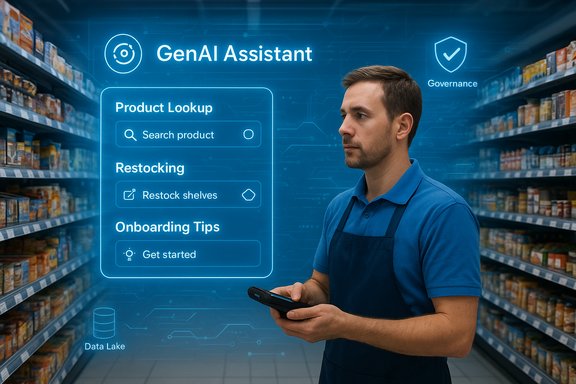
EPAM’s award entry highlighted a collaboration with Albert Heijn (the Netherlands’ largest retailer) to build a scalable GenAI platform that powers an employee‑facing virtual assistant inside the retailer’s internal app. The assistant answers product and stock queries, simplifies restocking tasks, supports onboarding, and reduces time to information for store teams — a tangible operational use case designed to improve customer service and shrink operational friction on the shop floor. EPAM described combining Azure AI Foundry with their own GenAI products and engineering accelerators to achieve these outcomes.Why this use case is credible
Retail operations are a classic high-value locus for agentic GenAI: frequent, repetitive knowledge queries (stock levels, product placement, promotions), a need for quick mobile access at point of work, and clear KPIs (speed of customer service, time to restock, error reduction). Microsoft and industry reporting in 2025 have repeatedly cited similar enterprise scenarios as early durable use cases for Copilot and agent frameworks when properly governed and integrated with authoritative backend data sources. EPAM’s narrative aligns with those patterns and fits the documented capabilities of Azure AI Foundry and Copilot Studio.Technical anatomy: what EPAM likely built (and how Azure components fit)
The press materials and broader platform documentation permit a reasonably precise reconstruction of the technical architecture EPAM used for the Albert Heijn assistant. Where public details are thin, those items are explicitly flagged.Core building blocks
- Azure AI Foundry (model catalog, lifecycle, observability, safety tooling).
- Azure OpenAI Service (model hosting, embeddings, RAG / retrieval components).
- Microsoft Copilot Studio / Agent framework (agent composition, low‑code/no‑code orchestration for workflows and user-facing copilots).
- Microsoft Fabric / OneLake or equivalent data lake (unified enterprise data layer for product catalog, inventory, training data).
- Identity and access via Microsoft Entra / Azure AD (enterprise authentication and role‑based controls).
- DevOps and SDLC acceleration via GitHub Copilot (EPAM explicitly calls out Copilot as part of accelerating its SDLC).
Likely architecture pattern
- Authoritative backend connectors: real‑time product and stock data are exposed through secure APIs or connectors (OneLake, Fabric, or direct ERP/POS connectors).
- Ingestion and index creation: structured product metadata and semi‑structured knowledge (policies, training guides) are normalized into a retrieval layer (embeddings + vector store).
- Model layer: a governance‑wrapped model deployment in Azure OpenAI (or a Foundry‑hosted model) handles inference; RAG pipelines limit hallucinations by grounding responses in indexed content.
- Agent orchestration: Copilot Studio or Foundry Agent Service composes prompts, decision logic, and multi‑turn conversation flows; the agent can invoke backend APIs for stock checks or trigger task workflows.
- Observability and safety: Foundry’s management console logs queries, response provenance, moderation flags and drift metrics for audits and continuous improvement.
Where EPAM’s IP and accelerators matter
EPAM says its internal accelerators — such as EPAM AI/RUN™ and DIALX Lab initiatives — plus SDLC automation with GitHub Copilot reduced time‑to‑market and strengthened quality and security. These are plausible differentiators: large SIs succeed by productizing repeatable pipelines (ingestion, indexing, RBAC patterns, test harnesses, red‑team playbooks), and EPAM’s description mirrors that industrial approach. Independent coverage of partner engineering practices in 2025 shows similar patterns across award winners.Cross‑checking the claims (verification and independent confirmation)
Several independent sources corroborate the core facts claimed in EPAM’s announcement:- Microsoft’s own Partner of the Year announcements and blog confirm the scope and scale of the 2025 awards program and the existence of an Innovate with Azure AI Platform category.
- Regional and trade press published partner winners lists that explicitly name EPAM as the Innovate with Azure AI Platform winner in the Azure category. Those contemporaneous reports echo the case study framing.
- EPAM’s corporate newsroom and investor communications confirm the company’s expanded Microsoft relationship (Globally Managed Enterprise SI status) and its public narrative about AI and GenAI products such as EPAM AI/RUN™ and DIALX Lab. Those materials parallel the award announcement and provide corporate context for the achievement.
Strengths: what EPAM brings to enterprise Azure AI projects
- Engineering scale and process maturity. EPAM’s global delivery network and long history of enterprise engineering make it well‑positioned to productize pipelines, manage regional compliance, and staff scaled rollouts. This is a practical advantage when deploying agentic systems across hundreds or thousands of stores.
- Platform-first alignment. Deep alignment with Microsoft product roadmaps (Azure AI Foundry, Copilot Studio, Fabric) eases integration friction and unlocks co‑sell/go‑to‑market support. Microsoft’s partner program amplifies winners across field teams, which accelerates enterprise introductions.
- Responsible AI and governance emphasis. The award category itself prioritizes safety, governance and model lifecycle — areas where EPAM claims to have invested engineering effort and tooling. For regulated industries and large retailers, such controls are necessary to meet auditability and compliance requirements.
- Practical, operational use cases. Building assistant experiences that accelerate day‑to‑day operations (restocking, onboarding, inventory lookup) is lower risk than high‑stakes decision automation and yields quick, measurable ROI when done correctly.
Risks and open questions: what buyers should scrutinize
- Proven production SLAs and scalability evidence. Awards and press releases validate capability and market recognition, but they do not substitute for operational SLAs. Ask for:
- Named references with contactable operations teams.
- Telemetry demonstrating throughput and latency under peak store conditions.
- Incident and remediation histories for production assistants.
- Cost predictability and inference economics. Agentic solutions introduce ongoing inference costs, vector store storage and search charges, and possible data egress — all of which compound with scale. Validate actual cost models and forecasting under realistic query volumes.
- Data governance and privacy boundaries. Retailer data frequently includes sensitive supply‑chain, employee, and customer information. Ensure:
- Clear data residency and retention policies (BYOS storage options, if required).
- Contractual commitments on data usage and model training.
- Audit logs and explainability artifacts for critical decisions.
- Hallucination management and red‑team testing. Even with RAG and retrieval constraints, LLM outputs can deviate. Confirm:
- Provenation controls linking responses to authoritative sources.
- A structured red‑team program and automated regression tests for agent behavior.
- Vendor lock and portability. Many partners accelerate delivery with proprietary accelerators (EPAM AI/RUN™, internal templates). While these speed deployment, buyers should secure exportable indexes, documented transformation pipelines, and clear exit provisions to avoid lock‑in.
- Runbook for updates and model drift. Enterprise assistants must have documented procedures for model updates, safety threshold changes, and emergency rollback. Ask for the partner’s model‑update cadence, testing rig, and rollback SLAs.
Practical checklist for IT leaders considering an EPAM‑led Azure AI Foundry project
- Request a joint architecture workshop with Microsoft field teams in attendance (this clarifies product roadmap alignment and co‑sell possibilities).
- Insist on named production references and a technical deep dive that includes telemetry and cost models.
- Require contractual commitments for data governance, red‑team results, and a documented incident response playbook.
- Validate portability by obtaining sample exported artifacts (index snapshots, ETL code, transformation scripts).
- Pilot in a low‑risk, high‑value domain (e.g., internal employee assistant for store teams) and measure:
- Task completion time reductions.
- Error rate and escalation volume.
- Monthly inference and storage cost per active user.
- Automate continuous evaluation: integrate monitoring dashboards that capture hallucination incidents, latency percentiles, and usage patterns.
Market implications
EPAM’s award is part of a broader pattern in 2025: hyperscaler partner programs increasingly reward partners that can deliver governed, repeatable AI outcomes — not just proofs of concept. Microsoft’s emphasis on Foundry, Copilot Studio and production observability reflects an enterprise pivot from experimentation to responsible, auditable AI at scale. This means:- Large SIs with productized accelerators and strong platform partnerships (EPAM, Accenture/Avanade, Cognizant, Tata, etc. are the default go‑to for cross‑region rollouts where governance, SLAs and operating processes matter.
- Differentiation will increasingly come from verticalized accelerators (retail, manufacturing, life sciences) and the ability to stitch models into regulated data estates securely.
- Procurement decisions will shift from “Who can build an LLM pilot?” to “Who can reliably operate and govern the assistant across thousands of endpoints with predictable costs and recoverable incidents?”
Conclusion
EPAM’s recognition as the 2025 Innovate with Azure AI Platform Partner of the Year is a credible market milestone: it confirms the firm’s ability to combine Azure AI Foundry, Copilot tooling, and disciplined engineering to deliver operational GenAI that addresses real retail problems such as restocking, onboarding and employee assistance. The award aligns with Microsoft’s strategic push to move AI into auditable, lifecycle‑managed production — and EPAM’s global delivery and accelerators make it one of the plausible scale partners for enterprises exploring this path.At the same time, the award is an endorsement of capability, not a substitute for procurement rigor. Enterprise buyers should still demand named references, telemetry, cost models, documented governance controls, and portability assurances before committing to multi‑region rollouts. When these checks are in place, the combination of EPAM’s engineering scale, Microsoft’s Foundry platform, and disciplined operational planning can produce rapid, measurable value — exactly the outcome the Innovate with Azure AI Platform award seeks to spotlight.
Source: Morningstar https://www.morningstar.com/news/pr...-azure-ai-platform-partner-of-the-year-award/
