

Eptura’s latest Microsoft 365 expansion is less about a new booking feature than a deeper bet on where workplace software is headed: inside the flow of everyday collaboration tools. By pushing Eptura Engage further into Outlook, Teams and Copilot, the company is trying to meet large enterprises exactly where employees already work, while also giving administrators stronger control over desks, rooms, shared spaces and office policies. The timing is notable because Microsoft’s own calendar and workplace roadmap is shifting toward Microsoft Graph and away from Exchange Web Services, which is forcing vendors to modernize whether they want to or not.
The workplace software market has been moving for years from simple room booking toward broader space orchestration, but the transition accelerated after hybrid work became a durable operating model rather than a temporary response. Employers discovered that the hardest part of office management was not reserving a desk; it was coordinating people, space, policy and utilisation across multiple locations at once. Eptura is now leaning hard into that reality, presenting Engage as a platform for workplace coordination rather than a narrow scheduling utility.
That framing matters because hybrid work creates a very different set of demands for enterprise IT and facilities teams. They need visibility into occupancy patterns, policy enforcement, recurring bookings, exceptions and meeting coordination, but they also need the experience to feel native to workers who spend most of their day in Microsoft 365. Eptura’s pitch is that workflow complexity can be hidden behind familiar tools if the integration is deep enough.
The company’s announcement also arrives with an important credibility signal: its Solutions Partner has received the certified software designation for Financial Services AI in Microsoft’s AI Cloud Partner Program. For regulated buyers, this sort of badge is not mere marketing polish. It can be a meaningful shortcut in procurement conversations because it suggests the product has cleared program requirements tied to the Microsoft Cloud ecosystem and is better aligned to compliance-heavy environments.
Just as importantly, Eptura is aligning itself with Microsoft’s own technical direction. Microsoft has announced that Exchange Web Services will be disabled in Exchange Online in October 2026, and the company is actively pushing developers toward Microsoft Graph as the modern replacement. For a workplace platform that depends on calendars, bookings and resource data, that is not an abstract architecture note; it is a deadline that can shape product roadmaps, support costs and customer retention.
Eptura’s announcement suggests it understands that distribution is product strategy. If the booking experience lives in Outlook and Teams, workers are less likely to bounce between portals or fallback to informal channels. That matters because the most common failure mode in workplace software is not feature inadequacy; it is low usage caused by just enough extra effort to make the process feel optional.
The risk is that a “seamless” experience can mask poorly designed policy underneath. If the rules governing room reassignment, recurring meetings or space allocation are too rigid, the system may be easy to access but frustrating to use. If they are too permissive, facilities teams lose the control they need to run a distributed office estate effectively.
That matters because enterprise buyers increasingly judge software by how cleanly it fits into existing governance and operations. If a workplace tool can inherit identity, security, reporting and procurement processes from Microsoft’s platform, the deployment burden drops. In regulated sectors, that can be enough to move a purchase from “interesting” to “acceptable.”
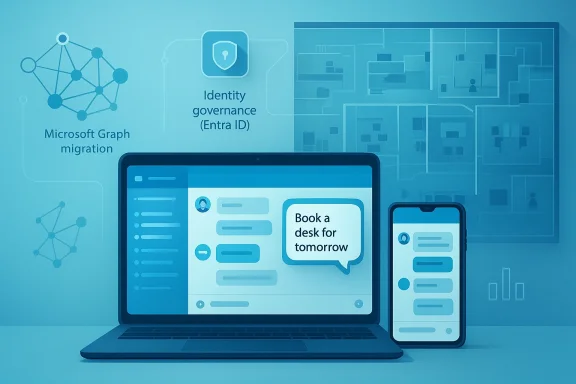
There is also a security story hidden inside that architecture. Central identity governance helps enforce least privilege, supports auditability and simplifies deprovisioning when employees change roles or leave. In enterprise software, those are not nice-to-haves; they are often the difference between a pilot and a production rollout.
The opportunity here is substantial. A conversational layer can lower the barrier for occasional users, improve findability and make the system feel more intelligent even when the underlying rules remain deterministic. For hybrid workplaces, that can reduce the small operational frictions that quietly erode office attendance and meeting efficiency.
It also raises governance questions. When users ask an AI assistant to find a room or recommend a workspace, the response depends on the quality of the underlying data and access controls. Enterprises will want clear assurances around how recommendations are generated, what data is visible, and how errors are handled when the system misreads the booking context.
Eptura says it is advancing a Graph-based integration for secure, real-time access to calendars and resource bookings. That is smart positioning because the vendor is not merely reacting to deprecation; it is presenting the move as part of a broader modernization story. Customers hear resilience, continuity and a reduced chance of a last-minute integration scramble.
This is also where enterprise trust is built. A vendor that can speak clearly about Graph readiness signals maturity and lowers the perceived risk of future disruption. In contrast, a company that appears late to the migration could trigger customer concern long before the actual shutdown date arrives.
That creates demand for systems that can handle more than a simple reservation. Enterprises want automated reassignment, recurring meeting management, attendee coordination and a central view of utilisation. Eptura’s feature set is designed to address exactly those pressure points, which makes the product more relevant to facilities, workplace ops and IT than a standard calendaring add-on.
That is why analytics matter so much. When workplace leaders can see utilisation, occupancy trends and policy exceptions in one place, they can make evidence-based decisions about office footprint, neighbourhood design and meeting-room inventory. Microsoft Fabric and Power BI give Eptura a credible story here because they support governed analytics and visualisation in the same ecosystem customers already know.
Eptura’s mention of Azure Government Cloud is equally significant. Microsoft documents Azure Government as a physically separated cloud environment designed for US government and certain regulated workloads, with specific compliance and data residency characteristics. While not every Eptura customer will need that level of isolation, the option strengthens the vendor’s story for public sector-adjacent and compliance-conscious buyers.
That does not automatically make Eptura the cheapest or best option. It does, however, make it easier to buy, and in enterprise software that distinction is often decisive. When budget owners can align a workplace platform purchase with existing cloud commitments, the friction of approval drops substantially.
At the same time, Microsoft itself is shaping the market by defining the integration surface. Vendors that align closely with Microsoft’s roadmap may gain distribution and trust, but they also become more dependent on Microsoft’s platform decisions. The EWS retirement is a good example: it creates an opening for Graph-first vendors, but it also shows how quickly a partner ecosystem can be forced to adapt.
But the opposite is also possible. If customers see the integration as superficial, or if Graph migration introduces instability, competitors will not need to offer much more than reliability and simplicity to win deals. In enterprise software, good enough often defeats ambitious architecture if the latter is harder to deploy.
Another concern is architectural dependency. A Microsoft-centric strategy is powerful, but it also ties Eptura’s product direction to Microsoft’s evolving APIs, identity model and workplace roadmap. If Microsoft changes priorities again, partners can be forced into expensive migrations or interface redesigns.
The next twelve months will likely determine how durable this strategy is. Microsoft’s EWS retirement clock is now visible, and that means vendors must demonstrate readiness with real migrations, not just roadmap language. For Eptura, the opportunity is to prove that workplace coordination can be both deeply integrated and enterprise-grade without losing clarity for the end user.
Source: IT Brief Australia https://itbrief.com.au/story/eptura-expands-microsoft-365-workplace-tools-for-firms/
 Overview
The workplace software market has been moving for years from simple room booking toward broader space orchestration, but the transition accelerated after hybrid work became a durable operating model rather than a temporary response. Employers discovered that the hardest part of office management was not reserving a desk; it was coordinating people, space, policy and utilisation across multiple locations at once. Eptura is now leaning hard into that reality, presenting Engage as a platform for workplace coordination rather than a narrow scheduling utility.That framing matters because hybrid work creates a very different set of demands for enterprise IT and facilities teams. They need visibility into occupancy patterns, policy enforcement, recurring bookings, exceptions and meeting coordination, but they also need the experience to feel native to workers who spend most of their day in Microsoft 365. Eptura’s pitch is that workflow complexity can be hidden behind familiar tools if the integration is deep enough.
The company’s announcement also arrives with an important credibility signal: its Solutions Partner has received the certified software designation for Financial Services AI in Microsoft’s AI Cloud Partner Program. For regulated buyers, this sort of badge is not mere marketing polish. It can be a meaningful shortcut in procurement conversations because it suggests the product has cleared program requirements tied to the Microsoft Cloud ecosystem and is better aligned to compliance-heavy environments.
Just as importantly, Eptura is aligning itself with Microsoft’s own technical direction. Microsoft has announced that Exchange Web Services will be disabled in Exchange Online in October 2026, and the company is actively pushing developers toward Microsoft Graph as the modern replacement. For a workplace platform that depends on calendars, bookings and resource data, that is not an abstract architecture note; it is a deadline that can shape product roadmaps, support costs and customer retention.
Why This Integration Matters
At first glance, an integration update can look incremental. In reality, it can decide whether a workplace platform becomes embedded infrastructure or remains a sidecar tool that employees ignore. Microsoft 365 is where many large organisations already manage identity, communication and calendaring, so extending workplace coordination into that stack reduces friction and makes adoption more likely.Eptura’s announcement suggests it understands that distribution is product strategy. If the booking experience lives in Outlook and Teams, workers are less likely to bounce between portals or fallback to informal channels. That matters because the most common failure mode in workplace software is not feature inadequacy; it is low usage caused by just enough extra effort to make the process feel optional.
The employee experience problem
For employees, the promise is simple: book the desk, room or collaboration space from the tools they already use, and let Copilot help with the natural-language parts. That could mean asking for a room based on team size, finding a nearby workspace for a specific day, or coordinating recurring meetings without spending time hunting through systems. The real value is not novelty but reduction of context switching.The risk is that a “seamless” experience can mask poorly designed policy underneath. If the rules governing room reassignment, recurring meetings or space allocation are too rigid, the system may be easy to access but frustrating to use. If they are too permissive, facilities teams lose the control they need to run a distributed office estate effectively.
Microsoft 365 as the Control Plane
Eptura is not just plugging into a calendar API; it is inserting itself into Microsoft’s broader identity, collaboration and analytics environment. The company says its products run on Microsoft Azure, support Azure Government Cloud, use Microsoft Entra ID for single sign-on and provisioning, and rely on Microsoft Fabric and Power BI for data analysis. That stack turns workplace management into something closer to an enterprise platform play than a point solution.That matters because enterprise buyers increasingly judge software by how cleanly it fits into existing governance and operations. If a workplace tool can inherit identity, security, reporting and procurement processes from Microsoft’s platform, the deployment burden drops. In regulated sectors, that can be enough to move a purchase from “interesting” to “acceptable.”
Identity, access and governance
Microsoft Entra ID is a particularly important layer here. Microsoft documents Entra as a foundation for single sign-on and automated user provisioning, which means organisations can centralise access control instead of managing yet another identity silo. For a platform used by thousands of employees across multiple sites, that reduces admin overhead and makes joiner-mover-leaver workflows more consistent.There is also a security story hidden inside that architecture. Central identity governance helps enforce least privilege, supports auditability and simplifies deprovisioning when employees change roles or leave. In enterprise software, those are not nice-to-haves; they are often the difference between a pilot and a production rollout.
Copilot and the New Booking Layer
One of the most interesting parts of Eptura’s update is its Microsoft 365 Copilot angle. Rather than forcing users to navigate traditional booking screens, the company says Copilot integration can support natural-language booking requests, workspace recommendations and collaboration planning. That is a sign that workplace software is beginning to absorb the same conversational interface shift we have seen across productivity tools more broadly.The opportunity here is substantial. A conversational layer can lower the barrier for occasional users, improve findability and make the system feel more intelligent even when the underlying rules remain deterministic. For hybrid workplaces, that can reduce the small operational frictions that quietly erode office attendance and meeting efficiency.
What AI can and cannot solve
Copilot can improve the front end of workplace coordination, but it cannot fix broken office policy. If space allocation is inconsistent, if room inventories are inaccurate, or if staffing assumptions are out of date, AI simply makes the wrong answer easier to reach. In that sense, generative AI is best viewed as an interface layer, not a substitute for disciplined workplace operations.It also raises governance questions. When users ask an AI assistant to find a room or recommend a workspace, the response depends on the quality of the underlying data and access controls. Enterprises will want clear assurances around how recommendations are generated, what data is visible, and how errors are handled when the system misreads the booking context.
The Calendar Migration Pressure
The Microsoft Graph component of the announcement may be the most strategically important detail. Microsoft has made clear that EWS will be disabled in Exchange Online in October 2026, and in February 2026 it said the retirement would proceed with a phased, admin-controllable disablement plan. That creates a practical imperative for vendors that still depend on legacy calendar interfaces.Eptura says it is advancing a Graph-based integration for secure, real-time access to calendars and resource bookings. That is smart positioning because the vendor is not merely reacting to deprecation; it is presenting the move as part of a broader modernization story. Customers hear resilience, continuity and a reduced chance of a last-minute integration scramble.
Why Graph is the strategic path
Microsoft has been steadily closing Graph parity gaps precisely because it wants developers off EWS. For vendors like Eptura, the long-term benefit is not just survival after October 2026; it is a better fit with Microsoft’s cloud-native security and app model. The short-term pain is migration work, testing and support complexity, especially in mixed or legacy customer environments.This is also where enterprise trust is built. A vendor that can speak clearly about Graph readiness signals maturity and lowers the perceived risk of future disruption. In contrast, a company that appears late to the migration could trigger customer concern long before the actual shutdown date arrives.
Workplace Coordination at Enterprise Scale
Eptura’s language around desks, rooms, neighbourhoods and shared resources is important because it reflects how offices are actually being managed in 2026. The workplace is no longer a fixed collection of cubicles and conference rooms. It is a dynamic allocation problem, with changing attendance patterns, team-based collaboration needs and policy constraints that vary by site, region and employee group.That creates demand for systems that can handle more than a simple reservation. Enterprises want automated reassignment, recurring meeting management, attendee coordination and a central view of utilisation. Eptura’s feature set is designed to address exactly those pressure points, which makes the product more relevant to facilities, workplace ops and IT than a standard calendaring add-on.
Operational visibility versus employee convenience
The tension in this market is between employee convenience and operational control. Employees want easy booking; managers want compliance, visibility and better space economics. A platform succeeds only when it satisfies both sides without making either feel trapped in the process.That is why analytics matter so much. When workplace leaders can see utilisation, occupancy trends and policy exceptions in one place, they can make evidence-based decisions about office footprint, neighbourhood design and meeting-room inventory. Microsoft Fabric and Power BI give Eptura a credible story here because they support governed analytics and visualisation in the same ecosystem customers already know.
Regulated Industries and Procurement Signal
The Financial Services AI certification is not just a badge; it is a procurement accelerant. In regulated industries, buyers want evidence that software vendors can operate inside stringent security, data handling and compliance boundaries. Microsoft’s certification framework can help de-risk that decision, especially when the vendor is already built on Azure, Entra ID and the Microsoft Marketplace.Eptura’s mention of Azure Government Cloud is equally significant. Microsoft documents Azure Government as a physically separated cloud environment designed for US government and certain regulated workloads, with specific compliance and data residency characteristics. While not every Eptura customer will need that level of isolation, the option strengthens the vendor’s story for public sector-adjacent and compliance-conscious buyers.
Marketplace and commercial implications
Availability through Microsoft Marketplace adds another practical advantage: procurement convenience. Microsoft states that eligible Marketplace purchases can count toward a customer’s Azure Consumption Commitment when bought through the Azure portal or qualifying Marketplace flows. For large organisations already committed to Microsoft spend, that can make the purchasing path easier to justify internally.That does not automatically make Eptura the cheapest or best option. It does, however, make it easier to buy, and in enterprise software that distinction is often decisive. When budget owners can align a workplace platform purchase with existing cloud commitments, the friction of approval drops substantially.
Competitive Pressure on the Workplace Software Market
Eptura is competing in a market where differentiation is increasingly about ecosystem fit rather than standalone novelty. Rivals can offer desks and room bookings, but fewer can claim a deep, Microsoft-native workflow spanning Outlook, Teams, Copilot, Entra, Fabric and Marketplace procurement. That is a meaningful competitive advantage if customers already standardise on Microsoft 365.At the same time, Microsoft itself is shaping the market by defining the integration surface. Vendors that align closely with Microsoft’s roadmap may gain distribution and trust, but they also become more dependent on Microsoft’s platform decisions. The EWS retirement is a good example: it creates an opening for Graph-first vendors, but it also shows how quickly a partner ecosystem can be forced to adapt.
Why this could widen the gap
The biggest winners are likely to be vendors that can combine domain depth with platform fluency. Eptura appears to be positioning itself exactly there: specialised enough to handle complex workplace operations, but integrated enough to fit into Microsoft’s enterprise stack. If it executes well, that could widen the gap with smaller booking tools that remain isolated from the broader Microsoft environment.But the opposite is also possible. If customers see the integration as superficial, or if Graph migration introduces instability, competitors will not need to offer much more than reliability and simplicity to win deals. In enterprise software, good enough often defeats ambitious architecture if the latter is harder to deploy.
Strengths and Opportunities
Eptura’s update has several advantages that could translate into stronger enterprise adoption, especially among Microsoft-first organisations. The combination of workplace coordination, AI-assisted booking and broader Microsoft stack integration makes the product feel aligned with how large companies actually operate today. It also gives the vendor a sharper narrative for regulated industries, where trust and interoperability matter as much as features.- Native Microsoft 365 workflow integration should reduce friction for end users.
- Copilot-enabled natural language booking could improve accessibility and adoption.
- Microsoft Graph alignment helps future-proof calendar and booking integrations.
- Entra ID support strengthens governance, SSO and provisioning.
- Fabric and Power BI analytics give administrators better visibility into utilisation.
- Azure Government support broadens appeal in regulated environments.
- Marketplace availability may simplify procurement for large enterprises with Microsoft commitments.
Risks and Concerns
The main risk is that deeper integration raises customer expectations. Once workplace software sits inside Outlook, Teams and Copilot, failures become more visible and more disruptive. Any glitch in booking logic, identity sync or calendar access can affect daily work in ways that are hard for employees to ignore.Another concern is architectural dependency. A Microsoft-centric strategy is powerful, but it also ties Eptura’s product direction to Microsoft’s evolving APIs, identity model and workplace roadmap. If Microsoft changes priorities again, partners can be forced into expensive migrations or interface redesigns.
- Overreliance on Microsoft services could reduce strategic flexibility.
- Graph migration complexity may create implementation and support overhead.
- AI recommendations could expose data-quality problems if governance is weak.
- Compliance claims will need to hold up under customer scrutiny.
- Feature breadth can become complexity if the user experience is not carefully designed.
- Competitive pressure from simpler rivals could challenge the value of a full-platform approach.
- Hybrid work uncertainty means office demand may continue to shift unpredictably.
Looking Ahead
The key question is whether Eptura can turn technical alignment into measurable operational value. If the integration genuinely improves booking accuracy, policy enforcement, analytics and user convenience, the company could strengthen its position as a serious workplace operating platform rather than just another booking vendor. If not, the market will treat the announcement as another incremental Microsoft partnership story.The next twelve months will likely determine how durable this strategy is. Microsoft’s EWS retirement clock is now visible, and that means vendors must demonstrate readiness with real migrations, not just roadmap language. For Eptura, the opportunity is to prove that workplace coordination can be both deeply integrated and enterprise-grade without losing clarity for the end user.
- Watch for evidence of Graph-based calendar migration in production environments.
- Look for broader Microsoft Places interoperability and directory support.
- Monitor whether Copilot booking workflows move from demo value to daily use.
- Track adoption in regulated verticals where certification signals matter most.
- Pay attention to whether analytics and utilisation reporting become a deciding factor in renewals.
Source: IT Brief Australia https://itbrief.com.au/story/eptura-expands-microsoft-365-workplace-tools-for-firms/
