

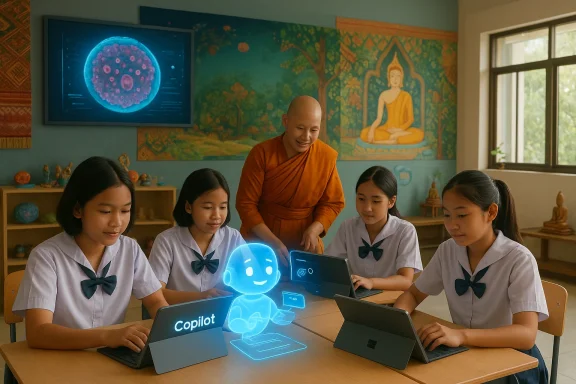
Dhammajarinee Witthaya School has turned a long-held charitable mission — giving underserved Thai girls a safe home and a complete education — into a laboratory for what education looks like when cutting-edge AI tools are aligned with Buddhist values and community-focused pedagogy. The Ratchaburi boarding school, which serves more than a thousand girls from kindergarten through grade 12, is piloting Microsoft Copilot, Microsoft Surface devices, and AI-skilling programs tied to the Microsoft Elevate and THAI Academy initiatives, and the results are already reshaping classroom practice, teacher workflows, and the school’s wider mission of equitable opportunity.
For IT professionals supporting school networks, the case illuminates practical priorities: robust device lifecycle plans, secure identity management, offline-friendly architectures, and clear incident-response protocols for data breaches or misuse. For edtech product teams, it’s a reminder that features enabling teacher agency, explainability, and exportability matter as much as raw model performance.
That said, the path from pilot to national scale will require deliberate attention to data governance, infrastructure resilience, interoperable procurement, and independent evaluation. Governments, industry, philanthropies, and civil society must align around those guardrails so that initiatives like Dhammajarinee’s are replicable, scalable, and protective of the children they aim to serve.
If Thailand’s THAI Academy and Microsoft Elevate projects achieve their stated ambitions — equipping teachers and learners across the country with practical AI skills and ethical guardrails — the real test will be whether those initiatives translate into sustainable improvements in educational equity and lifelong opportunity. Dhammajarinee’s “bridge of opportunity” is already spanning that divide for its students; the challenge now is to ensure the bridge is strong, maintained, and replicable so more children can cross it safely.
Source: Microsoft Source Dhammajarinee Witthaya School pioneers learning transformation through AI and Buddhist principles to build "Bridge of Opportunity" for Thai youth - Source Asia
 Background
Who is Dhammajarinee Witthaya School and why it matters
Dhammajarinee Witthaya School (DWS) is Thailand’s first free boarding school administered by Buddhist nuns, founded to provide a high-quality, holistic K–12 education for girls from impoverished or at‑risk backgrounds. The school covers tuition, accommodation, meals, and basic needs, serves over 1,000 students, and couples academic learning with meditation, vocational training, and character formation. That foundation — a residential, values-driven environment focused on equity — creates a distinctive context for introducing digital transformation.Microsoft’s role and the broader Thai AI push
Microsoft Thailand has been running a multi-pronged national effort to scale AI literacy and capability across Thai society, with programs such as THAI Academy, Microsoft Elevate, and partnerships with government education bodies to deliver teacher training and resources. In this ecosystem, schools like Dhammajarinee are receiving AI toolkits, device donations, classroom pilots, and professional development that aim to position students and teachers as active AI creators rather than passive consumers. Microsoft’s public briefings on these efforts cite ambitious upskilling targets and highlight AI-in-education collaborations as core to the company’s regional strategy.What’s happening at Dhammajarinee: AI woven into pedagogy and operations
A whole-school approach, not a one-off pilot
Instead of isolating AI in a single subject, Dhammajarinee has embedded AI across curricula and management workflows. Teachers use Copilot to prepare differentiated lessons and generate classroom resources; students use AI assistants for visualization and creative output; and administrative staff use automation to reduce repetitive work. The integration aims to free teacher time for pedagogy and mentorship while giving students hands-on experience using AI as a tool to deepen learning. This approach reflects guidance from Microsoft’s education programs that emphasize teacher capacity-building alongside tool deployment.Concrete classroom examples
The school has documented several classroom applications that illustrate how AI can be pedagogically useful without replacing human judgment:- Cover Dance and Arts: Students use Copilot to analyze international song lyrics, craft performance concepts, and brainstorm choreography that blends global pop ideas with local Ratchaburi cultural motifs such as the traditional Pha Khao Ma pattern. This is a deliberate fusion of cultural identity with technological fluency.
- 5th Grade Science: Copilot-generated 3D visualizations of cellular structures help students translate complex microscopic concepts into clay models, improving comprehension through multimodal representation — text, graphics, and hands-on crafting. This ties AI output to active learning cycles.
- Junior-High Mathematics: Teachers use Copilot as an “intelligent explainer,” prompting the model to create analogies, songs, or short narratives that make geometric relationships (like alternate interior angles) intuitive and memorable. These creative strategies align with evidence that multi-sensory and storytelling approaches improve retention.
- Computer Classes and Responsible AI: Beyond tool training, students engage in role-play and scenario analysis of ethical and unethical AI applications, fostering skills in source verification, data literacy, and digital citizenship — an explicit attempt to cultivate discernment rather than blind reliance. Microsoft’s Elevate materials emphasize similar ethical training for educators.
Administrative and teacher workflow gains
Teachers report that AI tools are reducing time spent on lesson planning, grading scaffolding tasks, and administrative documentation. That time savings is being repurposed for individualized instruction, special projects, and mentorship — an important redistribution if the technology is to improve learning outcomes rather than merely automate labor. Microsoft’s program notes frame Copilot as an assistant to increase teacher capacity, citing training programs designed to build educator confidence with AI tools.The Microsoft support ecosystem: tools, training, and programs
Microsoft Copilot and Surface devices in classrooms
The school’s deployments center around Microsoft Copilot (an AI assistant embedded across Microsoft 365 and other applications) and Microsoft Surface hardware provided to teachers and students for learning and content creation. Microsoft’s regional initiatives — notably Microsoft Elevate and THAI Academy — have emphasized device access, curriculum integration, and teacher skilling as core pillars. Public statements from Microsoft Thailand explain that these programs include AI and cybersecurity training alongside software and hardware provisioning.Microsoft Elevate and national partnerships
Microsoft Elevate in Thailand positions itself as a skills-development umbrella that brings together government agencies, education institutions, NGOs, and the private sector to scale AI literacy. Collaborations with bodies such as the Office of the Basic Education Commission and other ministries are intended to create classroom-ready training and to certify teachers. Microsoft’s public materials indicate these programs aim to produce measurable upskilling outcomes at scale. Dhammajarinee’s workshops and certification sessions are presented as local instances of this nationwide push.Why this model is compelling — strengths and wins
1. Equity-first deployment
Dhammajarinee is explicitly mission-driven: it accepts students regardless of socioeconomic background and covers basic needs — a reality that drastically reduces the barriers that typically marginalize disadvantaged learners in digital initiatives. Giving AI access in a setting where students already have stable housing, meals, and healthcare dramatically increases the chance that tech investments will translate into real educational gains. This is a powerful example of pairing edtech with social supports.2. Cultural alignment and identity uplift
The school’s choice to incorporate local traditions (e.g., Pha Khao Ma fabric motifs) into AI-aided creative projects shows how technology can amplify, not erase, local cultural identity. That keeps learning relevant and builds pride and agency — essential elements for long-term empowerment.3. Teacher-centered change management
The program’s emphasis on teacher training, certification, and workflow augmentation addresses a common failure mode in edtech: tool deployment without capacity-building. By training teachers in both AI usage and cyber-responsibility, the school is reducing the risk that teachers will be sidelined or overwhelmed. Microsoft’s Elevate and THAI Academy resources emphasize similar teacher-centered strategies.4. Multimodal, active learning
Using AI to create visualizations, audio, and storytelling — then converting those artifacts into tactile activities (like clay models) — is a textbook example of multimodal learning. The school’s practice aligns with robust pedagogical evidence that combining modalities increases retention and deeper comprehension.Risks, limits, and real-world challenges
While Dhammajarinee’s work is promising, several risks and structural issues must be acknowledged and addressed.Data privacy and student protection
Schools collecting student work, inputs, and biometric or behavioral traces (such as voice, images, or fine-grained usage telemetry) must guard against data misuse. Commercial AI tools may route data through cloud services or use it to improve models under vendor terms; without carefully drafted agreements and technical safeguards, vulnerable students’ data could be exposed or repurposed in ways the community did not intend.- Recommendation: adopt strict data-minimization policies, explicit parental consent protocols, and clear contractual terms with vendors around data retention, deletion, and model-training exclusions.
Internet and infrastructure fragility
Relying on cloud-based AI and frequent device use presumes reliable connectivity and maintenance. In many parts of Thailand, network costs, intermittent bandwidth, and device aging can undermine sustainability. If devices are donated without a long-term maintenance and replacement plan, classrooms can see short-lived boosts followed by deterioration.- Recommendation: invest in offline-first workflows, local caching, and scheduled maintenance funds. Consider low-bandwidth AI modes and local model hosting where feasible.
Vendor dependence and the risk of lock-in
Heavy dependence on a single vendor for devices, software, and training risks future lock-in; shifts in product licensing or priorities could disrupt classroom services. Schools should plan for interoperability, open standards, and cross-platform content export to preserve future options.- Recommendation: demand open export formats, negotiate durable education licensing, and pursue multi-vendor strategies where possible.
Equity beyond the campus
Dhammajarinee’s students benefit from a residential model that removes many access barriers, but scaling such AI-backed programs nationally requires confronting rural connectivity, household affordability, and uneven teacher capacity. National programs like THAI Academy are designed to scale, but careful monitoring is needed to ensure that gains are not confined to well-resourced pilot sites.Measuring learning outcomes vs. activity metrics
Deployments often report usage data (hours, licenses, workshops) rather than student outcome metrics (concept mastery, long-term attainment, critical thinking). Without rigorous evaluation — randomized or well-controlled longitudinal studies — it is hard to attribute learning gains to AI rather than to novelty effects, increased teacher attention, or other interventions.- Recommendation: pair deployments with independent research partners to capture robust impact metrics and to publish findings that inform national policy.
Responsible practice checklist: what Dhammajarinee and similar schools should adopt now
- Governance: Create a school-level AI governance committee (teachers, parents, student representatives, IT) to approve tool use and policies.
- Data hygiene: Require vendor commitments to not use student data for model retraining, institute retention limits, and maintain local backups under school control.
- Teacher PD: Fund sustained professional development with follow-up coaching, not just one-off workshops.
- Assessment: Use validated pre/post assessments to measure conceptual learning, critical thinking, and digital citizenship.
- Interoperability: Prioritize content and workflows that can export to non-proprietary formats to avoid vendor lock-in.
- Community engagement: Educate parents and local stakeholders on what AI does, what data is collected, and how it is protected.
- Offline options: Build curricula that can run with limited connectivity and provide printed or device-local resources for continuity.
Policy implications and what government and industry should do
Governments: set minimum standards and fund infrastructure
National ministries should create minimum standards for student data protection, procurement clauses that protect public interest, and co-finance network and device maintenance in underserved areas. Microsoft’s collaboration with Thai ministries signals institutional appetite for public-private partnership — but governments must insist on long-term sustainability clauses and open reporting on outcomes.Philanthropy and NGOs: the gap funders
Schools such as Dhammajarinee benefit from donations and partners that cover non-tuition costs. Philanthropic bodies should prioritize multi-year funding for device refresh cycles, teacher coaching, and evaluation studies rather than one-time hardware gifts.Vendors and platform providers: transparency and teacher-first design
Companies supplying AI tools to schools should make educational licensing transparent, commit to non-consumptive uses of student data, provide offline or small-footprint model variants, and design interfaces that place teachers in control of AI prompts and outputs. Microsoft’s Elevate framework foregrounds training and governance; vendors should publish clear, localized guidance and legally binding privacy commitments for school contexts.Early evidence and questions to watch
- Enrollment and retention: Dhammajarinee already reports a long history of high graduation and university progression; watch whether AI-supported programs further strengthen these trajectories for STEM and creative disciplines. Historical records show high university attendance among graduates, a promising baseline to measure change.
- Teacher retention and workload: Early signals indicate that AI reduces routine administrative work. Track whether that time savings is sustained and results in measurable improvements in individualized instruction or teacher job satisfaction.
- Learning outcomes vs. engagement: Distinguish between heightened student engagement driven by novelty and actual gains in mastery. Independent evaluations will be essential.
- Data stewardship in practice: Monitor vendor agreements, data flows, and any model-usage clauses to ensure student protection.
Why Dhammajarinee’s story matters for WindowsForum readers and the global education community
This school’s experience is instructive for infrastructure managers, IT policymakers, educators, and technology purchasers because it demonstrates a realistic route for integrating AI: center the human (teacher and values), protect the vulnerable (data and consent), and adapt technology to culture (local motifs and creative projects). Dhammajarinee’s model is not a template to copy wholesale; it’s a set of principles that illustrate how to choose trade-offs thoughtfully when implementing AI in constrained or mission-driven educational settings.For IT professionals supporting school networks, the case illuminates practical priorities: robust device lifecycle plans, secure identity management, offline-friendly architectures, and clear incident-response protocols for data breaches or misuse. For edtech product teams, it’s a reminder that features enabling teacher agency, explainability, and exportability matter as much as raw model performance.
Practical recommendations for other schools considering similar pilots
- Start with a pilot that focuses on high-impact classes (STEM, languages, arts) and measurable learning objectives.
- Pair device and tool donations with a three-year sustainability budget that includes training refreshers and maintenance.
- Contractually require education-specific privacy clauses and the right to delete school data on demand.
- Use low-bandwidth modes and local caching for rural deployments and consider on-prem or regional cloud options when sovereignty is a concern.
- Involve students in responsible AI education: include them in governance conversations and teach verification, bias recognition, and ethical scenarios.
Conclusion
Dhammajarinee Witthaya School’s careful, values-aligned adoption of AI shows that transformative technology and grounded cultural mission can coexist — and even amplify each other — when people, policy, and pedagogy are placed ahead of platforms. The school’s work demonstrates a model of inclusion: providing underserved students not only access to devices, but to meaningful, culturally resonant learning experiences and teacher-led frameworks for responsible AI.That said, the path from pilot to national scale will require deliberate attention to data governance, infrastructure resilience, interoperable procurement, and independent evaluation. Governments, industry, philanthropies, and civil society must align around those guardrails so that initiatives like Dhammajarinee’s are replicable, scalable, and protective of the children they aim to serve.
If Thailand’s THAI Academy and Microsoft Elevate projects achieve their stated ambitions — equipping teachers and learners across the country with practical AI skills and ethical guardrails — the real test will be whether those initiatives translate into sustainable improvements in educational equity and lifelong opportunity. Dhammajarinee’s “bridge of opportunity” is already spanning that divide for its students; the challenge now is to ensure the bridge is strong, maintained, and replicable so more children can cross it safely.
Source: Microsoft Source Dhammajarinee Witthaya School pioneers learning transformation through AI and Buddhist principles to build "Bridge of Opportunity" for Thai youth - Source Asia