

Google’s decision to withdraw its EU antitrust complaint against Microsoft is a tactical pivot that hands the dispute over cloud portability and vendor lock‑in to Brussels’ newly launched market investigations under the Digital Markets Act (DMA), changing the enforcement arena from a bilateral legal fight to a systemic regulatory review with potentially industry‑wide consequences.
The immediate context is straightforward: the European Commission announced three DMA‑based market investigations into cloud computing services on 18 November 2025 — two company‑level probes focused on Microsoft Azure and Amazon Web Services (AWS), and a horizontal sectoral study to evaluate whether the DMA’s toolkit can be adapted to cloud infrastructure more broadly. Those investigations explicitly test whether Azure and AWS act as “important gateways” that could be designated DMA gatekeepers, which would trigger ex‑ante obligations far more prescriptive than traditional competition remedies. Google Cloud originally lodged an antitrust complaint against Microsoft in 2024, alleging that Microsoft’s packaging, licensing and commercial terms for widely used enterprise software (notably Windows Server and SQL Server) had the practical effect of making it harder and more expensive for customers to run Microsoft workloads on rival clouds. Google’s withdrawal — announced 28 November 2025 — was accompanied by an explicit statement that the company would instead concentrate its evidentiary and policy efforts on the European Commission’s DMA‑era inquiries. That move is best read as strategic reallocation of enforcement energy, not an abandonment of the substantive concerns.
Why this matters now: cloud infrastructure is a central input for enterprise IT and an accelerator for AI development. Market concentration among hyperscalers remains high — industry trackers place AWS at about 30%, Microsoft Azure at roughly 20%, and Google Cloud near 13% — which is one reason Brussels elected to examine systemic remedies rather than relying only on isolated antitrust cases.
For enterprises, the immediate imperative is practical: audit contracts, test portability, and build procurement clauses that protect future choice. For vendors, the choice is equally pragmatic: adapt product roadmaps to support verified portability and demonstrate workable interoperability while shaping the technical detail of any DMA obligations. For regulators, the task is to craft enforceable, proportionate rules that restore contestability without undermining the stability and innovation that modern cloud services deliver.
The next 12–18 months will determine whether Brussels can convert legal intent into technical reality. The shift from private complaint to public investigation does not end the debate — it escalates it into a process where regulators, engineers and buyers must together reconceive how cloud competition, portability and platform power are governed.
Source: Tech in Asia https://www.techinasia.com/news/google-withdraws-eu-antitrust-complaint-against-microsoft/
 Background / Overview
The immediate context is straightforward: the European Commission announced three DMA‑based market investigations into cloud computing services on 18 November 2025 — two company‑level probes focused on Microsoft Azure and Amazon Web Services (AWS), and a horizontal sectoral study to evaluate whether the DMA’s toolkit can be adapted to cloud infrastructure more broadly. Those investigations explicitly test whether Azure and AWS act as “important gateways” that could be designated DMA gatekeepers, which would trigger ex‑ante obligations far more prescriptive than traditional competition remedies. Google Cloud originally lodged an antitrust complaint against Microsoft in 2024, alleging that Microsoft’s packaging, licensing and commercial terms for widely used enterprise software (notably Windows Server and SQL Server) had the practical effect of making it harder and more expensive for customers to run Microsoft workloads on rival clouds. Google’s withdrawal — announced 28 November 2025 — was accompanied by an explicit statement that the company would instead concentrate its evidentiary and policy efforts on the European Commission’s DMA‑era inquiries. That move is best read as strategic reallocation of enforcement energy, not an abandonment of the substantive concerns.Why this matters now: cloud infrastructure is a central input for enterprise IT and an accelerator for AI development. Market concentration among hyperscalers remains high — industry trackers place AWS at about 30%, Microsoft Azure at roughly 20%, and Google Cloud near 13% — which is one reason Brussels elected to examine systemic remedies rather than relying only on isolated antitrust cases.
What Google alleged — the substance of the original complaint
Core themes of the complaint
Google’s case crystallised around several recurring technical and commercial themes that regulators and customers have worried about for years:- Differential licensing and surcharges — claims that running Microsoft software on non‑Azure infrastructure carries higher effective costs because of licensing add‑ons or special terms.
- Migration friction and egress costs — assertions that data egress fees, export tooling limitations and contract terms materially increase the time and expense of migrating workloads.
- Proprietary control‑plane and API designs — concerns that managed services and control‑plane APIs are structured in ways that favour Azure‑native implementations, raising engineering and operational costs for rivals.
- Self‑preferencing and marketplace mechanics — claims that bundling, marketplace placement or first‑party managed services tilt competition away from independent vendors.
Why Google withdrew — strategic not capitulatory
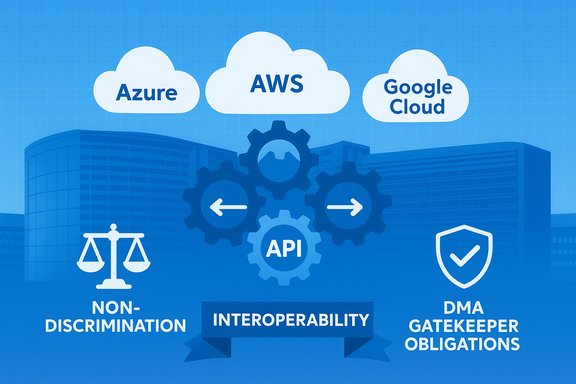
Google’s withdrawal is a calculated legal strategy. The DMA market probes give Brussels ex‑ante powers to impose systemic, prescriptive remedies — such as mandated interoperability, non‑discrimination, enforced data portability and restrictions on self‑preferencing — that a single Article 102 complaint cannot achieve with the same scope or speed. By stepping back, Google places the dispute into an investigation where the Commission can compel documents from a wider set of market participants and design remedies that apply across providers. That amplifies the potential regulatory leverage and shifts the narrative from bilateral tussle to public policy reform.The DMA, the Data Act, and changing rules for cloud portability
What the DMA can do to cloud providers
The Digital Markets Act targets dominant platforms that function as “gatekeepers” in digital markets. A gatekeeper designation carries specific obligations — non‑discrimination, interoperability, data portability, and controls on tying and self‑preferencing — enforced by the Commission with significant penalties for non‑compliance. While the DMA was originally designed for consumer‑facing services, the November 2025 initiative tests whether its gatekeeper mechanics can be applied or adapted to cloud infrastructure where enterprise contracts and high‑value customers complicate the usual numerical thresholds for designation. The result, if applied, would be binding obligations that change how hyperscalers design APIs, bundle services, and negotiate enterprise contracts.The Data Act and egress charges — a separate but related lever
Parallel to the DMA scrutiny, the EU Data Act contains provisions that materially lower switching friction. Crucially, the Data Act phases out switching charges, including data egress fees, by 12 January 2027. Between 11 January 2024 and 12 January 2027 providers can impose switching charges only to the extent they reflect direct costs, but after 12 January 2027 switching (including egress) fees are generally prohibited. This legal timeline already triggered commercial responses from hyperscalers: Google announced free multicloud data transfers in the EU and UK ahead of the Act’s implementation, Microsoft moved to at‑cost charging in August 2025, and AWS has offered targeted waivers or discounts in some cases. The Data Act’s commercial and contractual rules therefore run alongside the DMA as a practical enforcement lever to reduce financial lock‑in.Independent verification of key claims (what’s confirmed)
- Google formally withdrew its EU antitrust complaint against Microsoft.
- The European Commission launched three DMA‑based market investigations on 18 November 2025 (AWS, Azure, and a horizontal cloud sector review).
- Market share snapshots showing AWS ~30%, Microsoft ~20%, Google Cloud ~13% are consistent across industry trackers and contemporaneous reporting. Those figures are reference points to explain the Commission’s concern.
- The EU Data Act phases out switching and egress charges by 12 January 2027; transitional rules limit charging to direct costs until then. This is a confirmed statutory requirement.
- Cloud providers have already adjusted pricing and programmes in response: Google announced cost‑free intra‑EU multicloud transfers and Microsoft adjusted to at‑cost fees; AWS has in multiple public examples offered discounts or case‑by‑case waivers (including an observable case where a customer migration resulted in AWS waiving approximately $250,000 in egress fees). Those market responses are documented in reporting and vendor communications.
Why regulators escalated to DMA probes — structural drivers
Scale, integration and switching frictions
Cloud markets combine extreme scale with deep vertical integration (infrastructure, platform services, identity, productivity tools). That mix creates potential lock‑in vectors:- Customers depend on complex control‑plane APIs, managed services and proprietary integrations that are costly to replicate.
- Enterprise contracts are bespoke; a handful of large customers can represent outsized revenue for vendors, complicating classic “user‑count” gatekeeper tests.
- Data gravity and specialized managed features make migration technically and economically challenging.
The role of AI and strategic sovereignty
Cloud is no longer just storage and compute; it underpins AI model training, inference and data pipelines. Access to GPU farms, specialized AI services and low‑latency data flows is strategically important for firms and for European digital sovereignty. Regulators have therefore framed cloud contestability as both an economic and a strategic policy priority. That broader framing increases the urgency of structural remedies.Immediate market responses and practical effects
Pricing moves, waivers, and the migration market
The Data Act deadline produced commercial counter‑moves from providers:- Google announced elimination of certain EU/UK data transfer fees and launched a multicloud “Data Transfer Essentials” offering that is free in some configurations.
- Microsoft implemented at‑cost charging for EU transfers in late summer 2025.
- AWS has long offered targeted waivers or discounts for specific customers (public sector, research institutions) and, in at least one documented migration case, waived roughly $250,000 in egress fees to support a customer’s on‑prem repatriation. Those waivers are evidence of providers treating egress as a negotiable commercial lever rather than a fixed barrier.
Procurement, contract language and public buyers
Public procurement authorities in Europe are sensitive to the DMA/Data Act narrative. Large public buyers are likely to demand enhanced contractual portability clauses, transparency on egress pricing, and exit assistance guarantees in new RFPs. Vendors that can demonstrate DMA/Data Act‑compliant migration pathways — ideally packaged with local data‑sovereignty and jurisdictional guarantees — will enjoy a competitive advantage in public tenders.Technical and legal complexities regulators must solve
Applying platform‑style DMA obligations to cloud infrastructure presents real technical friction points:- Functional equivalence: the Data Act requires functional equivalence for IaaS switching in some cases, but ensuring equivalent performance, security and identity integrations across providers is non‑trivial.
- API exposure risks: mandating APIs or interoperability interfaces raises security, confidentiality and operational resilience concerns. Poorly designed API obligations could expose sensitive control‑plane surfaces or create attack paths.
- Enforcement and standardisation: the Commission must coordinate with standards bodies and technical experts to avoid blunt or infeasible mandate language. Remedies that are too prescriptive could destabilise production systems or undermine innovation incentives.
Risks and unintended consequences
- Cost shifting: compliance and engineering work to expose APIs or support functional equivalence will generate real product and operational costs that hyperscalers could pass to customers in other forms if not carefully constrained.
- Regulatory overreach: ill‑fitted DMA rules could hamper cloud innovation or fragment ecosystems if obligations force providers to support legacy or suboptimal interoperability designs.
- Contractual churn: enterprises with long‑term contracts signed before regulatory changes may face legal uncertainty — litigants could contest retroactive application of obligations, generating litigation risk and procurement delays.
- Regulatory capture and gaming: large incumbents will mobilise legal and policy resources to influence rule design and implementation; the practical outcome may depend heavily on the technical detail rather than headline objectives.
What IT leaders, procurement teams and MSPs should do now
Short, actionable steps for enterprise teams and vendors preparing for the next 12–18 months:- Perform a licensing and exit‑cost audit.
- Identify where Microsoft, Oracle or other essential licenses create dependency paths.
- Map any egress costs, migration tool limitations, and contractual exit windows.
- Negotiate portability and transparency clauses in new contracts.
- Demand clear egress cost schedules, documented migration procedures, and pre‑priced migration support.
- Use the Data Act as a bargaining lever for better exit guarantees in EU contracts.
- Operationalise portability through run‑books and testing.
- Build repeatable migration run‑books, export/restore tests, and a functional equivalence checklist for mission‑critical workloads.
- Run pilot failovers to alternative clouds or on‑prem stacks to validate assumptions.
- Engage specialized migration vendors and FinOps tools now.
- MSPs and migration specialists that can combine technical execution with pricing negotiation (e.g., securing waivers) offer practical value.
- FinOps tools that track egress, API call patterns and cross‑cloud traffic can be used to quantify switching economics.
- Prepare compliance and evidence packages for procurement and regulators.
- If an organisation is a major cloud buyer, prepare to document switching costs and technical constraints for public procurement or regulator inquiries.
- Monitor the Commission’s timetable and be ready to respond.
- The Commission signalled a roughly 12‑month timeline for company‑level gatekeeper assessments; enterprises and vendors should watch consultations, information requests, and technical working groups.
Strategic implications for vendors and investors
- For Microsoft and AWS: designation as DMA gatekeepers for cloud would impose ongoing obligations that reshape product roadmaps. Preparing defensive — and constructive — remediation plans (clear interoperability roadmaps, price transparency mechanisms, and third‑party developer access programmes) is essential.
- For Google Cloud: withdrawing the complaint is a bet that regulators will impose structural remedies that open markets. Google can play policy and technical expert roles in shaping any DMA rules — a well‑executed strategy could pay off in improved competitive parity.
- For independent cloud providers and European MSPs: the DMA/Data Act window is an opportunity to commercialise portability and sovereignty offerings. Differentiation through local expertise, compliance assurances and migration guarantees may win EU customers even if hyperscalers remain dominant.
- For investors: regulatory uncertainty adds execution risk to hyperscaler valuations, but the long‑term demand for cloud and AI capacity remains structural. Regulatory outcomes will affect margins, contract structures and competitive dynamics rather than negate secular demand.
How the next 12 months could play out
- Evidence gathering (months 0–6)
- The Commission issues information requests and holds technical hearings with hyperscalers, independent providers, customers and standards bodies.
- Preliminary findings and consultations (months 6–9)
- Brussels may publish initial assessments, solicit stakeholder feedback, and outline potential DMA obligations adapted to cloud.
- Final gatekeeper assessments and rule design (months 9–12+)
- If Azure or AWS qualify as gatekeepers for cloud core services, the Commission could impose specific obligations and timelines; parallel recommendations could propose DMA amendments for sectoral fit.
Conclusion
Google’s withdrawal of its antitrust complaint against Microsoft shifts a heated cloud rivalry into the public, system‑level arena of EU regulation — a change that amplifies the stakes for hyperscalers, enterprise customers, and independent cloud providers alike. Brussels’ use of the DMA framework combined with the Data Act’s imminent ban on switching charges creates a regulatory corridor where technical standards, contractual transparency, and open interfaces will become central battlegrounds.For enterprises, the immediate imperative is practical: audit contracts, test portability, and build procurement clauses that protect future choice. For vendors, the choice is equally pragmatic: adapt product roadmaps to support verified portability and demonstrate workable interoperability while shaping the technical detail of any DMA obligations. For regulators, the task is to craft enforceable, proportionate rules that restore contestability without undermining the stability and innovation that modern cloud services deliver.
The next 12–18 months will determine whether Brussels can convert legal intent into technical reality. The shift from private complaint to public investigation does not end the debate — it escalates it into a process where regulators, engineers and buyers must together reconceive how cloud competition, portability and platform power are governed.
Source: Tech in Asia https://www.techinasia.com/news/google-withdraws-eu-antitrust-complaint-against-microsoft/
