• Thread Author
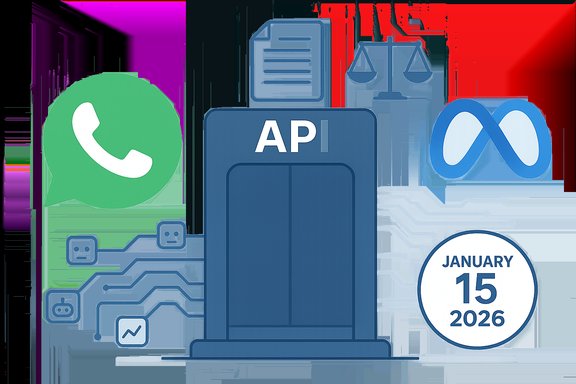
A blue API gateway centerpiece, surrounded by icons (chat, scales, infinity) and a January 15, 2026 date.
Meta’s decision to prohibit non‑Meta conversational assistants from operating through WhatsApp’s Business Solution has reshaped the battleground for everyday AI, setting a clear deadline—January 15, 2026—and provoking regulators, enterprises, and developers worldwide to scramble for alternatives.

Background​

WhatsApp’s Business Solution (often called the WhatsApp Business API) has long been positioned as a tool for transactional messaging, customer support, and business notifications. Over the past two years, however, a wave of large‑language‑model providers used that same channel to deploy general‑purpose chat assistants that users could message directly inside WhatsApp without installing separate apps or creating vendor accounts. Meta’s mid‑October 2025 revision to the Business Solution terms inserts an “AI Providers” prohibition that bars providers of large language models and general‑purpose AI assistants from using the API when those AI features are the primary functionality being offered. The change is explicit: vendors that built ChatGPT‑ or Copilot‑style contacts on WhatsApp must wind down those integrations by January 15, 2026. This shift is not merely a product tweak. It transforms WhatsApp from an open distribution surface for third‑party conversational AI into an environment where Meta’s own assistant gains preferential access—raising competition, data‑access, and regulatory questions at scale.

What changed (the policy in plain language)​

  • The Business Solution terms now define and restrict “AI Providers,” covering LLMs, generative AI platforms, and general‑purpose assistants.
  • The restriction applies when the AI capability is the primary feature offered through the Business API; incidental or ancillary AI used for customer support remains allowed.
  • Meta set an enforcement date for existing integrations of January 15, 2026; new entrants face immediate application of the revised contract language.
Meta frames the change as a restoration of the Business Solution’s intended purpose—enterprise‑to‑customer messaging—while critics argue the practical effect is to channel in‑app conversational activity toward Meta AI. Both views matter: Meta points to operational concerns such as scalability and moderation costs, while outside observers emphasize the competitive leverage Meta gains by limiting rival AI distribution inside a messaging app used by billions.

Timeline and immediate facts to verify​

  1. Mid‑October 2025 — WhatsApp published revised Business Solution terms adding the “AI Providers” clause.
  2. October 15, 2025 — New contractual terms were introduced (this date is reflected in regulatory filings and reporting).
  3. January 15, 2026 — Enforcement date for existing integrations; third‑party general‑purpose bots must cease operation by this deadline.
These core dates are corroborated by multiple independent reports and regulatory notices, making them among the most load‑bearing claims in this story. For business and IT leaders, the January 15 enforcement date is the operational pivot they must treat as fixed unless regulators order interim relief.

Who’s affected — scope and real‑world impact​

  • Individual consumers who used ChatGPT‑style or Copilot‑style contacts in WhatsApp will lose that frictionless access and may need to export conversations before the cutoff. Many of those integrations were unauthenticated, meaning chat histories typically cannot migrate automatically into vendor account surfaces.
  • Enterprises that built customer‑facing assistants on WhatsApp using third‑party LLMs must rearchitect or replace those flows, especially where the assistant was the primary interface for end users.
  • Startups and smaller AI vendors that used WhatsApp as a discovery and distribution channel face the toughest challenge: rebuilding acquisition funnels (standalone apps, web widgets, or other messaging platforms) at short notice.
Major vendors have already begun announcing migration plans. Microsoft confirmed Copilot’s WhatsApp presence will be discontinued on the January 15, 2026 date and is directing users toward Copilot’s first‑party surfaces (mobile, web, and Windows). OpenAI issued guidance for ChatGPT users to link phone numbers to ChatGPT accounts where possible to preserve history; both companies warned users to export chats when necessary. These vendor statements have been reported independently across news outlets.

Regulatory reaction and antitrust concerns​

Regulators wasted no time. Italy’s competition authority (AGCM) launched an investigation in mid‑2025 into whether Meta’s integration of Meta AI into WhatsApp and the October contractual change could abuse a dominant position and restrict competition in the nascent AI chatbot market. The AGCM’s formal press release cites concerns that pre‑installing Meta AI and revising Business Solution terms may "impose" Meta’s assistant and create functional dependency for users. The AGCM also signaled possible interim measures regarding the October 15 terms. Reuters and other outlets have reported that the AGCM broadened the probe in late November 2025 and may seek precautionary steps—an escalation that suggests competition authorities view the policy as more than a narrow product decision. The AGCM’s involvement is consequential because EU regulators can impose binding interim obligations and sizeable fines if they find abuse under Article 102 TFEU.

Business and IT‑leader playbook: what to do now​

For organisations that rely on WhatsApp for customer engagement, the next weeks are critical. Practical steps:
  1. Map every WhatsApp integration and identify where a third‑party general‑purpose assistant is the primary interface.
  2. Export any chat history needed for compliance, customer records, or analytics before January 15, 2026.
  3. Test Meta AI on representative workloads to determine functional parity gaps for tasks such as code assistance, complex query handling, or domain‑specific knowledge.
  4. Evaluate migration targets: vendor first‑party apps (ChatGPT, Copilot), alternative messaging platforms (Telegram), or enterprise collaboration tools (Slack, Microsoft Teams).
  5. Budget for redevelopment where a rearchitected, authenticated, account‑backed integration is required for continuity.
This checklist aims to minimize business disruption while preserving security and data portability. Firms in emerging markets—where WhatsApp is a primary commerce layer—should prioritize contingency planning; migration to vendor apps or web clients will likely reduce conversion friction and complicate localized workflows.

Strategic implications for Meta and rivals​

  • Meta’s advantage: By restricting third‑party assistants, Meta consolidates conversational interactions inside its ecosystem, increasing opportunities to gather user signals that can feed Meta AI and adjacent ad‑personalization systems. Short term, this may accelerate Meta AI’s usage metrics inside a massive distribution channel.
  • Competitive risk: The move can spur competitors to double down on open distribution strategies—native apps, cross‑platform integrations, and partnerships with other messaging services. Telegram, Apple Messages, or app‑based assistants on iOS/Android become more attractive to vendors who want to avoid platform gatekeeping.
  • Developer ecosystem: Smaller AI firms that depended on WhatsApp’s low‑friction reach must now rebuild acquisition funnels, a nontrivial cost that could shape startup survivability and industry consolidation.
Meta’s gamble is that convenience and default placement will win user loyalty. The counterargument is that heavy‑handed platform controls — especially when coupled with data aggregation — catalyze regulatory pushback and creative workarounds that decentralize AI distribution. Historical parallels to app‑store disputes suggest litigation and regulation are probable outcomes.

Technical and privacy considerations​

Meta argues the Business API was not designed to host high‑volume, open‑ended LLM traffic and that third‑party chatbots impose moderation and infrastructure burdens. WhatsApp has told regulators the API’s architecture was never intended to support unauthenticated general‑purpose assistants at scale. Those operational claims are plausible, but they coexist with the competitive effects of restricting an open channel. Privacy and data‑training concerns are central. If user‑assistant interactions shift from third‑party vendors to Meta‑owned models, Meta gains access to massive conversational datasets that could be used to refine its models—raising questions about consent, data use, and model‑training transparency. Regulators in Europe under the Digital Markets Act and other frameworks may scrutinize such data flows as part of broader gatekeeper obligations. These risks are real and merit careful contractual and technical mitigations for businesses.

Where the industry is likely to go next​

  • Interoperability pressure: Expect regulators and rivals to press for portability and interoperability—mechanisms that would let users choose which assistant responds inside messaging experiences. Legal outcomes could force Meta to narrow the scope of enforcement or provide neutral access routes.
  • Vendor pivots: OpenAI, Microsoft, and others will accelerate native app capabilities, account linking, and web UIs. Microsoft in particular is routing Copilot use to its integrated Windows and Office surfaces as a compensating strategy.
  • Decentralized innovation: The restriction may fuel decentralized and browser‑based AI access methods that bypass centralized platform distribution entirely—driving an ecosystem of specialized, domain‑specific models delivered via web widgets, Progressive Web Apps (PWAs), and alternative messaging protocols.
The evolution will be contested: Meta benefits if users accept a one‑stop in‑app AI; competitors gain if legal or user behavior undermines that lock‑in.

Strengths and risks of Meta’s approach​

Strengths​

  • Operational clarity: The new terms reassert the intended scope of the Business API and create a cleaner delineation between business messaging and consumer chat assistants.
  • Control over quality and moderation: Centralizing AI inside Meta gives the company unified moderation tools and engineering incentives to maintain performance at scale.

Risks​

  • Antitrust exposure: The AGCM’s investigation and the prospect of interim measures in the EU represent material regulatory risk—enforcement could force reversals or constraints on the policy.
  • Developer backlash and ecosystem fragmentation: Startups and developers may abandon WhatsApp as a distribution channel permanently, weakening the platform’s role as an innovation surface.
  • User dissatisfaction and churn: Where third‑party assistants offered superior or specialized capabilities, forcing users to Meta AI may degrade perceived value and encourage migration to alternative platforms.
These trade‑offs are both technical and strategic: Meta accepts regulatory heat in exchange for tighter control over conversational AI distribution inside its crown‑jewel messaging app.

Caveats and unverifiable claims​

Several headline numbers and vendor‑reported adoption statistics circulating in public discourse (for example, vendor claims about tens of millions of WhatsApp users of third‑party bots) are vendor‑provided and lack independent audit. Those figures should be treated as indicative rather than definitive until corroborated by neutral measurement. Where practical decisions depend on volume or conversion rates, firms should run their own logs and analytics rather than relying on published vendor claims.

Practical guidance for Windows admins and enterprise architects​

  • Prioritize exporting and archiving chat transcripts for records retention and compliance. Documented exports will be invaluable if vendor migration lacks native history transfer.
  • Evaluate Copilot and ChatGPT native desktop clients and browser UIs as alternatives for workflows that previously relied on WhatsApp. Test authentication and context preservation features before decommissioning the WhatsApp channel.
  • Reassess SLAs and monitoring: third‑party vendor uptime guarantees and data retention policies will change when shifting from WhatsApp to vendor apps or web services.
  • Consider hybrid architectures: use WhatsApp for transactional notifications while redirecting open‑ended conversational flows to authenticated web or app surfaces that preserve context and identity.

Conclusion​

Meta’s revision to WhatsApp’s Business Solution terms—effectively removing general‑purpose third‑party AI assistants from the platform by January 15, 2026—represents a decisive moment in how conversational AI will be distributed to billions of users. The policy clarifies the Business API’s role but concentrates influence over one of the largest messaging channels in a single corporate stack. That concentration has immediate commercial consequences, invites regulatory intervention, and is likely to accelerate both vendor pivot strategies and legal contests over platform gatekeeping.
For businesses and IT leaders, the immediate priority is pragmatic: inventory integrations, preserve critical histories, and validate alternatives now. For regulators, the central question remains whether platform owners can lawfully restrict distribution of competitive AI services inside apps that function as essential communication infrastructure. The answer will shape the rules of engagement for AI distribution for years to come.
Source: WebProNews Meta Bans ChatGPT, Copilot from WhatsApp in 2026 Amid Antitrust Fears
 

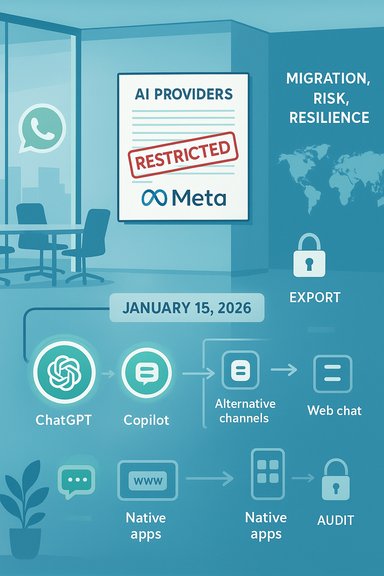
Blue infographic showing AI providers (Meta) with a RESTRICTED stamp and migration/export workflow.
Meta’s decision to tighten WhatsApp’s Business Solution terms and effectively exclude third‑party general‑purpose chatbots has turned a platform policy update into a practical crisis for many enterprise AI deployments: OpenAI’s ChatGPT and Microsoft’s Copilot will no longer be available via WhatsApp after January 15, 2026, and businesses that relied on those integrations face a short, concrete timeline to evaluate options, preserve critical data, and rearchitect workflows.

Background​

WhatsApp’s Business Solution (the Business API) was built to let organizations send verified messages, manage customer support queues, and automate transactional communication at scale. In October 2025, the platform added a new “AI Providers” clause that explicitly restricts providers of large‑language models, generative AI platforms, and general‑purpose AI assistants from using the Business Solution when those AI capabilities are the primary functionality being delivered. Meta set the change to take effect on January 15, 2026 — creating a defined enforcement date for existing integrations. The practical result is simple: third‑party consumer‑facing assistants that used WhatsApp as a distribution channel must be withdrawn from the Business API. Businesses may still operate AI inside WhatsApp when AI is incidental to broader customer‑service workflows (for example, an airline’s booking assistant or a retail returns bot), but standalone assistants — the “ask a chatbot” contact many users relied on — are excluded under the new terms.

What changed — the policy in plain language​

  • The Business Solution terms now include an “AI Providers” prohibition that covers LLMs, generative AI platforms, and general‑purpose assistants when those technologies are the primary service delivered via the Business API.
  • Meta framed the rationale as preserving the API for predictable, enterprise‑customer workflows and avoiding operational strain from high‑volume, open‑ended chatbot traffic; however, the company did not publish specific load or threshold numbers that triggered the change, leaving room for interpretation. Treat Meta’s load‑related claims as its stated rationale rather than independently verified fact.
  • Major vendors have accepted the ruling and published transition guidance: OpenAI is directing WhatsApp users to link accounts and move to native ChatGPT apps and web experiences, while Microsoft has announced Copilot will be discontinued on WhatsApp and advised users to adopt Copilot’s mobile, web, or Windows clients.
These policy specifics matter because they draw a regulatory boundary inside a single communications channel — a boundary with immediate operational and legal implications for businesses that used WhatsApp as an AI delivery surface.

The immediate facts every IT leader should lock in​

  • Enforcement date: January 15, 2026 — ChatGPT and Copilot will stop functioning on WhatsApp on this date.
  • What remains allowed: AI as a business tool (customer support, transactional workflows) where the AI is incidental to a broader service via an authenticated business account.
  • What is banned: Third‑party general‑purpose AI assistants that used the Business Solution as a distribution channel.
  • Migration reality: For Copilot, WhatsApp interactions are unauthenticated and cannot be migrated to Microsoft’s Copilot accounts automatically; Microsoft recommends customers export chat history if they need records. OpenAI provides a link‑and‑migrate path to preserve WhatsApp history in ChatGPT if users create accounts and link their phone numbers before the cutoff.
These points are not ambiguous — the date is firm, the enforcement model is narrow and discretionary, and vendors are already publishing transition playbooks.

Why this matters to enterprises: vendor lock‑in, distribution, and risk​

WhatsApp is not a niche channel. It is the default conversational layer in many regions — Latin America, India, large parts of Europe — and for many businesses it is the primary way customers interact with support, logistics, and commerce systems. That market reality makes WhatsApp a unique distribution asset: losing third‑party assistant access here is materially different from losing a widget inside a lesser platform.
  • Vendor lock‑in risk: When a single platform controls the primary interface to large user populations, platform policy becomes a de‑facto product requirement. Meta’s move demonstrates how platform owners can convert distribution control into exclusionary access — and in this case, Meta’s own assistant benefits by default. This is platform concentration in action.
  • Operational risk: Workflows that assumed omnichannel parity (e.g., “Ask the assistant via WhatsApp and get the same authenticated, logged answer as via Teams”) will break. Data continuity, audit trails, and regulatory recordkeeping may be disrupted, especially where WhatsApp conversations were used as evidence of decisions or approvals.
  • Competitive risk: For customer‑facing services that treated ChatGPT or Copilot as a product differentiator, the policy eliminates an entire distribution vector — potentially forcing costly migrations or a return to in‑house solutions.

The plausible motives — and why to treat them critically​

Meta’s public rationale cites platform intent and system load; independent analysis points to a second, strategic motive: consolidating AI interactions within Meta’s ecosystem to control distribution and data flows. Both claims are plausible and not mutually exclusive.
  • Meta’s infrastructure argument is credible: high‑volume LLM interactions behave differently from transactional messages and can create unexpected load patterns for an API built for enterprise messaging. But Meta has not published specific traffic or cost metrics to allow independent verification. Treat infrastructure claims as plausible but unverified.
  • The strategic argument also has weight: restricting third‑party assistants while preserving business‑incidental AI gives Meta a distribution advantage for its own assistant across WhatsApp, Instagram, and Messenger. That advantage translates directly into control over monetization levers and data capture.
Both motives are relevant to enterprise decision‑making: if the change is purely technical, alternatives may be easier to negotiate; if it’s strategic, expect long‑term constraints and build plans accordingly.

What IT leaders and tech buyers must do now — a practical checklist (90‑day priority plan)​

This is a compressed playbook for the immediate window up to and through January 15, 2026. Prioritize speed: the enforcement date is not theoretical.
  1. Inventory dependencies (days 1–10)
    • Identify all teams, workflows, and customer touchpoints that interact with ChatGPT/Copilot on WhatsApp.
    • Tag use cases by criticality: revenue impact, compliance, safety, productivity, and customer satisfaction.
    • Output: a prioritized dependency register (CSV or ticketed system).
  2. Preserve evidence and exports (days 1–30)
    • For integrations that store no server‑side history (unauthenticated WhatsApp contacts), instruct users to export chat history for required retention. Microsoft explicitly notes WhatsApp Copilot chats cannot be migrated automatically; OpenAI provides an account‑link path for history preservation. Export early — some export tools have rate limits.
  3. Assess Meta AI as a stopgap (days 7–30)
    • Run representative pilot tests using real business prompts against Meta AI to measure accuracy, latency, cost, and moderation behavior. Capture failure modes and content‑safety differences.
    • Evaluate integration complexity and whether Meta AI supports required connectors, authentication, and logging. Don’t assume parity with ChatGPT/Copilot.
  4. Model alternative distributions (days 15–45)
    • For critical workflows that must retain third‑party assistant behavior, model options:
      • Move AI interactions to first‑party apps (ChatGPT app, Copilot app, copilot.microsoft.com).
      • Replatform to other messaging channels that still allow third‑party bots (e.g., Telegram, SMS, web chat widgets, or authenticated enterprise channels like Microsoft Teams/Slack).
      • Build a lightweight in‑house assistant using vendor APIs where permitted (but watch rate limits, data residency, and compliance).
    • Include cost, change management, and security in each model.
  5. Run a phased migration pilot (days 30–75)
    • Select one or two non‑critical but representative workflows.
    • Migrate them to the chosen alternative channel, measure user acceptance, business KPIs, and technical gaps.
    • Iterate quickly. Keep a rollback plan.
  6. Communication and training (days 30–90)
    • Prepare user communications that explain changes, migration steps, and support resources.
    • Offer hands‑on training, short video guides, and quick‑start links to new assistant surfaces.
    • Track adoption metrics and feedback loops.
  7. Governance and contractual reviews (days 1–60)
    • Review contracts and SLAs for downstream vendors who rely on the WhatsApp channel.
    • Clarify liability for data loss, migration effort, and customer SLAs tied to WhatsApp interactions.
    • If you were using vendor‑provided WhatsApp connectors, demand migration assistance and clarity on timelines.
  8. Long‑term resilience (post‑90 days)
    • Reassess multi‑channel strategy to avoid single‑platform distribution dependencies.
    • Update procurement requirements to include distribution resilience and portability clauses for future AI projects.

A tactical migration playbook — step‑by‑step​

  1. Extract: Use WhatsApp’s export tool (or an approved connector) to pull all conversations linked to ChatGPT/Copilot. Store exports in a secure, access‑controlled repository. Microsoft and others advise exporting because some WhatsApp integrations are unauthenticated.
  2. Map: Link exported conversations to business processes (ticket numbers, order IDs, user IDs). This mapping lets you replay context or reconstruct business events if needed.
  3. Authenticate: Where possible, shift to authenticated surfaces (e.g., ChatGPT accounts, Copilot accounts). Authenticated sessions enable audit trails, access controls, and server‑side history retention.
  4. Reconnect: Recreate integrations on target channels using vendor APIs or webhooks. For example, deploy a web chat widget that calls the same LLM backend and provides equivalent prompts with added telemetry.
  5. Validate: Run parallel testing for accuracy, privacy behavior, and failover. Confirm retention and export mechanisms are in place and that legal/compliance teams sign off.
  6. Switch: After validation and communication, switch users to the new channel. Maintain monitoring and a small operations team to support early migration issues.
  7. Retire: Decommission WhatsApp bot endpoints once migration is validated and usage drops to near zero.

Risks and mitigations — what keeps CIOs up at night​

  • Risk: Loss of critical business workflow continuity.
    Mitigation: Prioritize high‑impact flows, export conversations, and run parallel pilots on alternative channels immediately.
  • Risk: Data sovereignty and compliance gaps due to unauthenticated WhatsApp sessions.
    Mitigation: Move to authenticated surfaces that support corporate DLP, audit logs, and conditional access. Update retention policies to include exported WhatsApp transcripts.
  • Risk: Relearning and productivity loss after moving teams/customers off WhatsApp.
    Mitigation: Prepare change management materials, short training sessions, and in‑channel notifications before the switch.
  • Risk: Increased cost and complexity from running parallel systems.
    Mitigation: Run a rapid decommission program for low‑usage fallbacks and consolidate where feasible.
  • Risk: Hidden strategic exposure if Meta’s policy changes further or if other platform gates appear.
    Mitigation: Build distribution‑agnostic architectures, avoid embedding core business logic within a single messaging surface, and include contractual fallback clauses with vendors.

Vendor negotiation and procurement implications​

This episode should recalibrate how procurement and sourcing teams evaluate platform dependency:
  • Require distribution portability in vendor contracts. Ask vendors for export APIs, authenticated migration paths, and an explicit plan for channel deprecation scenarios.
  • Favor vendors who support authenticated, auditable sessions across channels rather than unauthenticated, contact‑based models.
  • Add political risk and platform policy risk to procurement checklists — quantify estimated migration costs when evaluating the lifecycle TCO for any external service.
These contractual steps reduce the chance that a single platform policy change forces a disruptive rip‑and‑replace later.

Building resilient AI strategies — beyond the immediate migration​

The right strategic posture is not merely about moving from WhatsApp to another channel. It is about designing AI services with portability, observability, and governance baked in.
  • Architect for portability: Separate the LLM/service layer from the distribution layer. Treat the messaging channel as interchangeable — use an adapter pattern so the same backend can serve web, Teams, Slack, and multiple messengers.
  • Centralize governance: Use a central AI governance plane to manage prompts, safety filters, and logging across channels so policy changes in one channel don’t require wholesale rework.
  • Measure UX drift: When you replatform an assistant, measure task completion, time‑to‑answer, user sentiment, and escalation rates. Different channels change user behavior and expectations.
  • Negotiate data rights: When vendors provide integrations, document who owns what data, and ensure exports are technically possible and contractually guaranteed.
  • Monitor platform policy: Build a lightweight regulatory‑watch capability to track platform policy changes and maintain predefined playbooks that trigger automatically when a channel’s rules change.
Adopting these practices reduces the operational shock of unilateral platform policy changes and converts platform risk into a manageable governance problem.

Bottom line for IT leaders​

Meta’s WhatsApp update and the confirmed departures of ChatGPT and Copilot from the platform are a practical reminder that distribution channels are strategic assets — and that platform owners can change the rules on short notice. The enforcement date, January 15, 2026, is real and actionable: organizations must inventory dependencies, preserve data, run migration pilots, and rethink procurement and architecture to avoid similar shocks in the future. This is not a moment to react emotionally; it is a window to professionalize AI delivery. Prioritize the business‑critical paths, prepare migration options that preserve auditability and compliance, and use the enforced deadline as an organizational forcing function to fix fragile architectures and contract language that silently trusted a single platform for critical distribution.

Quick tactical checklist (one page)​

  • Export critical WhatsApp bot conversations now.
  • Run representative Meta AI pilot tests and compare results to current vendor assistants.
  • Map and prioritize impacted workflows by business impact.
  • Plan and execute a migration pilot to an authenticated surface or alternative channel.
  • Update legal and procurement standards to require portability and migration support.
The calendar is set: January 15, 2026 is the hard horizon. Treat it as a project deadline and mobilize teams accordingly. The firms that act now will convert disruption into modernization; those that delay will face higher costs, frustrated users, and compliance gaps.
Source: UC Today Meta is Removing Microsoft Copilot and ChatGPT From WhatsApp: Key Takeaways For IT Leaders
 

Meta’s decision to rewrite WhatsApp’s Business Solution terms and effectively ban third‑party general‑purpose AI assistants from the platform by January 15, 2026 forces organizations to rethink how they distribute conversational AI, manage customer workflows, and hedge platform risk.

Glowing icons show WhatsApp, messaging, a January 15, 2026 calendar, a phone, security shield, and Telegram.Background / Overview​

In mid‑October 2025, WhatsApp updated its Business Solution (commonly referred to as the WhatsApp Business API) to add an “AI Providers” clause that prevents providers of large language models, generative AI platforms, and general‑purpose AI assistants from using the Business Solution when those AI capabilities are the primary functionality offered. Meta set an enforcement date of January 15, 2026 for the policy. Practically, that change removes consumer‑facing assistants like OpenAI’s ChatGPT and Microsoft’s Copilot from in‑chat distribution inside WhatsApp, while preserving enterprise use of AI when it is ancillary to a core business workflow (for example, appointment reminders, ticket triage, or transactional updates). Several vendors have already confirmed they will discontinue WhatsApp integrations that conflict with the new terms and are advising users to migrate histories to native apps or web clients. Meta frames the update as a defensive, operational move: the Business API was designed for customer support and transactional messages, not as a mass distribution channel for open‑ended LLM assistants. That explanation is technically plausible — but it also delivers a clear strategic advantage to Meta by reserving high‑visibility in‑app assistant real estate for Meta AI. This dual character — operational justification with strategic effect — is central to how businesses must respond.

What changed and why it matters​

The policy in plain language​

The updated Business Solution terms introduce a broad prohibition on “AI Providers” using WhatsApp’s Business Solution when the AI is the primary functionality being offered, granting Meta broad discretion to determine whether a use case is permitted. Enforcement is strict: the specified calendar cutoff forces vendors and customers to act within a fixed window.

Immediate operational consequences​

  • Consumer‑facing assistants that relied on phone‑number‑based, unauthenticated in‑chat experiences will lose their distribution channel on WhatsApp.
  • Businesses that used LLMs as a visible, primary product inside WhatsApp must migrate those experiences to alternate surfaces or reclassify AI as ancillary to permitted workflows.
  • Users who relied on WhatsApp for convenience must either link accounts where vendors provide that option or export chat histories before they become inaccessible.

Why this is more than a product tweak​

The Business Solution is a strategic chokepoint: WhatsApp reaches billions of users globally and is a primary communications channel in regions like Latin America, India, Africa, and much of Europe. By closing the Business Solution to general‑purpose LLMs, Meta is not merely pruning an API; it is reshaping distribution economics for conversational AI at scale. That has marketplace and regulatory implications that extend beyond a single technical change.

Strategic impacts for enterprises and product teams​

Business continuity and customer experience​

For organizations that embedded ChatGPT, Copilot, or other LLMs into customer workflows inside WhatsApp, the policy raises three immediate risks: loss of in‑chat convenience, potential data fragmentation, and user friction during migration. In practice, unauthorized assistant shutdowns can cause service gaps, increased support tickets, and erosion of trust if users can’t find their prior conversations or workflows.

Vendor lock‑in vs. operational tradeoffs​

Tech buyers face a stark strategic choice: migrate to Meta AI inside WhatsApp — accepting deeper platform dependency — or move core conversational interfaces to vendor‑controlled surfaces (apps, web clients) and alternative channels (Telegram, SMS, native apps). The former reduces short‑term migration cost but increases long‑term vendor lock‑in risk; the latter protects vendor diversity and portability but raises user‑acquisition and support costs.

Regional variation requires differentiated strategies​

WhatsApp’s centrality varies by geography. Organizations operating heavily in markets where WhatsApp is the default communications channel must weigh the practical impossibility of abandoning the app for customers in those regions. In these scenarios, a hybrid approach — limited use of Meta AI for high‑volume WhatsApp touchpoints while moving complex or proprietary capabilities to vendor platforms — may be necessary for continuity.

Legal, regulatory and competitive risks​

Antitrust and platform‑gatekeeping scrutiny​

The change has already attracted regulatory attention: national competition authorities — notably in Europe — are scrutinizing whether WhatsApp’s rules unfairly advantage Meta’s AI offerings. Exclusionary platform policies that preserve first‑party advantage can trigger investigations under competition law, especially where the platform also operates a competing product. Organizations should monitor regulatory developments closely as remedies or enforcement guidance could alter the migration calculus.

Data portability, privacy and security concerns​

Exporting chat histories is possible but imperfect: exported transcripts are plaintext, lose WhatsApp’s end‑to‑end encryption, and cannot be re‑imported as native threads. For enterprises and users with regulated data, export and storage must comply with data‑protection obligations and internal governance. Moving conversations to vendor apps often means new data flows and different retention models that require legal review.

Monetization and advertising dynamics​

Concentrating in‑app assistants on Meta’s first‑party AI can amplify Meta’s ability to derive intent signals from conversational activity, increasing the potential value of ad personalization and commerce integrations. That commercial incentive compounds the regulatory and competitive concerns — the policy affects not only technical distribution but also revenue flows across Meta’s ecosystem.

Technical checklist: inventory, analyze, test​

A methodical, short‑term program will minimize disruption. The following checklist translates strategy into execution.
  • Inventory all WhatsApp integrations and classify them:
  • Category A: General‑purpose LLM assistants (consumer‑facing) — high priority for migration.
  • Category B: Enterprise support bots (AI ancillary to workflows) — may remain but validate compliance.
  • Category C: Notification/transactional automations — likely unaffected but verify message volumes and patterns.
  • Measure dependency impact:
  • Quantify active users interacting with LLM assistants via WhatsApp.
  • Measure business KPIs tied to those interactions (conversion, resolution time, NPS).
  • Evaluate contractual obligations that might require continuity.
  • Test Meta AI for parity:
  • Create a proof‑of‑concept implementing representative flows on Meta AI inside WhatsApp.
  • Evaluate response quality, latency, moderation behavior, privacy controls, and integration limitations.
  • Document functional gaps relative to Copilot/ChatGPT capabilities.
  • Run alternative channel pilots:
  • Stand up vendor web and mobile chat surfaces with OAuth or phone‑link authentication.
  • Deploy Telegram, SMS gateways, or website widgets as secondary channels and measure retention.
  • Test re‑authentication flows and history continuity for migrated users.
  • Plan data migratory paths and retention rules:
  • For unauthenticated WhatsApp sessions, export archives and map required compliance storage.
  • Where vendors provide account linking (e.g., ChatGPT), instruct users to link before the enforcement date.
  • Implement encryption and access controls for exported conversations.
  • Prepare support and comms:
  • Draft user notifications, step‑by‑step migration guides, and FAQ materials.
  • Schedule surge support during and after the cutoff window.
  • Train front‑line staff on expected friction points.
Each of these steps should be timeboxed and assigned to accountable teams with executive oversight to avoid last‑minute scrambling.

Migration strategies: options, trade‑offs, and guardrails​

Option A — Migrate to Meta AI inside WhatsApp​

Benefits:
  • Minimal user friction for customers who prefer in‑app convenience.
  • Faster short‑term continuity for high‑volume interactions.
Risks:
  • Increases platform lock‑in and dependence on Meta’s roadmap, data practices, and commercial terms.
  • Feature gaps: Meta AI may not match specialized capabilities or integrations (e.g., deep Microsoft 365 context in Copilot).

Option B — Move to vendor‑controlled surfaces (app/web)​

Benefits:
  • Full control over authentication, data retention, richer features and monetization.
  • Reduced dependence on a single messaging platform.
Risks:
  • Higher acquisition and activation costs due to install/login friction.
  • Potential loss of reach in WhatsApp‑dominant markets unless you maintain a complementary channel.

Option C — Hybrid approach (dual channel)​

Benefits:
  • Balance continuity with strategic independence: limited Meta AI for low‑complexity WhatsApp touchpoints, vendor surfaces for advanced capabilities.
  • Allows incremental migration while protecting mission‑critical features.
Risks:
  • Operational overhead running two parallel systems, potential consistency and synchronization challenges.
  • Data governance complexity increases; consider centralizing user identity and canonical conversation storage.

Operational guardrails for any strategy​

  • Prioritize authenticated experiences where possible to enable portability and continuity.
  • Maintain canonical state and histories in vendor backend systems rather than relying on WhatsApp as the single source of truth.
  • Apply consistent safety and moderation controls across all channels to prevent divergent user experiences.

Cost modeling: what to budget for​

Switching channels or maintaining dual systems has predictable cost components. Plan budgets across these pillars:
  • Development and engineering (re‑architecting to web/app, creating OAuth/SSO flows).
  • User acquisition and onboarding (marketing, conversion optimization, onboarding funnels).
  • Support and operations (surge support during migration, monitoring, and rate‑limit handling).
  • Legal and compliance (data export handling, DPA updates, regulatory monitoring).
  • Vendor licensing or cloud compute (running LLMs on vendor infrastructure or hybrid deployments).
Conservative estimates for medium‑sized deployments (hundreds of thousands of users) should assume non‑trivial engineering work and increased customer‑acquisition spend; startups that relied on WhatsApp for viral distribution may face existential increases in customer acquisition costs.

Risk assessment matrix​

  • High risk: Services that use WhatsApp as the primary distribution channel for consumer LLM features — immediate migration required.
  • Medium risk: Enterprise automation that uses LLMs as a visible feature but could be restructured to be ancillary — requires architectural review.
  • Lower risk: Transactional, notification, or support automations where AI is a background service — validate messaging patterns and volumes to ensure compliance.

Communications and change management: the human side​

Technical migrations fail more often from poor communication than from engineering gaps. Good practice includes:
  • Clear deadlines and user‑facing timelines that explain what will change and why.
  • Guided migration steps with screenshots and a single‑click path where possible (e.g., account linking).
  • Early outreach to high‑value customers to offer concierge migration assistance.
  • Internal playbooks for support staff that include triage scripts, escalation paths and FAQs.
Well‑executed change management reduces churn, preserves trust, and contains support costs during the transition window.

A regulator’s mirror: what compliance teams should watch​

  • Monitor competition authority actions, inquiries, and any guidance about platform nondiscrimination.
  • Evaluate contract language where WhatsApp‑based features are part of service level commitments.
  • Prepare documentation demonstrating good‑faith efforts to preserve data portability and avoid consumer harm.
  • Be ready to provide regulators with migration plans and data handling safeguards if investigations broaden.

Longer‑term strategic lessons​

  • Own your distribution:
  • Building authenticated, vendor‑owned surfaces reduces exposure to sudden platform policy changes and preserves customer relationships.
  • Design for portability:
  • Offer account linking, export APIs, and standardized backups so users can move between channels without losing context.
  • Multi‑channel resilience:
  • A diversified distribution strategy (web app + mobile app + multiple messaging channels) increases resilience and reduces single‑platform failure risk.
  • Negotiate platform fallback terms:
  • Where dependence on a channel is unavoidable, aim for contractual protections, transition support from platform owners, and clear SLAs to mitigate cutover risk.

Practical roadmap for the next 90 days​

  • Days 0–14: Complete inventory, risk classification, and executive decision on strategic direction (Meta AI adoption vs. vendor migration vs. hybrid).
  • Days 15–45: Run parity testing on Meta AI and pilot vendor web/app alternatives; start user communications and prepare export guidance.
  • Days 46–75: Implement migration tooling, finalize support playbooks, and begin staged rollouts to early‑adopter cohorts with concierge support.
  • Days 76–90: Scale migration, monitor KPIs, and finalize deprecation of WhatsApp‑native assistant features ahead of January 15, 2026.
This disciplined cadence minimizes operational surprises and ensures teams can iterate during the migration window.

Final analysis — strengths, risks and a call to action​

Meta’s WhatsApp Business Solution policy change is defensible on operational grounds: it clarifies the API’s intended purpose and reduces unpredictable, high‑volume, and moderation‑intensive traffic. For many enterprises, the clarification helps separate transactional workflows from consumer‑facing experiments. That operational benefit is real and nontrivial. Yet the strategic effect is equally material: the policy consolidates control of the in‑app assistant channel, raising legitimate concerns about vendor lock‑in, reduced consumer choice, and competitive distortion. Companies that relied on WhatsApp’s low‑friction distribution must now choose between short‑term convenience and long‑term independence. The right choice will depend on regional market dynamics, customer behavior, and the organization’s appetite for platform risk. Action is mandatory: inventory, test, and migrate where needed — but do so strategically. Treat the January 15, 2026 deadline as a hard milestone for operational continuity planning and an inflection point for broader vendor management and platform‑risk strategies. Use this disruption as an opportunity to strengthen authenticated experiences, implement portability, and design distribution resilience into the product roadmap.
The coming months will show whether platform governance and market competition can be balanced to preserve both operational stability and an open, competitive conversational AI ecosystem. Until then, the prudent path is clear: plan early, diversify channels, and put authenticated ownership of the user relationship at the center of your AI distribution strategy.

Source: VoIP Review Meta WhatsApp AI Shift: Rethink Your Business Strategy | VoIP Review
 

The European Commission has launched a formal antitrust investigation into Meta’s decision to rewrite WhatsApp’s Business Solution terms in a way that blocks third‑party, general‑purpose AI chatbots — a change that immediately rewrites the distribution map for conversational AI and threatens to lock millions of users into Meta’s own assistant inside WhatsApp. The probe, opened in early December 2025, focuses on whether WhatsApp’s October contractual changes — which bar external AI providers from using the Business API when AI is the primary functionality — amount to unlawful self‑preferencing by a dominant platform and whether interim relief is needed to prevent irreparable harm to competition as the market for conversational AI matures.

Regulatory scrutiny on AI providers: stop sign, scales of justice, glowing brain, and barred observers.Background / Overview​

WhatsApp’s Business Solution (the Business API) has long been pitched as a channel for enterprise messaging: customer notifications, booking confirmations, ticket triage and other transactional workflows. Over 2024–2025, a wave of AI providers used that same Business Solution as a low‑friction distribution surface for consumer‑facing conversational agents — allowing users to message assistants such as ChatGPT or Copilot without installing separate apps or creating vendor accounts. Starting in mid‑October 2025, WhatsApp added a dedicated “AI Providers” clause that forbids providers of large language models and general‑purpose AI assistants from using the Business Solution when those AI features are the primary service being delivered. The policy applied immediately to new entrants and set January 15, 2026 as the enforcement deadline for existing integrations. The practical effect was swift. OpenAI confirmed that more than 50 million people had used ChatGPT on WhatsApp and announced a migration plan after the policy change; Microsoft likewise published migration guidance saying Copilot on WhatsApp will be discontinued on January 15, 2026. Regulators in the EU — including the European Commission and national authorities such as Italy’s AGCM — moved quickly to examine whether the rule is a legitimate platform governance decision or an exclusionary tactic that privileges Meta’s own in‑app assistant.

What WhatsApp actually changed: the policy in plain language​

The new “AI Providers” clause​

  • WhatsApp’s revised Business Solution terms explicitly define “AI Providers” to include developers of large language models, generative AI platforms, and general‑purpose AI assistants.
  • The clause prohibits those providers from accessing or using the Business Solution “for the purposes of providing, delivering, offering, selling, or otherwise making available such technologies when such technologies are the primary (rather than incidental or ancillary) functionality being made available for use.” The terms giving WhatsApp broad discretion to determine what falls inside that scope.

Carve‑outs and exceptions​

  • The rule is narrowly drafted in one important respect: AI used incidentally in enterprise workflows — for customer support bots, booking confirmations, appointment scheduling, transaction notifications — remains permitted so long as the AI is ancillary to a broader business service.
  • The ban specifically targets consumer‑facing, general‑purpose chat assistants delivered as the primary experience via the Business API.

Dates that matter (concrete and verified)​

  • October 15, 2025 — WhatsApp published the updated Business Solution terms and began applying them to new entrants.
  • January 15, 2026 — Enforcement date for existing AI provider integrations (the practical cut‑off for ChatGPT, Copilot and similar in‑chat assistants).

Immediate technical and commercial impacts​

Migration and service shutdowns​

Major AI vendors moved fast to comply with the new timeline:
  • OpenAI published guidance on October 21, 2025 instructing users how to link WhatsApp phone numbers to ChatGPT accounts and migrate their conversations, while acknowledging 50+ million users accessed ChatGPT via WhatsApp.
  • Microsoft confirmed Copilot on WhatsApp will be discontinued as of January 15, 2026 and posted a migration FAQ pointing users to Copilot’s mobile apps, web client, and Windows integration. Microsoft warned that many WhatsApp‑based sessions were unauthenticated and therefore do not port automatically to account‑backed Copilot histories.
These announcements forced both consumers and businesses to choose between exporting chat transcripts, linking phone numbers where possible, or moving to vendor‑owned apps and web surfaces.

Startup and distribution fallout​

  • For startups and small AI vendors, WhatsApp had been a low‑cost, discovery‑rich acquisition channel. Losing the Business API as a mass distribution surface raises immediate acquisition costs and threatens the viability of business models that relied on viral in‑chat discovery.
  • Enterprises that used third‑party general‑purpose assistants as the primary customer interface must rearchitect flows or migrate to authenticated, account‑backed integrations on other channels.

Meta’s stated rationale — technical reasons and operational constraints​

WhatsApp and Meta have framed the change as protective of the Business API’s original purpose:
  • The Business API was designed for predictable, transactional enterprise traffic; general‑purpose LLMs generate high volumes of unpredictable conversational traffic, placing a different moderation and infrastructure burden on the service.
  • Meta says the emergence of high‑throughput chatbot contacts required a type of support the Business API was not designed to provide and that preserving enterprise reliability justified the policy update.
These operational claims are technically plausible — large‑scale, open‑ended LLM sessions do change traffic patterns, require specialized rate‑limiting, monitoring, and safety controls — but they do not eliminate the competition questions triggered by the clause’s discretionary wording and the timing of Meta’s own assistant rollout.

Why regulators opened an antitrust probe — legal framing and risks​

The European Commission’s focus​

The European Commission opened an antitrust investigation to determine whether Meta’s new policy may block competing AI providers from reaching their customers through WhatsApp while keeping Meta’s own assistant, Meta AI, accessible on the platform. The Commission framed the inquiry as aimed at preventing “dominant digital incumbents from abusing their power to crowd out innovative competitors,” and said it will examine whether the policy breaches EU competition rules and whether urgent measures are needed to avoid irreparable harm to competition in the AI space.

Legal theories likely to be tested​

  • Refusal to deal / denial of access (Article 102 TFEU): If WhatsApp is found to be dominant in app‑based communications, excluding third‑party assistants from a crucial distribution channel could be treated as abusive foreclosure. Italy’s AGCM has explicitly framed the October 15 contractual change in these terms and has pursued precautionary proceedings.
  • Self‑preferencing / discriminatory conduct: The policy simultaneously prevents rivals from using the Business API while Meta’s own assistant enjoys on‑platform placement — a textbook set of facts that triggers close scrutiny in EU competition practice.
  • Potential interim remedies: Regulators may seek provisional measures that suspend enforcement of the rule while the substantive inquiry proceeds, particularly if evidence suggests “serious and irreparable” harm to market structure and consumer choice.

What the European probe can and cannot do​

  • The Commission can order interim measures, impose fines up to a percentage of global turnover, and require behavioural remedies if it finds abuse — but these powers unfold on legal timelines. There is no automatic deadline for the probe’s conclusion, and national authorities (like Italy’s AGCM) can run parallel, accelerated procedures seeking faster interim relief.

Technical and privacy considerations: data, portability, and moderation​

Data portability and user experience​

  • Many provider integrations on WhatsApp were unauthenticated, meaning chats were contact‑based and not tied to vendor accounts. That design choice optimized frictionless discovery but made migration and continuity fragile: exports from WhatsApp produce static archives that are not equivalent to account‑backed, stateful histories in a vendor’s app. Microsoft explicitly warned that Copilot WhatsApp sessions cannot migrate automatically to Copilot accounts. OpenAI offered an account‑linking path for some users, which illustrates the difference between authenticated and unauthenticated designs.

Moderation and safety trade‑offs​

  • Centralising conversational AI inside a single provider (Meta AI) reduces some distributed moderation burdens, but it concentrates systemic risk: a widespread hallucination, bias, or safety failure in Meta AI would affect billions of WhatsApp users at once.
  • Conversely, distributed third‑party assistants create complex, multi‑vendor moderation surfaces that are harder for a single platform to manage. Meta’s operational claims about moderation burden are meaningful — but they must be weighed against the competitive harms caused by eliminating distribution options.

Data access and model training risks​

  • If user interactions shift from third‑party assistants to Meta’s in‑app models, Meta gains richer conversational signals inside WhatsApp that can improve its models and downstream personalization — a competitive and privacy risk that regulators are watching closely. These dynamics raise questions about consent, transparency and the use of conversational data for model training.

Market consequences: winners, losers and the structural picture​

Who benefits​

  • Meta — gains distribution leverage for Meta AI inside WhatsApp and reduces competitive pressure inside the app.
  • Platform incumbents with first‑party apps (who can steer users to their own authenticated experiences) benefit from stronger control over ownership of the user relationship and data.

Who loses​

  • Startups and smaller AI vendors — lose a viral, low‑cost discovery channel and face sharply higher user‑acquisition costs.
  • Consumers — lose convenience and potentially choice inside a dominant messaging surface; migration to first‑party apps typically increases friction and reduces serendipitous discovery of alternatives.

Likely regulatory scenarios and likely outcomes​

  • Interim relief & suspension: Regulators (European Commission or national authorities) could seek provisional measures to pause enforcement of the rule while the case proceeds, preserving the status quo for third‑party providers during the substantive investigation. Italy’s AGCM already moved fast with precautionary proceedings.
  • Behavioural remedies: The Commission could require Meta to maintain non‑discriminatory access to the Business API for AI providers, subject to operational safeguards (rate limits, moderated flows, authenticated status).
  • Structural remedies or fines: In extreme outcomes the Commission could impose fines and impose conduct obligations; structural remedies (like forced divestiture) are less likely in a short timeframe but cannot be ruled out in theory.
  • No action / narrow fix: Regulators might find Meta’s operational case credible and require minor clarifications (narrowing the clause’s discretionary language) rather than sweeping remedies.
Regulators will weigh the operational plausibility of Meta’s technical arguments against the measurable foreclosure effects on the nascent conversational AI market. The deciding factors will be empirical: the extent to which WhatsApp functioned as a uniquely powerful channel for assistant discovery, the competitive impact on rivals, and whether reasonable, less‑restrictive technical measures could mitigate infrastructure concerns.

Practical guidance for IT leaders, developers and users​

For enterprises and IT teams​

  • Inventory: Map every WhatsApp integration and identify whether a third‑party assistant is the primary interface for users.
  • Export: Advise stakeholders to export critical WhatsApp chat histories now if they need records for compliance or audits; treat exported archives as static snapshots.
  • Rebuild: For workflows that rely on uninterrupted assistant access, plan authenticated, account‑backed replacements on vendor surfaces or alternative messaging channels (Telegram, SMS, native apps, web widgets).
  • Legal: Review vendor contracts and include portability / contingency clauses to avoid single‑platform dependency.

For startup founders and product teams​

  • Accelerate app/web releases and implement account linking early to preserve user history and reduce friction during platform policy shifts.
  • Diversify distribution: design to discover users across multiple channels rather than depending on a single messaging gatekeeper.

For end users​

  • If important conversations exist in ChatGPT or Copilot on WhatsApp, link your phone number to an account where supported or export chats before January 15, 2026. Expect degraded continuity unless you create an authenticated account on vendor surfaces.

Strengths of Meta’s position — and why regulators still have work to do​

  • Meta’s technical rationale is credible: the Business API was engineered for enterprise flows, and large‑scale LLM traffic differs materially from typical transactional messaging.
  • The carve‑outs for ancillary AI and the stated aim of preserving enterprise reliability are defensible public‑policy goals.
But regulators are right to press on the discretionary language and timing. The clause gives Meta significant latitude to decide what counts as “primary functionality,” and the timing of enforcement comes as Meta is rolling out Meta AI across its ecosystem — a classic fact pattern that can create durable advantages for the incumbent. The immediate harm to startups and the demonstrated migration costs for users sharpen the Commission’s case for at least provisional scrutiny.

Risks and unresolved questions (flagged where unverifiable)​

  • Unverified operational numbers: Meta’s public statements cite “system strain” but have not disclosed precise telemetry or thresholds showing how much additional load third‑party LLM traffic caused on the Business API. Regulators will demand hard evidence; until that data is presented and verified, the load‑based justification remains a claimed (but not proven) explanatory factor. Treat Meta’s load claims as plausible but not independently verified.
  • Data‑training practices: The extent to which Meta intends to use in‑WhatsApp interactions to train Meta AI — and whether users were adequately informed — remains a regulatory and privacy live question. Vendors’ published privacy policies and any regulator inquiries will have to clarify these practices in detail.

Conclusion — what this means for the conversational AI ecosystem​

WhatsApp’s October 2025 rule change and the EU’s prompt antitrust response mark a turning point in how conversational AI will be distributed. Platform governance decisions can instantly rewire markets; where messaging apps serve as mass discovery channels, the ability to close or open access translates directly into competitive fortunes. The European Commission’s probe will test the fine line between legitimate platform safety decisions and anti‑competitive foreclosure by a dominant gatekeeper.
For businesses and developers the takeaways are immediate and practical: design for portability, insist on authenticated relationships with users, and avoid single‑channel reliance. For regulators, the case is an opportunity to clarify how competition law applies when platform policy choices intersect with fast‑moving AI markets. For users, the short‑term consequence is convenience lost — but the longer‑term outcome depends on whether regulators force open distribution channels or allow platform owners to consolidate control over conversation itself.

Source: theregister.com WhatsApp AI restrictions attract EU antitrust investigation
 

The European Commission has opened a formal antitrust investigation into Meta’s recent decision to curtail how third‑party artificial intelligence services can operate on WhatsApp, signaling a major new front in Brussels’ effort to police platform power as AI features become central to consumer apps. The probe targets a change to WhatsApp’s Business Solution terms that effectively bars general‑purpose chatbots from using the Business API — a move that leaves Meta AI fully integrated on WhatsApp while many rival assistants, including OpenAI’s ChatGPT and Microsoft’s Copilot, have announced they will exit the platform when the rule takes effect. Regulators in Brussels say the change may amount to an abuse of a dominant position under EU competition law; Meta says the concerns are “baseless” and points to technical constraints and alternative access routes for AI providers.

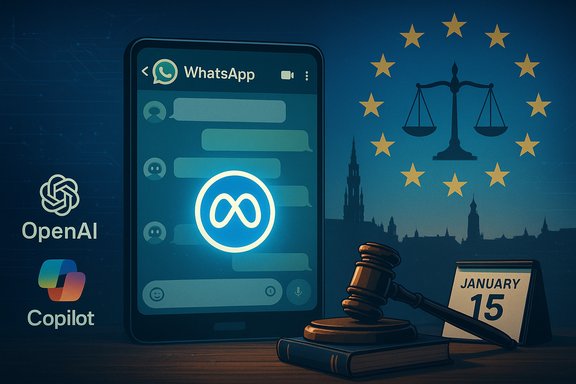
EU AI regulation scene: WhatsApp chat on a phone, OpenAI and Copilot logos, scales of justice, gavel, and January 15.Background​

What changed, and when​

In October 2025 WhatsApp updated its Business Solution (Business API) terms with a new clause addressing “AI providers.” The clause prohibits “providers and developers of artificial intelligence or machine learning technologies, including but not limited to large language models, generative AI platforms, general‑purpose AI assistants” from using the WhatsApp Business Solution when those technologies are the primary functionality being offered. The updated terms were applied to new AI providers immediately and set a transition deadline of January 15, 2026 for existing integrations.
The change drew rapid industry reaction: a number of AI assistants that had been accessible on WhatsApp announced they would shut down their integrations ahead of the January 15 cutoff. OpenAI and Microsoft confirmed plans to discontinue ChatGPT and Copilot on WhatsApp and directed users toward their native apps and web clients. The European Commission announced a formal antitrust investigation on December 4–5, 2025 to determine whether the policy is illegal under EU competition rules.

Why WhatsApp matters​

WhatsApp is one of the world’s largest messaging platforms with billions of users and wide daily engagement across regions. For general‑purpose AI assistants, being discoverable and reachable inside WhatsApp represented a low‑friction distribution channel that brought millions of users into conversational AI experiences without separate app installs. That scale and the app’s role in business communications made the platform strategically important to both AI startups and established vendors.

Overview of the EU’s concerns​

Core legal frame​

The Commission’s investigation examines whether Meta’s updated terms may constitute an abuse of dominance under Articles 101/102 TFEU — the EU’s core competition rules — and comparable EEA provisions. If an undertaking with a dominant position imposes exclusionary conditions that foreclose rivals or distort competition, the Commission can open in‑depth proceedings, impose remedies and levy fines.
Under the EU’s enforcement regime, fines for competition infringements can run up to 10% of a company’s global annual turnover. To put that ceiling in context: Meta’s annual revenue for 2024 was reported at roughly $164.5 billion, meaning the theoretical 10% cap would equate to about $16.45 billion. That figure is a statutory ceiling and not a predicted fine; actual penalties (if any) would depend on the Commission’s findings, gravity, duration and any mitigating circumstances.

Immediate regulatory priorities​

Brussels has signalled two immediate priorities:
  • Establish whether the Business Solution policy change has the effect (not just the intent) of locking out competitors from an essential distribution channel in the EEA.
  • Consider whether interim measures are necessary to prevent irreparable harm to competition while the probe runs. Interim measures are extraordinary but have been contemplated by both the Commission and national authorities (notably Italy’s competition authority) given the speed at which network effects and user habits can entrench market power.

The factual record: what the public documents show​

  • WhatsApp’s new policy targeting “AI Providers” was publicly reflected in the Business Solution terms published in October 2025 and tied to an effective cutoff for existing providers on January 15, 2026.
  • The European Commission opened a formal antitrust investigation in early December 2025, explicitly noting that the measure may prevent third‑party AI providers from offering services through WhatsApp in the EEA.
  • Major AI vendors announced withdrawals from the WhatsApp Business channel in response: OpenAI updated guidance for users to move to the ChatGPT app and linked account flows; Microsoft said Copilot on WhatsApp will be discontinued and pointed users to its Copilot apps and web interfaces.
  • Meta/WhatsApp has publicly defended the change by arguing that the Business Solution was designed for business‑to‑customer interactions and that general‑purpose chatbots place a strain on systems not designed for that scale and usage model. Meta also emphasized that the AI market remains competitive and that users have many other ways to reach AI services.
These points are corroborated by official Commission communications, vendor blog posts and media reporting; the timeline and the key contractual language are matters of public record.

What Meta says — the operational argument​

Meta frames the change as operational and product‑design driven, not anticompetitive.
Key elements of Meta’s position include:
  • The WhatsApp Business Solution was built to support business workflows — transactional messages, support tickets, appointment reminders and similar enterprise uses — rather than to act as a mass distribution network for consumer chat assistants.
  • Widespread use of general‑purpose chatbots on the Business API increased message volume, infrastructure load, and customer‑support overhead in ways that WhatsApp claims it did not architect the API to handle.
  • Meta stresses that businesses can still use AI incidental to their services (e.g., a retailer using AI to automate customer support), which the terms explicitly permit; the restriction targets AI when it is the primary product.
  • Meta points to the existence of alternative access points for AI services — app stores, native apps, web clients, operating system integrations — arguing that consumers retain choice.
This is a defensible factual argument about product purpose and operational constraints; however, whether an operational rationale is a legitimate, proportionate business decision or a pretext for exclusionary conduct is precisely what competition authorities will investigate.

What rivals and regulators say — competition and market effects​

Regulators and many competitors stress contestability and access:
  • The Commission’s central worry is that blocking general‑purpose AI providers from the Business Solution will make it materially harder for rivals to reach users inside WhatsApp, while Meta’s own assistant remains integrated — an asymmetric treatment that can tilt adoption dynamics in Meta’s favour.
  • EU officials noted submissions from small businesses and startups that relied on WhatsApp integrations as a core distribution channel for their AI services. Regulators flagged that the change could crowd out innovative competitors and create irreversible switching costs for users.
  • National authorities (Italy’s AGCM) have expanded parallel inquiries and explicitly considered interim measures, reflecting concern about fast‑moving harms to market contestability.
The regulatory narrative emphasizes that access to platforms with dense user networks is a structural bottleneck: once a dominant platform denies third‑party access, incumbents may capture downstream value that is hard for rivals to re-create.

Technical and business realities: parsing Meta’s system‑strain claim​

Meta’s claim that general‑purpose AI bots place unusual load on the Business API is plausible on technical grounds: large‑scale LLMs generate high volumes of tokens and may trigger many small, high‑frequency interactions compared with traditional business messaging. Key points to weigh:
  • The Business Solution monetization model is structured around templates and business message types; general‑purpose assistants often use conversational, open‑ended interactions that don’t map neatly to template pricing.
  • Running LLM‑backed assistants inside a messaging channel can produce spikes in inbound and outbound messages, leading to infrastructure and moderation considerations for WhatsApp.
  • That said, platform operators routinely evolve APIs and capacity plans. The existence of technical constraints does not, on its own, justify permanent, categorical exclusions — especially when a vertically integrated firm retains access for its own competing service.
In short, the technical argument is not decisive; it is a legitimate operational explanation that will be tested against evidence about feasibility of accommodation, proportionality of the restriction, and the availability of less‑restrictive remedies.

Possible legal outcomes and remedies​

  • No infringement found — the Commission could conclude Meta’s policy falls within legitimate product design and is proportionate. In that case the status quo stands; providers will have to continue developing alternative distribution routes.
  • Behavioral remedies — if the Commission finds an abuse, it can require Meta to change the terms, grant equal access under fair, non‑discriminatory conditions, or adopt technical interfaces that enable third‑party integration subject to safeguards.
  • Structural remedies (rare) — in extreme scenarios the Commission can impose more intrusive measures, though these are exceptional.
  • Fines — administrative fines up to 10% of global turnover are the statutory maximum for antitrust infringements. The final amount would be calibrated based on seriousness and duration.
Regulators have additional tools: the Commission and national authorities can seek interim measures to preserve competition while the investigation proceeds, a step they have indicated they may consider.

Wider regulatory context: DMA, DSA and competition law​

This probe is being conducted under traditional EU competition tools rather than the Digital Markets Act (DMA). That distinction matters:
  • The DMA imposes ex ante obligations on designated “gatekeepers” to prevent certain forms of self‑preferencing and to grant interoperability rights; it’s a preventive regime.
  • The current WhatsApp case is being handled under antitrust rules (abuse of dominance), which are ex post enforcement tools focused on specific conduct.
However, the line between the DMA and antitrust enforcement is porous in practice: concerns about self‑preferencing and gatekeeper conduct are central to both frameworks, and the DMA’s existence increases regulatory appetite to act quickly where market closure is alleged.

Implications for developers, businesses and users​

For AI startups and third‑party developers​

  • Loss of a low‑friction distribution channel: companies that relied on WhatsApp to engage users now face migration costs to native apps, web clients, or other messaging platforms.
  • Increased customer acquisition costs: rebuilding discovery outside WhatsApp may require direct marketing and tighter integration with platform ecosystems (Android/iOS).
  • Uncertainty and risk: pending regulatory outcomes mean short‑term strategic decisions (invest in WhatsApp alternatives or accelerate apps) must be weighed against potential reinstatement of access if the Commission requires remedies.

For enterprises using AI on WhatsApp​

  • Customer‑facing bots that were ancillary to broader services are still permitted, but vendors should audit whether their use cases qualify as incidental vs primary under the new terms.
  • Small businesses that routed AI‑driven support through third‑party assistants may face service disruption and must prepare migration and continuity plans.

For end users​

  • Users who discovered AI assistants inside WhatsApp will need to move to provider apps and web clients to retain service continuity, and some chat histories may not be preserved due to export limitations.
  • The change raises consumer‑choice questions: platform control over in‑app distribution can meaningfully shape which AI experiences users encounter first.

Strategic motives versus operational reality — what’s verifiable and what’s inference​

  • Verifiable facts: the contractual change, the effective dates, OpenAI and Microsoft public announcements, the Commission’s formal investigation and the possibility of interim measures are all documented and public.
  • Less verifiable claims: asserting Meta’s intent—for example, that the policy was primarily designed to entrench Meta’s AI market position or to maximize monetization—requires inference from behavior, timing and commercial context. Those inferences are reasonable for analytical commentary but should be flagged as interpretive rather than proven facts.
Regulators will evaluate both the effect and the motive where relevant, but legal determinations hinge on market effects and the proportionality of conduct, not on boardroom intentions alone.

What this means for platform policy and antitrust enforcement going forward​

  • The case highlights a new enforcement frontier where AI features intersect with platform gatekeeping. Messaging apps, app stores, operating systems and social graphs are all potential chokepoints for AI distribution.
  • Regulators are signaling they will use the full toolkit — national authorities, EU antitrust law and, where appropriate, the DMA — to address cases where platform updates risk denying rivals access to key distribution channels.
  • The speed of AI adoption raises the stakes: temporary exclusions or small frictional costs can ossify into market dominance due to network effects, user inertia and data advantages.
For policymakers, the challenge is balancing legitimate product design choices and platform safety against the long‑term risk of foreclosure in essential digital channels.

Practical checklist for Windows developers, IT pros and tech buyers​

  • Audit dependencies: if your product or service relied on third‑party AI through WhatsApp, identify which flows are at risk and build contingency plans now.
  • Prepare migration paths: encourage users to link accounts to vendor apps or to use web clients to preserve continuity when integrations are disabled.
  • Reassess messaging strategy: consider multi‑channel distribution (SMS, Telegram, native apps) rather than reliance on a single platform API.
  • Monitor regulatory developments: interim measures could change the immediate landscape; keep an eye on public filings and Commission decisions.
  • Engage with platform terms: read updated Business Solution terms carefully to classify whether your use of AI is incidental or primary under the new text.

Risks and broader market consequences​

  • Concentration risk: if dominant platforms can selectively deny access to third‑party AI while privileging their own services, downstream competition in AI services could shrink rapidly.
  • Innovation chill: startups and small vendors that depend on easy distribution may find it cost‑prohibitive to scale without platform access, reducing experimentation.
  • Fragmentation: consumers may face a trade‑off between convenience (integrated experiences in a single app) and choice (diverse external AI providers). That trade‑off has implications for data portability, privacy and interoperability.
  • Regulatory escalation and transatlantic friction: high‑profile enforcement actions can fuel diplomatic tensions and lobbying, but they also set precedents for how platform control over AI will be judged.

Conclusion​

The European Commission’s decision to open a formal antitrust investigation into Meta’s WhatsApp Business Solution policy is a consequential moment in the intersection of platform governance and AI competition. On the one hand, Meta advances an operational rationale: the Business API was never designed to be a mass channel for general‑purpose LLMs, and system strain plus product alignment justify a restrictive stance. On the other hand, the practical result — that rival AI assistants are excluded from a platform where Meta’s own assistant remains available — raises precisely the sort of exclusion and self‑preferencing risks that EU competition law was designed to deter.
For developers, businesses and users, the immediate task is pragmatic: mitigate disruption, move essential services to alternative channels and prepare for an unsettled regulatory period. For policymakers and competition authorities, the Commission’s probe is part of a broader effort to ensure that dominant digital platforms do not weaponize next‑generation features to cement control over rapidly evolving markets.
The case will be watched closely as a test of how flexible competition law can be in fast‑moving technological contexts where distribution channels — not just algorithms — determine who wins in AI. The ultimate outcome will shape not only WhatsApp’s ecosystem but also the next phase of platform‑AI relations: whether major players must keep open the gates to rival intelligence, or whether platform owners will be allowed to close those gates in the name of product coherence and operational stability.

Source: Business Today EU launches antitrust probe against Meta’s AI strategy blocking AI rivals on WhatsApp - BusinessToday
 

Meta’s sudden pivot to licensing mainstream and niche publishers into its AI stack is the clearest sign yet that the social network is betting the company’s future engagement and credibility on its ability to deliver real‑time, sourced news inside Meta AI — a move that stitches commercial licensing, product strategy, and the fraught legal battle between publishers and AI companies into one high‑stakes experiment.

A glowing blue infinity symbol on a monitor, set against a neon circuit-board backdrop.Background​

Meta announced on December 5–6, 2025 that it has begun rolling out commercial content agreements with a range of major publishers so that Meta AI — the company’s conversational assistant across Facebook, Instagram, WhatsApp and other surfaces — can surface timely news, entertainment and lifestyle content and link users back to original articles. The company framed the effort as a way to make Meta AI “more responsive, accurate, and balanced” when users ask news‑related questions.
This announcement follows a broader industry scramble in 2024–2025: large language model makers, AI startups, and platform owners have all been negotiating licensing deals with publishers or facing lawsuits for unlicensed scraping and reuse of journalism. Over the past 18–24 months we’ve watched publishers move in two directions simultaneously — suing startups for alleged copyright infringement while also striking revenue deals with larger AI firms that offer scale and payment. Meta’s deals are the latest manifestation of that dual track.

What Meta said — and what it will actually do​

Meta’s official blog post lays out a simple product promise: when a user asks Meta AI a question about current events, entertainment, sports, or lifestyle topics, responses will now draw on a broader mix of publisher content and — crucially — include links to partner articles so people can “visit partners’ websites for more details.” The company emphasized adding diverse viewpoints and content types as a guardrail against stale or biased answers.
Key elements of the announcement:
  • Meta AI responses to news queries will be augmented with partner content and links.
  • Initial partner slate includes national and international outlets across the political and editorial spectrum.
  • Meta said it will expand the list of partners over time and experiment with related features.
  • Financial terms were not disclosed in Meta’s announcement.

The first‑wave partners (who signed on)​

In press coverage and corporate statements published alongside Meta’s blog, the following publishers were named among the first participants:
  • CNN, Fox News and Fox Sports
  • Le Monde Group (France)
  • People Inc. portfolio (PEOPLE, Better Homes & Gardens, Food & Wine, Allrecipes, Verywell Health, InStyle, Investopedia)
  • USA TODAY Co. and its local network
  • The Daily Caller and The Washington Examiner
These partners represent a deliberate mix: mainstream legacy brands with global reach, niche lifestyle publishers that drive engagement, and conservative outlets that broaden ideological coverage. The initial list was confirmed by multiple outlets and by publisher press releases.

Why this matters now: strategy and context​

Meta’s move is strategic on several concurrent fronts.
  • Product differentiation in an increasingly saturated AI market. Big tech challengers and startups are all racing to make chat assistants more useful at current events — a capability that requires either frequent model retraining or live access to trusted content. Licensing publisher content is the clearest, short‑term path to making an AI assistant appear timely and authoritative.
  • Rebuilding trust and credibility for AI outputs. Chatbots have a persistent hallucination problem; providing explicit links to named sources and established newsrooms gives an anchor for verification and attribution, and it allows publishers to claim their brand is visible in the answer pipeline rather than being invisibly scraped. Meta explicitly linked that credibility goal to this program.
  • A new commercial calculus for publishers. News organizations that once viewed platform distribution primarily as referral traffic are now evaluating direct licensing revenue, measurability, and the risk of disintermediation. Several publishers made announcements today that their content will appear in Meta AI under multiyear agreements, highlighting a shift from confrontation to conditional collaboration.

The publisher calculus: benefits — and brittle tradeoffs​

For participating newsrooms, the commercial and audience upside is real.
  • Direct revenue: Licensing deals provide a new income stream at a time when ad and subscription models are under stress.
  • Attribution and traffic: Meta’s promise to link out to partner URLs could restore measurable referral traffic — if the product actually drives clicks rather than retaining readers inside the AI experience.
  • Reach and discovery: Meta’s scale offers publishers rapid audience access across demographics that may be less likely to seek them out directly.
But these benefits come with immediate and structural tradeoffs:
  • Risk of substitution: If Meta AI learns to answer many queries succinctly, users may no longer click through. Publishers must negotiate payment structures that recognize both clickthrough value and replacement risk.
  • Brand dilution: Short answers that omit context or reduce complex reporting to single‑line summaries could underrepresent investigative work.
  • Unequal leverage: Large outfits can command better rates; smaller local and niche outlets may be squeezed or excluded, amplifying consolidation in news ecosystems.
Publishers that licensed Meta struck a pragmatic balance: guaranteed revenue and maintained attribution in exchange for a potential long‑term erosion of direct audience relationships. The exact scope of that erosion depends on product design (how prominent are links, are excerpts allowed, is attribution visible) — all contract details Meta declined to disclose publicly.

Legal and regulatory pressure: the backdrop of copyright fights​

The licensing announcement should be read against a backdrop of escalating legal fights between publishers and AI companies. In the same week as Meta’s licensing rollout, major publishers filed copyright suits against AI startups accused of reproducing articles verbatim or otherwise using paywalled content without permission. That litigation environment is motivating publishers to seek negotiated licenses with companies that can offer credible, enforceable contracts.
Two important dynamics are in play:
  • Lawsuits channel publisher leverage by threatening reputational and financial harm to startups that reuse journalism without permission.
  • Licensing programs with deep pockets (Big Tech) offer publishers a hedge: cash now and explicit attribution mechanisms that litigation cannot guarantee.
Regulators are also watching. Meta’s earlier moves to shut down dedicated news features on Facebook and to restrict news access in jurisdictions with news‑payment laws demonstrated that platform policy can become entangled with national media policy. The reversal from “we won’t sign deals” to “we will license content” shows how rapidly platform positions can shift under regulatory, commercial and reputational pressure.

Product details and technical implications​

Meta’s public statements are deliberately light on technical specifics. The company has said Meta AI will draw on partner content and include links, but it did not disclose:
  • Whether the system will use retrieval‑augmented generation (RAG) architecture that queries a live index of partner content during answer generation.
  • How content will be sampled, summarized, or excerpted in replies.
  • Which telemetry and metrics (clickthrough rates, dwell time, subscription conversions) partners can access.
This opacity matters. RAG systems can reduce hallucinations by grounding answers in indexed documents, but they also require strict provenance tracing, rate limits, and content‑use rules to avoid reproducing copyrighted text verbatim. For publishers, the contract terms that govern excerpt length, caching, indexing frequency, and attribution visibility will determine whether the partnership is a win or a slow erosion of value.
Technical safeguards to expect and demand:
  • Explicit provenance tags that show which article(s) informed a specific answer.
  • Strict excerpt limits and automated checks against verbatim reproduction.
  • Click incentives that prioritize user ability to access full reporting.
  • Audit logs and third‑party verification so publishers can measure how their content is used.
Absent those safeguards, the product risks becoming a revenue‑rich black box that shrinks publishers’ audiences while capturing their intellectual property.

Editorial and political risks​

Meta’s choice of partners — spanning CNN to The Daily Caller — is strategically defensive: present a diversity of viewpoints so critics can’t easily accuse Meta AI of ideological bias. But inclusion alone does not neutralize editorial risk.
  • Selective inclusion can create curated imbalance: choosing which outlets to license and which to ignore will shape the AI’s default “information diet.”
  • Amplification risks: AI chat responses, by virtue of concise formatting and high reuse, can disproportionately amplify sensational or under‑contextualized headlines.
  • Monetization optics: Large upfront licensing payments from Meta could be perceived as pay‑to‑play by smaller publishers and by audiences concerned about editorial independence.
If Meta AI privileges certain partners in ranked answers or as the primary link authority — intentionally or because of contractual metadata — the perceived neutrality of the assistant will be undermined. That makes transparency about ranking rules and editorial weighting essential.

What this means for users​

For everyday users, the immediate benefits should be tangible:
  • Faster, more current answers to breaking events.
  • Easier pathways to read full reporting via links in the AI responses.
  • Potentially less hallucination on time‑sensitive facts when the system is properly grounded.
But users should also be aware of the limits:
  • A single succinct AI response cannot replace reading the entire article — nuance and investigative context are easily lost.
  • The presence of links doesn’t guarantee balanced coverage; users must still evaluate source credibility.
  • Privacy and tracking: if Meta uses usage data from these interactions to target content or ads, that will raise new questions about how conversational queries are monetized.

Industry reaction and what publishers are saying​

Initial publisher statements were measured: major groups signaled that the deals will let them reach new audiences while capturing licensing revenue, but they declined to disclose financial terms. Some publishers noted the benefits of attribution and the ability to steer readers to subscriptions or deeper coverage. Others outside the initial deal list expressed skepticism, demanding clearer guarantees around clickthrough and anti‑substitution protections.
This mixed response is predictable. Publishing houses are balancing two competing incentives: protect the long‑term economics of original reporting; and monetize new AI distribution channels before more of the traffic and value migrates to tech platforms.

Risks to journalism and the information ecosystem​

Several systemic risks deserve attention:
  • Concentration risk: If only the largest publishers get meaningful licensing revenue while smaller outlets are excluded, local news ecosystems may suffer further.
  • Standards erosion: If AI responses routinely flatten investigative nuance, public understanding of complex issues could degrade over time.
  • Precedent for compensation models: Deals with one big platform will set market expectations for all AI companies; publishers must ensure contract standards are portable and enforceable.
Finally, legal precedents from ongoing lawsuits could reshape what “licensed use” looks like. If courts impose limits on how content can be reused in generative outputs, the commercial terms worthwhile to publishers may change rapidly.

What to watch next (short list)​

  • Product behavior in the wild: Are AI answers including clear provenance and visible links, or do they remain opaque summaries?
  • Contract transparency: Will publishers disclose payment models and excerpting rules, or keep terms private?
  • Metrics: Will licensed content produce clickthrough gains, subscription conversions, or will it cannibalize traffic?
  • Regulatory reaction: Will lawmakers demand transparency about algorithmic ranking and editorial weighting?
  • Litigation outcomes: Will ongoing lawsuits against startups like Perplexity influence publisher bargaining power and contract language?

Practical recommendations​

For publishers considering similar deals:
  • Negotiate specific protections against substitution and verbatim republishing.
  • Demand measurable attribution and access to relevant telemetry.
  • Secure trial periods with build‑in review clauses to adjust terms if clickthroughs decline.
  • Insist on clear audit rights for how content is indexed, cached, and summarized.
For policymakers:
  • Require algorithmic transparency where large platforms integrate licensed content into public‑facing assistants.
  • Ensure small and local publishers have pathways to participate, avoiding exclusive deals that distort competition.
  • Monitor whether licensing arrangements create de facto paywalls inside AI experiences that reduce public access to journalism.
For users:
  • Favor answers that show source links and provenance.
  • Read the linked original reporting for complex topics.
  • Be skeptical of short AI summaries for breaking news or investigative claims.

Conclusion​

Meta’s licensing push is a pivotal moment for the interplay between platform power, publisher survival, and AI productization of news. On paper, the approach solves an immediate product problem — giving AI assistants access to timely, credited content — while giving publishers new revenue levers. In practice, success hinges on three fragile pieces: the technical ability to ground answers to named sources without reproducing protected text; the contractual design that protects publishers from substitution; and the regulatory and public accountability that prevents a small set of deals from reshaping the information ecosystem in opaque ways.
If Meta can deliver transparent provenance, fair compensation models that scale to small publishers, and product designs that privilege clickthrough and subscription conversions rather than substitution, this might become a workable model for AI‑publisher collaboration. If not, the arrangement risks consolidating information power in platforms that monetize content while publishers shoulder long‑term costs to democracy and local reporting. The next few months of product experiments, contract disclosures and courtroom rulings will determine which of those futures arrives.

Source: ABS-CBN https://www.abs-cbn.com/news/techno...-with-news-outlets-to-expand-ai-content-1045/
 

Last edited:
Back
Top