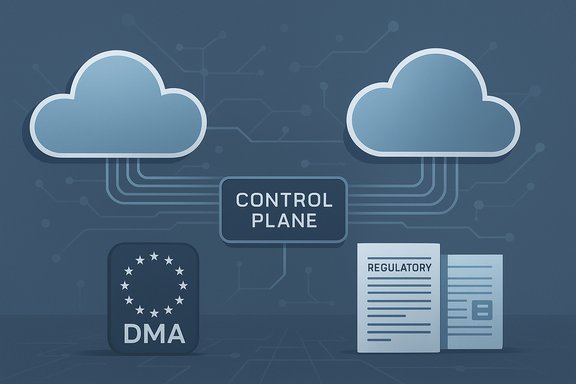
The European Commission has opened a trio of market investigations into the cloud businesses run by Amazon Web Services (AWS) and Microsoft Azure — a move that explicitly tests whether hyperscale cloud platforms should be treated as “gatekeepers” under the Digital Markets Act (DMA) and whether the DMA’s toolbox can meaningfully be applied to infrastructure-level services that underpin Europe’s digital economy. This is not a routine antitrust probe: Brussels is asking hard questions about market concentration, switching costs, self‑preferencing, interoperability and data egress pricing — and it has given itself roughly 12 months to gather evidence and propose remedies.
Background
Cloud computing today is foundational: governments, banks, telecoms, critical public services and virtually every major internet business run on infrastructure and managed services supplied by a very small number of firms. AWS and Azure are the two dominant public cloud providers globally, with Google Cloud in a distant third place in many markets. Independent market analyses and national regulators have repeatedly flagged the concentration that results from this structure — and the UK’s Competition and Markets Authority (CMA) and Ofcom have already sounded alarms about switching frictions such as egress fees and licensing practices that can cement vendor lock‑in. The DMA, adopted to tame gatekeeper power in a digital economy, sets ex‑ante obligations for platforms that meet quantitative and qualitative thresholds. The Commission has used the DMA before to designate major firms and impose mandatory transparency, interoperability and non‑discrimination duties; applying those principles to cloud infrastructure raises novel legal and technical challenges that Brussels has now committed to explore.Why this probe happened: the proximate and structural drivers
1. Concentration and high barriers to switching
Hyperscalers control a substantial share of public cloud spend in many EU member states. The CMA’s work and industry trackers have repeatedly shown that AWS and Azure each command very large market slices in regions such as the UK and across EMEA, leaving smaller providers with limited ability to challenge incumbents. When a market is heavily concentrated, entrenched practices that raise the cost or complexity of migration become effective barriers to competition. Regulators view those frictions — whether contractual, pricing or technical — as classic signs of market power that warrant intervention.2. Systemic outages and operational fragility
High‑impact outages at major cloud providers over the last 12–24 months exposed how dependent many downstream services are on a handful of cloud primitives (DNS, identity fabrics, managed databases, global ingress/egress networks). When a control‑plane or edge misconfiguration cascades, the social and economic impact is immediate and broad. Those incidents heightened regulator urgency: concentration is not only a competition problem, it is a systemic‑risk and resilience problem.3. The AI accelerant
Generative AI and large‑scale machine learning are intensifying demand for specialised compute, networking and tightly integrated software stacks. Hyperscalers now offer managed AI stacks and custom accelerator access that are difficult to replicate elsewhere; customers build architectures and pipelines that are highly provider‑specific. That technical stickiness amplifies commercial lock‑in and raises the stakes for contestability in the age of AI. Policymakers increasingly see cloud concentration as a lever over next‑generation AI markets.4. Political and sovereignty considerations
European policymakers are explicitly framing cloud competition as part of a broader digital sovereignty agenda. Concerns about data residency, resilience of critical infrastructures and dependence on non‑EU providers feed a political will to reduce strategic exposure and expand in‑region alternatives. These geopolitical currents make regulators likelier to adopt aggressive interventions if they can be grounded in solid evidence of harm.Legal framework: the DMA and market investigations
What the DMA does — and what it does not
The Digital Markets Act was designed around “core platform services” such as app stores, search engines and social networks; it imposes ex‑ante duties on firms designated as gatekeepers (firms with systemic market impact meeting defined thresholds). Designated gatekeepers are subject to obligations like non‑discrimination, data portability, and requirements to make certain features interoperable. In principle, if a cloud service or specific cloud offering is designated a core platform service, the provider faces binding obligations and heavy penalties for non‑compliance.Why cloud complicates the DMA’s mechanics
Applying the DMA to cloud raises immediate methodological questions. The DMA’s quantitative thresholds (turnover, market cap, number of users) and measurement approaches were drafted for consumer‑facing platforms and do not map cleanly to enterprise providers, contract values, or infrastructure capacity. The Commission’s third, horizontal probe will therefore test whether the DMA is fit for purpose in this domain or whether bespoke or sector‑specific tools are necessary. That is a central legal question of this inquiry.What investigators will look for — the practical points of friction
Regulators have a well‑worn playbook for what constitutes exclusionary conduct in platform markets; translated to cloud, the Commission’s areas of interest will include:- Data portability and egress fees — Are charges or technical impediments making it prohibitively expensive to move large datasets out of a provider? Do those costs materially reduce customers’ ability or incentive to switch?
- Self‑preferencing and bundling — Do first‑party managed services, marketplaces or integrated stacks receive preferential treatment (pricing, performance, feature parity) that disadvantages third‑party offerings?
- Licensing and pricing practices — Are licensing terms (for Windows, SQL Server or other middleware) structured to make it cheaper to run workload X on Azure rather than a rival cloud?
- Interoperability and proprietary control‑plane features — Are APIs, orchestration primitives or control interfaces intentionally closed or engineered to frustrate migration, multi‑cloud architectures or seamless failover?
- Market structure and entry barriers — Are investment costs, economies of scale, or contractual terms making entry for serious competitors infeasible in practice?
Each of these areas is evidence‑driven: the Commission will look for contracts, invoices, technical logs, performance data, customer testimonies and internal documents that show whether provider behaviour materially affects contestability.
Possible remedies EU authorities could consider
If investigators find actionable harm or that DMA obligations should apply, the Commission’s toolkit ranges from behavioural to structural measures. Practical options include:- Mandated interoperability and open APIs
- Require non‑discriminatory access to essential control‑plane functions and published technical interfaces that enable migration and orchestration across providers.
- Limits on self‑preferencing and bundling
- Ban or circumscribe practices that give first‑party managed services unfair commercial or operational advantages.
- Caps, standardisation or auditability of egress fees
- Require transparent, standardized pricing or cap excessive exit charges that materially prevent migration.
- Data portability obligations and migration tooling
- Oblige providers to supply audit‑grade migration tools, escrowed keys, or harmonised export formats to reduce friction.
- Transparency and independent audits
- Require regular, independent audits of performance, preferential treatment claims and contractual terms, with public reporting.
- Hybrid, DMA‑tailored measures or sectoral rules
- If the DMA is found imperfect for cloud, the Commission could recommend tailored sectoral remedies while proposing legislative updates.
What this means for customers, competitors and cloud strategy
- For enterprise customers: expect a stronger negotiating position over the next 12 months and an incentive to audit exit clauses, egress pricing, key management and architecture portability. Large public buyers — governments and telecoms — are likely to revise procurement rules to demand stronger portability and sovereignty guarantees.
- For competitors and smaller cloud providers: the investigations could unblock headroom for differentiation if remedies reduce lock‑in. However, commercial viability still depends on scale, data‑centre footprint and specialised hardware access (especially for AI workloads).
- For AWS and Microsoft: a gatekeeper designation or binding DMA‑style obligations would force operational and contractual changes, increased disclosure and potential fines for breaches. Both companies have publicly pushed back in prior regulatory debates, warning about the risk of stifling innovation and raising costs. The Commission’s conclusion will shape global cloud governance norms.
Risks, trade‑offs and unintended consequences
While contestability and resilience are legitimate public‑interest goals, aggressive ex‑ante interventions in cloud markets carry meaningful risks:- Investment chill — Hyperscalers argue that ex‑ante constraints could reduce returns on capital and thereby limit new data‑centre and specialised‑accelerator investments needed for AI and resilience. That is a credible concern: building global cloud capacity is capital‑intensive and driven by scale economics.
- Technical fragmentation — Heavy-handed mandates that impose incompatible interfaces or divergent regional rules risk fragmenting the global cloud ecosystem. Fragmentation would raise costs for multi‑national businesses and increase complexity for software vendors.
- Enforcement complexity — Translating DMA obligations to the technical semantics of control planes, APIs and orchestration primitives is non‑trivial. Rules that look good on paper may be hard to enforce in the field without detailed technical specifications and ongoing oversight.
- Regulatory arbitrage and political pushback — The probe occurs against a charged geopolitical backdrop; the U.S. government and industry lobbyists see DMA‑style measures as potentially protectionist. Political pressure could influence the Commission’s course or provoke tensions in transatlantic trade relations.
These trade‑offs mean that any remedy must be narrowly tailored, technically feasible and calibrated to preserve incentives for innovation while protecting contestability.
Verifiable facts, cross‑checks and caution where reporting relies on anonymous sources
- Verified: The European Commission has opened market investigations into AWS and Azure and a third inquiry into DMA fitness for cloud markets; the Commission set an approximate 12‑month timeframe for these market reviews. This is confirmed in multiple reporting outlets.
- Verified: The DMA provides ex‑ante obligations for designated gatekeepers and imposes significant fines for non‑compliance; the list of designated gatekeepers and the obligations are public. The DMA’s mechanics and thresholds are accessible in the Commission’s public materials.
- Corroborated: UK regulators (CMA and Ofcom) have previously identified substantial market concentration and switching frictions in cloud, and recommended further action in the UK context; those findings influenced the EU’s agenda and provide prior empirical evidence for concentration concerns.
- Caution: Early press accounts that attribute the Commission’s internal reasoning to single anonymous briefing(s) should be treated with care. Some outlets have relied on inside sources for the Commission’s thinking; formal Commission notices and public documentation remain the authoritative record. Where reporting uses anonymous sources, that dependency will be flagged in this piece.
Practical steps for IT leaders and procurement teams now
- Map dependencies: catalogue workloads, managed services, and control‑plane primitives your business depends on and assess technical coupling to provider‑specific APIs.
- Audit exit costs and contractual terms: quantify egress fees, data export times and hidden migration costs for critical workloads.
- Design for portability: where feasible, adopt container orchestration, open formats and multi‑cloud-compatible data architectures to reduce single‑provider risk.
- Negotiate portability clauses: seek contractual commitments for migration tooling, testable egress SLAs and independent audit rights.
- Plan for resilience: implement multi‑region or multi‑cloud failover strategies for critical services where operationally and economically sensible.
How regulators should think about remedies (a checklist)
- Targeted and evidence‑based: only adopt remedies where the record shows clear, durable harm to competition or security.
- Technically precise: legislate or insist on standards that map to control‑plane semantics and real-world migration processes.
- Investment‑aware: calibrate obligations so they do not remove the commercial returns necessary for hyperscale investment in data centres and AI accelerators.
- Internationally harmonised: work with other jurisdictions to avoid fragmentation and ensure global interoperability.
- Time‑boxed and reviewable: adopt pilot or phased remedies with sunset clauses and periodic reassessment.
Conclusion
The European Commission’s decision to open market investigations into AWS and Azure marks a defining moment for how governments will regulate infrastructure that sits at the heart of modern digital life. The probes ask whether the DMA’s gatekeeper framework — designed for consumer platforms — can be adapted to the technical and contractual realities of cloud, and whether targeted remedies can reduce lock‑in without hampering investment and innovation.For cloud customers, the immediate imperative is practical: map dependencies, pressure vendors for stronger portability guarantees, and design for resilience. For regulators, the challenge is technical and institutional: craft remedies that are precise, enforceable, and attuned to the unique economics of cloud. For the hyperscalers, the inquiry will likely mean more scrutiny, more disclosure and potentially new constraints on how they bundle services and price migrations.
This story will move fast and will be shaped by hard technical evidence, commercial documents and high‑stakes political negotiation. The next 12 months will determine whether Europe imposes a new set of ex‑ante rules on the backbone of the AI era — with consequences that reach well beyond the continent.
Source: Bloomberg.com https://www.bloomberg.com/news/arti...crosoft-azure-face-eu-probe-into-cloud-power/
Last edited: