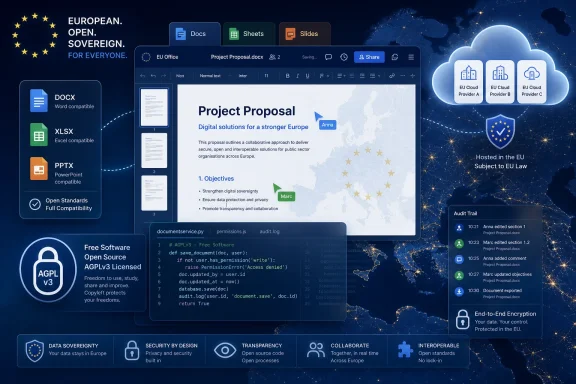
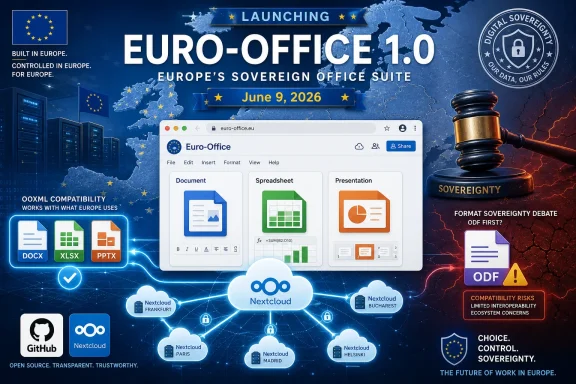
Euro-Office 1.0 is scheduled to launch Tuesday, June 9, 2026, as a free AGPLv3 web-based office suite on GitHub and inside Nextcloud Hub 26 Spring, while The Document Foundation is warning that its OOXML-first design weakens the sovereignty pitch for European governments and businesses. That tension is not a launch-day sideshow; it is the whole argument compressed into one product decision. Europe wants an office stack that is open, auditable, hosted under European law, and usable by people who still live in a Microsoft Office world. Euro-Office’s first release says the practical migration problem comes first, and LibreOffice’s parent says that is exactly how lock-in survives.
The most important thing about Euro-Office is not that it exists. Europe has had open-source office software for decades, and The Document Foundation is right to bristle at any marketing that implies otherwise. The important thing is that Euro-Office is arriving as a web collaboration component, bundled into infrastructure that organizations already use, at the exact moment European digital sovereignty has moved from conference rhetoric into procurement language.
That makes the launch more consequential than another fork on GitHub. Euro-Office is aimed at the daily workflow that kept Microsoft 365 and Google Workspace dominant even where policy documents praised open standards: shared documents, browser editing, comments, permissions, and the expectation that five people can be in the same spreadsheet without emailing version-final-final-revised.xlsx around the office.
The suite’s launch bundle is deliberately narrow. It covers browser-based editing for documents, spreadsheets, presentations, and PDFs. It does not attempt to be email, calendaring, identity management, storage, chat, or an AI assistant. Those pieces are expected to come from host platforms such as Nextcloud, IONOS Workspace, OpenProject, or XWiki.
That narrowness is a strength and a limitation. Euro-Office is not trying to replace Microsoft 365 in one dramatic cutover. It is trying to remove the document-editing engine from the US cloud dependency chain while leaving the rest of the collaboration stack to European platforms that already have customers.
Euro-Office’s backers can fairly answer that DOCX, XLSX, and PPTX are not optional in the real world. Any organization trying to migrate away from Microsoft must still open existing documents, preserve layouts, exchange files with outside partners, and survive procurement departments that treat “works with Word” as a baseline requirement. A suite that mangles formatting on day one will not be praised for its ideological purity; it will be uninstalled.
But The Document Foundation is not making a merely theological point about standards. It is arguing that the format is where power hides after the server contract changes. If public administrations move their files to European clouds but keep creating and exchanging Microsoft-shaped documents by default, Microsoft remains the gravitational center of the office ecosystem.
That is why this fight is sharper than the usual open-source family quarrel. Euro-Office is selling a migration bridge. TDF is warning that bridges have a habit of becoming permanent infrastructure.
The rendering strategy reflects that priority. OnlyOffice-style editors draw documents using an HTML5 Canvas approach rather than translating every part of a document into ordinary browser DOM elements. In plain English, the editor behaves more like a document viewer with editing capability than a web page trying to imitate a document. The payoff is visual consistency, especially for Microsoft-originated files with complex layouts.
That is precisely the kind of engineering decision that wins pilots. A ministry, university, hospital, or engineering firm does not evaluate office software on abstract format governance alone. It opens a nasty inherited Word document with tables, footnotes, tracked changes, embedded objects, and fonts nobody remembers licensing, then asks whether the document still looks like itself.
Euro-Office’s answer is to optimize for that test first. The political problem is that this same optimization reinforces OOXML as the practical center of gravity. The better Euro-Office becomes at preserving Microsoft Office documents, the easier it becomes for organizations to postpone the harder work of moving to ODF-native workflows.
LibreOffice in particular is not merely a desktop office suite with a nostalgic fan base. It is one of the reasons ODF remains a credible public-sector option at all. Its community has done the slow, unglamorous work of maintaining format support, fighting document lock-in, and keeping open office software viable after many institutions lost interest.
That history matters because Euro-Office’s launch rhetoric risks collapsing two different concepts into one phrase. “European open-source office suite” is not new. “A web-first, Microsoft-format-compatible, coalition-backed office editor bundled into major European collaboration platforms” is more specific — and more defensible.
TDF’s response should be read in that context. It is defending both a standard and a legacy. It is also defending the claim that sovereignty is not just about who hosts the server or signs the support contract, but about whether users can leave tomorrow with their documents intact and independently implementable.
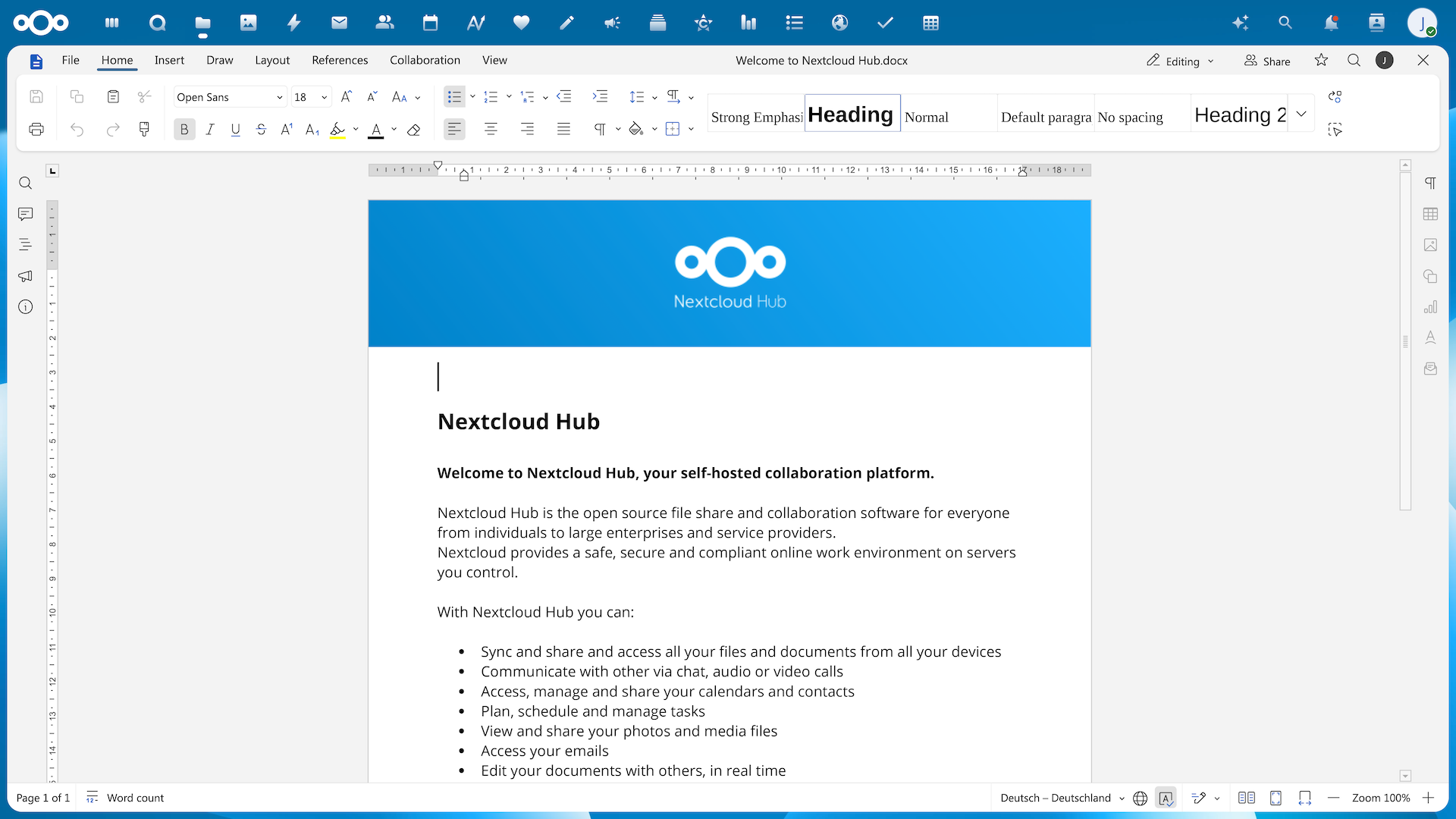
That is why Euro-Office is launching as an option inside Nextcloud Hub 26 Spring rather than as a standalone consumer productivity suite. Nextcloud already provides storage, users, sharing, permissions, and administrative controls. Euro-Office supplies the editing surface. Together, they create something closer to a self-hostable Google Docs or Microsoft 365 Online experience than a traditional office-suite download.
The distribution channel may be Euro-Office’s real innovation. Previous open-source office pushes often depended on users choosing to download software or administrators forcing a desktop migration. Euro-Office arrives inside platforms that are already running on organizational infrastructure. That lowers the activation energy from “launch a migration program” to “enable an editor.”
There is a reason that matters for public-sector IT. Desktop migrations are political. Web-app additions can be incremental. If Euro-Office can be enabled beside Collabora, tested with a subset of users, and adopted department by department, it avoids the all-or-nothing failure mode that has haunted government office-suite transitions.
Euro-Office moves the tradeoff in the other direction. It is designed to make DOCX, XLSX, and PPTX feel less foreign. For organizations whose working documents already live in those formats, that is not a minor feature. It is the difference between a pilot that survives first contact with users and one that gets dismissed as “not ready.”
The danger for Nextcloud is that offering both editors may turn a strategic choice into an administrative shrug. If Collabora is framed as the standards-respecting option and Euro-Office as the compatibility option, many organizations will simply pick the one that breaks fewer documents. That is rational behavior, but it does not automatically advance ODF.
The opportunity is that Nextcloud can make the distinction visible. If administrators can choose defaults, enforce policies, track format usage, and guide users toward ODF where appropriate, Euro-Office could become a bridge rather than a trap. Without that governance layer, the market will do what it always does: choose compatibility first and standards later, if later ever comes.
The coalition says it has invested in engineering capacity, automated testing, code cleanup, and contributor onboarding. That is necessary, but it is only the entry fee. A production office suite must keep pace with browser changes, security issues, evolving file-format behavior, accessibility requirements, localization, spreadsheet edge cases, and enterprise integration demands.
The March dispute with OnlyOffice also casts a shadow over the launch. Euro-Office’s backers have argued that a clean AGPLv3 fork cannot be constrained by branding requirements that survive in ways the license does not permit. That may be legally sound, and the dispute appears to have cooled, but the practical result is clear: Euro-Office now owns its roadmap.
Owning the roadmap is sovereignty. It is also responsibility. If Microsoft changes behavior in Office, if customers report fidelity bugs, if security researchers find flaws, or if ODF output remains incomplete longer than promised, the coalition cannot point upstream forever.
For some organizations, a browser-only editor is enough. Knowledge bases, shared policy documents, lightweight spreadsheets, project documentation, and internal collaboration often work well in that model. For others, especially those with complex spreadsheets, heavily formatted reports, or field workers, the missing clients will matter immediately.
The coalition has described desktop and mobile apps as next priorities, along with fuller ODF support. That roadmap is sensible, but the sequencing reveals the central bet: get the collaborative web editor into production first, then broaden the client story. It is the right order if the target is Microsoft 365 Online and Google Docs. It is not enough if the target is the full Microsoft Office estate.
That distinction should keep expectations grounded. Euro-Office 1.0 is not a complete productivity platform. It is a strategically placed document editor that could become a platform component if the next releases arrive quickly and coherently.
That does not mean European law will automatically make Euro-Office successful. Procurement rules can create openings, but they cannot make users love software. If the product is slow, buggy, incomplete, or confusing, policy support will only delay rejection.
Still, timing matters. A few years ago, a European office suite pitch could sound like a values statement looking for a budget. In 2026, it lands in a market where governments and regulated sectors are actively asking which dependencies they can reduce without breaking daily operations.
Euro-Office’s coalition model is designed for that moment. IONOS, Nextcloud, XWiki, OpenProject, and other partners are not merely endorsing an abstract project; they have distribution channels, customers, and adjacent collaboration products. That gives Euro-Office something many open-source alternatives lacked: a route into real deployments without waiting for every organization to discover it independently.
Users do not experience file formats as policy instruments. They experience them as whether a line break moved, whether a spreadsheet recalculated, whether a presentation survived export, and whether an external partner complains. Microsoft’s dominance persists because compatibility is social, not merely technical. Everyone else must adapt to the installed base.
This is where TDF’s criticism has its greatest force. If Microsoft remains the compatibility target, Microsoft retains influence even outside Microsoft’s own cloud. The question is whether Euro-Office can use that compatibility to help organizations leave Microsoft, or whether it simply builds a European room inside Microsoft’s document universe.
The answer will depend less on launch-day messaging than on defaults, migration tooling, administrative controls, and the speed of ODF maturation. A compatibility bridge can be liberating if it has exits. Without exits, it is just a nicer road back to the same city.
Security will be part of that test. A web-based collaborative editor exposed through widely deployed platforms is an attractive target. The coalition’s claims about cleanup, patching, and auditable code will matter only if vulnerability handling is fast, transparent, and boring in the best possible way.
Governance will matter just as much. Euro-Office is backed by a coalition, which sounds healthier than dependency on one vendor but can also create ambiguity. Users will want to know who decides defaults, who reviews patches, who funds long-term maintenance, and how disagreements between commercial partners and community priorities are resolved.
Then there is the ODF promise. Nextcloud’s leadership has said full ODF support is a top priority for the next release. That pledge is now a credibility marker. If ODF remains perpetually “next,” TDF’s warning will look less like pre-launch sniping and more like early diagnosis.
The fairest reading is that Euro-Office is a strategically useful compromise with a dangerous default. It may help organizations leave Microsoft 365 faster than an ODF-pure approach could. It may also normalize the idea that sovereignty can stop at hosting and licensing, leaving the document layer untouched.
That is why the next phase matters more than the first release. If Euro-Office makes ODF a first-class output target, gives administrators meaningful format policy controls, and communicates honestly about compatibility tradeoffs, it can strengthen the European office ecosystem rather than divide it. If it treats ODF as a concession to critics, it will become exactly what TDF fears: a Microsoft-compatible escape hatch that never fully escapes.
 Europe Gets an Office Suite Built for the World It Actually Has
The most important thing about Euro-Office is not that it exists. Europe has had open-source office software for decades, and The Document Foundation is right to bristle at any marketing that implies otherwise. The important thing is that Euro-Office is arriving as a web collaboration component, bundled into infrastructure that organizations already use, at the exact moment European digital sovereignty has moved from conference rhetoric into procurement language.That makes the launch more consequential than another fork on GitHub. Euro-Office is aimed at the daily workflow that kept Microsoft 365 and Google Workspace dominant even where policy documents praised open standards: shared documents, browser editing, comments, permissions, and the expectation that five people can be in the same spreadsheet without emailing version-final-final-revised.xlsx around the office.
The suite’s launch bundle is deliberately narrow. It covers browser-based editing for documents, spreadsheets, presentations, and PDFs. It does not attempt to be email, calendaring, identity management, storage, chat, or an AI assistant. Those pieces are expected to come from host platforms such as Nextcloud, IONOS Workspace, OpenProject, or XWiki.
That narrowness is a strength and a limitation. Euro-Office is not trying to replace Microsoft 365 in one dramatic cutover. It is trying to remove the document-editing engine from the US cloud dependency chain while leaving the rest of the collaboration stack to European platforms that already have customers.
The Sovereignty Fight Has Moved From Servers to File Formats
The Document Foundation’s objection lands because it targets the soft underbelly of many sovereignty claims. Hosting a document on a European server does not necessarily make the document itself sovereign if the format, behavioral expectations, compatibility target, and de facto roadmap remain controlled elsewhere. That is the heart of TDF’s argument against Euro-Office’s reliance on Microsoft’s OOXML formats.Euro-Office’s backers can fairly answer that DOCX, XLSX, and PPTX are not optional in the real world. Any organization trying to migrate away from Microsoft must still open existing documents, preserve layouts, exchange files with outside partners, and survive procurement departments that treat “works with Word” as a baseline requirement. A suite that mangles formatting on day one will not be praised for its ideological purity; it will be uninstalled.
But The Document Foundation is not making a merely theological point about standards. It is arguing that the format is where power hides after the server contract changes. If public administrations move their files to European clouds but keep creating and exchanging Microsoft-shaped documents by default, Microsoft remains the gravitational center of the office ecosystem.
That is why this fight is sharper than the usual open-source family quarrel. Euro-Office is selling a migration bridge. TDF is warning that bridges have a habit of becoming permanent infrastructure.
OOXML Compatibility Is the Feature Users Will Notice First
Euro-Office’s technical lineage explains the product bet. It is based on the OnlyOffice AGPLv3 codebase, which has long prioritized high-fidelity handling of Microsoft Office formats in the browser. For users who have been burned by tiny layout shifts, spreadsheet formula oddities, or presentation glitches, that matters more than philosophical cleanliness.The rendering strategy reflects that priority. OnlyOffice-style editors draw documents using an HTML5 Canvas approach rather than translating every part of a document into ordinary browser DOM elements. In plain English, the editor behaves more like a document viewer with editing capability than a web page trying to imitate a document. The payoff is visual consistency, especially for Microsoft-originated files with complex layouts.
That is precisely the kind of engineering decision that wins pilots. A ministry, university, hospital, or engineering firm does not evaluate office software on abstract format governance alone. It opens a nasty inherited Word document with tables, footnotes, tracked changes, embedded objects, and fonts nobody remembers licensing, then asks whether the document still looks like itself.
Euro-Office’s answer is to optimize for that test first. The political problem is that this same optimization reinforces OOXML as the practical center of gravity. The better Euro-Office becomes at preserving Microsoft Office documents, the easier it becomes for organizations to postpone the harder work of moving to ODF-native workflows.
LibreOffice Is Not Wrong to Feel Written Out of Its Own Story
The most awkward part of the Euro-Office pitch is the implied novelty. Europe did not wake up in 2026 and invent open-source office software. OpenOffice.org, LibreOffice, Collabora Online, and the ODF ecosystem have carried that burden through years when the market mostly rewarded Microsoft compatibility and punished standards idealism.LibreOffice in particular is not merely a desktop office suite with a nostalgic fan base. It is one of the reasons ODF remains a credible public-sector option at all. Its community has done the slow, unglamorous work of maintaining format support, fighting document lock-in, and keeping open office software viable after many institutions lost interest.
That history matters because Euro-Office’s launch rhetoric risks collapsing two different concepts into one phrase. “European open-source office suite” is not new. “A web-first, Microsoft-format-compatible, coalition-backed office editor bundled into major European collaboration platforms” is more specific — and more defensible.
TDF’s response should be read in that context. It is defending both a standard and a legacy. It is also defending the claim that sovereignty is not just about who hosts the server or signs the support contract, but about whether users can leave tomorrow with their documents intact and independently implementable.
Nextcloud Is Betting That Adoption Beats Purity
Nextcloud’s position is pragmatic, and it is not hard to understand. If the goal is to move organizations off Microsoft 365 and Google Docs, the first enemy is friction. The second enemy is broken documents. ODF compliance may be the destination, but the installed base is overwhelmingly shaped by Microsoft Office formats.That is why Euro-Office is launching as an option inside Nextcloud Hub 26 Spring rather than as a standalone consumer productivity suite. Nextcloud already provides storage, users, sharing, permissions, and administrative controls. Euro-Office supplies the editing surface. Together, they create something closer to a self-hostable Google Docs or Microsoft 365 Online experience than a traditional office-suite download.
The distribution channel may be Euro-Office’s real innovation. Previous open-source office pushes often depended on users choosing to download software or administrators forcing a desktop migration. Euro-Office arrives inside platforms that are already running on organizational infrastructure. That lowers the activation energy from “launch a migration program” to “enable an editor.”
There is a reason that matters for public-sector IT. Desktop migrations are political. Web-app additions can be incremental. If Euro-Office can be enabled beside Collabora, tested with a subset of users, and adopted department by department, it avoids the all-or-nothing failure mode that has haunted government office-suite transitions.
Collabora Becomes the Unspoken Control Group
Euro-Office’s launch also creates a fascinating comparison inside Nextcloud itself. Collabora Online, already familiar to many Nextcloud users, is built around LibreOffice technology and treats ODF as its native home. That makes it more aligned with the open-standards argument. It also means OOXML files often pass through a conversion layer that can expose the messy edge cases of Microsoft compatibility.Euro-Office moves the tradeoff in the other direction. It is designed to make DOCX, XLSX, and PPTX feel less foreign. For organizations whose working documents already live in those formats, that is not a minor feature. It is the difference between a pilot that survives first contact with users and one that gets dismissed as “not ready.”
The danger for Nextcloud is that offering both editors may turn a strategic choice into an administrative shrug. If Collabora is framed as the standards-respecting option and Euro-Office as the compatibility option, many organizations will simply pick the one that breaks fewer documents. That is rational behavior, but it does not automatically advance ODF.
The opportunity is that Nextcloud can make the distinction visible. If administrators can choose defaults, enforce policies, track format usage, and guide users toward ODF where appropriate, Euro-Office could become a bridge rather than a trap. Without that governance layer, the market will do what it always does: choose compatibility first and standards later, if later ever comes.
The Fork Solves One Problem and Creates Another
Euro-Office’s OnlyOffice heritage gives it a running start, but it also defines the project’s biggest engineering risk. Forking an office suite is not like forking a small utility. Document editors are sprawling compatibility machines, full of rendering rules, import/export filters, collaboration logic, security surfaces, and user expectations shaped by decades of Microsoft behavior.The coalition says it has invested in engineering capacity, automated testing, code cleanup, and contributor onboarding. That is necessary, but it is only the entry fee. A production office suite must keep pace with browser changes, security issues, evolving file-format behavior, accessibility requirements, localization, spreadsheet edge cases, and enterprise integration demands.
The March dispute with OnlyOffice also casts a shadow over the launch. Euro-Office’s backers have argued that a clean AGPLv3 fork cannot be constrained by branding requirements that survive in ways the license does not permit. That may be legally sound, and the dispute appears to have cooled, but the practical result is clear: Euro-Office now owns its roadmap.
Owning the roadmap is sovereignty. It is also responsibility. If Microsoft changes behavior in Office, if customers report fidelity bugs, if security researchers find flaws, or if ODF output remains incomplete longer than promised, the coalition cannot point upstream forever.
The Missing Desktop App Is More Than a Checkbox
Euro-Office 1.0 is web-first by design, but the absence of desktop and mobile apps is not a trivial launch gap. Many users still need offline editing, local file integration, reliable handling of large documents, and workflows that do not assume a persistent browser session. Microsoft’s strength is not only Office on the web; it is the continuity between desktop Office, OneDrive, SharePoint, Teams, mobile apps, and decades of user muscle memory.For some organizations, a browser-only editor is enough. Knowledge bases, shared policy documents, lightweight spreadsheets, project documentation, and internal collaboration often work well in that model. For others, especially those with complex spreadsheets, heavily formatted reports, or field workers, the missing clients will matter immediately.
The coalition has described desktop and mobile apps as next priorities, along with fuller ODF support. That roadmap is sensible, but the sequencing reveals the central bet: get the collaborative web editor into production first, then broaden the client story. It is the right order if the target is Microsoft 365 Online and Google Docs. It is not enough if the target is the full Microsoft Office estate.
That distinction should keep expectations grounded. Euro-Office 1.0 is not a complete productivity platform. It is a strategically placed document editor that could become a platform component if the next releases arrive quickly and coherently.
The Policy Weather Finally Favors a European Alternative
Euro-Office is launching into a policy environment that is unusually receptive to its message. European governments have spent years worrying about data protection, foreign jurisdiction, hyperscaler concentration, and the uncomfortable reality that critical public-sector workflows often depend on US-controlled clouds. The US CLOUD Act remains a recurring concern because it complicates the claim that data residency alone equals sovereignty.That does not mean European law will automatically make Euro-Office successful. Procurement rules can create openings, but they cannot make users love software. If the product is slow, buggy, incomplete, or confusing, policy support will only delay rejection.
Still, timing matters. A few years ago, a European office suite pitch could sound like a values statement looking for a budget. In 2026, it lands in a market where governments and regulated sectors are actively asking which dependencies they can reduce without breaking daily operations.
Euro-Office’s coalition model is designed for that moment. IONOS, Nextcloud, XWiki, OpenProject, and other partners are not merely endorsing an abstract project; they have distribution channels, customers, and adjacent collaboration products. That gives Euro-Office something many open-source alternatives lacked: a route into real deployments without waiting for every organization to discover it independently.
Microsoft Is Still the Standard Euro-Office Must Imitate
The irony is unavoidable. Euro-Office exists to reduce dependence on Microsoft, but its first measure of success will be how well it imitates Microsoft Office behavior. That is not hypocrisy. It is the cost of entering a market Microsoft shaped.Users do not experience file formats as policy instruments. They experience them as whether a line break moved, whether a spreadsheet recalculated, whether a presentation survived export, and whether an external partner complains. Microsoft’s dominance persists because compatibility is social, not merely technical. Everyone else must adapt to the installed base.
This is where TDF’s criticism has its greatest force. If Microsoft remains the compatibility target, Microsoft retains influence even outside Microsoft’s own cloud. The question is whether Euro-Office can use that compatibility to help organizations leave Microsoft, or whether it simply builds a European room inside Microsoft’s document universe.
The answer will depend less on launch-day messaging than on defaults, migration tooling, administrative controls, and the speed of ODF maturation. A compatibility bridge can be liberating if it has exits. Without exits, it is just a nicer road back to the same city.
The Real Test Starts After the Livestream
Launch events reward demos. Office suites are judged by accumulated annoyance. The first serious signal will come not from the June 9 livestream but from administrators who enable Euro-Office in production and discover which documents behave, which users complain, and which workflows still require Microsoft Office.Security will be part of that test. A web-based collaborative editor exposed through widely deployed platforms is an attractive target. The coalition’s claims about cleanup, patching, and auditable code will matter only if vulnerability handling is fast, transparent, and boring in the best possible way.
Governance will matter just as much. Euro-Office is backed by a coalition, which sounds healthier than dependency on one vendor but can also create ambiguity. Users will want to know who decides defaults, who reviews patches, who funds long-term maintenance, and how disagreements between commercial partners and community priorities are resolved.
Then there is the ODF promise. Nextcloud’s leadership has said full ODF support is a top priority for the next release. That pledge is now a credibility marker. If ODF remains perpetually “next,” TDF’s warning will look less like pre-launch sniping and more like early diagnosis.
The Launch-Day Verdict Is Conditional, Not Cynical
Euro-Office deserves to be taken seriously because it addresses a real gap: Europe needs a deployable, collaborative, open-source office editor that can live inside sovereign infrastructure and handle the Microsoft files users actually have. Dismissing it because it is not ODF-native enough would ignore the practical mess of migration. Declaring it a sovereignty breakthrough without confronting its OOXML dependency would be just as shallow.The fairest reading is that Euro-Office is a strategically useful compromise with a dangerous default. It may help organizations leave Microsoft 365 faster than an ODF-pure approach could. It may also normalize the idea that sovereignty can stop at hosting and licensing, leaving the document layer untouched.
That is why the next phase matters more than the first release. If Euro-Office makes ODF a first-class output target, gives administrators meaningful format policy controls, and communicates honestly about compatibility tradeoffs, it can strengthen the European office ecosystem rather than divide it. If it treats ODF as a concession to critics, it will become exactly what TDF fears: a Microsoft-compatible escape hatch that never fully escapes.
The Euro-Office Bargain Comes With Fine Print
Euro-Office’s launch is best understood as a bargain between compatibility and control. That bargain may be worth making, but only if users and administrators understand what they are buying into before they flip the switch.- Euro-Office 1.0 is a web-based collaborative editor, not a full Microsoft 365 replacement with email, identity, desktop clients, mobile apps, and AI services.
- Its strongest launch advantage is likely to be Microsoft Office format fidelity, especially for organizations with large stores of DOCX, XLSX, and PPTX files.
- The Document Foundation’s criticism is substantive because document sovereignty depends on file formats as well as hosting location, source code, and vendor jurisdiction.
- Nextcloud’s distribution gives Euro-Office a better adoption path than many earlier open-source office efforts, because it can appear inside existing collaboration deployments.
- The project’s long-term credibility depends on rapid ODF improvement, transparent governance, and the coalition’s ability to maintain a complex fork without falling behind.
References
- Primary source: Tech Times
Published: 2026-06-08T13:38:07.715034

Euro-Office Launches Tomorrow: Document Foundation Says OOXML Default Undermines Sovereignty
Euro-Office 1.0 launches June 9 as a free, open-source Microsoft 365 alternative built entirely on European infrastructure. The suite integrates into Nextcloud Hub 26 Spring and supports real-time collaborative editing of DOCX, XLSX, and PPTX files — but The Document Foundation warns its default www.techtimes.com
- Related coverage: nextcloud.com

Sovereign office suite Euro-Office to release June 9 - Nextcloud
The first release of Euro-Office will be made available for all users on June 9, also integrated into Nextcloud Hub 26 Spring nextcloud.com
- Related coverage: computerworld.com

Open source Euro-Office productivity suite to launch June 9
European vendors such as Nextcloud and Ionos plan to incorporate the open-source apps into products next month. But disagreement persists over whether Euro-Office failed to comply with licensing and attribution requirements related to the OnlyOffice codebase from which it was forked. www.computerworld.com
- Related coverage: drwindows.de
Euro-Office: Nextcloud kündigt Start für den 9. Juni an
Trotz der laufenden Streitigkeiten mit OnlyOffice steht der Start von Euro-Office nun unmittelbar bevor. Wie Nextcloud in einer gestern veröffentlichten Pressemitteilung verkündet, wird die souveräne Office-Suite am 9. Juni erstmals als stabile Version für alle interessierten Nutzer zum Download...www.drwindows.de
- Related coverage: muycomputerpro.com

La suite europea Euro-Office estará disponible el 9 de junio
Apenas dos meses después de las primeras noticias sobre su desarrollo, Euro-Office ya tiene fecha de lanzamiento para su primera versión. Será el próximo 9 de junio cuando la suite, desarrollada y apoyada por una docena de compañías europeas, con IONOS y Nextcloud al frente, podrá descargarse... www.muycomputerpro.com
- Related coverage: poloarchivistico.regione.emilia-romagna.it

The Document Foundation: l’interoperabilità dei formati fondamentale per la salvaguardia dei dati
Tornando a contestare la tesi di chi sostiene che il formato OOXML di Microsoft sia annoverabile tra gli standard aperti, l’associazione che sviluppa e supporta LibreOffice ha ribadito la loro importanza per garantire la conservazione nel tempo dei documenti digitalipoloarchivistico.regione.emilia-romagna.it
- Related coverage: itmagazine.ch
The Document Foundation stichelt gegen Onlyoffice
Onlyoffice sei Fake Open Source, moniert die Libreoffice-Herausgeberin The Document Foundation. Der Grund: Onlyoffice setzt auf Microsofts proprietäre OOXML-Dokumentenformate.www.itmagazine.ch
- Related coverage: laecuaciondigital.com
Euro-Office llega a Nextcloud para reforzar la soberanía digital europea
Euro-Office estará disponible el 9 de junio e integrará edición colaborativa, compatibilidad con Microsoft Office y gobernanza abierta europea. www.laecuaciondigital.com