

Euro-Office 1.0, a Europe-backed, cloud-based office suite built around familiar Microsoft-style document workflows, reached its first stable release this week in Europe, immediately drawing criticism from LibreOffice’s stewards over its default reliance on Microsoft’s OOXML formats rather than OpenDocument standards. That detail turns a software launch into a sovereignty test. The fight is not really about whether Europe can build an office suite; it is about whether Europe can escape Microsoft by imitating the parts of Microsoft that made escape so difficult.
Euro-Office arrives at a moment when “digital sovereignty” has become the phrase every European technology project wants on the brochure. The pitch is simple enough: public agencies, schools, and businesses should not be forced to run their documents, calendars, files, and workflows through American hyperscalers simply because no credible local alternative exists.
That is a powerful argument in 2026. Microsoft 365 and Google Workspace are no longer just productivity suites; they are identity layers, collaboration hubs, compliance surfaces, storage platforms, AI delivery channels, and procurement defaults. Replacing them means replacing a great deal more than Word, Excel, and PowerPoint.
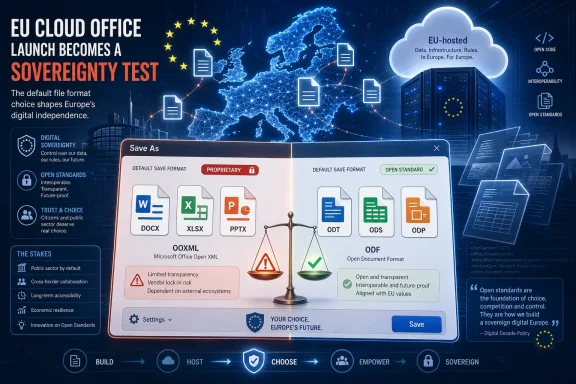
Euro-Office’s practical answer is to meet users where they already are. It promises a cloud-native editing experience, integration into a European software stack, and high compatibility with the document formats that dominate business life: DOCX, XLSX, and PPTX. For procurement officers and IT departments, that sounds less like surrender than survival.
But for The Document Foundation and the LibreOffice camp, the format choice cuts against the premise. If a European suite stores and exchanges work primarily in Microsoft’s format universe, critics argue, then Europe has moved the server without moving the power.
That is why Microsoft formats remain so sticky. The world’s organizations have spent decades accumulating documents whose value depends on the assumption that Office will open them correctly. Even when the formal specification is published, the lived reality of compatibility includes edge cases, historical quirks, undocumented behaviors, font substitutions, macro assumptions, and user expectations trained by Microsoft Office itself.
ODF, the OpenDocument Format, was supposed to answer that lock-in problem by giving governments and users a vendor-neutral standard. LibreOffice’s moral claim rests heavily on that fact. If documents are public records, contracts, budgets, research, or educational material, they should not depend on a single vendor’s product decisions.
Euro-Office’s counterargument is implicit: a sovereign product nobody can deploy at scale is not sovereign in any useful sense. Administrators cannot tell tens of thousands of users that old documents might look different because the new system is philosophically cleaner. Compatibility is not a marketing feature in office software; it is the floor beneath the migration plan.
The sharpest LibreOffice critique is not nostalgia. It is architectural. If the default format remains Microsoft-shaped, then every supposedly independent platform must keep chasing Microsoft’s interpretation of document behavior. The center of gravity remains in Redmond because everyone else is optimizing for fidelity to Redmond.
Yet LibreOffice also exposes the gap Euro-Office is trying to fill. Modern enterprise productivity is increasingly collaborative, browser-based, and tied to cloud storage, permissions, comments, version history, and real-time editing. A desktop-first suite can be excellent and still not be the thing a ministry, university, or distributed company thinks it is buying when it compares itself with Microsoft 365 or Google Workspace.
That is the uncomfortable truth beneath the backlash. LibreOffice represents the open standard ideal more cleanly. Euro-Office appears designed to answer the procurement reality more directly.
A product can be open source but still reinforce a proprietary ecosystem. A service can be hosted in Europe but still depend on standards or interfaces controlled elsewhere. A cloud suite can be governed by European entities but still force users into workflows designed by the incumbent it hopes to replace.
That does not make Euro-Office pointless. It makes the project narrower than its slogan. If Euro-Office reduces reliance on Microsoft’s cloud, identity, licensing bundle, and data processing practices, that matters. If it merely recreates Microsoft Office in European wrapping while preserving OOXML as the default document reality, then it solves one dependency while preserving another.
This is the distinction policymakers often blur. A European alternative to Microsoft 365 can be valuable even if it is not a complete escape from Microsoft’s document legacy. But calling that complete digital sovereignty invites exactly the backlash Euro-Office is now receiving.
That is why Euro-Office’s Microsoft compatibility strategy is rational. Most organizations do not begin with a blank document universe. They begin with archives, templates, contract clauses, reporting macros, grant forms, procurement worksheets, and presentation decks exchanged with suppliers, regulators, citizens, and partner institutions.
A hard pivot to ODF-first purity would make sense if Europe could move as a coordinated bloc. It cannot. Agencies migrate at different speeds. Contractors continue sending DOCX files. Courts, universities, auditors, and multinational suppliers do not all agree to the same format discipline on the same date.
So Euro-Office is betting that the first battle is behavioral, not ideological. Get users into a European-hosted, open-source-adjacent web suite first. Then, perhaps, shift the default format culture later. The risk is that “later” never comes.
The company’s advantage is not only technical. It is organizational inertia. Microsoft 365 is embedded in admin training, support contracts, identity management, document workflows, compliance dashboards, and now Copilot-era AI ambitions. The more complicated the alternative landscape looks, the easier it becomes for risk-averse buyers to renew what they already have.
That is why the Euro-Office fight matters to Windows administrators, even if they never deploy it. The same organizations considering Euro-Office are also negotiating Microsoft licensing, evaluating sovereign cloud promises, managing endpoint fleets, and trying to decide how much of their digital estate should sit inside one vendor’s subscription graph.
For Microsoft customers, this controversy is a reminder that “open source” is not a single migration path. It is a set of trade-offs that can collide with the everyday requirement to keep documents working on Monday morning.
LibreOffice’s freedom is structural. It says the document itself must be liberated first, because everything else follows from that. If the file format is open, durable, and vendor-neutral, then users can choose tools without dragging their institutional memory through a proprietary keyhole.
Euro-Office’s freedom is operational. It says users need an exit ramp from Microsoft’s cloud and licensing ecosystem that does not demand a cultural revolution in document handling. If the alternative feels familiar and preserves existing files, the political project has a chance to survive contact with the help desk.
Both views contain truth. The problem is that only one can be the default. Defaults are where ideology becomes infrastructure.
That plan matters more than launch-day rhetoric. Open-source users are accustomed to imperfect 1.0 releases. They are less forgiving when a project markets itself as sovereign while obscuring who controls the stack, how decisions are made, which standards are privileged, and whether community objections can change the product.
Euro-Office’s supporters should also resist the temptation to dismiss LibreOffice advocates as purists. The open standards argument is not academic in government computing. Public records must outlive vendors, subscriptions, product names, and cloud bundles.
At the same time, LibreOffice’s side should acknowledge that Microsoft compatibility is not a trivial concession made by weak-minded bureaucrats. It is the condition under which many migrations become possible at all. A standard nobody can adopt in the real world becomes a museum piece.
If Euro-Office makes ODF a first-class citizen, documents its compatibility limits honestly, and gives administrators meaningful policy controls over default formats, it could become a pragmatic transition tool. If it keeps OOXML at the center while presenting that arrangement as sovereignty, it will validate LibreOffice’s criticism.
This is where WindowsForum readers should pay attention. Office migrations are rarely all-or-nothing. A Windows shop might keep Microsoft Office for advanced Excel users, test LibreOffice for desktop workloads, deploy Euro-Office-like tools for browser collaboration, and still standardize archival records in ODF or PDF/A. The smart strategy is not brand loyalty; it is dependency mapping.
The bad strategy is pretending that format choice is merely a preference pane. It is a long-term governance decision disguised as a save dialog.
 Europe’s Office Rebellion Starts With a Microsoft-Shaped Compromise
Euro-Office arrives at a moment when “digital sovereignty” has become the phrase every European technology project wants on the brochure. The pitch is simple enough: public agencies, schools, and businesses should not be forced to run their documents, calendars, files, and workflows through American hyperscalers simply because no credible local alternative exists.That is a powerful argument in 2026. Microsoft 365 and Google Workspace are no longer just productivity suites; they are identity layers, collaboration hubs, compliance surfaces, storage platforms, AI delivery channels, and procurement defaults. Replacing them means replacing a great deal more than Word, Excel, and PowerPoint.
Euro-Office’s practical answer is to meet users where they already are. It promises a cloud-native editing experience, integration into a European software stack, and high compatibility with the document formats that dominate business life: DOCX, XLSX, and PPTX. For procurement officers and IT departments, that sounds less like surrender than survival.
But for The Document Foundation and the LibreOffice camp, the format choice cuts against the premise. If a European suite stores and exchanges work primarily in Microsoft’s format universe, critics argue, then Europe has moved the server without moving the power.
The Document Format Is the Battlefield Nobody Escapes
Document formats sound like plumbing until they break. A misplaced table, a mangled spreadsheet formula, a broken presentation layout, or a tracked-change disaster can kill confidence in an office migration faster than any policy paper.That is why Microsoft formats remain so sticky. The world’s organizations have spent decades accumulating documents whose value depends on the assumption that Office will open them correctly. Even when the formal specification is published, the lived reality of compatibility includes edge cases, historical quirks, undocumented behaviors, font substitutions, macro assumptions, and user expectations trained by Microsoft Office itself.
ODF, the OpenDocument Format, was supposed to answer that lock-in problem by giving governments and users a vendor-neutral standard. LibreOffice’s moral claim rests heavily on that fact. If documents are public records, contracts, budgets, research, or educational material, they should not depend on a single vendor’s product decisions.
Euro-Office’s counterargument is implicit: a sovereign product nobody can deploy at scale is not sovereign in any useful sense. Administrators cannot tell tens of thousands of users that old documents might look different because the new system is philosophically cleaner. Compatibility is not a marketing feature in office software; it is the floor beneath the migration plan.
LibreOffice Is Right About Lock-In, but Not Done With the Cloud
LibreOffice has earned its standing in this debate. It is the descendant of a long European open-office lineage, with roots reaching back through OpenOffice.org and StarOffice, and it has spent years doing the unglamorous work of keeping a free desktop office suite viable. Its defenders are not wrong to bristle when a newer project wraps itself in the language of European openness while leaning on Microsoft’s format gravity.The sharpest LibreOffice critique is not nostalgia. It is architectural. If the default format remains Microsoft-shaped, then every supposedly independent platform must keep chasing Microsoft’s interpretation of document behavior. The center of gravity remains in Redmond because everyone else is optimizing for fidelity to Redmond.
Yet LibreOffice also exposes the gap Euro-Office is trying to fill. Modern enterprise productivity is increasingly collaborative, browser-based, and tied to cloud storage, permissions, comments, version history, and real-time editing. A desktop-first suite can be excellent and still not be the thing a ministry, university, or distributed company thinks it is buying when it compares itself with Microsoft 365 or Google Workspace.
That is the uncomfortable truth beneath the backlash. LibreOffice represents the open standard ideal more cleanly. Euro-Office appears designed to answer the procurement reality more directly.
Sovereignty Becomes Fuzzy When Users Expect Microsoft Without Microsoft
The word sovereignty carries too much weight in European tech debates because it tries to describe legal control, geographic hosting, open-source licensing, procurement independence, privacy guarantees, security posture, and industrial policy all at once. Euro-Office benefits from that ambiguity. So do its critics.A product can be open source but still reinforce a proprietary ecosystem. A service can be hosted in Europe but still depend on standards or interfaces controlled elsewhere. A cloud suite can be governed by European entities but still force users into workflows designed by the incumbent it hopes to replace.
That does not make Euro-Office pointless. It makes the project narrower than its slogan. If Euro-Office reduces reliance on Microsoft’s cloud, identity, licensing bundle, and data processing practices, that matters. If it merely recreates Microsoft Office in European wrapping while preserving OOXML as the default document reality, then it solves one dependency while preserving another.
This is the distinction policymakers often blur. A European alternative to Microsoft 365 can be valuable even if it is not a complete escape from Microsoft’s document legacy. But calling that complete digital sovereignty invites exactly the backlash Euro-Office is now receiving.
The Only Migration That Works Is the One Users Barely Notice
Every IT department knows the tyranny of the pilot project. A new office suite can look politically attractive in a ministerial announcement and still die inside the first department that cannot open a spreadsheet template correctly.That is why Euro-Office’s Microsoft compatibility strategy is rational. Most organizations do not begin with a blank document universe. They begin with archives, templates, contract clauses, reporting macros, grant forms, procurement worksheets, and presentation decks exchanged with suppliers, regulators, citizens, and partner institutions.
A hard pivot to ODF-first purity would make sense if Europe could move as a coordinated bloc. It cannot. Agencies migrate at different speeds. Contractors continue sending DOCX files. Courts, universities, auditors, and multinational suppliers do not all agree to the same format discipline on the same date.
So Euro-Office is betting that the first battle is behavioral, not ideological. Get users into a European-hosted, open-source-adjacent web suite first. Then, perhaps, shift the default format culture later. The risk is that “later” never comes.
Microsoft Wins Whenever Alternatives Argue Like Procurement Is Theology
The irony is obvious enough to be painful. Microsoft does not need to defeat every open-source alternative on merit if its competitors split the market into incompatible visions of freedom. One camp says sovereignty begins with standards. Another says sovereignty begins with adoption. Microsoft continues selling the bundle.The company’s advantage is not only technical. It is organizational inertia. Microsoft 365 is embedded in admin training, support contracts, identity management, document workflows, compliance dashboards, and now Copilot-era AI ambitions. The more complicated the alternative landscape looks, the easier it becomes for risk-averse buyers to renew what they already have.
That is why the Euro-Office fight matters to Windows administrators, even if they never deploy it. The same organizations considering Euro-Office are also negotiating Microsoft licensing, evaluating sovereign cloud promises, managing endpoint fleets, and trying to decide how much of their digital estate should sit inside one vendor’s subscription graph.
For Microsoft customers, this controversy is a reminder that “open source” is not a single migration path. It is a set of trade-offs that can collide with the everyday requirement to keep documents working on Monday morning.
The Open-Source Movement Has Two Definitions of Freedom
The Euro-Office fight is best understood as a clash between two freedoms. One is freedom from vendor control at the standards layer. The other is freedom to leave a dominant vendor without breaking business continuity.LibreOffice’s freedom is structural. It says the document itself must be liberated first, because everything else follows from that. If the file format is open, durable, and vendor-neutral, then users can choose tools without dragging their institutional memory through a proprietary keyhole.
Euro-Office’s freedom is operational. It says users need an exit ramp from Microsoft’s cloud and licensing ecosystem that does not demand a cultural revolution in document handling. If the alternative feels familiar and preserves existing files, the political project has a chance to survive contact with the help desk.
Both views contain truth. The problem is that only one can be the default. Defaults are where ideology becomes infrastructure.
Europe Needs a Roadmap, Not a Format Civil War
The obvious path forward is not for Euro-Office to pretend the criticism is irrelevant. It should answer it with governance, not vibes. If OOXML is the default today because migration demands it, the project should say so plainly and publish a credible plan for improving ODF support, exposing format choices clearly, and avoiding a permanent Microsoft-shaped dependency.That plan matters more than launch-day rhetoric. Open-source users are accustomed to imperfect 1.0 releases. They are less forgiving when a project markets itself as sovereign while obscuring who controls the stack, how decisions are made, which standards are privileged, and whether community objections can change the product.
Euro-Office’s supporters should also resist the temptation to dismiss LibreOffice advocates as purists. The open standards argument is not academic in government computing. Public records must outlive vendors, subscriptions, product names, and cloud bundles.
At the same time, LibreOffice’s side should acknowledge that Microsoft compatibility is not a trivial concession made by weak-minded bureaucrats. It is the condition under which many migrations become possible at all. A standard nobody can adopt in the real world becomes a museum piece.
The Real Test Is Whether Euro-Office Can Move the Default
The most generous reading of Euro-Office is that Microsoft format compatibility is a bridge. The least generous reading is that it is a trap painted in European colors. The difference will become visible only in the project’s defaults, governance, and next few releases.If Euro-Office makes ODF a first-class citizen, documents its compatibility limits honestly, and gives administrators meaningful policy controls over default formats, it could become a pragmatic transition tool. If it keeps OOXML at the center while presenting that arrangement as sovereignty, it will validate LibreOffice’s criticism.
This is where WindowsForum readers should pay attention. Office migrations are rarely all-or-nothing. A Windows shop might keep Microsoft Office for advanced Excel users, test LibreOffice for desktop workloads, deploy Euro-Office-like tools for browser collaboration, and still standardize archival records in ODF or PDF/A. The smart strategy is not brand loyalty; it is dependency mapping.
The bad strategy is pretending that format choice is merely a preference pane. It is a long-term governance decision disguised as a save dialog.
The Save Dialog Is Now Europe’s Sovereignty Test
Euro-Office 1.0’s launch shows that Europe’s Microsoft problem is not just a lack of software. It is a lack of agreement about which dependency should be broken first, and how much discomfort users should endure to break it.- Euro-Office’s strongest case is that Microsoft-compatible workflows lower the practical barrier for governments and enterprises trying to leave Microsoft 365 or Google Workspace.
- LibreOffice’s strongest case is that a sovereignty project built around Microsoft’s document formats risks preserving the very lock-in it claims to defeat.
- ODF remains the cleaner long-term standard for public-interest documents, but OOXML remains the unavoidable language of much of today’s business exchange.
- The project’s credibility will depend less on launch claims than on transparent governance, visible ODF investment, and administrator control over default formats.
- Microsoft benefits if European alternatives frame the choice as purity versus usability instead of building a staged migration path that supports both.
References
- Primary source: The Tech Buzz
Published: 2026-06-11T17:48:11.646853
Loading…
www.techbuzz.ai - Related coverage: itpro.com
Loading…
www.itpro.com - Related coverage: windowscentral.com
Loading…
www.windowscentral.com - Related coverage: newsworm.de
Loading…
www.newsworm.de - Related coverage: golem.de
Loading…
www.golem.de - Related coverage: it-sicherheit.de
Loading…
it-sicherheit.de
- Related coverage: it-boltwise.de
Loading…
www.it-boltwise.de - Related coverage: linuxmag.nl
Loading…
linuxmag.nl - Related coverage: overcentral.com
European Tech Alliance Unveils Euro-Office to Rival Microsoft 365
Euro-Office, an open-source office suite by European tech firms, aims to replace Microsoft 365 and Google Docs for digital sovereignty.overcentral.com - Related coverage: computerbild.de
Loading…
www.computerbild.de - Related coverage: gry-online.pl
Loading…
www.gry-online.pl - Related coverage: techtimes.com

Euro-Office Launches Tomorrow: Document Foundation Says OOXML Default Undermines Sovereignty
Euro-Office 1.0 launches June 9 as a free, open-source Microsoft 365 alternative built entirely on European infrastructure. The suite integrates into Nextcloud Hub 26 Spring and supports real-time collaborative editing of DOCX, XLSX, and PPTX files — but The Document Foundation warns its default www.techtimes.com
- Related coverage: pdfsamenvoegen.nl
Loading…
pdfsamenvoegen.nl - Related coverage: techradar.com
Best Microsoft Office alternative of 2026 | TechRadar
Get better features from your office softwarewww.techradar.com - Related coverage: frandroid.com
Loading…
www.frandroid.com