

Europe’s cloud sovereignty debate just moved from policy whitepapers and proof-of-concepts to legally framed, operational contingency planning designed to keep critical services running even if geopolitical pressure tries to pull the plug.
SAP and Microsoft have announced a set of coordinated arrangements with European sovereign cloud initiatives that are explicitly designed to safeguard business continuity, data residency, and operational sovereignty for public-sector and regulated customers across Europe during extreme crises — including military conflict, state-imposed sanctions, and large-scale cyberattacks. The agreements thread together three elements: locally governed sovereign cloud operators (notably SAP’s Delos Cloud and France’s Bleu), contractual and technical contingency rights from Microsoft, and a broader European push toward cloud sovereignty and resiliency that is reshaping procurement choices. This is a tactical response to a growing strategic problem: European organisations increasingly fear that reliance on foreign hyperscalers could create a single point of failure or political lever in times of geopolitical tension. Recent vendor statements and press reports make clear that Microsoft is prepared to provide legal and technical mechanisms — like escrowed code copies and partner access rights — so that local or nationally controlled platforms can continue to run Microsoft-based services in constrained scenarios. At the same time, European partners are accelerating sovereign offerings that promise local governance, operations by nationals, and infrastructure isolated under European jurisdiction.
However, it is not a silver bullet. The approach adds legal complexity, new security responsibilities, and potential cost burdens. It may also cement dependence on particular technology stacks even as it addresses jurisdictional risk. Organisations preparing for a future of recurring geopolitical instability should treat these arrangements as one tool in a broader resilience toolkit: contractual contingency, multi-cloud design, validated exit plans, and a long-term strategy for reducing single-vendor risk where that aligns with business priorities.
For European public bodies and regulated industries, the emerging model is an important advance: it provides a testable, legal framework for continuity that governments and buyers can demand and audit. For CIOs and procurement teams, the immediate tasks are straightforward and urgent: parse the fine print, demand demonstrable operational proof, and build contingency exercises into procurement and risk management cycles. The cloud sovereignty era is no longer an abstract policy debate — it’s a procurement, legal and operational discipline that will determine whether critical services stay online when politics tries to pull the plug.
Source: theregister.com Microsoft-SAP pact aims to keep cloud running in a crisis
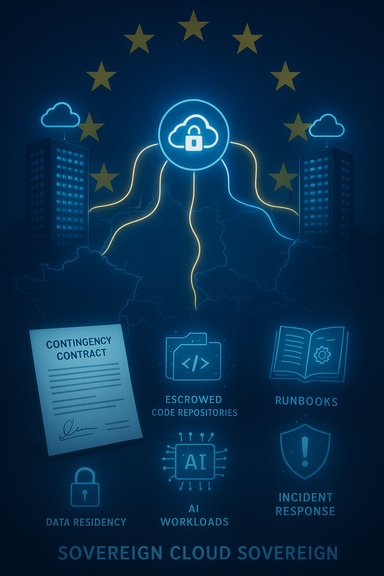 Background / Overview
SAP and Microsoft have announced a set of coordinated arrangements with European sovereign cloud initiatives that are explicitly designed to safeguard business continuity, data residency, and operational sovereignty for public-sector and regulated customers across Europe during extreme crises — including military conflict, state-imposed sanctions, and large-scale cyberattacks. The agreements thread together three elements: locally governed sovereign cloud operators (notably SAP’s Delos Cloud and France’s Bleu), contractual and technical contingency rights from Microsoft, and a broader European push toward cloud sovereignty and resiliency that is reshaping procurement choices. This is a tactical response to a growing strategic problem: European organisations increasingly fear that reliance on foreign hyperscalers could create a single point of failure or political lever in times of geopolitical tension. Recent vendor statements and press reports make clear that Microsoft is prepared to provide legal and technical mechanisms — like escrowed code copies and partner access rights — so that local or nationally controlled platforms can continue to run Microsoft-based services in constrained scenarios. At the same time, European partners are accelerating sovereign offerings that promise local governance, operations by nationals, and infrastructure isolated under European jurisdiction. What the pact actually says (and what it empowers)
Key commitments and capabilities
- Microsoft will support “business continuity” arrangements in Europe by enabling designated national partners to access the necessary software artifacts and operational capabilities to keep critical services running if a court, government order, or extraterritorial sanction were to interrupt Microsoft’s ability to serve a specific customer in Europe. This includes legal rights to use Microsoft cloud software in defined emergency scenarios and technical arrangements such as code repositories and operational handover mechanisms.
- SAP’s Delos Cloud and the French Bleu initiative (the Orange/Capgemini joint venture that runs Microsoft technology under French control) have signed mutual assistance commitments that focus on cross-border crisis cooperation — detection, remediation, and coordinated operational response during extensive emergencies. The two operators say they will work together to enable coordinated migration and continuity for customers whose services are at risk.
- SAP has positioned Delos Cloud as a sovereign platform able to host Microsoft foundational services locally in Germany, and the company is expanding its sovereign cloud investments in Europe to support regulated and public-sector workloads. Microsoft has publicly described similar arrangements for partner-operated sovereign clouds in France and Germany as part of a broader Europe-focused sovereignty portfolio.
What these arrangements enable, in practical terms
- Rapid workload migration or failover from a Microsoft-operated region to a nationally controlled environment that can legally operate and maintain Microsoft-based services in defined emergency conditions.
- Access to code and operational artefacts under controlled legal terms so a sovereign operator can keep services available for customers who cannot be served by Microsoft in a crisis.
- Cross-border technical collaboration between national sovereign cloud platforms (e.g., France’s Bleu and Germany’s Delos Cloud) to provide resilience for customers operating across EU borders.
Why this matters: geopolitics, risk, and procurement
Geopolitical pressure is not an abstract threat
The new arrangements are a direct response to real-world events and demonstrable political risk. High-profile disputes and sanction moves have shown that public institutions and private firms can become collateral in geopolitical fights, prompting migrations away from foreign platforms for sensitive workloads. Recent headline-making decisions by international bodies to move off US-sourced productivity suites and renewed talk of extraterritorial orders have crystallised European buyers’ risk calculus. Those shifts have, in turn, pushed CIOs and procurement teams to treat digital sovereignty and operational resilience as procurement-grade requirements rather than optional preferences. A Gartner survey of Western European CIOs — conducted in mid-2025 — found that 61 percent intend to increase reliance on local or regional cloud providers because of geopolitics, with 53 percent expecting geopolitical factors to restrict future use of global providers. That statistic captures a structural shift: European tech buyers are now actively factoring geopolitical risk into cloud sourcing choices.Procurement and compliance implications
- Public-sector tenders and critical infrastructure contracts increasingly demand demonstrable local control of data and operational staff, requirements traditionally phrased as SecNumCloud, national cloud qualification, or equivalent frameworks.
- The new De-facto “contingency partnership” model blends the innovation and scale of hyperscalers with sovereignty-by-contract and local operational control — a hybrid approach buyers may prefer over pure repatriation or costly bespoke replacement projects.
- Vendors and buyers will need to negotiate and document precisely when contingency powers can be exercised, what constitutes an “emergency,” liability in failover scenarios, and regulatory notification requirements.
How the mechanisms actually work (technical and legal mechanics)
Legal rights and code access
Microsoft’s public documents and partner statements explain two crucial mechanisms that underpin the pact:- Legal access rights: Microsoft will grant partner platforms the contractual right to access or use certain Microsoft code and operational artefacts under strictly defined emergency conditions. The partner’s ability to execute those rights will be governed by pre-existing contractual definitions in the MoU / agreement and by applicable national and EU law.
- Escrowed or backup repositories: Microsoft has committed to storing backup copies of relevant code and configuration artefacts in secure repositories (Microsoft publicly referenced storage locations in Europe/Switzerland as part of its resilience commitments) and to giving partners the right to retrieve and use those artefacts during emergency transitions. This is not a blanket open-source release of code; it is a tightly constrained legal and operational mechanism for continuity.
Operational handover and contingency playbooks
- The arrangements assume pre-agreed runbooks, data transfer processes, and certified operator procedures so that, in a crisis, the partner operator can take over or continue to run the affected services with minimal friction.
- That includes identity and access management handoffs, patching and security update responsibilities, and the ability to audit and verify service continuity for regulators and customers.
- Importantly, the model requires regular testing and exercises to remain credible: dormant contractual rights do not automatically translate into immediate, risk-free operational continuity without rehearsal.
Strengths of the approach
1. Pragmatic compromise between sovereignty and scale
The model recognises that wholesale replacement of mature SaaS stacks or hyperscaler-hosted platforms is economically and operationally prohibitive for many organisations. By enabling local sovereign operators to run Microsoft-based workloads under well-defined emergency rights, the pact offers a practical path to sovereignty without requiring every organisation to rebuild essential productivity and cloud services from the ground up.2. Legally framed contingency planning
Making contingency rights contractual and documented — with backup artefacts and legal definitions of emergency — reduces ambiguity. Governments and regulated customers get enforceable options to keep services running if geopolitical forces threaten availability. That legal clarity matters for procurement officers and boards.3. Cross-border resilience through mutual assistance
The mutual assistance commitment between Bleu and Delos Cloud suggests a model where sovereign clouds cooperate across borders to provide resilience for multinational public-sector workloads. That cooperative, regional approach better reflects how cross-border critical services operate in the EU context.4. Fast path to AI and cloud continuity
SAP and other vendors are explicitly tying sovereign cloud infrastructure to AI offerings and workloads (for example, SAP’s work to support sovereign AI use cases in Germany). This means national operators can provide continuity not only for email and productivity but also for increasingly mission-critical AI workloads.Risks, hidden costs, and governance questions
1. Legal ambiguity and edge cases
The effectiveness of the pact depends heavily on contract wording and judicial contexts. What exactly constitutes an “emergency” or a “government order” can be contested. If a foreign government issues a broad request that Microsoft cannot legally resist, the downstream right to run customers’ workloads under partner access rights might itself be litigated. That introduces legal complexity and potential service disruptions during the litigation window. The devil is in the contractual definitions and dispute-resolution mechanisms.2. Operational complexity and security surface area
Giving a third party the rights to run Microsoft-originated services introduces a complex operational transition with security implications. Partners will need direct, secure access to code, build pipelines, and cryptographic keys in a way that preserves confidentiality and integrity. Every handover or failover expands the attack surface and requires high assurance controls — personnel vetting, secure supply chain verification, and frequent audits.3. Vendor lock-in via alternative means
The arrangement could paradoxically entrench dependence on Microsoft technologies while moving operational control under local governance. In other words, sovereignty-by-contract may substitute one form of dependence (jurisdictional) with another (technology stack). For some buyers, the long-term strategic goal remains true technological autonomy — not sovereignty achieved through legal workarounds.4. Uneven regional capability and cost
Not every European country has the same cloud ecosystem maturity. National partner clouds will require significant capital and skilled staff to operate at hyperscaler scale. Those costs will be passed to customers, and smaller agencies or businesses may face higher bills or limited service choices compared with global hyperscaler options. SAP itself has committed substantial investment in Europe to expand its sovereign capabilities, but scaling this across the continent will be expensive and time-consuming.5. Political signalling and escalation risk
Public agreements that label specific scenarios as "emergencies" could be weaponised politically. A rival government could view the operational handover as a provocation, or pressure the partner operator directly through secondary means. There is also the reputational risk if a sovereign operator becomes a focal point in a larger diplomatic dispute.The buyer’s checklist: what CIOs and procurement officers should demand
When assessing sovereign-continuity offerings and pacts like the Microsoft–SAP–Bleu/Delos arrangements, buyers should insist on concrete, testable assurances.- Precise definitional clauses: Require contract language that clearly defines emergency triggers, the scope of rights granted, time-limited access, and dispute-resolution mechanisms.
- Operational runbooks and exercise reports: Demand evidence of regular failover exercises, independent audits of contingency execution, and verifiable post-exercise remediation plans.
- Security and personnel vetting: Insist on personnel security standards, background checks, and least-privilege controls for any external operator with access rights.
- Data protection guarantees: Ensure data residency, encryption at rest/in transit, and key custody arrangements are documented and aligned with regulatory obligations.
- Transparent liability and insurance: Clarify who bears liability for data breaches, service loss, or regulatory fines during and after a contingency operation.
- Exit and migration plans: Require mechanisms and timelines for reverting to the primary operator or migrating to a third alternative after the emergency has passed.
What this means for the European cloud ecosystem
A hybrid model is emerging
The announcements mark a clear move toward a hybrid sovereignty model: European operators will run and govern locally-hosted services while depending on technology stacks and, in some cases, intellectual property from major hyperscalers. This hybrid path delivers an operational compromise that may accelerate adoption because it avoids the complete costs of re-architecting large estates.Investment and consolidation are likely
Expect further consolidation and strategic partnerships: large systems integrators, telcos, and cloud native players will pair with hyperscalers to offer locally governed stacks. SAP’s own multi-billion euro commitment to sovereign cloud capacity and others’ similar pledges point to multi-year investment cycles.Policy and regulation will follow practice
Governments will need to clarify the legal frameworks for contingency rights, cross-border data transfers in emergencies, and liability allocation. Regulators — at national and EU level — may revise certification and procurement guidelines to incorporate contingency readiness and tested runbooks as part of “sovereignty” credentials.Scenarios: how the pact could play out in practice
Scenario A — A targeted sanctions order limits Microsoft’s ability to serve a public-sector customer
- Pre-existing contractual definitions trigger partner access rights. Delos Cloud or Bleu activates runbooks and operates the affected workloads locally until the legal dispute is resolved or the emergency condition ends.
- The partner uses escrowed artefacts and pre-authorised configuration to run the service without violating data residency or regulatory constraints. Audit trails and regulatory notifications are executed as per the playbook.
Scenario B — A cyberattack disables a regional hyperscaler control plane
- Mutual assistance between Bleu and Delos Cloud allows cross-border mitigation, redistribution of workloads, and coordinated incident response. The legal/access rights are less relevant here; technical resilience and cooperation drive continuity.
Scenario C — Political pressure or reputational attacks drive voluntary migration
- Organisations, fearful of instability, proactively migrate workloads to sovereign providers under standard commercial terms — a migration driven by procurement, not emergency clauses. Here, sovereign operators must demonstrate competitive service, not just contingency credibility.
Caveats and unverifiable elements
- Public announcements by vendors and partner press releases outline legal frameworks and technical commitments, but full contractual texts and operational playbooks are not publicly disclosed. That means independent verification of exact trigger definitions, escrow mechanics, and detailed security controls is limited in the public record. Readers should treat vendor statements as credible expressions of intent and capability, but confirm details through contract reviews and third-party audits before relying on contingency claims as a primary risk control.
- Some contextual narratives — such as the specifics of foreign-government actions that prompted urgency — are drawn from media reporting of discrete incidents and political events. While those reports accurately describe broader geopolitical tensions and examples of organisations moving to European alternatives, the causal attribution between a specific sanction and vendor policy changes can be complex and, in some cases, contested. Where direct causation is alleged, it should be corroborated with primary documentation or legal filings.
Conclusion: pragmatic sovereignty — not a panacea
The Microsoft–SAP–Bleu/Delos model represents a pragmatic, contract-first route to reconcile two competing imperatives: the scale, innovation and services hyperscalers provide, and the legal, operational and political assurances sovereign buyers demand. It is a major step toward making European cloud operations more resilient to political shocks while retaining access to mainstream cloud services and AI capabilities.However, it is not a silver bullet. The approach adds legal complexity, new security responsibilities, and potential cost burdens. It may also cement dependence on particular technology stacks even as it addresses jurisdictional risk. Organisations preparing for a future of recurring geopolitical instability should treat these arrangements as one tool in a broader resilience toolkit: contractual contingency, multi-cloud design, validated exit plans, and a long-term strategy for reducing single-vendor risk where that aligns with business priorities.
For European public bodies and regulated industries, the emerging model is an important advance: it provides a testable, legal framework for continuity that governments and buyers can demand and audit. For CIOs and procurement teams, the immediate tasks are straightforward and urgent: parse the fine print, demand demonstrable operational proof, and build contingency exercises into procurement and risk management cycles. The cloud sovereignty era is no longer an abstract policy debate — it’s a procurement, legal and operational discipline that will determine whether critical services stay online when politics tries to pull the plug.
Source: theregister.com Microsoft-SAP pact aims to keep cloud running in a crisis
