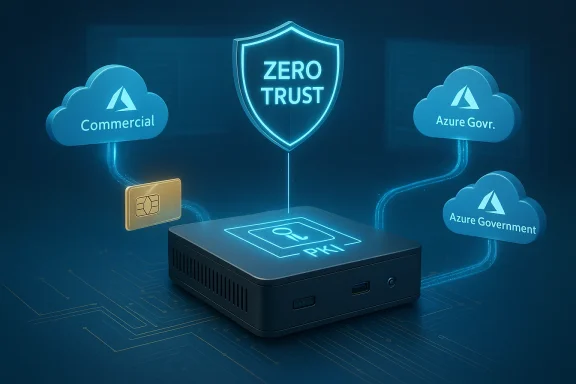
Everfox’s announcement that Microsoft has approved its Trusted Thin Client (TTC) for use across Microsoft Azure clouds marks a significant inflection point for secure multi-classification access in cloud environments, but the declaration raises as many operational and policy questions as it answers. Announced on February 23, 2026, the approval positions TTC as, according to Everfox, the “first Cross Domain multi-tenant Smart Card (SC) Single Sign-On (SSO) software cleared for Azure Commercial, Government, Government Secret and Government Top Secret clouds.” For government and defense organizations wrestling with the twin demands of mission agility and stringent compartmentalized security, the promise is straightforward: one endpoint, many classification levels, and cloud-native integration via Azure Virtual Desktop. For security engineers, procurement officers, and risk managers, the implications are complex—and worth careful scrutiny.
Everfox (formerly Forcepoint Federal) has been a long-standing vendor in the CDS space, and its Trusted Thin Client product family has been widely deployed across DoD, Intelligence Community, and federal civilian agencies. The vendor’s Feb. 23, 2026 announcement frames Microsoft’s endorsement as validation that TTC can now operate across Microsoft’s full range of Azure clouds, including the classified environments built for national security missions.
In short: “approved” is an important commercial and technical milestone, but not a substitute for an agency-level security authorization.
At the same time, the designation should be read as a technical and commercial milestone—not an automatic green light for production at any organization. Agencies and contractors must pursue full accreditation, insist on independent verification and supply-chain assurances, and plan for the operational complexity that cross-domain, multi-tenant solutions introduce.
If the promise is realized—with rigorous engineering, honest disclosure of scope, and careful program-level risk management—Trusted Thin Client integration into Azure could materially accelerate mission modernization. But the margin for error in cross-domain operations is small; decision makers must balance the compelling benefits of consolidated cloud access with the unforgiving requirements of national-security stewardship.
Source: Business Wire https://www.businesswire.com/news/h...verfoxs-Trusted-Thin-Client-for-Azure-Clouds/
 Background
Why this matters now
Over the past decade, U.S. national security agencies, defense contractors, and allied partners have accelerated cloud adoption while simultaneously demanding mechanisms to preserve classification boundaries and strict compartmentalization. Traditional approaches—separate physical machines for secret and unclassified work, or heavy local hardening—don’t scale for a mobile, coalition-enabled force. The result has been growing interest in cross domain solutions (CDS) and virtualized redisplay technologies that enable access to multiple domains from a single endpoint without commingling data.Everfox (formerly Forcepoint Federal) has been a long-standing vendor in the CDS space, and its Trusted Thin Client product family has been widely deployed across DoD, Intelligence Community, and federal civilian agencies. The vendor’s Feb. 23, 2026 announcement frames Microsoft’s endorsement as validation that TTC can now operate across Microsoft’s full range of Azure clouds, including the classified environments built for national security missions.
What Microsoft governs in these clouds
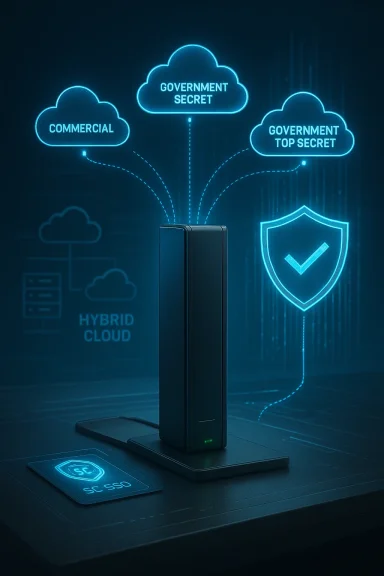
Microsoft’s Azure portfolio includes distinct commercial and government clouds—Azure Commercial, Azure Government, Azure Government Secret, and Azure Government Top Secret—each with progressively more rigorous facility, personnel, and security controls. These environments are designed for different classification levels and customer bases; integration or approval for operation across them is non-trivial and requires close coordination with Microsoft and often with U.S. government authority bodies. Any solution claiming interoperability across this spectrum raises technical, accreditation, and policy questions that must be answered before enterprise or mission deployment.What Everfox announced (the core claims)
- Microsoft has “approved” Everfox’s Trusted Thin Client as a Cross Domain secure access solution for all Azure clouds.
- TTC is described as the first Cross Domain multi-tenant Smart Card SSO solution cleared for Azure Commercial, Government, Government Secret and Government Top Secret clouds.
- TTC integrates with Azure Virtual Desktop and provides:
- Multi-tenant access to multiple Azure tenants from a single endpoint.
- Dynamic, policy-enforced access controls by identity and classification level.
- Cross Domain Smart Card Single Sign-On (SC-SSO) across the named Azure clouds.
- Support for hybrid cloud deployments and Zero Trust isolation to reduce endpoint attack surface.
Parsing “approved”: certification, validation, or marketing designation?
Types of third-party validation in national-security clouds
Before treating any vendor claim as a pass for operational use, practitioners need to understand the specific nature of the vendor–cloud provider “approval.” In the national-security and federal cloud ecosystem, statements about product readiness commonly mean one of several things:- The product has completed a compatibility or integration validation with a cloud service (technical interoperability).
- The product has been authorized by a government accreditation authority (e.g., a formal Authority to Operate (ATO), NCDSMO baseline listing, or FedRAMP authorization).
- The vendor and cloud provider have jointly tested and demonstrated the solution but not necessarily received agency-level ATOs.
- The product is listed in a cloud provider’s partner catalog or marketplace after passing a partner-level vetting process.
What to expect with Everfox’s wording
Everfox’s release uses “Microsoft has approved” and “cleared for Azure clouds.” Those phrases indicate a partnership-led integration and vendor certification from the platform provider’s side. However, they do not necessarily equate to a government ATO for a specific agency environment. Organizations considering TTC will still need to pursue their own accreditation and Authority to Operate (ATO) paths, perform system-level security assessments in their environment, and confirm that the product meets programmatic security baselines (e.g., NCDSMO Raise-the-Bar, DISA IL, or ICD 503/705 as applicable).In short: “approved” is an important commercial and technical milestone, but not a substitute for an agency-level security authorization.
Technical snapshot — what TTC says it delivers
Key technical capabilities claimed
- Hardware-agnostic client: TTC operates without requiring specific proprietary endpoints, enabling deployment to thin clients, ruggedized hardware, virtual machines, or traditional workstations.
- Multi-tenant Azure access: A single endpoint can access multiple Azure tenants securely, with tenant isolation enforced by policy.
- Cross Domain SC Single Sign-On (SC-SSO): Smart Card-based authentication that supports simultaneous access to different classification enclaves in an SSO fashion, reducing credential friction while maintaining separation.
- Integration with Azure Virtual Desktop (AVD): TTC uses AVD to host downstream sessions, leveraging cloud-native virtualization and redisplay technologies to ensure sensitive data never persists on the endpoint.
- Policy-enforced dynamic controls: Adaptive access enforcement tied to identity, device posture, and classification-level policy maps.
- Support for hybrid cloud: TTC is claimed to be operable in fully-clouded, hybrid, and on-prem scenarios to meet mission-specific network architectures.
Where the product fits in a modern Zero Trust posture
Trusted Thin Client’s model aligns with a Zero Trust approach by minimizing data at the endpoint, using strong identity-based authentication (smart cards), and applying fine-grained policy enforcement at the access layer. The design reduces lateral exposure and attempts to convert classification separation into an access-only control enforced by the cloud-hosted session endpoints.Strategic benefits for government and enterprise
- Reduced endpoint sprawl: Eliminates the need for multiple physical devices per user for each classification level, which lowers logistics, hardware costs, and Secure Compartmented Information Facility (SCIF) overhead.
- Faster cloud migration: By simplifying access to multiple tenants and clouds, TTC could accelerate timelines for agencies moving sensitive workloads into Azure environments.
- Improved mission collaboration: Multi-tenant and cross-domain access enables coalition and inter-agency workflows without the usual barriers of physical transfer or manual cross-domain procedures.
- Operational cost savings: Vendor materials reference reduced administration and infrastructure costs, and an independent vendor-commissioned TEI study (as cited by the vendor) claimed substantial ROI for similar deployments—though such studies should be scrutinized for assumptions and scope.
- Better user experience: SC-SSO and centralized session orchestration can reduce user friction, potentially improving secure tool adoption across operatives and analysts.
Critical analysis — strengths and red flags
Notable strengths
- Mission focus and pedigree: Everfox’s history in cross-domain and defense-grade products gives the company domain credibility. The TTC is a mature concept with substantial field deployments in government contexts.
- Cloud-native integration: TTC’s claimed compatibility with Azure Virtual Desktop and the spectrum of Azure government clouds (Secret/Top Secret) is strategically important—cloud providers moving into classified missions must have partner ecosystems to provide operational capabilities.
- Identity-centric security: The emphasis on smart card SSO and policy-driven controls fits established federal identity and access management expectations.
- Flexibility: Hardware-agnostic design and hybrid deployment patterns meet real-world constraints for deployed forces and contractors.
Important risks and open questions
- What exactly does Microsoft’s “approval” cover? Is this a technical interoperability verification, a partner catalog listing, or an endorsement that facilitates agency-level authorization? The distinction matters for procurement and ATO timelines.
- Supply chain and software assurance: As TTC acts as a gateway and arbiter between classification levels, its software and update supply chain become critical. Agencies will require demonstrable software bill-of-materials, secure update mechanisms, and SCRM mitigations.
- Persistent trust boundaries: Any cross-domain capability introduces a transformational change in where control points live. If misconfigured or if policy enforcement fails, it could create a single point of failure across multiple classification levels.
- Integration complexity: Multi-tenant cross-domain operation across Azure tenants and classified clouds will involve complex networking (ExpressRoute/ExpressRoute Direct), identity bridges, and possibly cross-domain guards. The operational burden to set this up securely should not be underestimated.
- Accreditation burden remains with customers: Even with Microsoft’s approval, agencies must perform due diligence and complete their own ATO and risk acceptance processes.
- Third-party validation: Independent third-party assessments (e.g., NSA/CDI baseline verifications, DISA evaluations, or third-party penetration tests) will be essential for confidence. Claims about being the “first” cleared solution are vendor assertions that should be corroborated when possible.
Procurement and compliance considerations
Accreditation and authorization checklist
Agencies and contractors should treat TTC as a high-impact component and work through standard Authorization to Operate (ATO) processes. Minimum checkpoints include:- System Security Plan (SSP) and Control Implementation: Ensure TTC’s architecture and control set is documented against NIST SP 800-53, ICD 503/705, or other applicable baselines.
- Configuration and Hardening Guides: Obtain a vetted configuration guide for operation within Azure Virtual Desktop and Azure Government clouds.
- Supply Chain & SBOM: Require a Software Bill of Materials (SBOM) and secure build / code-signing practices to mitigate supply chain compromise risks.
- Penetration Testing & Red Teaming: Require independent pentests and adversarial simulations that include cross-domain flows.
- Continuous Monitoring: Define logging, SIEM integration, and continuous monitoring expectations, including retention and cross-domain audit controls.
- Incident Response & Forensics: Confirm incident response playbooks for cross-domain incidents and ensure forensics is feasible without breaking classification boundaries.
- Interoperability Tests: Validate smart card types (CAC/PIV/SIPR tokens), SC-SSO behavior, and multi-tenant isolation in a lab that mirrors the production environment.
Contract language and liability
Requestors should include express acceptance criteria about Microsoft’s “approval” scope, define performance SLAs (latency, availability), and articulate liability and breach responsibilities, especially when cross-domain trust relationships are involved.Operational impact and deployment patterns
Typical deployment scenarios
- Consolidated analyst desktop: Remote analysts needing simultaneous access to unclassified and classified tools can use TTC to reduce physical movement between workspaces.
- Coalition operations: Trusted cross-domain access can enable faster information sharing between allied partners, with policy-driven constraints.
- Field-deployable command nodes: Ruggedized endpoints with TTC client capabilities give deployed units a way to access mission data across classification levels without carrying multiple devices.
Performance and user experience factors
Redisplay and remote desktop architectures introduce latency and bandwidth dependencies. Agencies should test AVD backplane performance, smart card latency (especially over high-latency connections), and multi-monitor/graphics use cases that are common in command centers. Vendor claims about improved timelines and reduced complexity need empirical validation in representative environments.Hardening guidance — a practical checklist
- Enforce strict network segmentation and dedicated ExpressRoute circuits for classified Azure tenancy.
- Apply least-privilege access policies and granular conditional access policies for smart card authentication.
- Require endpoint attestation for any device permitted to host TTC clients; integrate with device posture solutions.
- Ensure cryptographic keys and token lifetimes are properly managed, and cache behaviors do not leak classified session artifacts to lower-level endpoints.
- Implement tamper-evident logging and cross-domain audit trails; ensure logs destined for higher classification are handled securely and do not traverse low assurance paths.
- Require regular replay and continuity tests for SC-SSO flows and certificate revocation scenarios.
Economic considerations: cost, ROI, and lifecycle
Everfox and vendor-commissioned studies have argued significant return on investment by reducing hardware, logistical, and administrative overhead. Real-world cost-benefit depends on:- Scale: The more endpoints and classification separations consolidated, the higher the potential ROI.
- Existing investments: Agencies with entrenched legacy separation architectures may face transition costs.
- Support model: On-premise distribution consoles, virtualized host pools, and hybrid networking can add operational staff demands.
- Lifecycle: Ongoing vendor support, patch management, and accreditation maintenance create recurring costs that must be planned into total cost of ownership (TCO).
Recommendations for decision makers
- Treat Microsoft’s designation as a strong technical integration milestone, but require agency-level ATO and independent security assessments prior to production deployment.
- Demand clear documentation of Microsoft’s role in the designation—what tests were run, what scope was validated, and whether Microsoft assumes any operational liability for cross-domain enforcement.
- Require SBOMs, secure build attestations, and robust SCRM controls before granting network integration rights.
- Enforce periodic independent validation (pen tests, red teams) focused on cross-domain flow integrity and SC-SSO resilience.
- Start with pilot programs that replicate operational constraints (bandwidth, multi-monitor, token latency) and include coalition partners if cross-tenant collaboration is a goal.
- Clarify escalation and incident response: cross-domain incidents may require multi-organizational coordination—pre-define the chain of command and notifications.
Broader industry implications
Everfox’s announcement reflects a broader maturation of cloud provider ecosystems for classified workflows. As hyperscalers expand partner networks into Secret and Top Secret cloud spaces, expect:- Increased competition among specialized CDS vendors to integrate with Azure, other hyperscalers, and DoD/IC clouds.
- A rising bar for software assurance and supply chain transparency—authorities will demand SBOMs, reproducible builds, and code-signing attestations.
- Growing emphasis on identity-first designs (smart cards, hardware-backed keys) and decoupling of data storage from user endpoints.
- Policy evolution: accrediting bodies will likely refine guidance for multi-tenant cross-domain products to address new risk vectors.
Conclusion
Microsoft’s approval of Everfox’s Trusted Thin Client for Azure clouds—announced on February 23, 2026—signals a practical step toward consolidated, cloud-native secure access for multi-classification environments. It promises simplified operations, reduced endpoint sprawl, and improved interagency and coalition collaboration when implemented correctly.At the same time, the designation should be read as a technical and commercial milestone—not an automatic green light for production at any organization. Agencies and contractors must pursue full accreditation, insist on independent verification and supply-chain assurances, and plan for the operational complexity that cross-domain, multi-tenant solutions introduce.
If the promise is realized—with rigorous engineering, honest disclosure of scope, and careful program-level risk management—Trusted Thin Client integration into Azure could materially accelerate mission modernization. But the margin for error in cross-domain operations is small; decision makers must balance the compelling benefits of consolidated cloud access with the unforgiving requirements of national-security stewardship.
Source: Business Wire https://www.businesswire.com/news/h...verfoxs-Trusted-Thin-Client-for-Azure-Clouds/