

The Federal Circuit’s Exafer Ltd. v. Microsoft Corp. decision is a meaningful correction to an increasingly common mistake in patent-damages litigation: treating the use of an unaccused product metric as automatically fatal. In a precedential opinion issued on March 6, 2026, the court held that Exafer could rely on Azure virtual machine hours as the royalty base because the record showed a causal connection between the accused networking features and Microsoft’s ability to sell more VM-hours. That distinction mattered enough to revive the case, vacating both the exclusion of the damages expert and the follow-on summary judgment for Microsoft. (law.justia.com)
Patent damages law has long struggled with the tension between economic reality and anti-overreach discipline. On one hand, the law seeks to compensate a patentee for the value of the infringement; on the other, it cannot let a damages model sweep in revenue from products or services that were never actually accused. The Federal Circuit has repeatedly tried to keep that balance intact by insisting on a fact-intensive inquiry rather than bright-line formulas. Exafer fits squarely into that broader fight, but it applies the issue to the cloud-computing stack rather than to a standalone device. (law.justia.com)
The patents at issue, U.S. Patent Nos. 8,325,733 and 8,971,335, concern systems and methods for optimizing communication paths between virtual network devices by controlling data forwarding rules at intelligent switches. In practical terms, the inventions are about network efficiency, not compute virtualization as such. That separation is the key to understanding why the damages dispute became so important: the accused technology allegedly reduced CPU usage, and that reduction allegedly let Azure host more virtual machines on the same infrastructure. (law.justia.com)
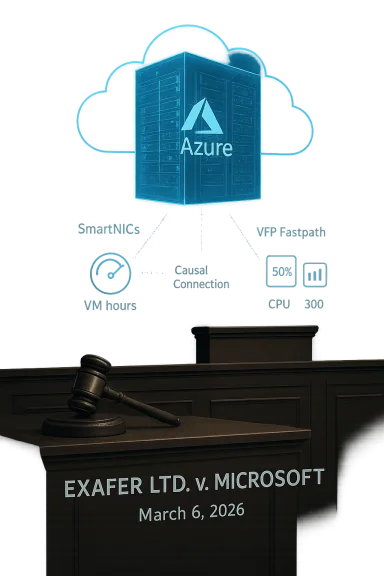
Exafer accused Microsoft’s Azure platform, focusing on SmartNICs and VFP Fastpath. According to the Federal Circuit, Exafer’s technical expert tied those features to measurable CPU gains using Microsoft’s own internal documents, including a presentation showing a 50% improvement for VFP Fastpath and an internal estimate showing roughly 300% CPU improvement for SmartNICs. The damages theory then connected those gains to additional VM capacity, because Azure monetizes service usage by the hour. (law.justia.com)
That setup mattered because the district court viewed the model through the lens of Enplas Display Device Corp. v. Seoul Semiconductor Co. and concluded that the royalty base improperly depended on unaccused virtual machines. The Federal Circuit disagreed, saying the district court had read Enplas too broadly. The appellate court’s core point was that a damages expert is not barred from using an unaccused product in the base when the evidence shows the accused feature contributes to the value of that product. (law.justia.com)
This dispute also reflects a broader trend in patent litigation: modern damages theories increasingly depend on platform economics, not just unit sales. Cloud infrastructure, software-as-a-service, and hybrid workloads often monetize usage rather than discrete hardware units. That makes classic royalty-base debates more complicated, because the “product” being sold may be a service bundle in which the accused feature changes capacity, performance, or cost structure rather than directly generating the sale itself. (law.justia.com)
That is why Exafer’s damages model did not need to prove that virtual machines themselves were infringing. It needed to show that the accused features made VMs more economically valuable to Microsoft. The court found that bridge plausible and sufficiently supported by Microsoft’s own materials and Exafer’s technical testimony. In practical terms, the case stands for the idea that usage-based monetization can be a legitimate yardstick when the patented improvement changes service capacity. (law.justia.com)
The technical evidence also gave the case a more modern feel than older patent-damages disputes over physical products. Instead of arguing about every sale of a standalone chip or appliance, the parties were fighting over the value created by a cloud feature inside a subscription and metered-consumption model. That shift is not merely stylistic; it affects how courts should think about incremental value, apportionment, and the proper royalty base. (law.justia.com)
This is where the case becomes especially relevant to cloud providers. A platform like Azure can monetize one improvement in several different ways: lower operating cost, better performance, higher density, or a greater number of billable workload hours. The court’s reasoning suggests that if the patented feature materially affects one of those business outcomes, the valuation can track that outcome even if it is not the patented thing itself. That is not a free pass, but it is a meaningful refinement. (law.justia.com)
That sequence is important because it shows a damages theory grounded in incremental value, not gross overreach. Courts routinely dislike models that capture profits from unrelated features, but they are much more receptive when the expert can trace the accused technology to a specific business advantage and then value only that advantage. Here, the appellate panel said Blok had done exactly that. (law.justia.com)
The opinion also underscores that technical expert testimony can anchor financial expert testimony. Congdon’s CPU-improvement analysis provided the factual bridge between the patented network optimization and increased VM density. Without that bridge, a VM-hour royalty base might have looked like a naked attempt to sweep in unaccused activity. With the bridge, it looked like an effort to monetize the commercial benefit Microsoft allegedly extracted from the patented technology. (law.justia.com)
That kind of documentary evidence is often decisive in damages fights. When a company’s internal slides, benchmarks, or planning documents describe a feature in economic terms, the patentee can use that framing to support a hypothetical negotiation. In a cloud case, internal materials that tie infrastructure efficiency to customer capacity are especially potent because they help connect engineering changes to revenue mechanics. That is exactly what happened here. (law.justia.com)
The panel’s comparison to method-of-manufacture cases was especially revealing. In those cases, the royalty base may be the unaccused product produced by the patented method. That precedent reflects the reality that a patented process may create value in a separate downstream item. The court saw the Azure model as analogous: the patented networking improvements allegedly enabled more VM-hours, so VM-hours were a logical proxy for the benefit produced by the accused features. (law.justia.com)
This is where the opinion pushes back on an overly mechanical reading of patent-damages law. If a patented feature makes an unaccused service more efficient, the law does not require the expert to pretend the service does not exist. Instead, the expert must isolate the incremental value attributable to the feature. That is a much more nuanced inquiry than the district court’s exclusion order suggested. (law.justia.com)
This distinction is the doctrinal centerpiece of the decision. The court did not repudiate Enplas; it confined it to circumstances where the royalty base is untethered to the accused technology. In other words, Enplas remains a warning against overbroad damages theories, but it is not a blanket prohibition on service-based or downstream bases. (law.justia.com)
That matters for future cases because defendants often invoke Enplas as if it were a universal bar against any model involving a non-accused item. The Federal Circuit rejected that reading. A damages expert may use a base associated with something unaccused if the patented feature changes the economics of that something. The relevant question is causation, not formal category labels. (law.justia.com)
This sequence is a reminder of how fragile no-damages judgments can be when they depend on a contested expert ruling. If the evidentiary foundation falls, the summary judgment often falls with it. That does not mean the plaintiff will ultimately prevail, but it does mean the dispute must be decided on a fuller record. Procedurally, that is a major difference. (law.justia.com)
For litigants, the message is practical: if your damages theory is the only real path to a recovery, then the admissibility of your expert may be outcome-determinative. Conversely, if you are the defendant, it is dangerous to treat a Daubert win as a final victory when the appellate court may view the model as methodologically sound even if aggressive. (law.justia.com)
That said, the decision does not bless speculative math. Plaintiffs still need technical support, business records, and a coherent causal chain. A royalty base that merely feels connected to the accused technology will not survive if the link is conjectural. The opinion is best read as a demand for rigor, not generosity. (law.justia.com)
That puts a premium on internal documentation and counterexpert testimony. If the accused company’s own materials describe efficiency gains, density improvements, or revenue effects from the challenged feature, the defendant may have a harder time arguing the base is irrelevant. In that sense, corporate engineering documents are becoming as important as sales data in damages litigation. (law.justia.com)
The broader market implication is that patented infrastructure improvements may support higher damages theories than companies expected if those improvements can be tied to measurable service output. That is likely to influence litigation strategy, settlement posture, and even product documentation practices. In short, the economics of cloud performance now matter more in court than they once did. (law.justia.com)
That puts rivals in a tricky position. They need strong internal performance analysis to manage their businesses, but that same analysis can become discoverable evidence that supports a plaintiff’s causal theory. In a modern platform economy, the line between engineering telemetry and damages evidence is getting thinner. That is not a reason to stop measuring; it is a reason to be deliberate about how those measurements are framed. (law.justia.com)
The longer-term question is whether this opinion becomes a reference point for a more mature cloud-damages doctrine. If so, future cases will likely focus less on whether an expert used a downstream metric and more on how well the expert proved the patent-feature-to-revenue chain. That shift would be healthy, because it would force both sides to litigate the actual economics rather than argue over formal labels. (law.justia.com)
Source: Vorys The Precedent: Federal Circuit Allows Patent Damages Theory Based on Virtual Machine Usage in Exafer Ltd. v. Microsoft Corp.
 Background
Patent damages law has long struggled with the tension between economic reality and anti-overreach discipline. On one hand, the law seeks to compensate a patentee for the value of the infringement; on the other, it cannot let a damages model sweep in revenue from products or services that were never actually accused. The Federal Circuit has repeatedly tried to keep that balance intact by insisting on a fact-intensive inquiry rather than bright-line formulas. Exafer fits squarely into that broader fight, but it applies the issue to the cloud-computing stack rather than to a standalone device. (law.justia.com)The patents at issue, U.S. Patent Nos. 8,325,733 and 8,971,335, concern systems and methods for optimizing communication paths between virtual network devices by controlling data forwarding rules at intelligent switches. In practical terms, the inventions are about network efficiency, not compute virtualization as such. That separation is the key to understanding why the damages dispute became so important: the accused technology allegedly reduced CPU usage, and that reduction allegedly let Azure host more virtual machines on the same infrastructure. (law.justia.com)
Exafer accused Microsoft’s Azure platform, focusing on SmartNICs and VFP Fastpath. According to the Federal Circuit, Exafer’s technical expert tied those features to measurable CPU gains using Microsoft’s own internal documents, including a presentation showing a 50% improvement for VFP Fastpath and an internal estimate showing roughly 300% CPU improvement for SmartNICs. The damages theory then connected those gains to additional VM capacity, because Azure monetizes service usage by the hour. (law.justia.com)
That setup mattered because the district court viewed the model through the lens of Enplas Display Device Corp. v. Seoul Semiconductor Co. and concluded that the royalty base improperly depended on unaccused virtual machines. The Federal Circuit disagreed, saying the district court had read Enplas too broadly. The appellate court’s core point was that a damages expert is not barred from using an unaccused product in the base when the evidence shows the accused feature contributes to the value of that product. (law.justia.com)
This dispute also reflects a broader trend in patent litigation: modern damages theories increasingly depend on platform economics, not just unit sales. Cloud infrastructure, software-as-a-service, and hybrid workloads often monetize usage rather than discrete hardware units. That makes classic royalty-base debates more complicated, because the “product” being sold may be a service bundle in which the accused feature changes capacity, performance, or cost structure rather than directly generating the sale itself. (law.justia.com)
The Patent and Technology Context
At the center of the appeal is a simple but consequential technical proposition: if a networking improvement frees up compute resources, the platform may be able to serve more customers or serve more workload hours. The Federal Circuit accepted that proposition as a matter of admissible damages methodology, not as an automatic conclusion on ultimate damages. That is a subtle but important distinction, because Rule 702 does not require certainty; it requires a reliable method grounded in the record. (law.justia.com)Why the Technology Matters
The asserted patents were directed to network-path optimization and flow forwarding in virtualized environments. The accused features, SmartNICs and VFP Fastpath, sat in Azure’s network path and allegedly offloaded work from the host CPU. In cloud systems, that sort of optimization can have a direct commercial consequence: less CPU overhead means more customer workloads can be packed onto the same physical machine. (law.justia.com)That is why Exafer’s damages model did not need to prove that virtual machines themselves were infringing. It needed to show that the accused features made VMs more economically valuable to Microsoft. The court found that bridge plausible and sufficiently supported by Microsoft’s own materials and Exafer’s technical testimony. In practical terms, the case stands for the idea that usage-based monetization can be a legitimate yardstick when the patented improvement changes service capacity. (law.justia.com)
The technical evidence also gave the case a more modern feel than older patent-damages disputes over physical products. Instead of arguing about every sale of a standalone chip or appliance, the parties were fighting over the value created by a cloud feature inside a subscription and metered-consumption model. That shift is not merely stylistic; it affects how courts should think about incremental value, apportionment, and the proper royalty base. (law.justia.com)
The Accused Features in Azure
Microsoft’s Azure platform was the alleged infringing environment, and the two accused features were SmartNICs and VFP Fastpath. The Federal Circuit described evidence showing that these features improved CPU usage and, by extension, could increase the number of VMs Azure could host without adding physical infrastructure. That was enough to let the damages expert use VM-hours as the economic expression of the benefit. (law.justia.com)This is where the case becomes especially relevant to cloud providers. A platform like Azure can monetize one improvement in several different ways: lower operating cost, better performance, higher density, or a greater number of billable workload hours. The court’s reasoning suggests that if the patented feature materially affects one of those business outcomes, the valuation can track that outcome even if it is not the patented thing itself. That is not a free pass, but it is a meaningful refinement. (law.justia.com)
The Damages Theory
The damages model was the heart of the appeal, and it was more sophisticated than the district court gave it credit for. Exafer’s expert, Justin Blok, did not simply apply a royalty rate to all Azure VM revenue. Instead, he used Microsoft’s VM-hour pricing as the base, then linked that base to incremental capacity created by the accused networking features. That structure mattered because it attempted to measure the value added by the infringement rather than the value of the entire cloud platform. (law.justia.com)How the Model Worked
Blok started with Microsoft’s total VM-hours sold. He then relied on Dr. Congdon’s technical opinions to estimate how much more VM capacity Microsoft could sell because of the accused features. Finally, he multiplied those incremental VM-hours by Azure’s average price and gross margin to derive an incremental benefit, which he calculated at about $534.3 million or $0.0625 per VM-hour over the damages period. (law.justia.com)That sequence is important because it shows a damages theory grounded in incremental value, not gross overreach. Courts routinely dislike models that capture profits from unrelated features, but they are much more receptive when the expert can trace the accused technology to a specific business advantage and then value only that advantage. Here, the appellate panel said Blok had done exactly that. (law.justia.com)
The opinion also underscores that technical expert testimony can anchor financial expert testimony. Congdon’s CPU-improvement analysis provided the factual bridge between the patented network optimization and increased VM density. Without that bridge, a VM-hour royalty base might have looked like a naked attempt to sweep in unaccused activity. With the bridge, it looked like an effort to monetize the commercial benefit Microsoft allegedly extracted from the patented technology. (law.justia.com)
The Role of Microsoft’s Internal Documents
One of the most persuasive aspects of the record was that Microsoft’s own materials supported the valuation chain. The Federal Circuit cited internal evidence describing VFP Fastpath as improving VFP CPU usage by 50% and a SmartNIC estimate suggesting 300% CPU improvement. Those materials mattered because they showed Microsoft itself thinking about these features in terms of resource savings and capacity gains. (law.justia.com)That kind of documentary evidence is often decisive in damages fights. When a company’s internal slides, benchmarks, or planning documents describe a feature in economic terms, the patentee can use that framing to support a hypothetical negotiation. In a cloud case, internal materials that tie infrastructure efficiency to customer capacity are especially potent because they help connect engineering changes to revenue mechanics. That is exactly what happened here. (law.justia.com)
Why Rule 702 Did Not Bar the Testimony
The district court excluded the expert report under Rule 702, reasoning that the model relied on unaccused VMs. The Federal Circuit held that was too blunt an application of the rule. Expert testimony is not unreliable merely because it uses a royalty base associated with an unaccused product, so long as the base reflects the value of the patented invention in context. (law.justia.com)A Case-by-Case Standard
The Federal Circuit emphasized that damages must be assessed on a case-by-case and fact-specific basis. That statement is easy to quote but hard to operationalize, which is why the court devoted so much attention to the technical and commercial context. The point was not that any unaccused product can serve as a base, but that the relevant question is whether the base captures the economic value of the accused technology. (law.justia.com)The panel’s comparison to method-of-manufacture cases was especially revealing. In those cases, the royalty base may be the unaccused product produced by the patented method. That precedent reflects the reality that a patented process may create value in a separate downstream item. The court saw the Azure model as analogous: the patented networking improvements allegedly enabled more VM-hours, so VM-hours were a logical proxy for the benefit produced by the accused features. (law.justia.com)
This is where the opinion pushes back on an overly mechanical reading of patent-damages law. If a patented feature makes an unaccused service more efficient, the law does not require the expert to pretend the service does not exist. Instead, the expert must isolate the incremental value attributable to the feature. That is a much more nuanced inquiry than the district court’s exclusion order suggested. (law.justia.com)
Distinguishing Enplas
The district court leaned heavily on Enplas, but the Federal Circuit said that case did not create a categorical bar. In Enplas, the problem was that the products included in the royalty base had no causal connection to the accused products, so the model effectively taxed activities outside the infringement. That is different from Exafer, where the evidence linked the accused features to additional VM capacity. (law.justia.com)This distinction is the doctrinal centerpiece of the decision. The court did not repudiate Enplas; it confined it to circumstances where the royalty base is untethered to the accused technology. In other words, Enplas remains a warning against overbroad damages theories, but it is not a blanket prohibition on service-based or downstream bases. (law.justia.com)
That matters for future cases because defendants often invoke Enplas as if it were a universal bar against any model involving a non-accused item. The Federal Circuit rejected that reading. A damages expert may use a base associated with something unaccused if the patented feature changes the economics of that something. The relevant question is causation, not formal category labels. (law.justia.com)
The Summary Judgment Fallout
Once the damages report was excluded, the district court entered summary judgment for Microsoft based on the purported absence of a remedy. The Federal Circuit’s reversal on admissibility necessarily unraveled that judgment. If the damages testimony was improperly excluded, then the conclusion that Exafer had no viable remedy could not stand. (law.justia.com)Why the Remedy Issue Collapsed
The remedy ruling was entirely derivative of the evidentiary ruling. That made the appellate outcome straightforward once the court found an abuse of discretion under Rule 702. Without the exclusion, Exafer still had a path to prove damages, and without a damages collapse, there was no basis for treating the case as remediless. (law.justia.com)This sequence is a reminder of how fragile no-damages judgments can be when they depend on a contested expert ruling. If the evidentiary foundation falls, the summary judgment often falls with it. That does not mean the plaintiff will ultimately prevail, but it does mean the dispute must be decided on a fuller record. Procedurally, that is a major difference. (law.justia.com)
For litigants, the message is practical: if your damages theory is the only real path to a recovery, then the admissibility of your expert may be outcome-determinative. Conversely, if you are the defendant, it is dangerous to treat a Daubert win as a final victory when the appellate court may view the model as methodologically sound even if aggressive. (law.justia.com)
Implications for Patent Damages Practice
Exafer is likely to be cited far beyond the cloud-computing niche because it addresses a recurring issue in patent damages: when may the royalty base be something other than the directly accused product? The answer the court gives is not “never,” and that alone makes the case significant. The decision gives plaintiffs more room to use downstream metrics, usage measures, or platform-level economics when those metrics correspond to the value of the patented improvement. (law.justia.com)For Plaintiffs
For patentees, the opinion is a roadmap for building a more defensible damages theory. The opinion rewards careful linkage between the claimed invention, the accused feature, and the commercial metric used as the base. If you can show that the feature improves capacity, reduces cost, or increases throughput in a way the accused company itself monetizes, you may be able to justify a broader economic base. (law.justia.com)That said, the decision does not bless speculative math. Plaintiffs still need technical support, business records, and a coherent causal chain. A royalty base that merely feels connected to the accused technology will not survive if the link is conjectural. The opinion is best read as a demand for rigor, not generosity. (law.justia.com)
For Defendants
For accused infringers, Exafer is a warning that a damages challenge must attack the causal chain, not just the label on the base. It will no longer be enough to say “the expert used an unaccused product, so the model is invalid.” Instead, defendants will need to show that the product or service metric has no reliable connection to the patented technology or that the expert failed to isolate the incremental value. (law.justia.com)That puts a premium on internal documentation and counterexpert testimony. If the accused company’s own materials describe efficiency gains, density improvements, or revenue effects from the challenged feature, the defendant may have a harder time arguing the base is irrelevant. In that sense, corporate engineering documents are becoming as important as sales data in damages litigation. (law.justia.com)
For Cloud and SaaS Markets
Cloud and SaaS providers should pay special attention because their revenue models are often usage-driven. VM-hours, compute units, storage consumption, and transaction volumes all function as monetization proxies for technical efficiency. That makes the Exafer framework especially transferable to disputes involving platform features that increase utilization rather than create discrete standalone products. (law.justia.com)The broader market implication is that patented infrastructure improvements may support higher damages theories than companies expected if those improvements can be tied to measurable service output. That is likely to influence litigation strategy, settlement posture, and even product documentation practices. In short, the economics of cloud performance now matter more in court than they once did. (law.justia.com)
Strengths and Opportunities
Exafer’s biggest strength is that it gives the Federal Circuit a clean way to modernize damages law without abandoning core apportionment principles. It recognizes the reality of cloud monetization while still demanding a causal link between invention and value. That balance should make the opinion attractive to judges who want flexibility without a return to sprawling royalty theories.- It rejects a categorical ban on unaccused royalty bases.
- It reinforces the importance of incremental value.
- It gives plaintiffs a stronger framework for cloud and SaaS damages.
- It confirms that internal company documents can anchor economic valuation.
- It aligns Rule 702 with economic reality, not labels.
- It preserves the defendant’s ability to challenge causation and apportionment.
- It offers a workable bridge between technical efficiency and commercial benefit.
Risks and Concerns
The decision is helpful, but it also carries obvious risks if later courts stretch it beyond its facts. A more permissive reading could encourage plaintiffs to dress up broad platform revenue as “incremental” benefit, and that would undermine the apportionment discipline the Federal Circuit has spent years trying to preserve.- Litigants may overread the case as permission to use almost any usage metric.
- Courts may face harder fights over what counts as a sufficient causal connection.
- Defendants may see more pressure to settle when damages models become harder to exclude.
- Cloud revenue models can blur the line between feature value and platform value.
- Experts may present highly technical models that are difficult for juries to evaluate.
- The decision may increase discovery battles over internal benchmarking data.
- There is a risk that incremental value becomes a slogan rather than a constraint.
The Competitive and Industry Angle
The competitive dimension of Exafer is just as important as the legal one. Microsoft is not alone in offering cloud services where infrastructure efficiency translates directly into sellable capacity. The same logic can apply to competitors like AWS, Google Cloud, and other hyperscalers that monetize usage, throughput, and density. That means the case could influence not only litigation but also how cloud vendors measure internal feature ROI. (law.justia.com)Why Rivals Should Care
When a platform feature improves utilization, the company may internally celebrate the engineering win as a cost reduction or capacity gain. Exafer suggests those same internal metrics may later become evidence of damages. The better a company can quantify the commercial effect of a feature, the more ammunition it may hand to a patentee in future litigation. (law.justia.com)That puts rivals in a tricky position. They need strong internal performance analysis to manage their businesses, but that same analysis can become discoverable evidence that supports a plaintiff’s causal theory. In a modern platform economy, the line between engineering telemetry and damages evidence is getting thinner. That is not a reason to stop measuring; it is a reason to be deliberate about how those measurements are framed. (law.justia.com)
Looking Ahead
The most immediate question is what happens on remand. The Federal Circuit did not decide the merits of infringement or the final damages amount; it simply held that Exafer deserved a fair chance to present its valuation theory. That means the district court will still have to sort out the evidentiary record, any remaining expert disputes, and the eventual battle over what royalty rate, if any, is appropriate. (law.justia.com)The longer-term question is whether this opinion becomes a reference point for a more mature cloud-damages doctrine. If so, future cases will likely focus less on whether an expert used a downstream metric and more on how well the expert proved the patent-feature-to-revenue chain. That shift would be healthy, because it would force both sides to litigate the actual economics rather than argue over formal labels. (law.justia.com)
- Expect more disputes over usage-based royalty bases.
- Expect defendants to lean harder on causation gaps rather than category labels.
- Expect plaintiffs to highlight internal capacity and efficiency documents.
- Expect cloud and SaaS cases to borrow from this framework.
- Expect appellate courts to keep refining the boundary between incremental value and overreach.
Source: Vorys The Precedent: Federal Circuit Allows Patent Damages Theory Based on Virtual Machine Usage in Exafer Ltd. v. Microsoft Corp.
