

Exchange Online’s High Volume Email feature has reached General Availability, marking an important shift for organizations that need to send large amounts of internal email from applications, devices, and line-of-business systems without tripping the familiar Exchange sending ceilings. Microsoft has spent more than a year refining the service in Public Preview, tightening the feature’s scope, and clarifying where it fits inside the broader Microsoft 365 messaging stack. The result is a more clearly defined offering that is not a general bulk-mail platform, but a dedicated internal automation channel with its own authentication model, reporting, and operational limits.
The timing matters. Microsoft had previously signaled that HVE’s GA target would move to March 2026, while also adjusting the feature’s direction toward internal recipients and away from external delivery. That makes the GA milestone less of a surprise than a confirmation that Microsoft has settled on the product’s real job: to support machine-generated mail without turning Exchange Online into a bulk marketing service. The official documentation now describes HVE as a purpose-built option for payroll, IT alerts, device mail, compliance notices, and similar workloads.
High Volume Email did not emerge in a vacuum. For years, Exchange Online has maintained recipient rate limits, message-rate throttles, and other anti-abuse controls designed to protect tenant health and service reliability. Microsoft has repeatedly said that Exchange Online is not intended for bulk or high-volume transactional email, especially to external recipients, and the company has nudged customers toward third-party bulk providers or Azure Communication Services for outward-facing campaigns. HVE is Microsoft’s attempt to offer a sanctioned exception for internal automation without undermining those guardrails.
That distinction is important because the Exchange ecosystem has been under mounting pressure from two directions. On one side, administrators have needed a modern replacement for brittle SMTP relay patterns and app passwords. On the other, Microsoft has been tightening abuse controls across Exchange Online, including outbound recipient limits and anti-spam policy changes. HVE sits in the middle: it gives enterprises a better tool for legitimate operational email, but it also preserves Microsoft’s stance that bulk commercial mail is not Exchange’s role.
The public preview history explains much of the current shape of the feature. Microsoft launched HVE preview in April 2024, later expanded support for OAuth, and then moved the GA target to March 2026 while promising pricing details before release. By May 2025, Microsoft had already reframed the service around exclusively internal recipients and said external sending would be removed later that June. The GA announcement is therefore the culmination of a staged repositioning, not merely a status change.
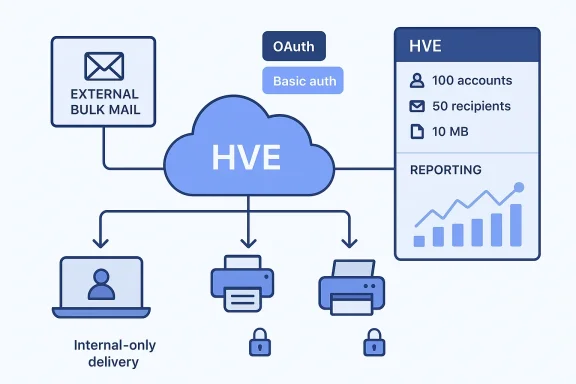
What administrators get now is a more disciplined service boundary. The documentation says HVE supports internal tenant recipients only, allows up to 100 HVE accounts per tenant, supports up to 50 recipients per message, and uses a dedicated SMTP endpoint rather than the standard Exchange Online submission path. It also supports both OAuth and basic authentication, although Microsoft clearly prefers OAuth and has built the service so it can operate even when SMTP client authentication is disabled elsewhere in the tenant.
It also reduces operational ambiguity. When a system sends mail from a human user account, the result can be confusing for compliance teams and for help desks trying to understand whether the sender was a real person or an automated process. HVE gives those workflows an identity class that is easier to recognize and govern. That is a subtle improvement, but one that matters at enterprise scale.
The documentation’s definition is also revealing because it frames HVE as part of the Microsoft 365 internal messaging story rather than as a separate email delivery platform. That means Microsoft can keep the service under Exchange Online governance while still carving out a special lane for applications. In other words, HVE is not a departure from Exchange policy; it is a controlled exception inside it.
That design also serves Microsoft’s broader platform strategy. The company can preserve Exchange Online’s reliability posture while keeping customers inside the Microsoft stack for internal operational traffic. At the same time, Microsoft points external bulk scenarios toward Azure Communication Services for email, which reinforces a cleaner product boundary across the portfolio. That is very much a platform-management decision as much as a feature decision.
That also explains why the service’s authentication story mattered so much. Microsoft added OAuth support during preview and documented how HVE can work with modern authentication even when some other SMTP paths are disabled. That was more than a security checkbox; it was a signal that HVE was meant to survive Exchange’s broader retirement of legacy auth patterns.
The change is strategically consistent with Exchange Online’s evolving policy direction. Microsoft has been deprecating Basic authentication in multiple protocols and pushing customers toward modern auth, while simultaneously keeping a small number of legacy-compatible lanes alive where necessary. HVE’s support for both OAuth and basic auth looks less like indecision and more like transitional engineering.
Microsoft’s broader messaging suggests it wants to keep customers inside the Exchange family while avoiding unsupported bulk-mail behavior. That means pricing likely has to do two jobs at once: encourage migration off fragile legacy mechanisms and avoid undercutting the boundary between Exchange Online and external email services. The company appears to be trying to price for legitimacy rather than raw throughput.
Enterprise buyers should also read the pricing discussion as a hint about product positioning. When Microsoft makes a feature available without assigning it normal mailbox licensing, it is often signaling that the service is intended to scale with operational need, not with employee count. That makes HVE conceptually closer to an infrastructure utility than to a standard collaboration license.
Basic authentication’s continued availability is more of a compatibility bridge than a strategic endorsement. Microsoft has already announced the broader retirement of basic auth for SMTP client submission, so any feature that still relies on basic auth is inherently living on borrowed time. HVE’s explicit support for OAuth is therefore not optional polish; it is part of the service’s long-term survival plan.
There is also an architectural nuance here. HVE uses a dedicated SMTP endpoint, and Microsoft says it can still authenticate even when
Those numbers matter because they tell you what class of workloads HVE is really meant for. The service is clearly designed to handle many messages, but not to behave like a mass distribution platform for large, externally routed announcements. Microsoft is optimizing for operational broadcast patterns, not for newsletter-scale campaigns.
It is also notable that HVE accounts cannot be used in distribution lists or mail-enabled security groups, and they do not have mailboxes that receive mail normally. Replies must be handled through a Reply-To mechanism pointed at an ordinary mailbox. That keeps the service firmly in the category of outbound automation.
That tradeoff is smart from Microsoft’s point of view, because a fully open-ended bulk mail feature would create a support nightmare. By narrowing the recipient scope and message size, Microsoft limits the edge cases while still addressing the workload class that customers actually complained about. It is a classic platform compromise: useful enough to adopt, constrained enough to govern.
The reporting story also helps. Microsoft provides an HVE usage report in the Exchange admin center with recipient and message volume views over multiple time windows. That gives IT teams a clearer way to identify heavy senders, justify capacity planning, and detect anomalous behavior before it turns into a service issue. Better observability is often the hidden value of a feature like this.
Enterprises will also appreciate the separation between machine mail and employee mail. When HVE is used correctly, a company can stop pretending that automated notifications are personal correspondence. That small conceptual shift can improve everything from incident response to compliance review.
At the same time, small businesses should not mistake HVE for a general outbound mail solution. Microsoft’s documentation is quite explicit that external delivery is unsupported and that legitimate bulk commercial email should go to third-party services. That means HVE solves the internal operational problem, not the customer-marketing problem.
There is also a cost-control angle. If Microsoft’s pricing lands sensibly, HVE could offer small and midsize organizations a better balance between capability and overhead than third-party relay platforms that were overkill for limited internal workflows. If pricing is not favorable, those customers may simply keep doing what they do today.
Azure Communication Services for email becomes the obvious companion service in Microsoft’s portfolio. By steering external high-volume scenarios there, Microsoft can keep Exchange Online focused on tenant-internal workflows while still offering a native cloud path for outward-facing communications. That portfolio separation is elegant, and it may be exactly what enterprise buyers wanted all along.
The broader competitive implication is that Microsoft is formalizing a layered messaging architecture: Exchange for collaboration and internal automation, ACS for external communications, and third-party providers for highly specialized bulk-mail operations. That is a cleaner story than the previous blend of SMTP relay, shared mailboxes, and ad hoc application accounts.
The opportunity space is wider than the feature description suggests. HVE could become the default internal notification layer for organizations that standardize on Microsoft 365, especially if Microsoft keeps improving administration, reporting, and OAuth handling. If the pricing is reasonable, adoption could accelerate quickly among tenants that want to retire legacy relay patterns.
Another concern is credential and identity management. HVE accounts are service identities, and service identities are often where organizations get lazy. If admins reuse passwords, fail to rotate secrets, or allow too many teams to share the same account, the service could become a governance weak point rather than a simplification. That risk is familiar, but it is no less real here.
The other thing to watch is whether Microsoft continues to narrow or formalize adjacent mail paths. Exchange Online’s outbound policies have become more restrictive, not less, and HVE is part of that broader pattern. If Microsoft keeps separating human mail, machine mail, and external bulk mail into distinct products, administrators will gain clarity—but they will also need to manage a more segmented messaging estate. That tradeoff is likely here to stay.
Source: Microsoft Exchange Team Blog High Volume Email reaches General Availability in Exchange Online | Microsoft Community Hub
The timing matters. Microsoft had previously signaled that HVE’s GA target would move to March 2026, while also adjusting the feature’s direction toward internal recipients and away from external delivery. That makes the GA milestone less of a surprise than a confirmation that Microsoft has settled on the product’s real job: to support machine-generated mail without turning Exchange Online into a bulk marketing service. The official documentation now describes HVE as a purpose-built option for payroll, IT alerts, device mail, compliance notices, and similar workloads.
 Overview
High Volume Email did not emerge in a vacuum. For years, Exchange Online has maintained recipient rate limits, message-rate throttles, and other anti-abuse controls designed to protect tenant health and service reliability. Microsoft has repeatedly said that Exchange Online is not intended for bulk or high-volume transactional email, especially to external recipients, and the company has nudged customers toward third-party bulk providers or Azure Communication Services for outward-facing campaigns. HVE is Microsoft’s attempt to offer a sanctioned exception for internal automation without undermining those guardrails.That distinction is important because the Exchange ecosystem has been under mounting pressure from two directions. On one side, administrators have needed a modern replacement for brittle SMTP relay patterns and app passwords. On the other, Microsoft has been tightening abuse controls across Exchange Online, including outbound recipient limits and anti-spam policy changes. HVE sits in the middle: it gives enterprises a better tool for legitimate operational email, but it also preserves Microsoft’s stance that bulk commercial mail is not Exchange’s role.
The public preview history explains much of the current shape of the feature. Microsoft launched HVE preview in April 2024, later expanded support for OAuth, and then moved the GA target to March 2026 while promising pricing details before release. By May 2025, Microsoft had already reframed the service around exclusively internal recipients and said external sending would be removed later that June. The GA announcement is therefore the culmination of a staged repositioning, not merely a status change.
What administrators get now is a more disciplined service boundary. The documentation says HVE supports internal tenant recipients only, allows up to 100 HVE accounts per tenant, supports up to 50 recipients per message, and uses a dedicated SMTP endpoint rather than the standard Exchange Online submission path. It also supports both OAuth and basic authentication, although Microsoft clearly prefers OAuth and has built the service so it can operate even when SMTP client authentication is disabled elsewhere in the tenant.
What HVE Actually Is
HVE is best understood as a specialized mailbox-like construct for automation, not as a lightweight user mailbox. Microsoft’s documentation says HVE accounts are dedicated objects for application and device-generated email, intended to keep these messages separate from human mailboxes and to reduce the risk that operational traffic affects ordinary users. That separation is one of the feature’s core value propositions, because it gives administrators a clearer boundary for permissions, logging, and troubleshooting.A service for machines, not people
The practical use cases are familiar: payroll notices, HR workflows, service-desk notifications, printer alerts, security warnings, and line-of-business systems that need to email employees at scale. These are the kinds of messages that can become painful when routed through a normal user mailbox, where rate limits and throttling can cause delays, retry loops, or unpredictable delivery. HVE exists to make those workloads boring, which in infrastructure terms is a compliment.It also reduces operational ambiguity. When a system sends mail from a human user account, the result can be confusing for compliance teams and for help desks trying to understand whether the sender was a real person or an automated process. HVE gives those workflows an identity class that is easier to recognize and govern. That is a subtle improvement, but one that matters at enterprise scale.
The documentation’s definition is also revealing because it frames HVE as part of the Microsoft 365 internal messaging story rather than as a separate email delivery platform. That means Microsoft can keep the service under Exchange Online governance while still carving out a special lane for applications. In other words, HVE is not a departure from Exchange policy; it is a controlled exception inside it.
Why Microsoft built it
Microsoft built HVE because administrators needed a first-party path between ordinary mailbox sending and full external email services. Exchange Online limits have long discouraged bulk dispatch, and Microsoft has repeatedly recommended that legitimate bulk commercial mail go through providers built for that purpose. HVE addresses the internal-only part of the problem while avoiding the slippery slope of turning Exchange into a marketing engine.That design also serves Microsoft’s broader platform strategy. The company can preserve Exchange Online’s reliability posture while keeping customers inside the Microsoft stack for internal operational traffic. At the same time, Microsoft points external bulk scenarios toward Azure Communication Services for email, which reinforces a cleaner product boundary across the portfolio. That is very much a platform-management decision as much as a feature decision.
The Road to General Availability
The GA result was preceded by several public pivots. In preview, HVE was originally described as supporting large volumes of email and even some external delivery, but Microsoft later tightened the service definition and removed that ambiguity. The May 2025 update is especially important because it set the directional expectations that the GA release now follows: internal-only messaging, expanded account limits, and no recipient rate limit.From preview feature to product line
Public Preview features often change, but HVE’s evolution was unusually instructive because Microsoft used the preview period to clarify the product’s purpose. Rather than expanding into a broader outbound email platform, the service got narrower and more opinionated. That suggests Microsoft observed real customer demand for internal automation and concluded that the strongest version of the feature was the most constrained version.That also explains why the service’s authentication story mattered so much. Microsoft added OAuth support during preview and documented how HVE can work with modern authentication even when some other SMTP paths are disabled. That was more than a security checkbox; it was a signal that HVE was meant to survive Exchange’s broader retirement of legacy auth patterns.
The change is strategically consistent with Exchange Online’s evolving policy direction. Microsoft has been deprecating Basic authentication in multiple protocols and pushing customers toward modern auth, while simultaneously keeping a small number of legacy-compatible lanes alive where necessary. HVE’s support for both OAuth and basic auth looks less like indecision and more like transitional engineering.
Timeline of the shift
A useful way to read the history is as a series of narrowing commitments:- Preview launched with broad “high volume” messaging language.
- Microsoft added OAuth and richer admin-center handling.
- Microsoft moved the GA target to March 2026.
- Microsoft reaffirmed that HVE would become internal-only.
- GA now formalizes that direction.
Pricing, Licensing, and What Microsoft Is Signaling
The announcement that sparked this discussion explicitly said pricing would be covered in the Microsoft 365 Blog post, which is significant because pricing shapes whether a feature becomes a niche utility or a mainstream operational standard. Microsoft’s documentation, meanwhile, makes clear that HVE accounts themselves do not require licenses and should not be treated like regular user mailboxes. That lowers friction, but it also suggests Microsoft wants adoption to be driven by workload fit rather than by seat-based packaging.Why pricing matters more than it first appears
If HVE is priced in a way that aligns with system workload usage, it could become a practical default for enterprise application email. If it is priced too aggressively, customers may stick with older relay patterns, especially in environments where internal mail volume is high but not mission-critical. Pricing will therefore determine whether HVE feels like a foundational capability or a specialist add-on. That distinction will matter a lot to large IT departments.Microsoft’s broader messaging suggests it wants to keep customers inside the Exchange family while avoiding unsupported bulk-mail behavior. That means pricing likely has to do two jobs at once: encourage migration off fragile legacy mechanisms and avoid undercutting the boundary between Exchange Online and external email services. The company appears to be trying to price for legitimacy rather than raw throughput.
Enterprise buyers should also read the pricing discussion as a hint about product positioning. When Microsoft makes a feature available without assigning it normal mailbox licensing, it is often signaling that the service is intended to scale with operational need, not with employee count. That makes HVE conceptually closer to an infrastructure utility than to a standard collaboration license.
Licensing implications for admins
The absence of a standard mailbox license requirement is attractive, but it also means admins need to be careful about identity governance. HVE accounts are mail-enabled objects, not human user mailboxes, so they should be treated like service identities with restricted privileges and explicit ownership. The operational convenience is real, but so is the need for policy discipline.Authentication and Security Posture
Security is the most consequential part of HVE’s design. Microsoft supports both OAuth and basic authentication, but the documentation plainly recommends OAuth when possible. That matters because the entire Exchange Online ecosystem has been moving away from legacy auth, and the HVE service must fit into a world where security defaults, authentication policies, and app permissions are taken seriously.OAuth versus Basic Authentication
OAuth gives HVE a more future-proof identity model, particularly in organizations that have already disabled basic authentication or adopted stricter Entra ID controls. Microsoft documents that Security Defaults can disable basic auth, which would make OAuth the only workable path in those tenants. That means HVE can serve modern environments without forcing them to reopen older auth methods globally.Basic authentication’s continued availability is more of a compatibility bridge than a strategic endorsement. Microsoft has already announced the broader retirement of basic auth for SMTP client submission, so any feature that still relies on basic auth is inherently living on borrowed time. HVE’s explicit support for OAuth is therefore not optional polish; it is part of the service’s long-term survival plan.
There is also an architectural nuance here. HVE uses a dedicated SMTP endpoint, and Microsoft says it can still authenticate even when
SMTPClientAuthenticationDisabled is set in transport configuration. That means Microsoft is preserving a tightly bounded path for HVE without reopening the entire standard SMTP submission surface. That is a careful security compromise, not a rollback.Security implications
The security posture creates several practical benefits:- HVE traffic can be isolated from standard user mailboxes.
- OAuth allows modern identity governance.
- Service accounts can be limited to specific workloads.
- Administrators can apply custom authentication policies where needed.
- Tenant-wide SMTP settings do not have to be loosened broadly.
- Security Defaults can remain enabled in environments that use OAuth only.
Limits, Constraints, and Design Tradeoffs
The GA documentation makes a point of telling customers what HVE is not. It is not external bulk mail, it is not a mailbox for human use, and it is not a limitless firehose for any kind of messaging. Even though the feature removes recipient rate and message-rate ceilings for internal mail, Microsoft still keeps boundaries around account count, recipient count per message, concurrency, and message size.The important numbers
The most relevant published limits are straightforward. HVE supports up to 100 HVE accounts per tenant, up to 50 recipients per message, a 10 MB maximum message size, and internal recipients only. Microsoft also documents connection ceilings of up to 100 concurrent connections per IP address or 250 authenticated connections per tenant.Those numbers matter because they tell you what class of workloads HVE is really meant for. The service is clearly designed to handle many messages, but not to behave like a mass distribution platform for large, externally routed announcements. Microsoft is optimizing for operational broadcast patterns, not for newsletter-scale campaigns.
It is also notable that HVE accounts cannot be used in distribution lists or mail-enabled security groups, and they do not have mailboxes that receive mail normally. Replies must be handled through a Reply-To mechanism pointed at an ordinary mailbox. That keeps the service firmly in the category of outbound automation.
Why the constraints are intentional
These constraints reduce abuse risk and prevent HVE from becoming a shadow marketing system. Microsoft has spent years tightening Exchange Online limits to protect service health and reduce unfair usage, and HVE’s design reflects that broader policy. The service is generous in one dimension—internal volume—but strict in all the dimensions that might make it drift toward misuse.That tradeoff is smart from Microsoft’s point of view, because a fully open-ended bulk mail feature would create a support nightmare. By narrowing the recipient scope and message size, Microsoft limits the edge cases while still addressing the workload class that customers actually complained about. It is a classic platform compromise: useful enough to adopt, constrained enough to govern.
Enterprise Impact
For enterprise IT, HVE’s GA status is most valuable as a replacement for awkward legacy patterns. Organizations that have been relying on shared mailboxes, SMTP relays, or overloaded user accounts for application email now have a cleaner native option inside Exchange Online. That can simplify audit trails, reduce configuration drift, and make lifecycle management easier for service identities.Migration and operational cleanup
The biggest enterprise win may be consolidation. Instead of running multiple patched-together mail pathways, administrators can centralize internal transactional email around HVE accounts and manage them in the Exchange admin center or via PowerShell. That creates a more consistent administrative experience, especially for larger tenants with many internal systems.The reporting story also helps. Microsoft provides an HVE usage report in the Exchange admin center with recipient and message volume views over multiple time windows. That gives IT teams a clearer way to identify heavy senders, justify capacity planning, and detect anomalous behavior before it turns into a service issue. Better observability is often the hidden value of a feature like this.
Enterprises will also appreciate the separation between machine mail and employee mail. When HVE is used correctly, a company can stop pretending that automated notifications are personal correspondence. That small conceptual shift can improve everything from incident response to compliance review.
Checklist for deployment
Before rolling HVE into production, admins should:- Identify the internal workloads that genuinely need high-volume email.
- Decide whether OAuth or basic auth is appropriate.
- Confirm Security Defaults and authentication policy behavior.
- Map each workload to a dedicated HVE account.
- Configure Reply-To handling for messages that need responses.
- Test reporting and message tracing procedures.
- Document ownership and credential rotation for each service identity.
Consumer and Small Business Impact
For smaller organizations, HVE is less about enterprise architecture and more about convenience. A school, a clinic, a managed service provider, or a small business running a handful of internal systems can now use a first-party Microsoft path for device alerts and internal notifications without depending on a separate relay service. That can be especially appealing in environments that already live inside Microsoft 365.Practical value for smaller tenants
The benefit for smaller tenants is not just volume. It is the reduction in support complexity. A printer, scanner, or monitoring system that needs to send internal alerts can be aligned to a service designed for exactly that purpose rather than to a user mailbox that someone might delete, repurpose, or lock down later. That creates less admin friction over time.At the same time, small businesses should not mistake HVE for a general outbound mail solution. Microsoft’s documentation is quite explicit that external delivery is unsupported and that legitimate bulk commercial email should go to third-party services. That means HVE solves the internal operational problem, not the customer-marketing problem.
There is also a cost-control angle. If Microsoft’s pricing lands sensibly, HVE could offer small and midsize organizations a better balance between capability and overhead than third-party relay platforms that were overkill for limited internal workflows. If pricing is not favorable, those customers may simply keep doing what they do today.
Competitive and Market Implications
HVE is also a market signal. Microsoft is acknowledging that the old “just send it from Exchange” model no longer scales for modern application messaging, but it is doing so in a way that preserves Exchange Online’s core identity as a collaboration service rather than a bulk-mail vendor. That is a notable strategic line to draw at a time when customers often expect cloud suites to solve everything inside one stack.Exchange versus purpose-built messaging services
For competitors, the message is clear: Microsoft will support internal high-volume operational mail, but not at the expense of specialized external email platforms. That leaves room for providers focused on marketing, transactional internet mail, and notification delivery to continue differentiating on deliverability, reputation management, and campaign tooling. Microsoft is not trying to outcompete them head-on.Azure Communication Services for email becomes the obvious companion service in Microsoft’s portfolio. By steering external high-volume scenarios there, Microsoft can keep Exchange Online focused on tenant-internal workflows while still offering a native cloud path for outward-facing communications. That portfolio separation is elegant, and it may be exactly what enterprise buyers wanted all along.
The broader competitive implication is that Microsoft is formalizing a layered messaging architecture: Exchange for collaboration and internal automation, ACS for external communications, and third-party providers for highly specialized bulk-mail operations. That is a cleaner story than the previous blend of SMTP relay, shared mailboxes, and ad hoc application accounts.
Strengths and Opportunities
HVE’s biggest strength is that it solves a real pain point without overpromising. It gives Microsoft 365 customers a first-party way to send large volumes of internal email from systems and devices, while preserving Exchange Online’s anti-abuse posture. The service feels intentionally scoped, which is often a sign of a product that will age well.The opportunity space is wider than the feature description suggests. HVE could become the default internal notification layer for organizations that standardize on Microsoft 365, especially if Microsoft keeps improving administration, reporting, and OAuth handling. If the pricing is reasonable, adoption could accelerate quickly among tenants that want to retire legacy relay patterns.
- Cleaner separation between human mailbox traffic and machine-generated email.
- Modern authentication support through OAuth.
- Reduced dependence on fragile legacy SMTP relay setups.
- Better auditability through dedicated HVE accounts and reporting.
- Less risk of user mailbox throttling for internal operational mail.
- Alignment with Microsoft’s broader security direction away from basic auth.
- A more coherent Microsoft 365 messaging portfolio when paired with ACS for external mail.
Risks and Concerns
The most obvious risk is confusion. Microsoft has changed HVE’s direction over time, and some administrators may still remember the earlier preview messaging about broader high-volume capabilities. If the GA scope is not communicated clearly, customers could assume external sending or mailbox-like behavior that the service does not provide.Another concern is credential and identity management. HVE accounts are service identities, and service identities are often where organizations get lazy. If admins reuse passwords, fail to rotate secrets, or allow too many teams to share the same account, the service could become a governance weak point rather than a simplification. That risk is familiar, but it is no less real here.
- Misuse as a bulk-mail workaround despite internal-only restrictions.
- Overreliance on basic authentication in environments that should be modernizing.
- Poor service-account governance leading to audit and security gaps.
- Expectation mismatch if teams think HVE replaces external email services.
- Operational surprises if recipient, message-size, or concurrency limits are not tested.
- Migration complexity for tenants with many legacy relay workflows.
- Potential support friction when applications need custom authentication policies.
Looking Ahead
The next phase will be about adoption quality, not just adoption volume. If Microsoft wants HVE to become a dependable part of Exchange Online, it will need to keep refining documentation, pricing, and admin ergonomics so that customers can deploy the feature without guesswork. The service already has a useful shape; the challenge now is to make that shape obvious to the market.The other thing to watch is whether Microsoft continues to narrow or formalize adjacent mail paths. Exchange Online’s outbound policies have become more restrictive, not less, and HVE is part of that broader pattern. If Microsoft keeps separating human mail, machine mail, and external bulk mail into distinct products, administrators will gain clarity—but they will also need to manage a more segmented messaging estate. That tradeoff is likely here to stay.
- Monitor the final pricing model and how it affects adoption.
- Watch for any documentation updates that clarify GA deployment details.
- Compare HVE against SMTP relay and ACS for email in real-world use.
- Track whether Microsoft further restricts or refines basic authentication support.
- Evaluate how quickly enterprises migrate legacy service mailboxes to HVE.
- Look for improvements to reporting, auditing, and PowerShell management.
Source: Microsoft Exchange Team Blog High Volume Email reaches General Availability in Exchange Online | Microsoft Community Hub
Last edited:
