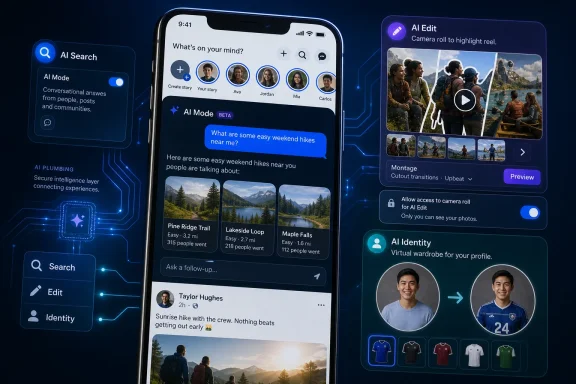
Meta announced on June 15, 2026 that Facebook is adding AI Mode search, AI-assisted camera roll sharing suggestions, generative photo presets, and virtual wardrobe effects inside its main app, expanding Meta AI from a chatbot layer into discovery, editing, and identity features across Facebook.
That is the factual story. The more interesting story is that Facebook is trying to make AI feel less like a destination and more like plumbing. Instead of asking users to open a separate assistant, Meta wants search results, photo edits, profile pictures, Stories, Groups, Reels, and sports fandom to become surfaces where machine-generated output quietly appears.
The first wave of consumer AI features across social apps was easy to spot because it was usually framed as a button: tap the assistant, type the prompt, wait for the trick. Facebook’s new release is different. AI Mode is search, camera roll suggestions are sharing, and wardrobe effects are identity play; the point is not merely to add AI to Facebook, but to make Facebook harder to imagine without AI.
Meta’s announcement positions the new tools as ways to “make things happen” with less effort. That sounds like standard platform optimism, but it is also a useful map of the company’s priorities. Facebook is no longer only competing for what users post; it is competing to automate the friction that happens before posting, searching, recommending, editing, and deciding what version of the self to show.
For years, Facebook’s central feed was a ranking machine. The user supplied social data, and Facebook decided what mattered. AI Mode extends that bargain into search: instead of presenting a familiar list of links or posts, the system is designed to synthesize answers from what people have publicly shared across Meta apps, especially Groups and Reels.
That makes this less like a cosmetic upgrade and more like a change in Facebook’s operating model. The platform is no longer just indexing social activity for browsing. It is turning that activity into raw material for generated answers.
That is a clever pitch because Facebook’s traditional weakness in search has also been its hidden advantage. It is not the web. It is full of local recommendations, niche hobby communities, neighborhood disputes, travel tips, parenting advice, buy-and-sell lore, and the sort of crowd wisdom that rarely appears cleanly on a static webpage.
If Google search is built around documents, Facebook AI Mode is built around testimony. That distinction matters. A user looking for “best stroller for cobblestone streets,” “quiet restaurants near a stadium,” or “how people are handling a local school policy” may want lived experience more than polished content.
Meta is betting that public social content can be converted into a conversational answer layer without flattening the very messiness that makes it useful. That is the risk. Groups and Reels can be lively, current, and specific, but they can also be wrong, promotional, repetitive, or distorted by social incentives.
The company’s phrasing — “real perspectives and experiences” rather than a “generic list of search results” — is not accidental. It is a direct challenge to the web search model, but it also quietly shifts responsibility. If an AI answer reflects what people are publicly saying, the quality of the product depends on whether Facebook can distinguish collective experience from collective noise.
That context could make Facebook AI Mode feel useful for everyday questions that are not purely factual. The best pizza place near a venue, the reality of a vacation spot in June, the practical downside of a gadget, or the mood inside a fan community before a match are all queries where “what people are saying” can be more valuable than an official page.
But context is also where the trust problem starts. A generated answer that draws from public Facebook content may feel authoritative because it is compact, fluent, and presented by Meta AI. Yet its underlying evidence may be uneven, anecdotal, or shaped by the same incentives that make social feeds addictive.
For WindowsForum readers, the analogy is familiar. Administrators know the difference between a Microsoft Learn article, a forum workaround, and a Stack Overflow answer that solved one person’s problem under unknown conditions. Facebook AI Mode appears to be productizing the forum-workaround layer for mainstream users, then wrapping it in AI confidence.
That can be powerful. It can also be dangerously smooth.
The direction is obvious: the app wants to do the first edit for you. A birthday album, a month of friend photos, a weekend trip, or a cluster of short videos becomes a suggested post before the user has assembled anything. Facebook is trying to collapse the distance between having media and publishing media.
That is not merely a convenience feature. It changes what counts as content creation. The old model asked the user to select, crop, edit, caption, and post. The new model asks the software to infer the story and invite the user to approve it.
For casual users, that may be welcome. Most people are not video editors, and the reason camera rolls become graveyards is that turning raw media into a polished post requires time. For creators, the bar for baseline polish keeps rising because automated montage tools make “good enough” easier for everyone.
The tension is that when platforms automate style, they also homogenize it. The same transitions, cutout logic, montage pacing, and AI-suggested visual language can spread quickly across feeds. Facebook may help users post more, but it may also make more posts feel as though they came from the same invisible editor.
This is not the same as a beauty filter, although it sits on the same road. A beauty filter modifies the image. A wardrobe tool can alter the social signal. The difference between wearing a jersey, appearing to wear a jersey, and using an AI-generated jersey effect may seem trivial during a game week, but platforms thrive on trivial signals repeated at huge scale.
Sports fandom is a smart beachhead because it is socially legible, seasonal, and brand-friendly. A jersey effect gives users a low-effort way to participate in a collective moment. It also gives Meta a template for future commercial overlays, from concerts and films to fashion drops and creator merchandise.
The profile picture angle is especially revealing. Profile photos are not just posts; they are durable identity markers across the service. When Facebook invites users to “restyle” a profile picture with AI, it is asking them to treat identity presentation as a live editable surface.
That may sound natural to younger users raised on filters, avatars, and short-form video effects. For older Facebook users, it may feel like another step away from the documentary promise of social networking — the idea that photos are evidence of life rather than prompts for a machine-generated version of it.
An AI system that suggests montages from a camera roll may be convenient, but it also asks for a high degree of trust. Users need to understand what is being analyzed, where that processing happens, how long signals are retained, and whether suggestions are generated locally, in the cloud, or through some hybrid approach. Meta’s announcement stresses user control, but the deeper privacy questions will depend on implementation details and policy language most people will never read.
This is where IT professionals and privacy-minded users should separate feature design from feature governance. A toggle is useful only if the surrounding defaults, explanations, and data practices are clear. “Opt-in” can mean a deliberate informed choice, or it can mean a brightly colored prompt that most users accept to make the interruption disappear.
Facebook has spent years recovering from a reputation that made privacy claims subject to unusually harsh scrutiny. That history does not mean every new feature is suspect by default. It does mean the burden of clarity is higher when the feature involves scanning personal media for shareable moments.
For administrators managing corporate devices, the practical concern is not whether someone can make a fun jersey profile picture. It is whether consumer social apps continue to blur personal storage, cloud inference, identity manipulation, and public posting in ways that are hard to audit. The more AI features live inside ordinary app workflows, the harder they become to separate from routine use.
AI Mode is a way to re-monetize and reanimate that archive. Public posts that once served only feed ranking can now serve answer generation. Groups that once competed with Reddit, Nextdoor, and hobby forums can become part of a broader recommendation engine. Reels, which were built for attention, can also become input for discovery.
This is a familiar platform move. First, a company encourages users to create and interact. Then it organizes that behavior for engagement. Then, when AI arrives, it discovers that years of human activity can be framed as a proprietary knowledge layer.
The obvious comparison is Reddit, whose value to AI companies lies in the density of human answers, arguments, and niche expertise. Facebook has some of that same material, but wrapped in a different social architecture. It is more personal, more local in some cases, and often less visible to the open web.
That gives Meta a potential advantage if it can surface useful answers without exposing private or semi-private spaces. It also raises a hard product question: will users who posted publicly inside Facebook understand that their content may now help generate AI answers for strangers?
Finding becomes AI Mode. Making becomes camera roll automation and generative editing. Presenting becomes wardrobe, hair, accessories, and profile-picture restyling. That is not random feature sprawl; it is a platform strategy.
The company wants AI to reduce the labor of participation. Search should require less browsing. Posting should require less editing. Identity signaling should require less real-world preparation. The user does less work, the platform gets more activity, and Meta AI becomes the invisible middleware connecting the two.
There is a bargain here, and it is not new. Social platforms have always traded convenience for control. What is new is the degree to which generative systems can now shape the substance of what users see, make, and appear to be.
That makes Facebook’s AI rollout more consequential than the lighthearted examples suggest. The jersey effect may be fun. The montage may be charming. The AI answer may be useful. But all three normalize the same idea: the platform can generate a polished version of reality on your behalf.
For sysadmins, the immediate implication is policy rather than panic. Organizations already struggle with employees mixing personal social apps, unmanaged devices, corporate screenshots, and cloud sync. AI-assisted camera roll features add another reason to revisit mobile device management, data loss prevention, and user education around what should never be stored in a personal media library in the first place.
For security teams, the generative identity tools deserve attention because they lower the cost of plausible visual alteration. A virtual outfit or restyled profile picture is not deepfake territory by itself, but it contributes to a culture in which manipulated self-presentation becomes ordinary. The more ordinary it becomes, the more users need better instincts for verifying identity and context.
For developers, AI Mode is another sign that retrieval and generation are converging inside dominant platforms. Search experiences will increasingly answer rather than route. That affects publishers, communities, brands, and support forums because the generated layer may become the first and last thing many users read.
For ordinary users, the advice is simpler: enjoy the tools, but understand the trade. If a feature needs access to your photos, your public posts, or your profile image, it is not just decorating content. It is learning from and acting on a personal data surface.
That is the factual story. The more interesting story is that Facebook is trying to make AI feel less like a destination and more like plumbing. Instead of asking users to open a separate assistant, Meta wants search results, photo edits, profile pictures, Stories, Groups, Reels, and sports fandom to become surfaces where machine-generated output quietly appears.
 Facebook’s AI Push Moves From Novelty to Infrastructure
The first wave of consumer AI features across social apps was easy to spot because it was usually framed as a button: tap the assistant, type the prompt, wait for the trick. Facebook’s new release is different. AI Mode is search, camera roll suggestions are sharing, and wardrobe effects are identity play; the point is not merely to add AI to Facebook, but to make Facebook harder to imagine without AI.Meta’s announcement positions the new tools as ways to “make things happen” with less effort. That sounds like standard platform optimism, but it is also a useful map of the company’s priorities. Facebook is no longer only competing for what users post; it is competing to automate the friction that happens before posting, searching, recommending, editing, and deciding what version of the self to show.
For years, Facebook’s central feed was a ranking machine. The user supplied social data, and Facebook decided what mattered. AI Mode extends that bargain into search: instead of presenting a familiar list of links or posts, the system is designed to synthesize answers from what people have publicly shared across Meta apps, especially Groups and Reels.
That makes this less like a cosmetic upgrade and more like a change in Facebook’s operating model. The platform is no longer just indexing social activity for browsing. It is turning that activity into raw material for generated answers.
AI Mode Turns Facebook’s Messy Social Graph Into a Search Product
AI Mode is the headline because it goes after the most valuable behavior on the internet: asking for an answer. Meta says the feature uses Meta AI to produce responses grounded in public posts and public discussion across its apps, including Groups and Reels. In plain English, Facebook wants its accumulated human chatter to become a search engine.That is a clever pitch because Facebook’s traditional weakness in search has also been its hidden advantage. It is not the web. It is full of local recommendations, niche hobby communities, neighborhood disputes, travel tips, parenting advice, buy-and-sell lore, and the sort of crowd wisdom that rarely appears cleanly on a static webpage.
If Google search is built around documents, Facebook AI Mode is built around testimony. That distinction matters. A user looking for “best stroller for cobblestone streets,” “quiet restaurants near a stadium,” or “how people are handling a local school policy” may want lived experience more than polished content.
Meta is betting that public social content can be converted into a conversational answer layer without flattening the very messiness that makes it useful. That is the risk. Groups and Reels can be lively, current, and specific, but they can also be wrong, promotional, repetitive, or distorted by social incentives.
The company’s phrasing — “real perspectives and experiences” rather than a “generic list of search results” — is not accidental. It is a direct challenge to the web search model, but it also quietly shifts responsibility. If an AI answer reflects what people are publicly saying, the quality of the product depends on whether Facebook can distinguish collective experience from collective noise.
The Search War Is Now a War Over Context
Facebook entering the AI search lane does not mean it is suddenly trying to become Google in the old sense. The company’s opportunity is narrower and, potentially, more defensible. Meta has context that general web search often lacks: social relationships, group membership, location-adjacent discussion, creator behavior, and engagement signals around recommendations.That context could make Facebook AI Mode feel useful for everyday questions that are not purely factual. The best pizza place near a venue, the reality of a vacation spot in June, the practical downside of a gadget, or the mood inside a fan community before a match are all queries where “what people are saying” can be more valuable than an official page.
But context is also where the trust problem starts. A generated answer that draws from public Facebook content may feel authoritative because it is compact, fluent, and presented by Meta AI. Yet its underlying evidence may be uneven, anecdotal, or shaped by the same incentives that make social feeds addictive.
For WindowsForum readers, the analogy is familiar. Administrators know the difference between a Microsoft Learn article, a forum workaround, and a Stack Overflow answer that solved one person’s problem under unknown conditions. Facebook AI Mode appears to be productizing the forum-workaround layer for mainstream users, then wrapping it in AI confidence.
That can be powerful. It can also be dangerously smooth.
Generative Editing Is the Social Network Eating Photoshop From Below
The new creative tools are less grandiose than AI Mode, but they may be more immediately visible. Facebook is updating camera roll sharing suggestions with collage cutout templates and transition effects that can turn photos and clips into shareable montages. Meta says these suggestions remain opt-in and can be disabled, which is an important detail given how sensitive camera roll features can be.The direction is obvious: the app wants to do the first edit for you. A birthday album, a month of friend photos, a weekend trip, or a cluster of short videos becomes a suggested post before the user has assembled anything. Facebook is trying to collapse the distance between having media and publishing media.
That is not merely a convenience feature. It changes what counts as content creation. The old model asked the user to select, crop, edit, caption, and post. The new model asks the software to infer the story and invite the user to approve it.
For casual users, that may be welcome. Most people are not video editors, and the reason camera rolls become graveyards is that turning raw media into a polished post requires time. For creators, the bar for baseline polish keeps rising because automated montage tools make “good enough” easier for everyone.
The tension is that when platforms automate style, they also homogenize it. The same transitions, cutout logic, montage pacing, and AI-suggested visual language can spread quickly across feeds. Facebook may help users post more, but it may also make more posts feel as though they came from the same invisible editor.
The Wardrobe Feature Makes Identity Editable by Default
The new photo presets push further into generative identity. Users can change clothing, hair, and accessories with AI, and sports fans can virtually wear team jerseys in Stories or profile pictures. The feature is playful on its face, but it belongs to a much larger platform trend: making the presented self more configurable than photographed.This is not the same as a beauty filter, although it sits on the same road. A beauty filter modifies the image. A wardrobe tool can alter the social signal. The difference between wearing a jersey, appearing to wear a jersey, and using an AI-generated jersey effect may seem trivial during a game week, but platforms thrive on trivial signals repeated at huge scale.
Sports fandom is a smart beachhead because it is socially legible, seasonal, and brand-friendly. A jersey effect gives users a low-effort way to participate in a collective moment. It also gives Meta a template for future commercial overlays, from concerts and films to fashion drops and creator merchandise.
The profile picture angle is especially revealing. Profile photos are not just posts; they are durable identity markers across the service. When Facebook invites users to “restyle” a profile picture with AI, it is asking them to treat identity presentation as a live editable surface.
That may sound natural to younger users raised on filters, avatars, and short-form video effects. For older Facebook users, it may feel like another step away from the documentary promise of social networking — the idea that photos are evidence of life rather than prompts for a machine-generated version of it.
Opt-In Camera Roll Access Is the Line Meta Knows It Has to Draw
Meta’s emphasis that camera roll sharing suggestions are opt-in is not incidental corporate housekeeping. Camera rolls are among the most sensitive reservoirs of consumer data on any device. They contain children, documents, locations, screenshots, private moments, receipts, medical context, and plenty of images users never intended to publish.An AI system that suggests montages from a camera roll may be convenient, but it also asks for a high degree of trust. Users need to understand what is being analyzed, where that processing happens, how long signals are retained, and whether suggestions are generated locally, in the cloud, or through some hybrid approach. Meta’s announcement stresses user control, but the deeper privacy questions will depend on implementation details and policy language most people will never read.
This is where IT professionals and privacy-minded users should separate feature design from feature governance. A toggle is useful only if the surrounding defaults, explanations, and data practices are clear. “Opt-in” can mean a deliberate informed choice, or it can mean a brightly colored prompt that most users accept to make the interruption disappear.
Facebook has spent years recovering from a reputation that made privacy claims subject to unusually harsh scrutiny. That history does not mean every new feature is suspect by default. It does mean the burden of clarity is higher when the feature involves scanning personal media for shareable moments.
For administrators managing corporate devices, the practical concern is not whether someone can make a fun jersey profile picture. It is whether consumer social apps continue to blur personal storage, cloud inference, identity manipulation, and public posting in ways that are hard to audit. The more AI features live inside ordinary app workflows, the harder they become to separate from routine use.
Meta’s Real Bet Is That Public Content Still Has Untapped Value
Facebook is an aging social network by Silicon Valley standards, but it remains a massive repository of human activity. Its challenge is not that it lacks content. Its challenge is that much of that content is buried in feeds, groups, comments, and videos that are difficult to search with precision.AI Mode is a way to re-monetize and reanimate that archive. Public posts that once served only feed ranking can now serve answer generation. Groups that once competed with Reddit, Nextdoor, and hobby forums can become part of a broader recommendation engine. Reels, which were built for attention, can also become input for discovery.
This is a familiar platform move. First, a company encourages users to create and interact. Then it organizes that behavior for engagement. Then, when AI arrives, it discovers that years of human activity can be framed as a proprietary knowledge layer.
The obvious comparison is Reddit, whose value to AI companies lies in the density of human answers, arguments, and niche expertise. Facebook has some of that same material, but wrapped in a different social architecture. It is more personal, more local in some cases, and often less visible to the open web.
That gives Meta a potential advantage if it can surface useful answers without exposing private or semi-private spaces. It also raises a hard product question: will users who posted publicly inside Facebook understand that their content may now help generate AI answers for strangers?
The Feature Set Is Small, but the Direction Is Not
Taken individually, these updates can look like a grab bag. There is a search tab, some montage suggestions, a few AI edit presets, and a virtual jersey trick. Taken together, they show Meta pushing AI into three of Facebook’s core loops: finding, making, and presenting.Finding becomes AI Mode. Making becomes camera roll automation and generative editing. Presenting becomes wardrobe, hair, accessories, and profile-picture restyling. That is not random feature sprawl; it is a platform strategy.
The company wants AI to reduce the labor of participation. Search should require less browsing. Posting should require less editing. Identity signaling should require less real-world preparation. The user does less work, the platform gets more activity, and Meta AI becomes the invisible middleware connecting the two.
There is a bargain here, and it is not new. Social platforms have always traded convenience for control. What is new is the degree to which generative systems can now shape the substance of what users see, make, and appear to be.
That makes Facebook’s AI rollout more consequential than the lighthearted examples suggest. The jersey effect may be fun. The montage may be charming. The AI answer may be useful. But all three normalize the same idea: the platform can generate a polished version of reality on your behalf.
Where WindowsForum Readers Should Pay Attention
Facebook’s new tools are not Windows features, but they matter to the Windows ecosystem because they sit in the daily workflow of users who move constantly between desktop, browser, phone, and cloud. The modern PC is no longer a sealed productivity environment. It is one surface in a mesh of consumer apps that increasingly perform AI inference on personal data and public behavior.For sysadmins, the immediate implication is policy rather than panic. Organizations already struggle with employees mixing personal social apps, unmanaged devices, corporate screenshots, and cloud sync. AI-assisted camera roll features add another reason to revisit mobile device management, data loss prevention, and user education around what should never be stored in a personal media library in the first place.
For security teams, the generative identity tools deserve attention because they lower the cost of plausible visual alteration. A virtual outfit or restyled profile picture is not deepfake territory by itself, but it contributes to a culture in which manipulated self-presentation becomes ordinary. The more ordinary it becomes, the more users need better instincts for verifying identity and context.
For developers, AI Mode is another sign that retrieval and generation are converging inside dominant platforms. Search experiences will increasingly answer rather than route. That affects publishers, communities, brands, and support forums because the generated layer may become the first and last thing many users read.
For ordinary users, the advice is simpler: enjoy the tools, but understand the trade. If a feature needs access to your photos, your public posts, or your profile image, it is not just decorating content. It is learning from and acting on a personal data surface.
The New Facebook Bargain Fits in Five Practical Sentences
The safest way to read this announcement is neither as a breakthrough nor as a gimmick. It is a marker of where large consumer platforms are taking AI now that the chatbot novelty cycle has cooled: into search boxes, camera rolls, profile pictures, and the small acts of daily participation that make a network valuable.- Facebook’s AI Mode is designed to generate answers from public social content across Meta apps rather than simply return conventional search links.
- Meta’s camera roll sharing suggestions are positioned as opt-in tools that can create collages and video montages from a user’s existing photos and clips.
- The new AI photo presets can alter clothing, hair, and accessories, including virtual team jerseys for Stories and profile pictures.
- The privacy stakes are highest around camera roll analysis because personal media libraries routinely contain sensitive material never intended for public sharing.
- The broader strategy is to make Meta AI part of ordinary Facebook behavior, not a separate assistant users must consciously seek out.
References
- Primary source: adgully.com
Published: 2026-06-16T05:50:10.906032

Facebook launches AI mode search and generative photo editing tools
Facebook launches AI mode search and generative photo editing tools Facebook has launched a mwww.adgully.com - Independent coverage: Tech My Money
Published: Mon, 15 Jun 2026 19:39:27 GMT

Facebook AI Tools: AI Mode and AI Photo Editing
Facebook AI tools now include an AI Mode that answers questions and AI photo and video edits, all rolling out in the mobile app now. techmymoney.com
- Independent coverage: meta.com
Published: Mon, 15 Jun 2026 16:00:23 GMT

New AI Tools to Help You Make Things Happen on Facebook
We’re introducing new AI-powered Facebook features to help you connect, create, and find what you’re looking for.
about.fb.com