

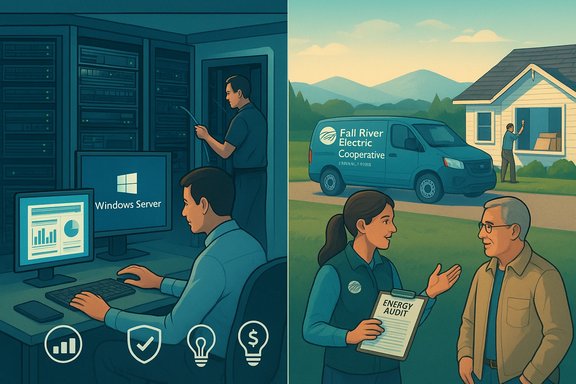
Fall River Electric Cooperative has opened two front-line positions in Ashton, Idaho — an IT Specialist to support and maintain the cooperative’s technology stack, and a Conservation Specialist / Member Services Representative to deliver energy-efficiency programs and customer-facing services — signaling a targeted hire drive that blends technical modernization with member engagement at a rural electric cooperative.
Fall River Electric Cooperative is a member-owned utility headquartered in the Ashton area serving communities across eastern Idaho, western Wyoming and parts of Montana. The co‑op manages a broad service area with thousands of meters and a long history of community-focused programs, including conservation, patronage capital returns, and community events. This local remit shapes both the technical needs and the customer-facing responsibilities of the open roles. These job postings are typical of small-to-mid-size utility IT and member services hiring: one role is technical and infrastructure-facing, the other is outward-facing, combining energy program delivery with traditional member services work. Together they reflect the dual priorities many cooperatives now balance — maintaining secure, modern IT operations while expanding energy-efficiency offerings that reduce demand and strengthen member value.
Fall River Electric’s hires reflect a practical, community-centered IT and member-services strategy: keep core infrastructure secure and manageable with Microsoft-centric skills, while investing in conservation and member-facing programs that drive long-term value. Candidates who combine hands-on Microsoft systems experience with strong communication and a willingness to work in a distributed, community-driven environment will be strongest matches. For both applicants and the cooperative, clarity on compensation, on-call expectations, and a roadmap for technical investments will be the deciding factors that turn a job posting into a durable hire.
Source: Idaho State Journal Fall River Electric Hiring
 Background
Fall River Electric Cooperative is a member-owned utility headquartered in the Ashton area serving communities across eastern Idaho, western Wyoming and parts of Montana. The co‑op manages a broad service area with thousands of meters and a long history of community-focused programs, including conservation, patronage capital returns, and community events. This local remit shapes both the technical needs and the customer-facing responsibilities of the open roles. These job postings are typical of small-to-mid-size utility IT and member services hiring: one role is technical and infrastructure-facing, the other is outward-facing, combining energy program delivery with traditional member services work. Together they reflect the dual priorities many cooperatives now balance — maintaining secure, modern IT operations while expanding energy-efficiency offerings that reduce demand and strengthen member value.Overview of the Openings
IT Specialist — role snapshot
- Works closely with the IT Manager and staff across the cooperative to ensure reliable, secure, and efficient IT operations.
- Preferred qualifications include a degree or technical training in Information Technology (or equivalent experience) and 3+ years of related IT experience.
- Technical skills explicitly requested: Windows Server, Windows 10/11, Microsoft 365, networking, and virtualization.
- Soft requirements: strong communication and teamwork skills, a valid driver’s license, and willingness/ability to travel between cooperative locations.
Conservation Specialist / Member Services Representative — role snapshot
- Focused on member engagement and applying energy-efficiency programs: promoting conservation programs, administering rebates and audits, and providing day-to-day billing and account support.
- Minimum education: high school diploma or equivalent; experience in customer service, billing, accounting or energy programs preferred.
- Emphasis also placed on positive interpersonal skills, multi-tasking ability, and willingness to learn as program rules evolve. Work will be a mix of office and field duties.
Benefits and hiring cadence
Both roles are described as offering a competitive pay and benefits package including health, dental, vision, 401(k) with matching, pension, paid time off and standard insurance coverages. The postings are listed as open until filled, with early applications encouraged. Interested candidates are asked to apply through the cooperative’s online careers portal.Why these hires matter: strategic context for rural utilities
Modernization and the hybrid IT reality
Electric cooperatives operate critical infrastructure across large geographic footprints with mixed on-premises and cloud systems. An IT Specialist versed in Windows Server, endpoint management (Windows 10/11), Microsoft 365 administration, networking, and virtualization helps a co‑op keep lights on — both for operational technology (OT) adjacency and for business systems. These skills map directly to maintaining AD/Azure AD directories, group policy, endpoint security, backup/restore plans, and virtualized server estates. Microsoft’s documentation frames these as core Windows Server and management responsibilities used in modern IT operations.Conservation work anchors member value
Conservation programs and rebates are strategic tools for cooperatives: they reduce peak demand, defer infrastructure investment, and create goodwill among members. Hiring a Conservation Specialist who can combine energy audits, rebate management, and member service tasks shows Fall River intends to keep direct member outreach and program administration in-house rather than outsourcing those touchpoints. That matters in places where member relationships are the cooperative’s competitive advantage. Local reporting and co‑op communications confirm Fall River’s ongoing conservation and community outreach efforts.Deep dive — IT Specialist: skills, tools, and day‑to‑day
What “Windows Server, Windows 10/11, Microsoft 365, networking, and virtualization” typically imply
- Windows Server: managing Domain Controllers, DNS/DHCP, file and print services, server roles, backup/restore, and patch management. Windows Admin Center, System Center or Azure Arc are commonly used for consolidated server management in mixed environments. Microsoft Learn documents these management responsibilities and tools.
- Windows 10/11: endpoint provisioning, Group Policy and Intune (Microsoft Endpoint Manager) for device compliance, deploying OS and security updates, and troubleshooting user devices. Co‑ops with distributed workforces often rely on secure remote-support tools and disciplined patching cadences.
- Microsoft 365: account and license management, Exchange Online administration, SharePoint/OneDrive policies, Teams configuration, auditing and compliance settings, and role-based admin delegation. The Microsoft 365 admin center is the central console for many of these tasks.
- Networking: managing LAN/WAN connectivity to substations, offices and field endpoints; VPNs for remote staff; firewall rule sets and segmented network designs to isolate OT/SCADA from IT networks.
- Virtualization: Hyper-V or other hypervisors for hosting server workloads and test environments, with expectations around VM lifecycle management, backups, live migration and high-availability planning. Microsoft’s Hyper-V documentation lays out core virtualization features and operational patterns for Windows environments.
Typical day-to-day responsibilities
- Respond to helpdesk tickets and device failures in a geographically distributed environment.
- Administer user accounts, permissions, and Microsoft 365 licensing.
- Maintain Windows Server and virtualization hosts — patching, monitoring, backups and capacity planning.
- Maintain network configurations, troubleshoot connectivity, and support remote sites.
- Work with vendors and the IT Manager on projects like endpoint security upgrades, virtualization rollouts, or M365 migrations.
Tools and automation expectations
A modern small-ish IT team will rely heavily on:- Windows Admin Center, PowerShell scripting, and automated patching.
- Endpoint management through Microsoft Intune or configuration management tooling.
- Virtualization management with Hyper‑V Manager or System Center Virtual Machine Manager (SCVMM).
- Cloud integration paths like Azure Arc for hybrid server management where applicable.
Deep dive — Conservation Specialist / Member Services: hybrid responsibilities
Skills that matter beyond the ad text
- Technical literacy in energy audits: ability to interpret basic energy usage data and recommend conservation measures, often coordinated with BPA or regional programs.
- Administrative competence: handling rebates, documentation, and reporting to meet external program or grant requirements.
- Customer service and conflict resolution: the role will handle billing questions, payout processes (patronage capital), and onsite work that requires professional member interactions. Local reporting describes patronage capital processes and member payouts as part of co‑op operations.
The field/office split
Expect one-third to one-half of the role to be in the field for audits and inspections, and the remainder in office work for member calls, processing rebates, and coordinating with contractors or the Bonneville Power Administration where applicable. Job boards mirror this blended expectation.Benefits analysis: what the posting tells applicants — and what it omits
What it promises
- Comprehensive benefits: health, dental, vision, life and disability insurance, 401(k) with matching, a pension, paid leave categories, and holidays. These items make the roles competitive in a rural labor market where employer-provided benefits can be a differentiator.
What to watch for
- The ad states “Competitive Pay” but does not list a pay band. That’s common in small organizations but can make early compensation comparisons challenging. Applicants should ask for a salary range during the recruiter screen or include desired salary ranges on applications to avoid wasted interviews.
- On-call and travel expectations are implied by the requirement for a valid driver’s license and travel between locations but are not explicitly defined. Candidates should clarify expected on-call rotations, travel mileage reimbursement, and response-time expectations before accepting an offer.
- The pension plus 401(k) matching is notable; candidates should confirm eligibility schedules, vesting, and whether the pension is a defined benefit or a defined contribution plan.
Practical advice for applicants — resume, interview, and certifications
For IT Specialist candidates — how to stand out
- Tailor your resume to the stack: explicitly list hands-on experience with Windows Server, Windows 10/11, Microsoft 365, and virtualization platforms (Hyper‑V or VMware). Use exact phrases from the JD so applicant tracking systems (ATS) and hiring managers see immediate matches.
- Show measurable outcomes: quantify helpdesk metrics, server uptime improvements, or cost savings from virtualization initiatives (e.g., “reduced physical server footprint by X% using Hyper-V, saving $Y per year”).
- Demonstrate hybrid skills: describe experience managing cloud-joined devices, Intune/Endpoint Manager policies, or hybrid Azure AD setups.
- Certifications that move the needle: Microsoft Certified: Modern Desktop Administrator Associate, Microsoft 365 Certified: Fundamentals or Administrator Associate, and Microsoft Azure Fundamentals are practical signals for a co-op environment. For virtualization, mention Hyper-V experience and VMware certifications if applicable. Provide dates on certificates.
For Conservation Specialist / Member Services candidates — practical tips
- Lead with member-facing wins: show examples of customer programs you’ve supported, rebates administered, or audits conducted — include metrics where possible (number of audits per month, rebate dollars processed).
- Highlight cross-functional collaboration: the role requires coordination across departments and external vendors; examples of successful coordination are valuable.
- Show adaptability: rural co-op work often requires field visits, data collection, and paperwork — demonstrate that you’re comfortable switching between field and office duties.
- Training to pursue: energy auditor certifications or coursework in building technologies and HVAC basics can help; experience with utility rebate program documentation is a plus.
Interview preparation checklist
- Ask about the IT team structure and reporting lines.
- Confirm on-call, travel, and response-time expectations.
- Ask for a clear benefits summary (401(k) match percentage, pension type, vacation accrual).
- Request examples of typical first‑90‑day projects so you can speak to immediate value-add.
Regional considerations — living and working in Ashton and the Fall River service area
- Geography and travel: Ashton and the broader Fall River service territory cover large, often remote areas. Candidates should expect occasional long drives, variable cell coverage, and work in winter conditions for field tasks. Local sources describe Fall River’s large rural footprint and community events that tie the cooperative to its member base.
- Community integration: cooperatives are member-owned; employees often play public-facing roles in community events and annual meetings. The cooperative model also means employees may have a deeper connection to local outcomes than at investor-owned utilities.
- Labor market dynamics: rural labor pools can be tight for IT talent. Candidates with hybrid skills (systems + networking + cloud) have an advantage; remote work flexibility and willingness to be on-site when needed are both assets.
Risks, trade-offs, and red flags for candidates and the employer
For candidates
- Undefined compensation bands: absence of a salary range can lead to misaligned expectations. Clarify early.
- On-call burden: small IT teams often carry the brunt of after-hours incidents; ask for an on-call policy.
- Operational stretch: in small organizations, job roles can broaden quickly. Ensure role boundaries and support structures (vendor contracts, training budgets) are clear.
For the employer
- Talent retention risk: rural locations plus wide-spread responsibilities can increase turnover if career progression and training aren’t supported.
- Single-point-of-failure risk: a lean IT team can be vulnerable if knowledge isn’t documented, or if runbooks and automation aren’t in place. Investing in documentation, standard operating procedures, and cross-training reduces that risk.
- Security posture: integrating OT adjacency with IT systems requires disciplined network segmentation and robust patching and backup procedures; small IT teams must prioritize clear governance and vendor-managed services where appropriate.
How to evaluate the opportunity if you apply
- Request a written job scope that describes typical tasks, on-call frequency, travel expectations, and first-year goals.
- Ask for a benefits packet that shows 401(k) match %, pension description, and vacation accrual.
- Confirm which virtualization platform and endpoint management tools are in use; ask for access to a sample runbook or an outline of the patch/update cadence to understand operational maturity.
- For conservation roles, ask which third parties (BPA, vendor auditors) the cooperative partners with and how performance is measured (rebate volumes, audit completion targets).
Short-term roadmap for hired IT Specialists (first 90 days)
- Inventory & access: map servers, endpoint fleets, network devices, and admin access paths.
- Security baseline: confirm patching, backup status, MFA adoption, and admin account hygiene.
- Stabilize on-call processes: ensure logging, alerting, and escalation paths exist.
- Quick wins: prioritize tasks that reduce daily friction — automate onboarding, standardize image deployment, or tune backup schedules.
- Document and train: deliver basic runbooks and a knowledge-transfer plan to reduce single-person dependencies.
Final assessment — strengths and opportunities
- Strengths: Fall River Electric’s dual hiring approach is pragmatic — pairing a technical hire with a direct member-facing role preserves operational resilience while advancing member programs. The explicit listing of Windows Server, Microsoft 365, and virtualization signals practical, widely used technology choices and lowers the ramp for candidates familiar with Microsoft ecosystems.
- Opportunities: the cooperative can further attract strong talent by publishing salary ranges, detailing on-call expectations, and describing the team’s technical roadmap (cloud-hybrid plans, endpoint management choices, and cybersecurity investments). These disclosures reduce negotiation friction and improve candidate fit.
- Risks: without clarified compensation and on-call policies, both recruiting and retention may be harder. Operational risk is mitigated by formalized documentation, vendor partnerships for specialized functions, and cross-training.
Practical next steps for applicants
- Prepare a resume highlighting specific Microsoft stacks: Windows Server, Hyper‑V (or VMware), Microsoft 365, and networking examples.
- Draft 2–3 short anecdotes that show results: a successful migration, a cost-saving virtualization project, or a customer-facing program you improved.
- Reach out early if you need benefits clarification; ask for a written benefits summary before the final interview.
- Apply via the cooperative’s online careers portal and be prepared to discuss community ties and willingness to travel between locations.
Fall River Electric’s hires reflect a practical, community-centered IT and member-services strategy: keep core infrastructure secure and manageable with Microsoft-centric skills, while investing in conservation and member-facing programs that drive long-term value. Candidates who combine hands-on Microsoft systems experience with strong communication and a willingness to work in a distributed, community-driven environment will be strongest matches. For both applicants and the cooperative, clarity on compensation, on-call expectations, and a roadmap for technical investments will be the deciding factors that turn a job posting into a durable hire.
Source: Idaho State Journal Fall River Electric Hiring
