

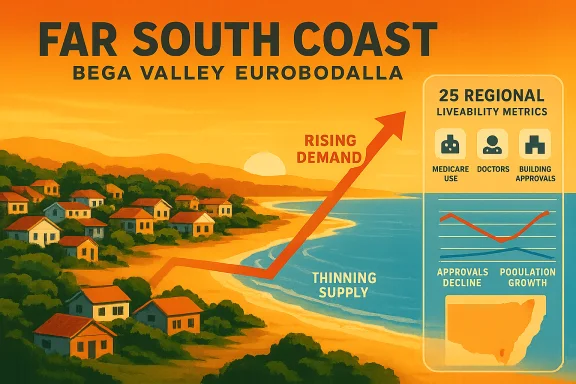
The Regional Australia Institute’s latest progress check casts a sharp light on how the Far South Coast stacks up against broader regional NSW — and the picture is a mix of clear strengths, stubborn structural shortfalls and policy choices coming to a head. RAI’s third annual report card and new online dashboard show most tracked liveability metrics are improving in regional Australia, but critical indicators — notably local building approvals, housing supply and some health workforce measures — are not keeping pace with population shifts on the Far South Coast. The result is rising pressure on housing markets, local services and long-term planning capacity in Bega Valley and Eurobodalla shires.
Key further reading and data portals that informed this feature: the Regional Australia Institute’s release and dashboard outlining the 25 metrics and the “Regionalisation Ambition 2032” framework; recent regional reporting on the Far South Coast summarising the RAI findings; and the Australian Bureau of Statistics’ national Building Approvals release for macro context and small‑area data availability.
Source: psnews.com.au How Far South Coast liveability measures up to regional NSW | PS News
 Background / Overview
What the Regional Australia Institute measured
The Regional Australia Institute (RAI) launched the third annual “report card” under its Regionalisation Ambition 2032 framework and published a granular dashboard tracking progress across 25 liveability and prosperity metrics spanning population, jobs & skills, liveability, health, sustainability & resilience and productivity & innovation. The RAI’s public push — including a recommendation called 40 for the regions — argues for proportionate decision‑making and investment to match the rising share of the national population that will be regional by 2032. RAI CEO Liz Ritchie has framed the policy ask plainly: regional Australians should expect to be represented in the public and private-sector boards and forums that shape policy and investment — otherwise decisions risk being made without a grounded understanding of regional pressures, trade-offs and local markets. The RAI’s data focus is designed to give planners and communities a shared set of indicators to measure whether policy moves are actually changing outcomes on the ground.Why the Far South Coast matters in this debate
The Far South Coast — an attractive mix of coastal lifestyle, tourism and agricultural activity — has been a visible poster child for some of the trends reshaping regional Australia: post‑bushfire rebuilding after the Black Summer fires, increased migration from metropolitan areas during the COVID era, and a tourism-driven economy that produces a high share of holiday homes and short‑term rentals. These dynamics interact with planning, approvals and service provision in complex ways and help explain why local indicators can diverge from state or national trends.The Far South Coast by the numbers: what RAI’s dashboard shows
The numbers RAI highlights for the Far South Coast (primarily Bega Valley and Eurobodalla LGAs) are uncomfortable because they show rising demand but local supply and workforce indicators that are either flat or weakening.- Building approvals: Bega Valley approvals fell from 207 to 191 year‑on‑year to June 2025, while Eurobodalla dropped from 271 to 189 over the same period. RAI flags these declines as lagging population growth and the regional NSW average.
- Regional context: across regional NSW, building approvals fell a modest 0.9%, in contrast with a 22% rise in metropolitan NSW over the comparable period cited by RAI — a clear metro/regional divergence in approvals activity.
- Rental vacancy rates: Eurobodalla 3.1%, Bega Valley 1.4%, compared with regional NSW 2.1% — the split highlights local variation in rental tightness within the Far South Coast.
- Health usage and workforce: Far South Coast residents access roughly 16.5 Medicare services per person compared with 11.7 for the average regional NSW resident. At the same time, medical practitioners per 100,000 are reported as 281 in Eurobodalla, 371 in Bega Valley, against 334 for regional NSW — signalling uneven workforce distribution even where per‑person service use is high.
Deep dive: housing, approvals and the supply squeeze
The approvals gap is the central alarm bell
The declines in local building approvals on the Far South Coast are significant because approvals are the leading indicator for future housing supply. A fall in approvals during a period of population rise means the pipeline of homes that will become available in the next 12–36 months is thinning. RAI warns this pattern — approvals trailing growth — has been a decade‑long issue in many regional areas and is now acute in places that have seen fire damage and rapid in‑migration. National data shows approvals are volatile but capable of strong rebounds at scale — the Australian Bureau of Statistics (ABS) reported total dwellings approved rose 11.9% to 17,076 in June 2025 across Australia, with marked state differences. That national context is important: macro conditions, apartment vs house composition, and state planning levers all shape how approvals translate to completed homes. But local LGA approvals remain the most relevant metric for immediate local shortages.Why approvals are low in Bega and Eurobodalla
Several interacting causes explain the local approvals shortfall:- Recovery from the Black Summer bushfires eliminated housing stock and added rebuild pressure.
- COVID-era migration and flexible work shifted demand towards coastal regional centres, increasing the effective population and demand for housing.
- A high share of short‑term rentals and holiday homes reduces the effective year‑round housing stock available for residents. Government registers and discussion papers show Eurobodalla and several South Coast LGAs have higher shares of non‑hosted short‑term rental dwellings than many other regional LGAs, amplifying local tightness.
- Planning and approvals bottlenecks at local and state levels have slowed delivery for years; RAI and other commentators argue the governance and pipeline issues need systemic attention rather than ad‑hoc measures.
The policy trap: tourism economy vs housing supply
A blunt approach to short‑term rentals risks collateral damage. Tourism is a core economic engine for the Far South Coast; restricting holiday homes without a nuanced transition plan would harm local businesses and employment. Conversely, failing to manage the long‑term rental supply can drive up rents, increase homelessness risk, and squeeze local workers out of critical jobs (teachers, health workers, hospitality staff). RAI’s recommendation — better data, pro‑active settlement planning and faster approvals pathways — is intended to strike a balance between economic resilience and resident affordability.Rental markets and short‑term rentals: granular pressure points
Short‑term rentals (STRs) and holiday homes are central to the supply equation on the South Coast. NSW state data and council-level registers have repeatedly shown some coastal LGAs host a disproportionate share of STR stock, which reduces long‑term rental availability and makes vacancy rates and median rents volatile. Eurobodalla was identified in government data as having a notable concentration of non‑hosted short‑term rental properties — a structural factor behind local tightness. Any policy response needs to be calibrated so it:- protects the tourism sector that relies on holiday accommodation,
- restores a stable long‑term rental pool for local workers, and
- provides transition support or incentives (for example, converting unutilised holiday stock to longer‑term affordable rental through subsidies or regulatory pathways).
Health services: more usage, uneven workforce
RAI’s dashboard indicates Far South Coast residents access more Medicare services per person than the average regional NSW resident (16.5 vs 11.7). At the same time, the density of medical practitioners varies substantially between the two shires (Eurobodalla lower, Bega Valley higher than the regional average). The combination — higher per‑person usage and uneven practitioner distribution — suggests local health services are stretched in ways that simple headcounts mask. This pattern matters because per‑person service usage is a demand indicator; if usage is higher it can reflect an older population profile, higher chronic disease burden, or greater reliance on Medicare‑funded care. Workforce planning therefore needs to consider not just raw practitioner counts but age profiles, visiting specialist rotations, allied health availability and after‑hours coverage. RAI’s dashboard is useful for identifying hotspots, but adequate policy requires integration with health workforce datasets and local service plans. Where RAI numbers are used as the primary small‑area source, independent confirmation at LGA level is often limited outside government health workforce publications — this is flagged as an area where more transparent small‑area health workforce reporting would improve planning.Representation, the “40 for the regions” ask and governance
RAI’s policy ask — dubbed “40 for the regions” — is straightforward: as regional Australia grows toward a projected ~40% share of population and output, national decision‑making should include commensurate regional representation and a share of program deliverables (for example, a proportion of new homes under national accords to be built in regions). The logic has three parts:- fairness: national decisions should reflect where people live and work,
- effectiveness: policies designed without regional inputs can produce perverse or blind‑spot outcomes in housing, health and infrastructure, and
- accountability: measurable carve‑outs create targets that federal and state agencies can track and plan toward.
What should policymakers, councils and industry do now? A practical playbook
The complexity of the Far South Coast’s pressures means simple, single‑instrument fixes are unlikely to work. The following is an evidence‑based, sequenced set of actions that balance urgency and systemic reform:- Rapid pipeline and approvals triage
- Identify shovel‑ready sites and fast‑track approvals with pre‑approved precinct templates and staged permits to convert approvals into builds faster.
- Establish a local “approvals concierge” to coordinate council, state planning and utility hookups for priority social and worker housing projects.
- Calibrated short‑term rental policy
- Use register data to target the highest‑impact STR properties and offer incentives for conversion to long‑term leases (tax concessions, transition grants) rather than blanket bans that crush tourism income.
- Health workforce surge and retention
- Fund targeted GP, allied health and visiting specialist rotations with bonded placements, relocation packages and telehealth support to fill critical gaps where per‑person usage is high.
- Partner RAI dashboard insights with state health workforce data to produce LGA‑level recruitment targets.
- Targeted migration and employment pipelines
- Where job vacancies exist alongside low unemployment, deploy migrant sponsorships and place‑based relocation incentives aimed at critical sectors (construction trades, health, aged care, education).
- Data transparency and local dashboards
- Maintain and expand the RAI dashboard at LGA level and integrate it with ABS small‑area approvals releases to create a live planning tool for councils, developers and community groups.
- Pre‑permitted housing precincts and modular construction
- Harness modular and prefabrication factories linked to pre‑permitted sites to accelerate delivery while managing local utility and environmental constraints.
Strengths, caveats and the limits of the evidence
Notable strengths
- RAI’s third annual report card and dashboard provide a comparably consistent, multi‑metric framework for monitoring regional liveability — a rare asset for policy planners. The dashboard’s local granularity is particularly valuable for councils and communities that need to prioritise interventions.
- The Far South Coast remains highly attractive for migration and tourism, giving the local economy a strong base for private investment, hospitality jobs and small business growth — strengths that policy can harness rather than try to suppress.
Caveats and verification limits
- Many of the most consequential small‑area metrics (LGA building approvals, vacancy rates, Medicare services per person, practitioner counts) are published in RAI’s dashboard and regional press reporting based on that dashboard. RAI is a trusted independent body, but some LGA‑level figures lack an immediately available second public source for cross‑validation at the same fine geographic scale. Where RAI is the primary data source for an LGA figure, that is flagged in the analysis and readers should treat those items as robust but contingent on local administrative reporting.
- National and state statistics (for example ABS national building approvals releases) provide crucial context but do not substitute for LGA‑level verification; the ABS does publish small‑area spreadsheets and caveats about revisions, and those should be consulted by local planners when confirming RAI snapshots.
- Some widely circulated claims about demand or projected migration flows are forecast‑based and should be treated as planning scenarios rather than fixed outcomes; transparent assumptions and scenario ranges are needed to avoid overconfidence in single‑number projections.
Risks and trade‑offs — what to watch for
- Policy missteps: punitive rules on STRs without transition support could blunt tourism revenue, while doing nothing may entrench housing unaffordability.
- Supply timing: even if approvals pick up, there is an implementation lag — houses take time to build, and capital and labour constraints can delay delivery further.
- Service capacity: higher Medicare usage and uneven practitioner distribution mean health access could degrade before new workforce programs take effect.
- Intergovernmental coordination failure: housing and planning are shared responsibilities; fragmented delivery across local, state and federal agencies will slow reform unless processes are accelerated and risks are allocated clearly.
Conclusion — a data‑driven push, not a one‑off fix
The RAI report card and dashboard have done the sector a service by making local liveability metrics visible and comparable. For the Far South Coast, the headline is stark: strong demand and pronounced local assets are colliding with approvals, rental supply and workforce bottlenecks. The policy objective must therefore be twofold and parallel: (1) increase the throughput of housing and worker supply quickly through targeted approvals, modular delivery and investor incentives, and (2) redesign governance so regional perspectives and proportional investment are baked into national decision‑making — the RAI’s “40 for the regions” framing is intended to provoke that shift. RAI’s dashboard gives councils and communities a shared scoreboard; converting those signals into on‑the‑ground homes, clinics and jobs will require pragmatic sequencing, intergovernmental will and careful design to protect the tourism economy while restoring long‑term liveability for residents. The Far South Coast has the assets to succeed — but without decisive, data‑driven, place‑sensitive action today the risks of entrenched housing stress and service shortfalls will grow.Key further reading and data portals that informed this feature: the Regional Australia Institute’s release and dashboard outlining the 25 metrics and the “Regionalisation Ambition 2032” framework; recent regional reporting on the Far South Coast summarising the RAI findings; and the Australian Bureau of Statistics’ national Building Approvals release for macro context and small‑area data availability.
Source: psnews.com.au How Far South Coast liveability measures up to regional NSW | PS News