

Faros AI’s selection as the 2025 Microsoft for Startups “Microsoft Partner of the Year” crystallizes a broader move: large cloud platforms and AI-focused startups are racing to make engineering productivity measurable, monetizable, and—crucially—part of enterprise procurement decisions.
Faros AI, a San Mateo–based startup that bills itself as an “engineering hub for the results-driven enterprise,” won the 2025 Microsoft for Startups Partner of the Year award for its solution built on Microsoft technology. The award recognizes startups that demonstrate innovation and strong partnership engagement within the Microsoft ecosystem. According to the announcement, winners were selected from more than 4,600 nominations across 100+ countries, and Microsoft highlighted partners that used Microsoft Cloud and AI platforms to deliver measurable enterprise solutions.
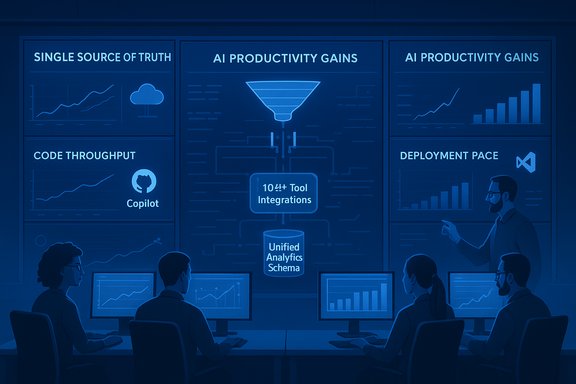
Faros says its platform aggregates and analyzes engineering telemetry—coding, deployment, quality, incident, security, HR and survey data—from 100+ tools and custom sources to help companies understand engineering productivity, delivery outcomes, budgets, and talent. The company positions that capability as particularly valuable to organizations running on Azure and using GitHub Copilot, where Faros claims to deliver a “single source of truth” for performance measurement.
This recognition arrives as Microsoft reshapes its marketplace and partner programs—focusing on AI apps, Copilot integrations, and curated startup tracks—so the award is as much a signal about market positioning as it is about product merit.
Key vendor integrations highlighted include:
But strategic buyers should treat marketplace badges and partner awards as starting points rather than procurement endpoints. The history of enterprise IT shows numerous cases where award-winning vendors still needed to prove sustainable, governed outcomes at scale. The critical follow-up steps for customers are reproducible case studies, referenceable customers in the same industry and size band, and clear contractual protections.
However, the substantive value will be proven in repeatable, auditable outcomes. Engineering leaders should pursue a disciplined evaluation: define clear, balanced metrics; run controlled pilots; demand security and data-portability guarantees; and require independent validation of any large productivity claims. When combined with strong governance, platforms like Faros can be powerful tools for bringing data-driven rigor to engineering management—but only if measurement design and procurement rigor match the ambition of the claims.
Faros’ award is an important signal that the market is prioritizing measurable AI outcomes for engineering teams; the next step is ensuring those measures translate into durable, governed results in production environments.
Source: Business Wire https://www.businesswire.com/news/h...5-Microsoft-for-Startups-Partner-of-the-Year/
 Background / Overview
Faros AI, a San Mateo–based startup that bills itself as an “engineering hub for the results-driven enterprise,” won the 2025 Microsoft for Startups Partner of the Year award for its solution built on Microsoft technology. The award recognizes startups that demonstrate innovation and strong partnership engagement within the Microsoft ecosystem. According to the announcement, winners were selected from more than 4,600 nominations across 100+ countries, and Microsoft highlighted partners that used Microsoft Cloud and AI platforms to deliver measurable enterprise solutions.Faros says its platform aggregates and analyzes engineering telemetry—coding, deployment, quality, incident, security, HR and survey data—from 100+ tools and custom sources to help companies understand engineering productivity, delivery outcomes, budgets, and talent. The company positions that capability as particularly valuable to organizations running on Azure and using GitHub Copilot, where Faros claims to deliver a “single source of truth” for performance measurement.
This recognition arrives as Microsoft reshapes its marketplace and partner programs—focusing on AI apps, Copilot integrations, and curated startup tracks—so the award is as much a signal about market positioning as it is about product merit.
What the announcement actually says
- Faros AI won the 2025 Microsoft for Startups Microsoft Partner of the Year award.
- Microsoft selects winners from thousands of nominations; the 2025 awards drew more than 4,600 nominations in 100+ countries.
- Faros markets its platform as ingesting data from 100+ tools to measure engineering productivity and to assess the impact of AI on engineering outcomes.
- The company emphasized its Azure and GitHub Copilot integrations and said Microsoft connected it with enterprise leaders representing “over 500,000 engineers” (a company-stated audience reach). This figure is reported as Faros’ claim.
Why the Microsoft for Startups Partner of the Year award matters
Winning a Microsoft partner award carries three concrete implications for a startup building tooling for enterprise engineering teams:- Market validation: It signals to enterprises and system integrators that Microsoft sees the solution as worthy of co-sell and go-to-market attention. That can accelerate pilot opportunities and procurement conversations with Microsoft-aligned customers.
- Channel access: Programs such as Microsoft for Startups, Pegasus cohorts and the unified Azure/AppSource marketplace provide startups with technical enablement, Azure credits, and introductions into Microsoft’s seller and co-sell channels—practical levers that help convert trials into production deals.
- Product positioning: Being framed as a partner that measures engineering and AI productivity helps Faros align with enterprise procurement priorities (governance, measurable outcomes, and cost control), which are increasingly decisive in cloud-native AI buys.
Technical integration and core capabilities
Data sources and aggregation
Faros’ core technical claim is large-scale data fusion: ingesting signals from code repositories, CI/CD pipelines, incident and observability data, quality and security scanners, HR systems and engineer surveys. The stated goal is to normalize these heterogeneous signals into a single analytics schema for productivity and outcome measurement.Key vendor integrations highlighted include:
- GitHub (and GitHub Copilot) for code and AI-assisted code metadata.
- Azure DevOps and Visual Studio telemetry for build/deploy and work-item metrics.
- Identity and access through Microsoft Entra, plus other enterprise connectors.
Measurement surface and dashboards
According to the announcement, Faros produces dashboards that report AI adoption metrics, engineering throughput and performance benchmarks. The platform claims to enable engineering leaders to quantify AI productivity gains and to trace AI-generated changes to downstream outcomes (incidents, performance, delivery timelines).Deployment and procurement
Faros states the platform is available in the Azure Marketplace and supports Microsoft Azure Consumption Commitment (MACC) procurement flows, offering a procurement path suitable for Microsoft-centric customers and regional cloud deployments (including Europe). This eases operational procurement for organizations already committed to Azure.How credible are the claims? A critical verification
The product claims fall into two categories: (A) measurable, technical integrations that are straightforward to verify in a trial; and (B) broader assertions about “measuring AI productivity gains at scale” and the size of the audience Microsoft has introduced to Faros.- Category A (technical integrations): The existence of connectors to GitHub, Azure DevOps, Visual Studio, and common telemetry sources is verifiable through trial deployments and technical documentation. A short pilot that validates data ingestion, normalization, and dashboarding can demonstrate the stated capability. Faros’ Azure Marketplace availability simplifies confirmation via a short proof-of-value.
- Category B (business-scale claims): Statements such as “connected with enterprise leaders representing over 500,000 engineers” are company-reported and presented as marketing metrics. These claims are meaningful as indicators of outreach, but they are not an audited measure of installed base or customer deployments; treat them as PR-level claims until validated through vendor references and contract evidence.
The hard problem: measuring “AI productivity gains”
AI productivity is a seductive metric, but it’s a notoriously slippery one. The Faros announcement centers on delivering a “single source of truth” to assess AI impact—an important ambition—but the following analytical caveats matter in practice.Measurement pitfalls
- Metric definition ambiguity: “Productivity” can mean many things—lines of code, features delivered, cycle time, customer outcomes, reduced bugs, or developer satisfaction. Without a clear, context-specific metric set, aggregated productivity claims are fuzzy.
- Attribution complexity: Correlating AI-assisted code generation with downstream business outcomes requires careful causal analysis. Many factors (team composition, testing, architecture changes) influence outcomes beyond whether Copilot or another assistant generated code. Automated attribution risks overclaiming effect sizes.
- Gaming and short-term optimization: Teams may optimize for measured KPIs (e.g., commit counts or cycle time) at the expense of long-term technical health. Designers must avoid incentivizing metrics that degrade maintainability.
Sound measurement design (recommended)
- Define a balanced metric suite that includes outcome, throughput, quality, and human-centric measures: e.g., time-to-merge, post-deploy defect rate, mean time to repair (MTTR), survey-based developer satisfaction, and business KPI alignment.
- Use controlled pilots and A/B designs where feasible, so that changes can be causally attributed to AI tooling.
- Complement raw telemetry with qualitative feedback and code-level review to validate whether AI-generated code meets maintainability and security standards.
- Insist on longitudinal reporting—short-term productivity spikes can reverse if technical debt accumulates.
Risks, governance and operational controls
Adopting a platform that aggregates deep engineering telemetry and evaluates AI use raises technical, legal, and cultural risks. Key risks and mitigations:- Data governance and privacy: Centralizing code, HR, and incident data concentrates sensitive information. Mitigation: insist on end-to-end encryption, fine-grained RBAC, data minimization, explicit data residency choices, and a documented data retention policy. Verify that the vendor supports region-specific Azure deployments for compliance.
- Security & supply-chain exposure: Any third-party agent with repository access must pass security assessments. Mitigation: require third-party security attestations, penetration-test reports, SBOMs for any agent components, and strong identity integration via Microsoft Entra.
- Metric manipulation: If teams are compensated on measured productivity without guardrails, behavior can distort metrics. Mitigation: use composite KPIs, rotate metric weightings, and add human oversight to interpret outliers.
- Over-reliance on vendor-supplied attribution: Acceptance criteria should require the vendor to provide raw data exports and reproducible analysis scripts so customers can independently validate claims. Contracts should include rights to audit and port data.
- Vendor lock-in & portability: A single-pane-of-glass is useful, but if dashboards and metric definitions are proprietary, moving away becomes costly. Mitigation: require documented export formats (open schemas), an API-first model, and contractual exit clauses that cover data extraction and handover timelines.
Procurement and pilot checklist for Windows-centric enterprises
When evaluating Faros or comparable engineering analytics platforms, use the checklist below to structure pilots and procurement:- Technical:
- Confirm Azure Marketplace listing and MACC compatibility for procurement.
- Validate connectors for GitHub, Azure DevOps, Visual Studio, observability stack (APM/logs), security scanners and HR systems.
- Test data ingestion latency and schema normalization on representative projects.
- Verify RBAC, encryption-at-rest/in-transit, and Entra integration.
- Security & compliance:
- Request penetration-test and third-party security attestations.
- Confirm regional deployment options and data residency for regulated workloads.
- Measurement design:
- Define a primary outcome metric and 3–5 supporting metrics (quality, cycle time, MTTR, developer sentiment).
- Set up A/B or phased rollout to establish causal claims.
- Require exportable raw data and reproducible metric definitions.
- Legal & commercial:
- Include SLAs for uptime and data access/export windows.
- Negotiate audit rights and contractual commitments on data portability.
- Define success criteria for proof-of-value and build milestone‑based payments if needed.
- Organizational:
- Assign a cross-functional sponsor (engineering, SRE, security, HR).
- Plan training and change management to align metrics with behavior and incentives.
Strategic implications for the Microsoft ecosystem and Windows enterprises
Microsoft’s partner programs and updated marketplace are deliberately oriented toward making enterprise procurement of AI solutions more discoverable and gatekept by enterprise readiness requirements. For Windows-focused organizations, the technical fit is compelling: Faros’ touted integrations with Visual Studio, Azure DevOps, Microsoft Entra and GitHub directly map onto the tooling many Windows shops run today, reducing friction for pilots and integrations.But strategic buyers should treat marketplace badges and partner awards as starting points rather than procurement endpoints. The history of enterprise IT shows numerous cases where award-winning vendors still needed to prove sustainable, governed outcomes at scale. The critical follow-up steps for customers are reproducible case studies, referenceable customers in the same industry and size band, and clear contractual protections.
Short-term recommendations for IT leaders
- Treat Faros (and similar vendors) as an opportunity to run a tightly scoped PoV that prioritizes causal measurement and governance.
- Insist on developer-backed KPIs (including developer satisfaction) to avoid incentive drift.
- Validate security posture and data residency before ingesting any production code or HR data.
- Require escape hatches in contracts—structured data exports, documented schemas and a defined exit timeline—so dashboards don’t become a form of lock-in.
Broader market view: why vendors that measure outcomes will rise
The market is shifting from feature-checklists to outcome-based procurement. Vendors that can demonstrate measurable reductions in time-to-market, delivery cost, or incident rates will command higher commercial value. Microsoft’s emphasis on co-sell and marketplace curation reflects buyer demand for enterprise-ready vendors who can show operational improvements—not just product demos. Winning a Microsoft for Startups Partner of the Year award gives Faros a louder megaphone in that transition, but converting attention into durable market share requires repeatable customer success stories that survive technical and organizational scrutiny.Limitations and unverifiable claims (transparency)
A few claims in the announcement deserve cautious treatment:- The “over 500,000 engineers” audience cited in Faros’ release appears to describe the audience Microsoft introduced or reached through partner engagements; this is a company-provided metric and is not independently audited in the announcement. Treat as a market outreach claim rather than a verified installed user base.
- Percentages or precise productivity improvements were not published in the announcement. Until Faros provides customer case studies with pre/post metrics and methodology, treat claimed productivity gains as promises that require validation under contract and pilot conditions.
Conclusion
Faros AI’s 2025 Microsoft for Startups Partner of the Year award signals both recognition for a startup tackling a hard industry need—measuring engineering and AI productivity—and the continuing evolution of Microsoft’s partner and marketplace strategy. For Windows and Azure-centric enterprises, the technical fit is promising: connectors to Visual Studio, Azure DevOps, GitHub and Entra reduce integration friction, and Azure Marketplace procurement paths simplify initial buying.However, the substantive value will be proven in repeatable, auditable outcomes. Engineering leaders should pursue a disciplined evaluation: define clear, balanced metrics; run controlled pilots; demand security and data-portability guarantees; and require independent validation of any large productivity claims. When combined with strong governance, platforms like Faros can be powerful tools for bringing data-driven rigor to engineering management—but only if measurement design and procurement rigor match the ambition of the claims.
Faros’ award is an important signal that the market is prioritizing measurable AI outcomes for engineering teams; the next step is ensuring those measures translate into durable, governed results in production environments.
Source: Business Wire https://www.businesswire.com/news/h...5-Microsoft-for-Startups-Partner-of-the-Year/
