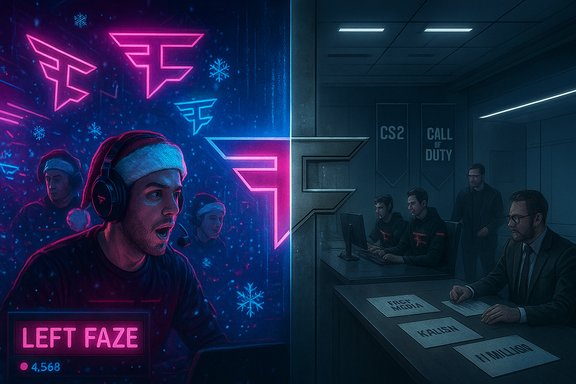
FaZe Clan’s content-creator arm imploded over Christmas week as founding members and high-profile streamers abruptly left the organization, handing what many see as the end of a defining era for one of gaming’s most visible brands while FaZe’s esports operations — legally and operationally separated under new ownership — move to preserve competitive continuity.
FaZe Clan began in 2010 as a scrappy Call of Duty trickshot collective and grew into one of the most influential creator-driven gaming brands of the 2010s and early 2020s. A high-profile SPAC-led public listing in mid‑2022 briefly positioned FaZe as a Wall Street play on creator culture; that transaction was widely reported as a roughly $724–725 million SPAC deal at the time. The public-company experiment did not go well. Mounting losses, shaky sponsorship dynamics and governance challenges left the organization struggling on the open market, and by early 2024 FaZe was acquired and absorbed into GameSquare as part of a restructure that split the business into two distinct arms: FaZe Media (the creator and IP/business arm) and FaZe Esports (the competitive teams). GameSquare’s public statements and filings describe an integration completed in March 2024 and the later formation of FaZe Media as a creator‑led subsidiary backed by outside capital. The spin‑out approach was explicit: GameSquare retained 100% ownership of competitive esports operations while FaZe Media became a separate entity designed to give creators equity and operational control, with a hotly publicized $11 million investment from investor Matt Kalish that left Kalish with a substantial stake in FaZe Media. GameSquare’s investor communications emphasize that split and the rationale for returning founders to more visible leadership roles. (User-uploaded files included with this request did not contain additional reporting that materially altered the public timeline or claims summarized here.
FaZe’s remaining esports arm may survive and even thrive as a focused competitive business, while the departed creators will test the commercial hypothesis that audiences follow personalities more than corporate banners. For companies and investors working with creators, the lesson is clear: thriving in the creator era requires deal structures, communication strategies and governance models that respect creator agency while delivering scalable commercial outcomes. The coming months will show whether FaZe’s brand value can be salvaged as a corporate asset or whether the real power now resides with the creators who chose to walk away.
Source: Technobezz FaZe Clan Co-Founder Exits After 15 Years as Creator Division Collapses
 Background / Overview
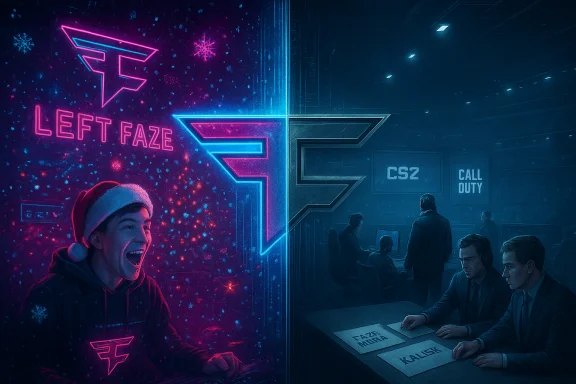
FaZe Clan began in 2010 as a scrappy Call of Duty trickshot collective and grew into one of the most influential creator-driven gaming brands of the 2010s and early 2020s. A high-profile SPAC-led public listing in mid‑2022 briefly positioned FaZe as a Wall Street play on creator culture; that transaction was widely reported as a roughly $724–725 million SPAC deal at the time. The public-company experiment did not go well. Mounting losses, shaky sponsorship dynamics and governance challenges left the organization struggling on the open market, and by early 2024 FaZe was acquired and absorbed into GameSquare as part of a restructure that split the business into two distinct arms: FaZe Media (the creator and IP/business arm) and FaZe Esports (the competitive teams). GameSquare’s public statements and filings describe an integration completed in March 2024 and the later formation of FaZe Media as a creator‑led subsidiary backed by outside capital. The spin‑out approach was explicit: GameSquare retained 100% ownership of competitive esports operations while FaZe Media became a separate entity designed to give creators equity and operational control, with a hotly publicized $11 million investment from investor Matt Kalish that left Kalish with a substantial stake in FaZe Media. GameSquare’s investor communications emphasize that split and the rationale for returning founders to more visible leadership roles. (User-uploaded files included with this request did not contain additional reporting that materially altered the public timeline or claims summarized here.What happened over Christmas week: timeline and departures
The exodus, in brief
Between December 25–28 multiple creators who were listed on FaZe’s content roster announced they had “left @FaZeClan,” many posting identical short updates on social platforms. The wave began with several departures on Christmas Day and continued through the following days, culminating with the exits of long‑standing and founding figures including Yousef “FaZe Apex” Abdelfattah, Alexander “FaZe Adapt” Prynkiewicz, Brian “FaZe Rug” Awadis, and Kris “FaZe Swagg” Lamberson. Other creators confirmed to have left include Stable Ronaldo, Jason Nguyen, Nick Fosco, Jerry Woo and Silky. Reporting across gaming outlets catalogued the stream of announcements and the shock among fans and industry watchers.How the departures played out publicly
Some creators announced exits live during a Christmas‑day “FaZemas” livestream; others posted terse social updates over the following days. Plaqueboymax — who had previously left FaZe in August 2025 — told audiences he had long felt like creators had “no control” and were treated like “puppets,” language that helped frame the emerging narrative of creator autonomy vs. corporate control. FaZe’s organization posted an emotional statement calling the moment “heartbreaking” and “beyond tragic,” while stressing that FaZe Esports would continue as a separate, unaffected operation.The negotiation breakdown and the role of Matt Kalish / HardScope
The central dispute
Multiple outlets reporting on the fallout — citing Bloomberg reporting and interviews with people involved — identify failed contract negotiations between creators and new management/investors as the proximate cause. Investor Matt Kalish (a co‑founder of DraftKings and the backer behind HardScope) invested in FaZe Media in 2024 and, according to his public statements and reporting, injected roughly $10–11 million into the creator arm across 2024–2025. Kalish offered creators new commercial terms through his HardScope platform or the option to operate independently; after roughly six months of talks he reportedly ended negotiations and elected to proceed without the departing creators. Kalish described FaZe’s prior financial structure as “unsustainable” and said the new arrangements were intended to build a different commercial model for creators as a next‑generation media business. Press accounts indicate the offer to creators included contractual terms that creators found unacceptable, prompting the coordinated departures.What the official corporate documents show
GameSquare’s investor presentations and press releases confirm the formation of FaZe Media and the $11 million investment that structured Kalish’s ownership stake in the new company. These filings also make explicit that GameSquare retained FaZe Esports and intended to consolidate FaZe Media’s financials for a limited period while the new structure matured. Those public documents are the single most authoritative record of the corporate reorganization even as media reporting filled in the narrative of private negotiations and interpersonal fallout.Financial context and conflicting valuation/price figures — what’s verified and what’s murky
The financial story surrounding FaZe is messy because different public statements and later analyses use different reference points.- The SPAC listing in 2022 that took FaZe public was widely reported as a roughly $724–725 million transaction at the time, a number cited repeatedly in contemporaneous press. That valuation has become a key piece of the cautionary tale of SPAC-era overpricing.
- GameSquare’s acquisition and subsequent treatment of FaZe have been reported with varying dollar figures. GameSquare’s own investor communication repeatedly discusses the March 2024 consummation of the merger and the ensuing carve‑outs, but external coverage and later summaries differ on the headline price tag — outlets and analyst posts have cited figures ranging from an all‑stock transaction valuing FaZe at $14 million to statements that suggested an approximate $17 million acquisition price in public narratives about FaZe’s decline. Other summaries frame the numbers in terms of valuations for FaZe Media post‑investment (for example, a valuation near $40–44 million tied to the Kalish financing and conversion options described in company notices). These inconsistent figures appear across earnings call transcripts, press summaries and secondary analyses; the divergence arises from different accounting framings (enterprise vs. subsidiary valuation, stock vs. cash considerations, conversion mechanics), not necessarily contradictory factual errors. Readers should treat any single headline figure as shorthand for a more complex transaction structure.
- Independent reporting that cites Bloomberg and interviews with participants confirms that Kalish invested roughly $10–11 million into FaZe Media over 2024–2025 and that he funded initiatives to professionalize and monetize creators via HardScope. The claim that Kalish offered creators new HardScope terms or independence, and that negotiations collapsed after months of talks, is consistently reported across multiple outlets.
FaZe Esports vs. FaZe Media: operational separation and what remains intact
GameSquare has been explicit that FaZe Esports — the competitive business housing CS2, Call of Duty, and other professional teams — remains under GameSquare’s control and will continue as a separate operational entity. That distinction is why esports staff and figures associated with competition quickly reassured fans that tournament schedules and team rosters would be unaffected by the creator exodus. Former and current FaZe esports personnel and reporting emphasized that competitive operations are not part of the media transaction that stranded creators and that the business intends to keep competing at the highest levels. Kaysan Ghasseminejad, a former FaZe creator now aligned with FaZe Esports operations, publicly reassured fans that CS2 and Call of Duty teams were “in great hands” and that there would be “no impact whatsoever at FaZe Esports,” comments that gave teams and sponsors immediate short‑term calm. DotEsports documented Kaysan’s stream and his pledge to keep the esports brand stable.Banks’ public defense and the culture war framing
Richard “FaZe Banks” Bengston — a founder of FaZe and an executive figure in the reboot era — responded to the controversy with video statements and tweets asserting he had provided creators with free housing, production staff, channel access and no income sharing, framing his stewardship as generous and productive. Banks alleged that he had invested deeply and taken on personal financial exposure to rebuild FaZe and pushed back hard against claims that creators were mistreated or squeezed. His statements were widely amplified across gaming outlets and became part of the public counter-narrative: that creators benefitted materially from FaZe’s platform and that the dispute was less about abuse than about difficult choices in a dire financial environment. That response — and the creators’ counterclaims of lack of control and “puppet” dynamics — crystallizes a broader creative vs. corporate tension: creators expect autonomy and fair commercial terms; investors and boardrooms demand scalable monetization and governance. When the commercial model is under pressure, those expectations conflict loudly.Critical analysis: strengths, failures and the long tail of creator economies
What FaZe did right (historically and recently)
- FaZe built an exceptionally sticky cultural brand that translated creator fame into sponsorship deals, fashion tie‑ins and mainstream visibility; that brand value is real and persistent, and it created avenues for return-on-investment that attracted buyers and investors.
- The move to legally separate FaZe Media from FaZe Esports was a defensible governance step: by splitting IP and creator economics from competitive operations, GameSquare created cleaner value buckets that could be invested into or divested from independently. That structural clarity can be a pragmatic way to rescue different businesses that happen to share a brand.
Where it failed
- The SPAC-driven public valuation and subsequent market reality exposed a fragile revenue model over‑exposed to sponsorship cycles. When sponsorships and ad markets softened, FaZe’s cash flows and balance sheet stress became acute — a risk that was underappreciated when the company went public.
- The governance design left creators in a liminal position: a creator‑led face to the brand on one hand, but subject to investor-led commercial re‑engineering on the other. That tension only becomes visible during contract renegotiations, and FaZe’s public unraveling shows how fragile creator alignment can be when investors demand more capture of downstream value.
- Communication and trust appear to have broken down. Where goodwill and informal house‑era relationships used to govern behavior, formal contracts and investor pressure introduced friction that became public — and unresolvable on the timeline investors wanted. The speed and simultaneity of creators’ exits suggest negotiations reached an impasse that could not be managed behind closed doors.
Industry risks this episode underscores
- Creator talent is portable and publicly empowered; brands that rely on creator collectives face substantial reputational and operational risk if contractual terms are perceived as unfair.
- SPAC-era valuations and public capital norms can incentivize short-term fixes rather than patient creator relationships.
- Corporate investors who lack creator-first cultural instincts risk misreading the social capital and community trust that creators build, making integration attempts brittle.
Likely near‑term scenarios and what to watch
- FaZe Esports continuity — GameSquare stabilizes competitive operations, refocuses sponsorships and pushes for profitability in the tournament business. This is the least disruptive path and one the company has signaled it intends to pursue.
- Creator regrouping — departing creators form new independent collectives or sign elsewhere; because creators control the audiences, they can rapidly monetize through direct sponsorships, platform revenue and cross‑platform deals. Early indicators (streamer posts and community responses) show creators will try to retain control of their content and brands.
- Legal/contractual aftershocks — depending on the exact contractual arrangements in place, there may be disputes over intellectual property, revenue sharing and non‑compete clauses. Public reporting has not yet flagged major litigation, but corporate restructurings frequently spawn downstream legal friction. This is an area to monitor against SEC filings and court dockets.
- Brand and sponsor response — sponsors will quickly reassess whether to anchor investments in FaZe Esports, FaZe Media (if it survives a reboot) or in the individual creators who left. Sponsorship allocation decisions in the coming weeks will reveal whether the value sits with the brand entity or the creator individuals.
Practical takeaways for creators, investors and esports operators
- For creators: secure clarity on revenue splits, IP ownership, and exit rights in writing. Opt for transparent, evergreen royalty or licensing mechanisms when transferring brand assets to a corporate vehicle. Consider staged commitments tied to performance and governance protections that lock in creative control.
- For investors / operators: design creator deals that balance monetization needs with creator sovereignty. Use convertible instruments and minority governance protections rather than blunt 20%+ cuts to creator revenue; such terms are politically toxic and operationally corrosive.
- For sponsors: diversify investments across both creator personalities and institutional esports assets. Short‑term reactions to public drama should be avoided; instead, focus on where audiences and engagement persist.
- For regulators and advisors: this episode reinforces the need for careful disclosure when creator collectives go public; SPAC-era valuation complexity made it hard for retail investors to gauge the sustainability of revenue models tied to influencer marketing. Clearer risk disclosure would serve markets better.
Conclusion
The collapse of FaZe’s creator division is both a cautionary tale and a moment of transformation for the creator economy. It shows how cultural brands built on trust and informal norms can buckle under formalized capital structures and governance pressures. The split between FaZe Media and FaZe Esports offered a path to separate contested commercial dynamics, but it also created a fault line: creators who felt their creative autonomy and commercial upside threatened chose independence over compromise.FaZe’s remaining esports arm may survive and even thrive as a focused competitive business, while the departed creators will test the commercial hypothesis that audiences follow personalities more than corporate banners. For companies and investors working with creators, the lesson is clear: thriving in the creator era requires deal structures, communication strategies and governance models that respect creator agency while delivering scalable commercial outcomes. The coming months will show whether FaZe’s brand value can be salvaged as a corporate asset or whether the real power now resides with the creators who chose to walk away.
Source: Technobezz FaZe Clan Co-Founder Exits After 15 Years as Creator Division Collapses