

Ferrari’s first fully electric car, the Luce, has arrived not with a touchscreen-dominated salon but with a cabin that reads like a design manifesto—one shaped by LoveFrom, the studio founded by Sir Jony Ive and Marc Newson, and revealed in a staged debut in San Francisco that teases a May exterior unveiling in Italy.
Ferrari’s move into battery-electric vehicles has been cautious and deliberate. The Luce is the company’s first production BEV and represents a pivot from Ferrari’s petrol-rooted identity toward electrification while attempting to preserve the brand’s emotional and sensory DNA. The project has been developed in phases: Ferrari revealed the underlying platform and technology last year, and this second phase—an interior-first reveal—puts the company’s design intentions on public display well ahead of the full exterior debut.
The name itself is deliberate. “Luce” is Italian for light, and Ferrari frames the model’s identity around the idea of clarity—light as inspiration rather than an overt signal of electrification. The name also marks a new naming strategy for the marque as it enters an era where powertrain type is no longer the primary naming cue. The interior reveal in San Francisco underscores that Ferrari sees design partners and cultural signaling as central to the Luce story.
This phased approach—technology, interior, exterior—lets Ferrari shape the narrative in stages. It highlights engineering pedigree and then emotional, tactile design, before finally delivering the visual coup de théâtre with the outer shell. For a brand whose essence is as much theatre as performance, that sequencing is telling.
This union of Italian automotive craft and Silicon Valley design sensibility is notable for two reasons. First, it signals that high-end carmakers continue to see value in cross-sector design credibility—Apple-era fingerprints confer cultural cachet. Second, it tests whether a minimalist, materially rigorous approach can coexist with the mechanical and safety constraints of an automotive cockpit.
These numbers position Luce as a top-tier performance BEV—one that competes not just on luxury but on raw acceleration and top-end capability. Ferrari’s challenge will be reconciling this performance with packaging, weight distribution, and the tactile character the brand insists on preserving.
This positioning matters. At the price point indicated, Ferrari is selling exclusivity, design authorship, and performative ownership as much as range or charging velocities. The Luce’s buyers will be collectors and clients who expect novelty and craftsmanship as much as EV efficiency.
At the same time, the Luce’s ultra-premium positioning separates it from mass-market EV trends. It’s a halo car—an expensive design statement that signals intention and capability rather than an attempt to capture volume. Its influence may therefore be more aspirational than broadly prescriptive. If the Luce’s material-tech playbook proves persuasive, elements—glass accents, tactile control groupings, ritualized key interactions—could trickle down into more mainstream offerings over time.
But the Luce also raises pragmatic questions. Can Ferrari reconcile substantial battery mass with the agility its customers expect? Will software and long-term support match the physical craft? And will bespoke materials and complex assemblies translate into sustainable production and service ecosystems?
For enthusiasts and collectors, the Luce will be compelling—an object that blends automotive theater with Silicon Valley finesse. For the broader market, its influence will depend on whether Ferrari can convert this design rhetoric into lasting ownership value and demonstrable engineering excellence. The May exterior reveal and forthcoming road tests will determine whether Luce is a singular design triumph or the first chapter of a new, enduring Ferrari language for the electric era.
Source: channelnews.com.au Ferrari Unveils First Electric Vehicle Featuring Interiors By Apple Design Legend Jony Ive - channelnews
 Background
Ferrari’s move into battery-electric vehicles has been cautious and deliberate. The Luce is the company’s first production BEV and represents a pivot from Ferrari’s petrol-rooted identity toward electrification while attempting to preserve the brand’s emotional and sensory DNA. The project has been developed in phases: Ferrari revealed the underlying platform and technology last year, and this second phase—an interior-first reveal—puts the company’s design intentions on public display well ahead of the full exterior debut. The name itself is deliberate. “Luce” is Italian for light, and Ferrari frames the model’s identity around the idea of clarity—light as inspiration rather than an overt signal of electrification. The name also marks a new naming strategy for the marque as it enters an era where powertrain type is no longer the primary naming cue. The interior reveal in San Francisco underscores that Ferrari sees design partners and cultural signaling as central to the Luce story.
Overview: What Ferrari Revealed — and What It Kept Back
Ferrari’s staged presentation focused almost exclusively on the cabin: a tactile-rich cockpit, a reimagined steering wheel, novel use of glass and aluminum, and a key fob engineered as a small ritual object. The exterior, mechanical packaging, and full production details remain reserved for the May reveal in Italy. Pricing hasn’t been fully confirmed, but analysts and reporting place the Luce squarely in ultra-luxury territory—expect figures well into the six-figure euro range.This phased approach—technology, interior, exterior—lets Ferrari shape the narrative in stages. It highlights engineering pedigree and then emotional, tactile design, before finally delivering the visual coup de théâtre with the outer shell. For a brand whose essence is as much theatre as performance, that sequencing is telling.
Design Partnership: LoveFrom and Ferrari
A five-year collaboration with a Silicon Valley sensibility
Ferrari’s collaboration with LoveFrom is not incidental. Announced years ago, the relationship matured into a deep design partnership focused on every dimension of the Luce’s appearance and interface. LoveFrom carries with it Jony Ive’s Apple-era aesthetic—a reductive, material-first approach that prizes edges, finishes, and the choreography of interaction. Ferrari’s brief appears to have been to translate Ferrari’s visceral drama into a tactile, human-scaled EV interior that resists the “big slab of glass” trend.This union of Italian automotive craft and Silicon Valley design sensibility is notable for two reasons. First, it signals that high-end carmakers continue to see value in cross-sector design credibility—Apple-era fingerprints confer cultural cachet. Second, it tests whether a minimalist, materially rigorous approach can coexist with the mechanical and safety constraints of an automotive cockpit.
What LoveFrom meant to Ferrari’s brief
LoveFrom’s influence shows up in measurable ways: a bias toward metal and glass over plastic, minimal visual clutter, and interaction design choices that prioritize feel over menu depth. Where many EV designers sought to make software central, Ferrari and LoveFrom deliberately re-centered the driver’s hands and the mechanical act of driving itself. The result is a cabin that reads like a study in controlled restraint—every surface, button, and dial staged rather than merely functional.Interior Deep Dive: Materials, Controls, and Ritual
Steering wheel: recycled aluminum meets 1960s Nardi cues
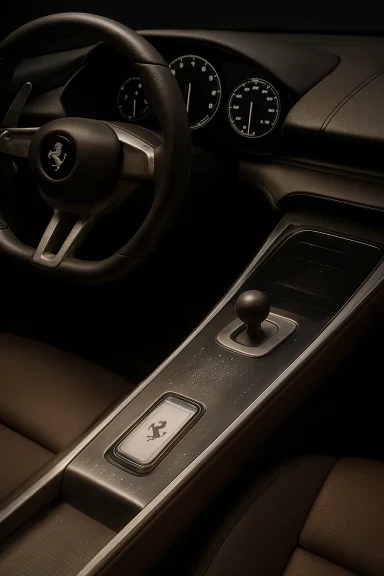
The steering wheel is a headline piece. LoveFrom and Ferrari took inspiration from 1960s Nardi wood-rim wheels, distilling that classic silhouette into a contemporary, exposed three-spoke form machined from a specially developed, 100% recycled aluminum alloy. The structure is engineered from multiple CNC-machined parts and is lighter than a conventional Ferrari wheel—an explicit nod to both sustainability and mechanical honesty. Controls are grouped into Formula One-like modules, with traditional gear paddles repurposed to manage torque distribution and regenerative braking. The wheel and control layout gesture to Ferrari’s racing lineage while adapting it for EV-specific functions.Instrument binnacle: layered OLEDs and aviation-inspired graphics
Ferrari mounted a dual OLED instrument cluster directly to the steering column—a positioning chosen so the binnacle moves with the wheel and remains ergonomically constant for the driver. The displays are layered, with cutouts and overlapping panels that give depth and mechanical presence—an effect designers liken to cockpit instruments in helicopters and airplanes. The graphics favor analog cues, including physical needles that move against layered OLED backgrounds, blending analog readability with digital flexibility. This hybrid approach aims to maintain glanceable instrumentation without surrendering depth to a single flat display.Central control: ball-and-socket pivot and palm rest ergonomics
Rejecting the fixed, portrait tablet common to many EVs, the Luce’s central control screen is mounted on a ball-and-socket joint, enabling it to pivot toward driver or passenger. It includes a palm rest to reduce visual distraction—a small but explicit design decision that treats the screen as an optional information surface rather than the cockpit’s organizing axis. This emphasizes the concept that tactile controls should remain primary while digital surfaces remain supportive.Corning Fusion5 glass and the laser-etched multigraphs
Ferrari partnered with Corning to specify Fusion5 glass—a hardened glass treatment used throughout the center console, shifter and even buttons. Panels are laser-etched with thousands of micro-holes that allow for subtle, backlit graphics and tactile detail. The gear shifter becomes an object—glass and metal fused into a sculptural control—rather than a mere selector, aligning with LoveFrom’s material-first philosophy. Ferrari claims more than forty glass parts are used inside the cabin, turning glass from a mere display substrate into a core design material.The key as ritual: E Ink, choreography, and “theatre”
Perhaps the most theatrical gesture is the Luce’s key. It’s a glass-bodied fob with an E Ink display; in the pocket it appears Ferrari yellow, but when docked in the console the display shifts color and triggers a choreographed cabin start-up sequence. The dock contains magnets that help align the key and create a deliberate tactile ritual when the driver presses it. It’s an attempt to reintroduce ceremony into an electric start process that otherwise tends to be silent and unsatisfying. This is design-as-experience: a small object intended to elicit delight and connect owner to machine.Controls by feel: buttons, dials, toggles and the anti-slab aesthetic
Across the cockpit Ferrari prioritized physical inputs—metal buttons, tactile rotary dials, toggles, and switches—over buried touchscreen menus. The aim is to allow drivers to operate core functions by feel, minimizing the need to look down and thereby preserving driving focus. This design thesis aligns with Ferrari’s performance roots: the car is still, at its core, a driving machine, and LoveFrom’s interface choices are meant to facilitate that connection rather than dilute it.Performance, Packaging, and Technical Snapshot
Ferrari’s earlier platform reveal set expectations: a quad-motor architecture, an 880V electrical architecture, and a bespoke battery pack. Early published figures circulated by automotive press and spec-driven reporting indicate power outputs exceeding 1,000 horsepower, a 122 kWh battery, and a claimed range in the neighborhood of ~330 miles (EU standard), with sprint times reportedly under 2.5 seconds for 0–60 mph. The Luce also appears to be heavier than many earlier Ferraris, tipping scales near the 5,000-pound mark—weights driven by batteries and the structural reinforcements required in an EV.These numbers position Luce as a top-tier performance BEV—one that competes not just on luxury but on raw acceleration and top-end capability. Ferrari’s challenge will be reconciling this performance with packaging, weight distribution, and the tactile character the brand insists on preserving.
Pricing, Market Placement, and the Phased Launch
Ferrari has been careful with timing and market signals. The Luce was first referred to in corporate presentations as part of Ferrari’s product roadmap, but the public rollout is clearly staged. The interior reveal in San Francisco served two purposes: to introduce LoveFrom’s design language to a design-conscious audience, and to set expectations around the brand’s EV ethos. Reporting suggests pricing will be firmly in ultra-luxury territory—previous estimates and commentary put the model beyond €500,000—making the Luce a halo product rather than a volume item. The exterior reveal is scheduled for May, with deliveries likely later in the year.This positioning matters. At the price point indicated, Ferrari is selling exclusivity, design authorship, and performative ownership as much as range or charging velocities. The Luce’s buyers will be collectors and clients who expect novelty and craftsmanship as much as EV efficiency.
Critical Analysis: Strengths
1) Design fidelity and material craft
The Luce’s most immediate strength is material execution. LoveFrom’s insistence on metal and glass over soft plastics has produced an interior that feels special in a way many EV cabins do not. The glass-forward surfaces, the machined aluminum steering wheel, and the precision engineering of mechanical controls communicate luxury by substance rather than ornament. This ties directly to Ferrari’s brand promise of tactile excellence.2) Driver-centric ergonomics and reduced distraction
The decision to prioritize physical controls over deep-screen interactions is a defensible safety and usability stance. By enabling blind operation of primary functions and keeping the gauge cluster physically connected to the steering wheel, Ferrari preserves glanceability and reduces cognitive load. This is especially important at Ferrari’s performance envelope, where driver attention is a critical factor.3) Cultural and design signaling
Collaborating with LoveFrom affords Ferrari a cultural signaling advantage. For clients who value design pedigree, the association with Jony Ive and the Apple design lineage is a powerful differentiator. It positions Ferrari at a crossroads of automotive heritage and contemporary design credibility. That cultural cachet is itself a luxury attribute.Critical Analysis: Risks and Open Questions
1) Weight and drivetrain compromises
The reported curb weight—approaching or exceeding 2,300 kilograms—creates inherent trade-offs. Heavy cars require more energy, affect handling, and demand structural countermeasures that further add mass. Ferrari’s engineering will be tested to maintain the dynamic sharpness buyers expect from the marque while negotiating battery mass and safety constraints. Reported range figures and weight need to be validated in real-world testing.2) The software and user interface challenge
Design excellence in hardware cannot compensate forever for weak software or updates. The Luce’s hybrid approach—physical controls supported by layered OLEDs—delivers immediate usability benefits, but the long-term ownership experience will depend on software quality: infotainment responsiveness, update cadence, integration with phone ecosystems, and the maturity of vehicle systems. Given LoveFrom’s emphasis on physicality, Ferrari must ensure software teams match that level of craft. Any dissonance between beautifully executed hardware and clumsy software will be conspicuous.3) Supply and sustainability questions
Using novel materials like Fusion5 glass and large amounts of machined recycled aluminum is a show of intent on sustainability, yet bespoke materials can complicate manufacturing, repair, and aftermarket servicing. High-cost, highly engineered parts increase repair complexity and limit third-party options, which matters for total cost of ownership and long-term customer satisfaction. Ferrari’s supply chain will need robust plans for part longevity and serviceability.4) Market timing and emissions regulatory context
Ferrari is entering a market now crowded with EV offerings and intensifying expectations for software features, charging convenience, and value propositions. The Luce will be measured not just against supercar peers but against technological expectations set by luxury EVs from other makers. Moreover, any shifts in regulatory regimes or incentives can reshape the business case for ultra-luxury EVs; Ferrari’s niche clientele mitigates some exposure, but macro trends matter.5) The Apple echo: benefit or burden?
The Ive connection brings attention, but it also invites comparison to Apple’s cancelled car ambitions and to the high bar of consumer electronics polish. If buyers expect Apple-like refinement in software, ecosystem integration, and update management, Ferrari must deliver across those vectors. The romance of Apple design cannot substitute for robust vehicle software engineering and long-term support. Warnings about conflating design celebrity with systems engineering expertise are warranted.How the Luce Fits into the Broader EV Landscape
Ferrari’s decision to foreground tactile controls represents a broader industry countercurrent to the touchscreen-first paradigm. Several luxury manufacturers have already begun to reintroduce physical knobs and buttons for core functions, citing safety and user experience. Ferrari’s take is more extreme: a comprehensive rejection of the slab-as-central-organ. That stance is notable because it combines a performance ethos with a human-centered design philosophy that privileges feel and immediacy over software surface area.At the same time, the Luce’s ultra-premium positioning separates it from mass-market EV trends. It’s a halo car—an expensive design statement that signals intention and capability rather than an attempt to capture volume. Its influence may therefore be more aspirational than broadly prescriptive. If the Luce’s material-tech playbook proves persuasive, elements—glass accents, tactile control groupings, ritualized key interactions—could trickle down into more mainstream offerings over time.
Practical Considerations for Prospective Buyers and Enthusiasts
- Expect exclusivity and craftsmanship, not cheap-tech economies of scale. The Luce is designed as a statement piece for collectors and brand loyalists.
- Verify real-world numbers. Published range, weight, and performance figures will vary by test cycle and spec; independent road tests will be decisive.
- Consider service and repair implications. Glass-heavy interiors and bespoke machined parts may increase repair costs and lead times.
- Watch software update policies and platform integration. Ownership experience will be shaped by Ferrari’s commitment to over-the-air updates and ecosystem compatibility.
What to Watch Next
- May Exterior Reveal — Ferrari has reserved the full visual reveal for May; that will complete the narrative and expose aerodynamic strategies, proportion, and how the Luce’s silhouette reconciles traditional Ferrari cues with EV packaging.
- Real-world testing and independent reviews — Dynamic tests will be crucial to validate the company’s performance and handling claims, and to measure range against reported figures.
- Pricing and order books — Final pricing, customization options, and allocation will confirm whether Luce is a true halo or a limited-volume halo with broader intent.
- Software roadmap and integration choices — Will Ferrari embrace deeper phone integration standards? Will live updates and new features arrive over time? The software story will determine long-term appeal.
Conclusion
The Ferrari Luce is a study in contrast: an EV that refuses the slide-toward-slab orthodoxy in favor of a materially rich, mechanically expressive interior. LoveFrom’s imprint is unmistakable—glass, anodized aluminum, carefully choreographed rituals, and controls designed to be felt rather than endlessly navigated. For Ferrari, the Luce is both a cultural statement and a technical proof point: it says electrification need not erase the brand’s tactile, driver-focused soul.But the Luce also raises pragmatic questions. Can Ferrari reconcile substantial battery mass with the agility its customers expect? Will software and long-term support match the physical craft? And will bespoke materials and complex assemblies translate into sustainable production and service ecosystems?
For enthusiasts and collectors, the Luce will be compelling—an object that blends automotive theater with Silicon Valley finesse. For the broader market, its influence will depend on whether Ferrari can convert this design rhetoric into lasting ownership value and demonstrable engineering excellence. The May exterior reveal and forthcoming road tests will determine whether Luce is a singular design triumph or the first chapter of a new, enduring Ferrari language for the electric era.
Source: channelnews.com.au Ferrari Unveils First Electric Vehicle Featuring Interiors By Apple Design Legend Jony Ive - channelnews
