

The past two weeks have crystallised a decisive shift: sustainability disclosure regimes are being simplified on paper but hardened in practice — fewer mandatory datapoints, stricter evidential requirements, supervisory tools that operationalise climate risk, and enforcement that treats green claims as potential legal liabilities rather than marketing copy.
Regulators and standard‑setters across jurisdictions have moved from design to execution. In Europe, EFRAG concluded a rapid simplification exercise and delivered revised ESRS exposure drafts to the European Commission, explicitly reducing mandatory datapoints while introducing proportionality, phasing and clearer principles for presentation. This work responds to a Commission mandate to cut preparer burden without surrendering decision‑usefulness; EFRAG’s public materials confirm both the mandate and the targeted leverage points for simplification. Across Asia‑Pacific, supervisors focused on sequencing and practical tooling: Hong Kong’s banking supervisor put a cloud‑based Physical Risk Assessment Platform into formal release for authorised institutions, and Singapore refined implementation timelines so the earliest cohorts report Scope 1/2 first while less‑ready issuers receive staged deadlines. China launched a provincial pilot to channel cross‑border green financing. These regional moves emphasise pragmatism — make fewer things mandatory early, but make the mandatory things verifiable and operationally relevant. Concurrently, enforcement authorities continued to signal — and deliver — material consequences for misleading sustainability claims. Australia’s regulator has secured multi‑million‑dollar penalties in high‑profile greenwashing cases, while the UK’s CMA continues to press retail sectors for clearer, substantiated consumer claims. At the same time, major cloud vendors (notably Microsoft) are embedding generative‑AI assistants into sustainability tooling, accelerating reporting but introducing new provenance and contractual risks that legal, procurement and IT teams must manage.
Caveat: where public summaries reference specific settlements, datapoint counts or technical thresholds not replicated in primary regulator or standard‑setter documents, those items were treated as contested and flagged for verification against the originating source before operational decisions are made.
Conclusion: regulatory momentum has shifted from broad ambition to operational discipline. The era of plentiful green statements and voluntary checklists is ending; the era of traceable, auditable sustainability facts is arriving. Organizations that adopt an enterprise control posture for ESG reporting will not only survive the next wave of enforcement — they will earn investor confidence and operational advantage.
Source: Lexology https://www.lexology.com/pro/content/esg-key-updates-and-developments-22-nov-5-dec/
 Background / Overview
Regulators and standard‑setters across jurisdictions have moved from design to execution. In Europe, EFRAG concluded a rapid simplification exercise and delivered revised ESRS exposure drafts to the European Commission, explicitly reducing mandatory datapoints while introducing proportionality, phasing and clearer principles for presentation. This work responds to a Commission mandate to cut preparer burden without surrendering decision‑usefulness; EFRAG’s public materials confirm both the mandate and the targeted leverage points for simplification. Across Asia‑Pacific, supervisors focused on sequencing and practical tooling: Hong Kong’s banking supervisor put a cloud‑based Physical Risk Assessment Platform into formal release for authorised institutions, and Singapore refined implementation timelines so the earliest cohorts report Scope 1/2 first while less‑ready issuers receive staged deadlines. China launched a provincial pilot to channel cross‑border green financing. These regional moves emphasise pragmatism — make fewer things mandatory early, but make the mandatory things verifiable and operationally relevant. Concurrently, enforcement authorities continued to signal — and deliver — material consequences for misleading sustainability claims. Australia’s regulator has secured multi‑million‑dollar penalties in high‑profile greenwashing cases, while the UK’s CMA continues to press retail sectors for clearer, substantiated consumer claims. At the same time, major cloud vendors (notably Microsoft) are embedding generative‑AI assistants into sustainability tooling, accelerating reporting but introducing new provenance and contractual risks that legal, procurement and IT teams must manage. What changed (22 Nov – 5 Dec): headline developments
1) EFRAG submitted draft simplified ESRS to the European Commission (3 December)
EFRAG completed and delivered its technical advice on draft simplified ESRS, marking the most consequential European development in the period. The package implements substantial reductions in mandatory datapoints (EFRAG’s public materials document targeted reductions well in excess of 50% across many item sets and later communications quantify reductions in the 50–61% range), while adding proportionality measures, reliefs and phased implementation windows for more challenging disclosures. The emphasis is explicit: fewer datapoints, but each one must be auditable and decision‑useful. Why it matters operationally- A reduced field of mandatory metrics concentrates auditor, regulator and investor attention on a narrow set of high‑value facts.
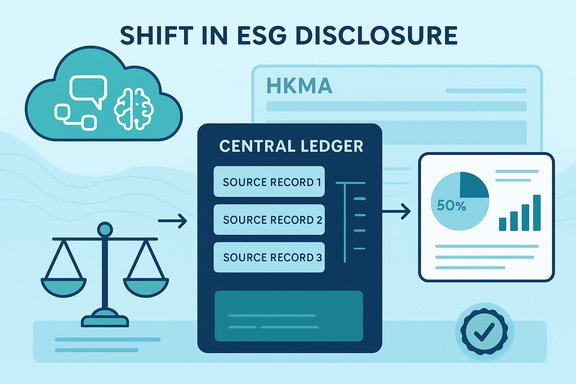
- Preparers must convert narrative claims into traceable, versioned evidence linked to raw source records and transformation logs.
- Third‑party assurance becomes more focussed and potentially mandatory for headline datapoints, raising the bar for audit‑grade control environments.
2) Hong Kong: Physical Risk Assessment Platform moves to formal release
The Hong Kong Monetary Authority’s Physical Risk Assessment Platform — developed with private partners and piloted in beta — moved into formal operational release for authorised institutions. The platform provides on‑demand, asset‑level physical climate risk analytics across hazards and scenarios, with exports and scenario outputs intended to feed supervisory stress tests and banks’ internal credit assessments. This turns physical climate risk from theoretical guidance into operational inputs for lending and capital decisioning. Operational consequence- Banks must integrate platform outputs into model governance, stress testing and underwriting workflows.
- Corporates borrowing from Hong Kong AIs should anticipate more granular due diligence and potential covenanting or pricing changes tied to physical‑risk ratings.
3) Singapore: sequencing and capacity building for climate disclosures
Singapore regulators (ACRA and SGX RegCo) continued implementing pragmatic sequencing: mandatory Scope 1 and 2 disclosures are front‑loaded for all listed issuers from FY2025, while broader ISSB‑aligned disclosures and Scope 3 obligations are phased by company size and readiness. The aim is capacity building, not relaxation — large issuers and STI constituents lead, smaller issuers receive extended runway to build systems and assurance readiness. Practical implications- Large issuers must deliver near‑audit‑grade Scope 1/2 data quickly.
- Smaller listed companies should use the breathing room to implement meter‑to‑ledger connectors, versioned evidence stores and vendor contract safeguards.
4) China: green foreign‑debt pilot to mobilise cross‑border capital
China’s State Administration of Foreign Exchange launched a pilot allowing eligible green and low‑carbon projects in selected provinces to access preferential cross‑border financing channels and streamlined registration procedures. The scheme reduces the share of green foreign debt in cross‑border financing risk weighting, effectively widening the ceiling for green project financing in pilot areas. This is a targeted funding channel to attract international capital into domestic transition projects. Operational consequence- Sponsors and international lenders must align documentation, use‑of‑proceeds controls and monitoring to local taxonomy and eligibility rules to access preferential allowances.
- Multinationals should expect tighter reporting and monitoring obligations tied to eligibility.
5) Enforcement developments: green claims are increasingly litigable
Australia’s ASIC continues to secure sizeable penalties in greenwashing actions (notably a recent six‑figure to multi‑million ruling), while the UK’s CMA and other consumer protection bodies have expanded action and guidance against vague or unsubstantiated consumer‑facing sustainability claims. Regulators are treating marketing as a compliance function — legal sign‑off, evidence checklists and, where appropriate, independent assurance are now basic defensive measures. Practical steps for communicators- Route every consumer‑facing sustainability message through legal and compliance.
- Preserve evidence, supplier attestations and any independent assurance reports in an immutable evidence repository.
6) Cloud + AI accelerate reporting — and raise provenance risks
Major vendors continued to productise connectors, taxonomies and Copilot‑style assistants inside sustainability platforms. Microsoft’s Sustainability Manager and Cloud for Sustainability offer Copilot features that can generate calculation models, parse source documents, and draft CSRD/ISSB‑aligned content — features now in preview or GA across Microsoft documentation. These features materially reduce manual effort, but they increase the need for preserved prompts, versioned lineage, contractual non‑use clauses, and human review logs. Without those controls, automated outputs are plausible but not provably accurate. Key governance gaps created by vendor stacks- Missing enforceable audit/export rights in vendor contracts.
- Contracts that permit vendor reuse or model training on customer data.
- Lack of preserved AI prompts and human review logs for disclosure drafting.
Technical verification: what we validated and how
The most load‑bearing claims were checked against primary or authoritative sources as follows:- EFRAG simplification and datapoint reductions — verified against EFRAG’s official progress reports, work plans and the December submission of draft simplified ESRS. EFRAG’s public notices confirm the simplification mandate, the levers being used and the final technical advice timing. The exposure drafts and EFRAG’s communications document a targeted reduction in mandatory datapoints in the 50%+ band (variously reported around 57–61% in subsequent briefings).
- HKMA Physical Risk Assessment Platform — verified using HKMA’s banking regulatory repository and development partners’ (KPMG / XDI) announcements; the platform’s formal release documents detail hazard coverage, export capabilities and supervised use cases for stress testing and credit evaluation.
- Singapore sequencing — verified through joint ACRA / SGX RegCo timeline announcements and corroborating market commentary and guidance from ISCA and professional firms outlining the staggered timelines for Scope 1/2 and Scope 3.
- ASIC enforcement outcomes — confirmed using ASIC media releases describing penalties and court rulings in greenwashing cases (including the significant Active Super decision). These are public regulatory actions, not speculative reports.
- Microsoft Sustainability Manager Copilot features — confirmed from Microsoft product documentation and blog posts that describe Copilot in Sustainability Manager (preview) for finding facts, creating calculation models and drafting CSRD/CSRD‑aligned reports; Microsoft explicitly documents the need to enable generative AI features and references responsible AI guidance.
- Some secondary summaries circulating in commentary threads referenced specific settlement amounts, industry undertakings or precise datapoint counts that were not directly corroborated in primary regulator or standard‑setter filings at the time of reporting. Where a numerical claim could not be matched to the originating regulator’s press release or the standard‑setter’s final text, those items were flagged as contested. Organisations should avoid operational decisions based solely on secondary briefings without checking the primary source documents.
Why this matters to enterprise IT, finance and legal teams
The regulatory pattern creates an operational playbook: reduce noise, secure evidence, pilot assurance, and harden AI governance. That has direct technical and contractual implications.Data architecture and IT controls (what to implement now)
- Build an auditable sustainability data layer: API connectors to meters, ERP, procurement, payroll, fleet telematics and other operational sources. Ensure each datum captures source identifiers, timestamps, transformation logs and authorisation stamps. Treat the sustainability data lake like the financial general ledger.
- Versioned evidence store: preserve raw source files (e.g., meter logs, invoices), transformation scripts, calculation profiles, and a tamper‑evident audit trail that links every reported figure to source records.
- Export and audit rights: renegotiate vendor contracts before deep integration. Insist on explicit data export, audit rights, and model non‑use clauses preventing vendors from training third‑party models on your data.
Assurance sequencing and finance readiness
- Pilot limited assurance on Scope 1 & 2 first — these are typically the most mature and easier to automate.
- Select one high‑risk Scope 3 category (purchased goods/services or upstream transport) for a targeted assurance pilot.
- Use pilot findings to remediate control gaps and scale third‑party assurance. Third‑party assurance will likely become practicable and expected for headline datapoints under simplified ESRS and other regimes.
Legal and procurement: contract and communication controls
- Make marketing and product sustainability claims subject to mandatory legal review and require an evidence checklist that maps each claim to source records and supplier attestations.
- Amend procurement terms to require suppliers to provide verifiable attestations, certificate evidence, and contractual cooperation for audits and assurance processes. The CMA and ASIC enforcement activity demonstrate that marketing claims are litigable; upstream supplier failures become downstream liabilities.
AI governance and human oversight
- Preserve AI prompts, model outputs, review logs and approval trails for any AI‑generated disclosure drafts. Regulators and auditors will expect traceability and human sign‑off where generative AI is used in reporting. Microsoft product guidance itself emphasises responsible AI and admin controls when enabling Copilot features in Sustainability Manager — but technology features do not remove the need for process controls.
Strengths, risks and trade‑offs: critical analysis
Notable strengths of the current direction
- Higher signal‑to‑noise: well‑targeted datapoint reduction improves comparability and allows assurance and investor attention to concentrate on material metrics. EFRAG’s simplification acknowledges usability and proportionality as first‑order objectives.
- Practical supervisory tooling: HKMA’s platform demonstrates supervisors moving beyond guidance to operational tools that embed climate analytics into credit risk and stress testing, forcing firms to account for physical risk in capital and credit processes.
- Scalable tech acceleration: Copilot and connector stacks materially reduce the time to draft preparatory disclosures and build calculation models where upstream governance exists. For organisations with mature data stacks, these tools are a productivity multiplier.
Key risks and unintended consequences
- Data gaps become legal exposure: reducing datapoints but increasing evidential standards means missing lineage or weak supplier attestations can convert reporting errors into enforcement or litigation risk. This shifts the balance of risk from purely reputational to financial and fiduciary.
- Vendor dependence without enforceable audit rights: vendor lock‑in, opaque model use clauses, or the absence of raw data exportability can create insurmountable evidential gaps when regulators or auditors request source records. Procurement must be proactive.
- Jurisdictional fragmentation and mapping costs: pilots and local taxonomies (e.g., China’s green foreign‑debt pilot) add mapping complexity for multinationals. A global reporting model must include a jurisdictional matrix to reconcile local eligibility rules with consolidated reporting.
- Overreliance on generative AI: Copilot‑generated drafts are helpful but require preserved prompts, human review and retained evidence. AI can accelerate the writing of disclosures but cannot create missing provenance.
Practical, prioritised playbook (0–18 months)
Immediate (0–3 months)- Board & governance: re‑validate materiality, document board approval minutes and decisions explicitly. This is now documentary evidence regulators expect.
- Legal & procurement: audit vendor contracts for export/audit rights and add AI non‑use clauses; require supplier attestations in master services agreements.
- IT & sustainability: inventory source systems, identify quick wins for Scope 1/2 automation (meters, BMS, fuel logs), and enable API exports.
- Deploy core connectors and implement a versioned evidence repository that links reported datapoints to raw source records and transformation logs.
- Run limited assurance pilots on Scope 1/2 and one priority Scope 3 category to surface real control defects.
- Implement mandatory legal review workflows for all external sustainability messaging.
- Scale Scope 3 measurement for spend‑concentrated categories and embed sustainability KPIs into executive reporting and incentive frameworks.
- Harden AI governance: preserve prompts, outputs, human review logs, and integrate AI use into internal audit programs.
- Map local taxonomies (e.g., China pilot criteria, APAC sequencing rules) into the consolidated reporting model to reduce surprise compliance costs.
Tactical checklist for technology teams
- Ensure collectors (meter, telemetry, ERP connectors) store immutable raw files and generate digestible exportable records.
- Implement change‑control and versioning for transformation scripts and calculation profiles (CI/CD for sustainability calculations).
- Enable role‑based access, approval workflows and signed attestation capture for supplier data.
- Build a discovery index for audit retrieval with unique object identifiers linking published figures to evidential artefacts.
Final assessment and conclusion
The regulatory trend over 22 November – 5 December is clear and durable: standard‑setters and supervisors are simplifying what must be reported while simultaneously raising the evidentiary bar for the datapoints that remain. That dual move — fewer datapoints, stronger evidence — rewards organisations that treat sustainability reporting as a governance and control problem rather than a communications exercise. Practical supervisory tools (HKMA’s platform), targeted financing pilots (China’s green foreign‑debt scheme), stepped timelines (Singapore), and major changes to European reporting (EFRAG’s simplified ESRS submission) make compliance a cross‑functional technical project involving finance, IT, legal, procurement and sustainability teams. Organisations that act now — by building versioned evidence stores, renegotiating vendor contracts for export and non‑use rights, piloting assurance for the most material datapoints, and preserving AI provenance — will lower legal risk and convert compliance into strategic advantage. Those that delay risk being asked for audit‑grade proof they cannot produce. The practical rule for the next 12–18 months is simple: reduce noise, secure evidence, pilot assurance, and harden AI governance.Caveat: where public summaries reference specific settlements, datapoint counts or technical thresholds not replicated in primary regulator or standard‑setter documents, those items were treated as contested and flagged for verification against the originating source before operational decisions are made.
Conclusion: regulatory momentum has shifted from broad ambition to operational discipline. The era of plentiful green statements and voluntary checklists is ending; the era of traceable, auditable sustainability facts is arriving. Organizations that adopt an enterprise control posture for ESG reporting will not only survive the next wave of enforcement — they will earn investor confidence and operational advantage.
Source: Lexology https://www.lexology.com/pro/content/esg-key-updates-and-developments-22-nov-5-dec/
