

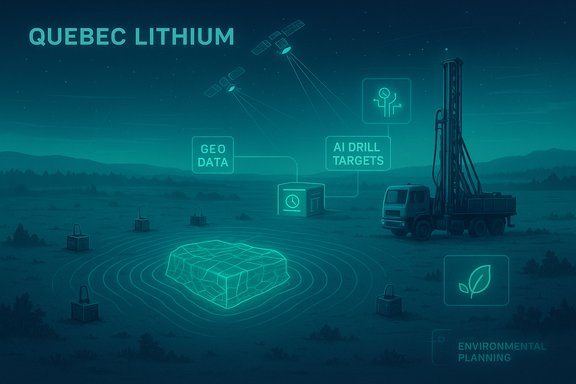
Fleet Space’s satellite‑enabled AI has helped expand the mapped boundaries of one of Quebec’s largest early‑stage lithium targets, a development that showcases the promise — and the caveats — of space‑driven mineral exploration as the battery metals scramble intensifies.
Background / Overview
Fleet Space Technologies’ ExoSphere platform combines ground sensors called Geodes, passive seismic imaging using Ambient Noise Tomography (ANT), a small constellation of low‑Earth‑orbit satellites, and cloud AI to produce rapid 3D subsurface models that guide drill targeting. The company says the system can deliver new drilling locations in as little as 48 hours and that the approach reduces on‑the‑ground disturbance compared with conventional wide‑area geophysical surveys and brute‑force drilling. Q2 Metals’ Cisco Lithium Project in Quebec’s Eeyou Istchee James Bay region is the recipient of ExoSphere‑guided targeting in the recent campaign. The company has published an initial exploration target for the main mineralized zone of 215 to 329 million tonnes at grades between 1.0% and 1.38% Li₂O — an early, conceptual estimate intended to guide follow‑up work but explicitly not a NI 43‑101 mineral resource or reserve. Q2’s drill program returned very wide spodumene‑bearing pegmatite intersections that remain open at depth and along strike. Multiple media outlets reported Fleet Space’s role in expanding the mapped extent and that ExoSphere’s work supported the latest drill results. The company’s own newsroom highlights the Q2 collaboration alongside other deployments, including a previous engagement with Barrick Gold at Reko Diq, illustrating how ExoSphere has been positioned in industry pilots and commercial projects.What Fleet Space actually did — technical snapshot
How ExoSphere works
- Geodes (portable sensors) are deployed across a survey area to record ambient seismic noise and other geophysical signals.
- Ambient Noise Tomography (ANT) uses that continuous, low‑amplitude seismic background (from wind, water, traffic and natural earth processes) to infer subsurface seismic velocity contrasts without active sources.
- Data from distributed Geodes are relayed via Fleet Space’s satellites to a central processing pipeline, which fuses multiphysics signals (seismic, electromagnetic, gravity) and applies machine learning models to generate 3D velocity and property models.
- The platform outputs ranked drill targets and a confidence metric intended to shorten the iterative cycle between geophysics and drilling.
Why this matters to exploration teams
- Speed: Fleet Space and several press reports highlight targets being generated in as little as 48 hours, cutting weeks or months of conventional processing. That rapid turnaround can accelerate seasonal programs or short field campaigns.
- Low footprint: Passive methods (ANT) and small, portable sensor networks reduce heavy‑equipment mobilization and the environmental footprint of reconnaissance surveys.
- Data fusion: Combining electromagnetic, gravity, and seismic proxies with machine learning aims to improve discriminating power for pegmatite‑hosted lithium systems that can be structurally complex.
What the Q2 / Cisco result actually is — reading the technical language
Q2 Metals has publicized drill intercepts that include very wide spodumene pegmatite intervals (for example: 272.5 m at 1.61% Li₂O in one hole and multiple intervals >100 m at grades above ~1.6% Li₂O in others). Those assays indicate continuous, thick pegmatites in parts of the Cisco 41,253‑hectare property. At the same time, Q2’s declared figure of 215–329 million tonnes at 1.0–1.38% Li₂O is an Exploration Target — a conceptual range derived from preliminary drilling and model interpolation, not an NI 43‑101 compliant mineral resource. That distinction is critical: Exploration Targets are inherently uncertain and require further drilling and technical studies to be converted into reported resources or reserves. Fleet Space’s communications and trade reporting emphasize that ExoSphere helped refine drill targeting that supported recent intercepts, but ground‑truthing — drilling, assaying, metallurgical testing and regulatory‑grade resource modeling — remains the standard path from prospect to mine. Fleet Space’s site also highlights broader deployments (Rio Tinto/Barrick collaborations, other commercial pilots), signaling the platform’s uptake across commodity types.Verifying headline claims: what can be corroborated and what is speculative
- The “329 million tonnes” headline number — corroborated as an exploration target range for Cisco (upper bound 329 Mt) published by Q2 Metals. This is not a declared resource or reserve; Q2 and independent consultants explicitly caution that the figure is conceptual and requires additional work.
- Fleet Space’s role and timeline claims (48‑hour targeting, ExoSphere guiding drills) — Fleet Space and multiple reputable outlets reported fast model delivery and that ExoSphere was used to refine drill programs at Cisco. Those operational claims are consistent across Fleet’s newsroom posts and third‑party reporting. The implication that the company’s workflow materially contributed to the recent wide intercepts is supported by company statements and industry coverage, though independent third‑party technical audits of the exact causal contribution remain unavailable.
- Industry success‑rate and economics statistics — figures such as “only about three out of every 1,000 prospects become commercially viable” (≈0.3%) and a traditional exploration project costing “$50–100 million” are widely cited in mining‑tech coverage and venture commentary; multiple industry articles and startup coverage repeat similar numbers. These are reasonable shorthand for the high‑risk, high‑cost nature of exploration, but they are broad averages that depend on commodity, jurisdiction, and a company’s definition of “prospect” and “commercially viable.” Treat such statistics as directional rather than precise deterministic facts.
- Claims about Fleet Space achieving "8 of 12" successful discoveries or "one‑tenth the cost" — several secondary outlets and news aggregators repeat these performance metrics, but close inspection shows Fleet Space’s public material and the Q2 releases do not contain a clear, independently audited dataset backing “8 of 12” or a consistent public figure for “one‑tenth the cost.” Those specific ratios appear in press summaries but are not currently traceable to an independent technical appendix or peer‑reviewed validation. Treat these numbers as claim‑level statements requiring independent verification before being used in commercial valuations.
Converting the headline tonnage into refined lithium: the math and why assumptions matter
Press coverage has translated the Cisco exploration‑target parameters into refined lithium carbonate (LCE) volumes and economic value — and those conversions depend on multiple chained assumptions. The industry uses standardized conversion factors to move between lithium chemistry units:- 1 tonne Li₂O ≈ 2.473 tonnes Li₂CO₃ (LCE).
- If the main mineralized zone contains 329 million tonnes of host rock at 1.38% Li₂O, the contained Li₂O mass ≈ 329,000,000 t × 0.0138 = ≈4.54 million tonnes Li₂O.
- Converting Li₂O to Li₂CO₃: 4.54 Mt Li₂O × 2.473 ≈ ≈11.23 million tonnes LCE.
- If an EV’s battery requires ~7 kg LCE (a low‑end figure used in some simplified comparisons), 11.23 Mt LCE ÷ 0.007 t ≈ ≈1.6 billion EVs, which aligns with the “1.6 billion EVs” figure quoted in some stories — but only under that low‑per‑vehicle LCE assumption.
- If an EV’s battery requires ~70 kg LCE (a more conservative figure for larger packs), 11.23 Mt LCE would support ≈160 million EVs. Industry estimates for LCE per EV vary considerably with pack chemistry, battery size, and cell design; therefore PV‑level EV numbers are highly sensitive to the chosen per‑car LCE assumption.
- At US$30,000 per tonne LCE, estimated value ≈ US$337 billion.
- At US$87,000 per tonne LCE, estimated value ≈ US$980 billion (a figure that appears in some media summaries).
- At spot values fluctuating in 2024–2025, LCE prices ranged widely in public indices and project studies; some corporate economic studies referenced prices near US$30k/t while commodity‑index spot reads in mid‑2025 showed much lower or higher values depending on timing and contract vs spot basis — price volatility means headline dollar figures are momentary and speculative without a disciplined price scenario.
Critical technical analysis: strengths, limitations, and open questions
Strengths and opportunities
- Faster decision cycles: Real‑time or near‑real‑time subsurface models can compress the reconnaissance‑to‑drill cycle and allow companies to target smaller, higher‑value drill campaigns. This reduces drill meters wasted on poor targets and can improve capital efficiency during expensive exploration phases.
- Lower surface disturbance: Passive sensors and small, distributed arrays mean less heavy seismic crew activity and lower environmental disturbance — a material benefit in sensitive jurisdictions and in permitting.
- Data fusion advantage: Multi‑physics fusion combined with ML ranking can pick up subtle contrasts and patterns that single‑method surveys might miss, especially in structurally complex pegmatite fields. Fleet Space’s collaborations with established mining companies suggest practical interest in deploying these tools at scale.
Limitations and important caveats
- ANT resolution and depth sensitivity: ANT is powerful for imaging contrasts but has physical resolution limits. Target discrimination for narrow or deeply buried bodies remains challenging, particularly in regions with complex noise fields or limited sensor apertures. ANT is about velocity contrasts, not direct mineralogy, so interpretation requires geologic context and calibration. Independent peer‑reviewed comparisons against conventional seismic or borehole data are still sparse in the public domain.
- Ground truth remains essential: Geophysical models cannot replace drilling. Companies must still validate targets by core drilling, assay, metallurgical testing, and resource modeling. ExoSphere can improve targeting efficiency, but converting an Exploration Target to a resource requires the established, multi‑stage technical pathway. Q2’s documentation explicitly states the exploration target is conceptual and needs further work to define a resource.
- Performance claims need independent audit: Metrics like “8 of 12 projects succeeded” or “one‑tenth the cost” are powerful marketing lines but must be audited. Exploration success is context‑sensitive: commodity type, deposit style, local geology, permit regimes and the definition of “success” vary. Independent verification or publication of raw survey results, tie‑in holes and before/after cost breakdowns would strengthen adoption across large majors.
- Economic and market risk: Lithium prices have swung dramatically in recent years. Any headline valuation of a project’s in‑ground value is a snapshot sensitive to forward price expectations and recovery assumptions. Mining project economics require capex, opex, processing route, permitting and community agreements — geophysics is only the first step.
- Community and regulatory dimensions: Faster identification and potential for rapid escalation of drill programs can stress permitting pathways and Indigenous/community consultation timeframes. Responsible development in Canada, especially in territories like Eeyou Istchee, demands meaningful local partnerships and environmental planning beyond simply proving a deposit. Q2’s communications note proximity to local infrastructure and traditional territories, and responsible engagement will be a key determinant of any project’s future.
How to read the competing narratives: hype vs. validated progress
- Headline translation: When a media headline announces “329 million tonnes” or “$980 billion value,” interpret the number as an exploration target converted through an assumption chain (grade → contained Li₂O → convert to LCE → assumed recovery → chosen price). Each link is an independent assumption.
- Proof of performance: The most persuasive technical evidence will be (a) independent technical appendices tying geophysical anomalies to drill intercepts, (b) case studies showing pre‑ vs post‑survey drill success metrics with control samples, and (c) peer‑reviewed or audit‑level documentation of the platform’s false‑positive/false‑negative rates. Absent that, treat commercial success claims as promising but preliminary.
- Valuation caution: Company or media valuations that multiply conceptual tonnes by spot prices ignore conversion losses, recovery rates, capital economics, and time‑value of money. Use scenario analysis and conservative price decks when modelling project value.
Practical recommendations for exploration teams and investors
- For exploration managers: pilot satellite + ANT surveys in parallel with a tightly scoped drill follow‑up program and publish clear pre‑/post‑deployment metrics (hit rate, meters saved, cost per successful meter). Demand transparent reporting on confidence measures and calibration against borehole data.
- For technical teams: insist on independent technical validation (NI 43‑101 or equivalent) before reclassifying exploration targets as resources; integrate ExoSphere outputs into traditional geological and structural models rather than replacing them.
- For investors and analysts: decompose headline claims into the underlying assumptions (grade, conversion, recovery, LCE per EV, price deck). Adopt sensitivity analyses and do not treat media valuations as definitive project economics.
- For communities and regulators: evaluate new survey technologies as tools that can reduce surface disturbance and drilling footprint, but require parallel commitments to consultation timelines, baseline studies, and transparent environmental thresholds.
Conclusion
Fleet Space’s ExoSphere and the Cisco result represent a clear example of how space‑enabled geoscience is moving from proof‑of‑concept to practical use in mineral exploration. Early commercial deployments and very wide drill intercepts at Cisco make the story compelling: rapid, lower‑impact surveys plus AI‑driven targeting can materially improve the economics and environmental profile of modern exploration.At the same time, the most attention‑grabbing numbers — the 329 million‑tonne upper bound, EV‑equivalent counts, and multibillion‑dollar in‑ground valuations — sit on a bed of assumptions that must be explicitly stated and scrutinized. The industry’s long history of low hit‑rates, the physical limits of passive seismic imaging, the continuing need for drilling to confirm geology, and volatile lithium prices all counsel caution.
This development is an important signal that geoscience and satellite technologies are converging to reshape how we look for critical minerals. The next phase will be rigorous, independently verifiable case studies and transparent performance metrics that let geologists, financiers, regulators and communities judge where the real, sustainable value lies.
Source: ARY News Fleet Space AI satellite tech expands massive lithium deposit in Quebec | ARY News