

GE Digital’s FlightPulse project is a clear example of how modern developer tools, Git-based workflows, and cloud platforms can compress the development cycle for safety‑critical aviation software — putting actionable flight data into pilots’ hands in months and delivering measurable gains in fuel efficiency and operational safety.
GE Digital built FlightPulse to solve a simple but high‑value problem: pilots make hundreds of operational choices every flight, yet they rarely see quantified feedback on how those choices affect fuel burn, safety margins, or emissions. FlightPulse turns post‑flight telemetry and aggregated fleet analytics into concise, pilot‑centric insights so crews can learn from their own flights and from anonymized industry data. The Microsoft case study that documented the early Qantas rollout notes that the platform put analytics into the hands of more than 3,000 Qantas pilots and that development moved far faster than traditional multi‑year programs thanks to Microsoft developer tooling, GitHub, and Azure CI/CD pipelines.
FlightPulse has evolved since that initial case study. GE Aerospace and GE Digital continued to expand the app’s reach, modules, and airline partnerships, and in recent years the registered pilot base for FlightPulse has climbed dramatically — GE reported milestones including tens of thousands of pilots and broad airline adoption. Those later figures show the product matured from a targeted Qantas deployment into a multi‑customer SaaS platform used by dozens of carriers and business‑jet operators.
Why airlines care: FlightPulse directly ties pilot behavior to three operational priorities:
At the same time, the story should be read with nuance. Reported outcomes often reference specific pilots, fleets, or procedures and are time‑bound. The larger rollout of FlightPulse into tens of thousands of pilots worldwide demonstrates commercial traction, yet it also introduces governance, trust, and security complexities that must be managed deliberately. External reporting and vendor press releases show both the promise and the operational realities of scaling telemetry products across regulated airlines.
For engineering teams and airline decision‑makers, the FlightPulse case offers a pragmatic blueprint: invest in modern developer tooling and CI/CD, design for operator trust and explainability, and prioritize robust data governance. When those elements converge, software can shift behavior on the flight deck in ways that improve safety, cut fuel use, and reduce emissions — and do so much faster than the classic multi‑year development timeline.
Source: Microsoft Microsoft | GE Digital helps make the skies safer with Microsoft development tools
 Background
GE Digital built FlightPulse to solve a simple but high‑value problem: pilots make hundreds of operational choices every flight, yet they rarely see quantified feedback on how those choices affect fuel burn, safety margins, or emissions. FlightPulse turns post‑flight telemetry and aggregated fleet analytics into concise, pilot‑centric insights so crews can learn from their own flights and from anonymized industry data. The Microsoft case study that documented the early Qantas rollout notes that the platform put analytics into the hands of more than 3,000 Qantas pilots and that development moved far faster than traditional multi‑year programs thanks to Microsoft developer tooling, GitHub, and Azure CI/CD pipelines. FlightPulse has evolved since that initial case study. GE Aerospace and GE Digital continued to expand the app’s reach, modules, and airline partnerships, and in recent years the registered pilot base for FlightPulse has climbed dramatically — GE reported milestones including tens of thousands of pilots and broad airline adoption. Those later figures show the product matured from a targeted Qantas deployment into a multi‑customer SaaS platform used by dozens of carriers and business‑jet operators.
Overview: what FlightPulse does and why it matters
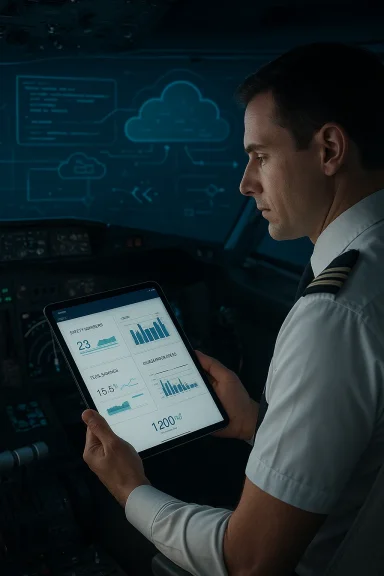
FlightPulse is designed as a pilot‑facing analytics app that integrates with the pilot’s Electronic Flight Bag (EFB). It exposes two high‑level functional areas:- Pre‑flight: aggregated, route‑level analytics and peer comparisons that feed into dispatch and briefing choices.
- Post‑flight: per‑flight metrics and trends so pilots can review specific maneuvers and long‑term habits (for example, reverse‑thrust usage, flap selection, and taxi strategies).
Why airlines care: FlightPulse directly ties pilot behavior to three operational priorities:
- Safety — highlighting deviations and near‑miss patterns so crews and training teams can address risk.
- Efficiency — surfacing fuel‑saving opportunities that add up across thousands of flights.
- Sustainability — quantifying emissions avoided through procedural changes, which supports airline ESG goals.
The development story: how Microsoft tools accelerated delivery
One of the most striking elements of the FlightPulse case is the development velocity. A project that might historically take years was delivered in months — and the technology choices were a major factor in that acceleration.Developer toolchain and platform
GE Digital’s engineering stack, as reported in Microsoft’s case study, included:- Visual Studio Code as the core editor, augmented by Live Share and IntelliCode for collaborative coding and AI‑assisted completions.
- GitHub for source control and pull request workflows, enabling distributed teams to iterate rapidly and reliably.
- ASP.NET Core and .NET Core for backend APIs.
- Blazor for the configuration console and UI components, enabling code sharing between client and server.
- Azure Pipelines to automate builds, tests, and security checks inside CI/CD flows.
DevOps and security by design
GE embedded security scanning and governance into the build pipelines, so compliance and code quality checks ran automatically at each commit. This DevSecOps posture reduced manual handoffs and late‑stage rework — an important factor for regulated industries like aviation, where auditability and traceability are non‑negotiable. The Azure pipeline automation also simplified release management for mobile EFB deployments and API upgrades.Technical architecture, at a glance
FlightPulse’s architecture can be described in three layers:- Edge & ingestion
- Aircraft sensors produce time‑series telemetry that GE’s Event Measurement System (EMS) ingests.
- Data is normalized, compressed, and securely transmitted to backend services.
- Cloud processing & analytics
- Azure services and GE’s analytics pipelines process raw telemetry into flight events and pilot metrics.
- Aggregation and anonymization layers compute peer comparisons and fleet‑level KPIs.
- Client & operations
- EFB apps (iPad and tablet form factors) and web consoles present Pre‑flight and Post‑flight modules.
- A Config Console (built with Blazor) provides airline safety and efficiency teams with controls to tune what pilots see.
Measured impact and adoption — read the numbers carefully
Early in the Qantas deployment, GE and Microsoft reported meaningful operational uplift:- Adoption: Microsoft’s 2020 case study states FlightPulse was made available to “more than 3,000 Qantas pilots.” That figure is anchored in the May 18, 2020 account of the Qantas rollout.
- Fuel efficiency: Qantas pilots were said to have increased their use of fuel‑saving techniques by up to 15 percent in measured contexts, with each kilogram of fuel saved equating to approximately three kilograms of CO2 avoided. Those outcome metrics were reported alongside the case study.
- Scale since launch: FlightPulse’s installed base grew substantially after the initial Qantas deployment. GE’s corporate releases in 2025 recorded tens of thousands of pilots using FlightPulse globally and a rapid expansion in airline customers — underscoring that the product transitioned from a single‑airline pilot program to a broad SaaS offering.
Why this approach works — strengths and practical advantages
FlightPulse’s success illustrates several repeatable strengths for other safety‑critical industries:- Pilot empowerment through data: giving frontline operators concise, personally relevant feedback encourages voluntary behavior change without heavy managerial enforcement. That fosters trust if the program is run transparently.
- Lean feedback loops: modern editors, Git workflows, and cloud pipelines reduce friction between ideation and delivery, enabling teams to test UX changes with real users quickly.
- Cloud elasticity for analytics: Azure’s ability to scale compute for large telemetry processing tasks allows teams to run fleet‑scale analytics without massive upfront infrastructure investment. That lets airlines try analytics features incrementally and scale what works.
- Modular product design: packaging Pre‑flight and Post‑flight as modular components simplifies deployment and allows airlines to opt into specific capabilities as their operational programs mature.
Risks, limits, and governance considerations
No technology is risk‑free, and telemetry‑driven performance programs in regulated, safety‑critical domains raise specific governance and human factors issues.Trust, privacy, and non‑punitiveness
Pilots (and unions) are naturally concerned about surveillance and punitive use of data. GE and airline partners repeatedly emphasized that FlightPulse was intended for improvement, not punishment — an explicit non‑punitiveness policy is essential for adoption. Absent strong governance, pilots will avoid or manipulate metrics, rendering the analytics ineffective. This is a common theme across aviation reporting on FlightPulse and similar programs.Data governance and provenance
Telemetry must be curated, timestamped, and traceable. If metrics are computed incorrectly because of mis‑aligned event definitions or missing metadata, the resulting feedback will be misleading. Industrial deployments require documented asset models, tag mapping, and provenance tracking — governance work that is often invisible but essential. Industry analysis of cloud‑based operational platforms stresses that data‑quality controls and asset mapping are the largest non‑technical risks in these programs.Security and attack surface
Delivering pilot telemetry into cloud services increases the attack surface. Practices such as strict identity controls, endpoint hardening, least‑privilege API access, and continuous monitoring are mandatory. Embedding security scans in pipelines helps, but runtime protections and anomaly detection are just as important for aviation data.Vendor and platform lock‑in
Relying on a single cloud ecosystem and managed services can make long‑term portability harder. Airlines should model data export, multi‑cloud or hybrid approaches, and contractual commitments that preserve operational continuity if vendor strategies shift. This is especially relevant for global carriers operating under diverse regulatory regimes. Industry advisories on cloud migration and hybrid analytics emphasize planning for portability and governance.Adoption playbook: how airlines and software teams should approach a FlightPulse‑style program
Below is a practical, sequential path that converges engineering rigor with operational adoption.- Define the safety and efficiency metrics you will measure, and publish the definitions to stakeholders.
- Establish non‑punitiveness policies with unions and staff councils before any pilot begins.
- Build a secure ingestion pipeline and an asset framework that maps telemetry to canonical aircraft systems.
- Implement DevSecOps: automate builds, tests, and security scans in CI/CD pipelines (for example, Azure Pipelines or GitHub Actions).
- Pilot with a small, engaged crew cohort to validate UX and trust, then iterate using real pilot feedback.
- Expand with phased rollouts, adding analytics modules tied to measurable KPIs (fuel, approach stability, dispatch deviations).
- Maintain an audit trail, explainability features, and human‑in‑the‑loop review for any system that recommends operational changes.
A closer look at human factors and behavioral change
Analytics only matter if the target audience changes behavior. FlightPulse’s design emphasizes:- Short, actionable summaries rather than raw logs.
- Peer benchmarking that motivates rather than shames.
- Ability for pilots to self‑monitor like athletes using fitness trackers.
Broader implications: a template for other safety‑critical sectors
FlightPulse illustrates a transferable pattern: combine domain‑aware analytics with a pilotable, low‑friction UX and run it on a cloud platform using modern developer toolchains.- Rail and mass transit could apply similar telemetry‑to‑operator feedback loops to improve braking profiles and energy usage.
- Maritime operations can expose navigational and fuel efficiency metrics to bridge crews.
- Power generation and grid operations can provide operators with short, operational decision aids derived from plant telemetry.
Critical appraisal and closing thoughts
FlightPulse is a compelling demonstration of how integrated developer tooling, cloud platforms, and focused UX design can produce rapid, verifiable outcomes in a safety‑critical context. The Microsoft case study documents an early Qantas rollout that delivered measurable fuel‑saving behaviors and a rapid development cycle using Visual Studio Code, GitHub, ASP.NET Core, Blazor, and Azure Pipelines.At the same time, the story should be read with nuance. Reported outcomes often reference specific pilots, fleets, or procedures and are time‑bound. The larger rollout of FlightPulse into tens of thousands of pilots worldwide demonstrates commercial traction, yet it also introduces governance, trust, and security complexities that must be managed deliberately. External reporting and vendor press releases show both the promise and the operational realities of scaling telemetry products across regulated airlines.
For engineering teams and airline decision‑makers, the FlightPulse case offers a pragmatic blueprint: invest in modern developer tooling and CI/CD, design for operator trust and explainability, and prioritize robust data governance. When those elements converge, software can shift behavior on the flight deck in ways that improve safety, cut fuel use, and reduce emissions — and do so much faster than the classic multi‑year development timeline.
Source: Microsoft Microsoft | GE Digital helps make the skies safer with Microsoft development tools
