

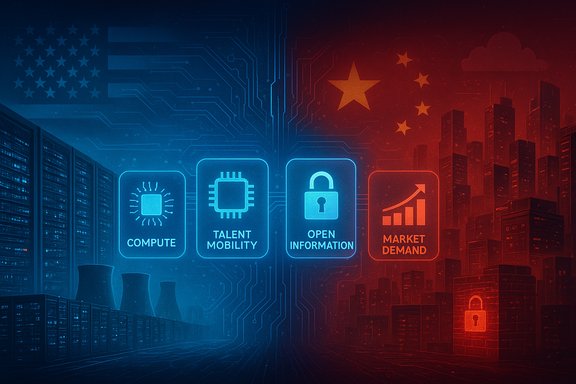
China’s apparent rush toward AI supremacy collided with a set of deeper structural limits long before headlines about market shocks and “Sputnik moments” began to dominate tech feeds this year, and two prominent Chinese scholars at Stanford argue those limits will likely cost Beijing the race for global AI leadership. Their case rests on four interlocking deficits — compute, talent mobility, open information, and domestic demand — each of which matters far more to frontier AI than is commonly appreciated. The argument is sobering for technologists and investors alike: breakthroughs in generative AI are no longer just software stories, they are hardware-and-institutions stories, and those who control large-scale compute, open research ecosystems, and robust market demand are best placed to reap the economic spoils.
AI’s economic promise has leapt from academic curiosity to macroeconomic force. International organizations and governments now project multi-trillion-dollar markets and measurable GDP gains from AI-driven productivity over the coming decade. The UN Conference on Trade and Development (UNCTAD) estimates the AI market could grow by roughly 25-fold from 2023 levels and reach almost $4.8 trillion by 2033, a change that threatens to concentrate value in the hands of a few nations and corporations. The International Monetary Fund’s staff scenarios likewise suggest that AI-driven productivity gains — while highly uncertain — could lift global output materially, with more optimistic IMF scenarios implying multi-percent gains for advanced economies over a ten-year horizon and particularly strong benefits for the United States. Those same staff assessments show the gains will be uneven: advanced, high-wage economies that have strong digital infrastructure and deep capital markets stand to capture a larger share of the upside. Against this macro backdrop, a single startup’s surprise release can become a geopolitical stress-test. In January 2025, a Chinese firm called DeepSeek released an open model that claimed competitive performance at dramatically lower training cost — and markets reacted as if a tectonic shift had occurred. Nvidia’s share price plunged on heavy volume the week DeepSeek’s claims circulated, only to rebound as analysts and company executives cautioned that the fundamentals of the compute market had not changed overnight. The episode crystallised the central debate: can algorithmic / software efficiencies substitute for raw compute and the cloud-scale ecosystems that undergird the current generation of frontier models? Evidence to date is mixed.
This creates a two-way advantage for the US: it attracts and retains international talent through visas, compensation, and the prestige of leading labs; and it benefits from a multiplier effect where private capital, entrepreneurial ecosystems, and academic openness accelerate the translation of research into products. When geopolitical tensions harden, pathways for collaboration and mobility can narrow, amplifying the advantage of whichever country retains open exchange, capital flexibility, and a dynamic startup ecosystem.
For technologists, entrepreneurs, and Windows ecosystem participants, the decisive takeaway is practical rather than ideological: whoever builds resilient, efficient, and portable AI stacks — and pairs them with trustworthy governance and strong developer tools — will capture the lion’s share of the near‑term benefits. The race is not only about national champions; it’s about platforms, standards, and the ability to turn compute advantage into durable products that solve real customer problems.
Source: EJ Insight China will lose AI war with U.S. – Chinese scholars EJINSIGHT - ejinsight.com
 Background
AI’s economic promise has leapt from academic curiosity to macroeconomic force. International organizations and governments now project multi-trillion-dollar markets and measurable GDP gains from AI-driven productivity over the coming decade. The UN Conference on Trade and Development (UNCTAD) estimates the AI market could grow by roughly 25-fold from 2023 levels and reach almost $4.8 trillion by 2033, a change that threatens to concentrate value in the hands of a few nations and corporations. The International Monetary Fund’s staff scenarios likewise suggest that AI-driven productivity gains — while highly uncertain — could lift global output materially, with more optimistic IMF scenarios implying multi-percent gains for advanced economies over a ten-year horizon and particularly strong benefits for the United States. Those same staff assessments show the gains will be uneven: advanced, high-wage economies that have strong digital infrastructure and deep capital markets stand to capture a larger share of the upside. Against this macro backdrop, a single startup’s surprise release can become a geopolitical stress-test. In January 2025, a Chinese firm called DeepSeek released an open model that claimed competitive performance at dramatically lower training cost — and markets reacted as if a tectonic shift had occurred. Nvidia’s share price plunged on heavy volume the week DeepSeek’s claims circulated, only to rebound as analysts and company executives cautioned that the fundamentals of the compute market had not changed overnight. The episode crystallised the central debate: can algorithmic / software efficiencies substitute for raw compute and the cloud-scale ecosystems that undergird the current generation of frontier models? Evidence to date is mixed. Overview: The Four Structural Constraints Shaping the AI Race
1. Compute: the physical bottleneck beneath the hype
Compute — the mass of processors, accelerators, and datacenter power required to train and run large models — is not fungible. A clear advantage in compute yields not only raw training capacity but also the ability to run repeated experiments, scale models, and deploy them globally. Multiple independent analyses and datasets indicate the United States and US-based hyperscalers dominate the commercial compute landscape, with the biggest cloud platforms (Amazon Web Services, Microsoft Azure, Google Cloud) collectively controlling roughly two-thirds of the enterprise cloud infrastructure market in mid‑2025. That market concentration translates directly into access to frontier GPUs, specialised AI accelerators, and integrated software stacks. Several sectoral studies and compute-tracking projects have quantified national shares of “AI compute” and found a very large advantage for the US over China at the global level. While exact percentages vary by dataset and methodology, multiple credible estimates place US-affiliated compute capacity at a substantial share of publicly visible AI-class compute, with China materially behind — a gap that export controls, foundry dependencies, and hyperscaler scale make difficult to close quickly. Even where China reports large domestic capacity, opaque reporting and non‑benchmarking of many national systems complicate direct comparisons; nevertheless, the effective compute available to commercial AI teams — the accelerators, cloud-hosted GPUs, software toolchains, and high‑frequency experimentation cycles — favors the US ecosystem. Why this matters for Windows users and developers: larger commercial compute pools mean faster iteration, more advanced off-device inference endpoints, and broader cloud services that integrate directly into developer toolchains (including Microsoft’s own cloud services and developer APIs that interact with Windows tooling). When compute is concentrated, platform-level features (like Windows Copilot, Edge integrations, and enterprise ML services) evolve faster and tie directly to cloud economics.2. Talent and intellectual ecosystems
Talent is the second pillar. China produces a very large number of AI-trained graduates and is a major source of top researchers globally, yet the mobility and cross-border exchange of talent — along with the open contest of ideas — remain easier in the US-led research ecosystem. The upshot is that many of the leading AI breakthroughs emerge from labs and mixed teams based in the US, even where individual researchers were born or educated elsewhere.This creates a two-way advantage for the US: it attracts and retains international talent through visas, compensation, and the prestige of leading labs; and it benefits from a multiplier effect where private capital, entrepreneurial ecosystems, and academic openness accelerate the translation of research into products. When geopolitical tensions harden, pathways for collaboration and mobility can narrow, amplifying the advantage of whichever country retains open exchange, capital flexibility, and a dynamic startup ecosystem.
3. Open information, research norms, and data quality
Breakthroughs in generative and multimodal models rely heavily on large, high-quality datasets and the open exchange of methods. The US research corpus — journals, preprints, code repositories and English-language internet text — remains massive and easily sharable across borders. China has impressive capabilities in surveillance-derived datasets and video collection, but those sources often suffer from siloing, censorship, and governance constraints that reduce their usefulness for open scientific progress and for building globally deployable models. Moreover, multimodal world-model progress depends on richly labeled, interoperable healthcare, industrial, and sensor data — categories where cross-border sharing and standards matter.4. Demand-side fundamentals: market incentives for automation and adoption
Industrial revolutions are rarely supply-side phenomena alone; demand matters. High labor costs, deep consumer markets, and enterprise willingness to pay for automation accelerate adoption. The United States, with high per-capita GDP and pervasive demand for productivity gains, creates persistent incentives for firms to adopt and commercialise AI across sectors. China’s economy, by contrast, faces demand headwinds — slow consumption growth, deflationary pressures in some sectors, and credit stress in others — which, according to the Stanford scholars, dampen the commercial tailwinds that historically accelerate industrial revolutions. The implication: even with strong state-led investment in AI, weak underlying demand can constrain the conversion of research and infrastructure into broad-based economic gains.DeepSeek: a case study in hype, efficiency, and market reaction
DeepSeek’s widely publicised R1 model posed a provocative question: if a team can radically improve efficiency — requiring far less training compute while delivering comparable performance — does the compute advantage suddenly matter less? The market’s initial answer was dramatic: DeepSeek’s January 2025 release coincided with an acute selloff in AI-related equities, with Nvidia experiencing its largest single‑day percentage decline in years as investors re-priced the outlook for expensive data‑centre capex. Within days, however, analysts pushed back: even if more efficient model families reduce some training demand, they often increase inference-level compute at scale, and they still rely on robust toolchains and clouds to deploy and iterate. Nvidia’s executives publicly framed DeepSeek as an “illustration” of different approaches, not as an existential threat to hardware demand, and markets stabilised as capital re-assessed longer-term orders and hyperscaler roadmaps. Key takeaways from the DeepSeek episode:- Efficiency does not automatically eliminate compute demand. Many efficiency techniques reduce peak training cost but increase iteration frequency or inference workload as applications scale.
- Open-source breakthroughs accelerate adoption but can raise trust and compliance questions for global enterprise customers when models emerge from jurisdictions with different governance norms.
- Market panic is a blunt instrument. Short-term volatility reflected investor reassessments, not a fundamental reversal in hyperscaler capex plans; long-run demand for specialized accelerators remains linked to services and enterprise adoption.
Why the United States still holds durable advantages
- Hyperscaler scale and integrated cloud services. AWS, Azure, and Google Cloud together held about 63% of the global enterprise cloud infrastructure market in Q2 2025. That combined scale gives US providers bargaining power over semiconductor demand, global datacenter footprints, and enterprise-go‑to‑market relationships. For developers in the Windows ecosystem, that means richer cloud-native ML services and lower friction for deploying AI-enhanced desktop and enterprise apps.
- Capital markets and private investment volume. Private investment in AI remained heavily concentrated in the US through 2024 and 2025, enabling high‑risk, high-cost frontier pursuits (massive training runs, custom chips, and proprietary data strategies) that smaller or state-led systems find harder to match at scale.
- Ecosystem coupling between hardware, software, and tools. From developer SDKs to production ML platforms and app marketplaces, the US model of open-market competition plus deep private capital fosters rapid productisation of AI research. Microsoft’s positioning — integrating cloud services, Windows desktop features, and developer tools — demonstrates how platform-level integration can amplify the US edge for software ecosystems.
China’s strengths and strategies: why the gap isn’t permanent
China is not a static laggard. The country’s strengths are real and growing:- Massive domestic data generation (particularly in video and industrial telematics).
- Rapidly expanding datacenter and electricity capacity, with ambitious national plans and large state funds directed at AI infrastructure.
- A thriving domestic software engineering talent pool and a cadre of ambitious startups that iterate fast under different market incentives.
The geopolitics of export controls, supply chains and “compute sovereignty”
Export controls on advanced AI chips are an increasingly salient lever. By restricting access to cutting-edge accelerators, export regimes can slow a rival’s ability to field the largest-scale training runs. That is precisely one of the dynamics behind the compute gap: advanced nodes and accelerators are manufactured in a handful of geographies and depend on ecosystem players (TSMC, Nvidia, foundry equipment suppliers) that are themselves networked across countries. Efforts to bifurcate the semiconductor supply chain — or to build alternative domestic stacks — are costly and take time, but they remain a major focus of state industrial strategy in China and elsewhere. Policy responses vary, and the future is not binary. Scenarios include:- Bipolar duopoly — persistent US-China split in compute and standards.
- Regional blocs — compute alliances (US-Gulf-Latin America vs East Asia) with shared infrastructure.
- Cloud oligopoly — hyperscalers maintain top-tier compute but license access widely.
- Distributed sovereignty — breakthroughs in energy-efficient or decentralised compute reduce concentration risk.
Risks, caveats, and unverified claims
Good journalism requires flagging the claims that deserve caution:- Many headline numbers about market caps, precise compute shares, or training‑cost claims are sensitive to methodology and timing. Estimates that the US “controls 75%” of global AI compute and China “15%” are widely repeated but depend on which compute pools are counted (public Top500-class systems vs private hyperscaler fleets vs opaque national deployments). Multiple independent datasets converge on a substantial US lead, but the precise percentage is not a single, incontrovertible fact. Readers should treat single‑point estimates as indicative rather than definitive.
- The IMF’s productivity scenarios are model-dependent. The “5.4% gain for the United States over a decade” appears in optimistic staff scenarios that rely on specific adoption trajectories and policy environments; less optimistic assumptions yield smaller gains. These projections are useful to frame scale, not to promise deterministic outcomes.
- DeepSeek’s claims about training costs and performance were debated vigorously in the months after its release. Independent verification of every technical claim remains incomplete in public sources; market reactions reflected investor sentiment as much as technical reality. The episode does, however, underscore that algorithmic efficiency and open-source approaches can shift dynamics even without immediately overturning hardware demand.
What this means for Windows users, developers and IT decision-makers
- Local development and GPU access. Expect volatility in GPU availability and pricing as global demand for data‑centre accelerators and consumer/prosumer GPUs shifts. For developers building AI-enhanced Windows apps or on-device features, this underscores the importance of designing for efficiency and multi-cloud portability.
- Cloud-first architectures will keep winning. Features that rely on server-side inference and cloud‑based updates will continue to outpace purely local models in capability; Windows remains a strategic endpoint for those cloud services, but reliance on US-based cloud providers can have geopolitical and compliance implications for global firms.
- Open-source models matter — but trust and governance do, too. Open models democratise capabilities and accelerate experimentation. However, enterprise adoption depends heavily on provenance, compliance, and lifecycle governance. Business users will demand signed models, audited data practices, and explainability — all areas with market opportunities for toolmakers in the Windows ecosystem.
- Enterprise buyers will reward integration and support. Vendors that can package model hosting, lifecycle management, and regulatory compliance — while integrating tightly with desktop and server OS features — will capture disproportionate share of enterprise spending.
Practical guidance (short checklist)
- For PC builders and gamers: diversify GPU procurement strategies and monitor both consumer and enterprise supply channels.
- For ISVs and enterprise IT: prioritise cloud‑native deployment paths with edge‑fallbacks and focus on inference efficiency to control operating costs.
- For developers: build modular apps that can switch inference backends (local, private cloud, public cloud) to manage geopolitical and cost risks.
- For IT policy teams: develop model‑governance frameworks that include provenance checks, red‑team testing, and a compliance playbook for cross‑border deployments.
Conclusion
The argument that China will “lose” the AI war is not a deterministic forecast but a structural thesis: today’s frontier AI leaders enjoy a compound advantage rooted in scale of compute, openness of research ecosystems, depth of private capital, and domestic demand dynamics. China counters with scale of its own — vast datacentres, aggressive state funding, and a deep engineering bench — but crucial bottlenecks remain, particularly in access to leading-edge accelerators, integrated cloud services, and the open scientific infrastructure that accelerates global innovation.For technologists, entrepreneurs, and Windows ecosystem participants, the decisive takeaway is practical rather than ideological: whoever builds resilient, efficient, and portable AI stacks — and pairs them with trustworthy governance and strong developer tools — will capture the lion’s share of the near‑term benefits. The race is not only about national champions; it’s about platforms, standards, and the ability to turn compute advantage into durable products that solve real customer problems.
Source: EJ Insight China will lose AI war with U.S. – Chinese scholars EJINSIGHT - ejinsight.com
