

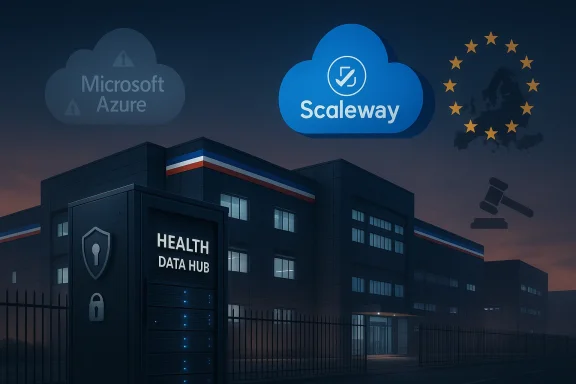
France’s Health Data Hub is poised for a significant cloud shift, with Scaleway set to replace Microsoft Azure as its cloud partner in a move that underscores how sovereignty concerns have reshaped Europe’s public-sector technology strategy. The change is more than a vendor swap: it reflects years of legal scrutiny, political pressure, and a broader European push to keep sensitive data away from providers that can be exposed to non-EU legal reach. For Microsoft, the loss is symbolic as much as commercial; for Scaleway, it is a watershed moment that could materially strengthen its standing in France’s trusted-cloud market.
The Health Data Hub has always sat at the intersection of innovation and controversy. Created to make France’s national health data more accessible for research and public-interest projects, the platform was conceived as a centralized gateway for sensitive medical information at a time when health analytics, AI, and secure cloud computing were rapidly converging. Its ambition was clear: unlock data-driven research without weakening privacy protections or public trust.
From the start, however, the platform’s hosting choice became politically charged. The decision to rely on Microsoft Azure triggered criticism from privacy advocates and sovereignty hawks, who argued that even if data were stored in Europe, an American provider remained vulnerable to foreign legal demands. That concern intensified after the Schrems II ruling, which invalidated the EU-US Privacy Shield and forced public bodies to reassess transatlantic cloud arrangements.
The debate was not purely theoretical. France’s CNIL and the Conseil d’État both acknowledged the risk that health data hosted by a US-linked provider could be subject to transfer requests or legal exposure under US law. In practical terms, that meant the Health Data Hub’s cloud architecture was never just a technical implementation choice; it was a test case for how Europe would balance data utility, public health, and digital sovereignty.
In parallel, the French government’s cloud doctrine matured. Over time, the center of gravity moved toward providers that could satisfy stricter expectations around sovereign cloud, security qualification, and effective resistance to extraterritorial access. That environment created an opening for European suppliers such as Scaleway, which has spent recent years positioning itself as a serious alternative to the hyperscalers.
It also reflects the reality that cloud in the public sector is now judged on more than raw scale. Governments increasingly care about where data lives, who controls the keys, what jurisdiction applies, and whether providers can demonstrate compliance with French and European security expectations. In that context, Scaleway’s appeal lies not only in being European, but in being able to align with France’s trusted cloud narrative.
The decision also gives French institutions a domestic alternative that can be held up as evidence that Europe’s cloud ecosystem is maturing. That matters in Brussels, too, where policymakers want to reduce dependence on American hyperscalers without sacrificing modern cloud capabilities.
The platform’s purpose has always justified caution. Health data is uniquely sensitive because it can reveal diagnoses, treatment histories, demographic patterns, and other personal details that can be misused if protections fail. This is why the hosting provider must be judged not only on uptime and cost, but on privacy architecture, auditability, and legal exposure.
This is where cloud choice becomes strategic. A platform meant to accelerate research cannot afford to be seen as a legal liability. If users doubt the sovereignty of the hosting environment, they may question the legitimacy of the data-sharing model itself.
The pressure built over time through court proceedings, regulatory commentary, and a broader European backlash against transatlantic dependence. The Health Data Hub became a symbol of a wider problem: Europe’s most sensitive workloads often ran on infrastructure owned or controlled by companies outside Europe. That contradiction became harder to justify as EU policy matured.
CNIL’s earlier warnings and the Council of State’s scrutiny gave those concerns institutional weight. Once courts and regulators enter the picture, cloud architecture stops being an internal engineering choice and becomes a governance issue.
Scaleway has spent years building a narrative around European cloud independence, and this deal fits that narrative perfectly. The company has made visible moves toward stronger security positioning, including entry into the SecNumCloud qualification process, while also expanding its product and partner ecosystem. The Health Data Hub contract validates those efforts in a highly visible domain.
The deal could also help Scaleway attract integrators, cybersecurity firms, and application partners that want exposure to sovereign workloads. In cloud, prestige contracts often have network effects that extend beyond the original customer.
This trend has been reinforced by French and European policy discussions around digital resilience. A provider’s nationality, governance, subcontractor chain, and legal exposure are now part of the decision matrix. That is a substantial departure from the old model, in which cloud decisions were dominated by price and performance alone.
Scaleway’s progress in this area matters because it shows that European firms can compete not only on patriotism, but on governance. The more public buyers accept that framing, the more sustainable sovereign cloud becomes as a market segment.
That said, enterprise buyers will still judge Scaleway on operational realities. Sovereignty may open the door, but performance, ecosystem depth, migration tooling, and support quality will determine whether clients stay. In other words, the symbolic win must still translate into day-to-day reliability.
If Scaleway can deliver on those expectations, the Health Data Hub award may serve as a proof point that sovereign cloud is ready for mainstream adoption. If not, the contract will remain an important but isolated reference case.
The public also benefits if the move helps reassure researchers, hospitals, and regulators that data sharing can proceed under clear rules. Public trust is not a soft benefit here; it is a prerequisite for the platform’s usefulness. Without trust, participation shrinks and the research value of the entire hub declines.
The cloud partner is therefore part of the trust architecture. It is not just hosting servers; it is helping define what “safe access” means in practice.
AWS and Google face the same structural challenge. Even when they invest in European regions, local partnerships, and compliance programs, they still operate under legal frameworks that European governments may view as insufficiently insulated from extraterritorial exposure. The Health Data Hub decision may therefore be read as a template, not an exception.
That means competition in sensitive markets may increasingly depend on who can credibly claim jurisdictional neutrality, not just who can deliver the most sophisticated platform.
Technical teams will need to ensure that performance, resilience, logging, backup strategy, and access control remain strong during and after the switch. The challenge is especially delicate because health data systems must maintain strong assurances even while changing infrastructure. The migration itself becomes part of the trust story.
The Health Data Hub transition will be judged partly on whether users experience any disruption. In a sensitive environment, even minor friction can draw attention.
The wider European cloud market will also be watching carefully. Public-sector workload placement is often a bellwether for broader adoption, and this particular workload carries unusually strong symbolic weight. If Scaleway succeeds here, it could help normalize the idea that sensitive national platforms do not need to sit on US hyperscaler infrastructure to be secure, modern, or scalable.
Source: Telecompaper Scaleway to replace Microsoft as cloud partner of France's Health Data Hub
 Background
The Health Data Hub has always sat at the intersection of innovation and controversy. Created to make France’s national health data more accessible for research and public-interest projects, the platform was conceived as a centralized gateway for sensitive medical information at a time when health analytics, AI, and secure cloud computing were rapidly converging. Its ambition was clear: unlock data-driven research without weakening privacy protections or public trust.From the start, however, the platform’s hosting choice became politically charged. The decision to rely on Microsoft Azure triggered criticism from privacy advocates and sovereignty hawks, who argued that even if data were stored in Europe, an American provider remained vulnerable to foreign legal demands. That concern intensified after the Schrems II ruling, which invalidated the EU-US Privacy Shield and forced public bodies to reassess transatlantic cloud arrangements.
The debate was not purely theoretical. France’s CNIL and the Conseil d’État both acknowledged the risk that health data hosted by a US-linked provider could be subject to transfer requests or legal exposure under US law. In practical terms, that meant the Health Data Hub’s cloud architecture was never just a technical implementation choice; it was a test case for how Europe would balance data utility, public health, and digital sovereignty.
In parallel, the French government’s cloud doctrine matured. Over time, the center of gravity moved toward providers that could satisfy stricter expectations around sovereign cloud, security qualification, and effective resistance to extraterritorial access. That environment created an opening for European suppliers such as Scaleway, which has spent recent years positioning itself as a serious alternative to the hyperscalers.
Why This Change Matters
The selection of Scaleway is best understood as a policy statement as much as an operational decision. France is signaling that the hosting of its most sensitive health infrastructure should rest with a provider that is not subject to non-EU legal pressure in the same way a US cloud giant is. That is a substantial shift in procurement philosophy and an unmistakable nod to the long-running debate over digital sovereignty.It also reflects the reality that cloud in the public sector is now judged on more than raw scale. Governments increasingly care about where data lives, who controls the keys, what jurisdiction applies, and whether providers can demonstrate compliance with French and European security expectations. In that context, Scaleway’s appeal lies not only in being European, but in being able to align with France’s trusted cloud narrative.
The sovereignty signal
For public buyers, the message is simple: critical national data should sit with vendors that are easier to reconcile with French legal and political priorities. That does not automatically make a provider more secure, but it does make the compliance story easier to defend. In a sector as sensitive as health data, defensibility matters almost as much as performance.The decision also gives French institutions a domestic alternative that can be held up as evidence that Europe’s cloud ecosystem is maturing. That matters in Brussels, too, where policymakers want to reduce dependence on American hyperscalers without sacrificing modern cloud capabilities.
What the decision says about procurement
The move suggests that procurement criteria are shifting toward sovereignty-first requirements. Those requirements are no longer abstract talking points; they are becoming formalized in tenders, framework agreements, and security qualification regimes.- Jurisdiction is now a procurement factor, not just a legal footnote.
- Cloud locality is no longer enough on its own.
- Security certification increasingly determines eligibility.
- Public trust is treated as an infrastructure requirement.
- European vendor resilience is becoming a strategic objective.
The Health Data Hub’s Role in French Health Policy
The Health Data Hub is not a niche IT platform. It sits at the center of how France wants to modernize health research, epidemiology, and public-sector data access. That makes every hosting decision politically visible and operationally consequential. When the platform changes cloud partners, it sends a signal about how France wants to govern one of its most sensitive digital assets.The platform’s purpose has always justified caution. Health data is uniquely sensitive because it can reveal diagnoses, treatment histories, demographic patterns, and other personal details that can be misused if protections fail. This is why the hosting provider must be judged not only on uptime and cost, but on privacy architecture, auditability, and legal exposure.
Research utility versus privacy assurance
The core tension is straightforward: researchers want broad, timely access to rich data, while regulators want strict controls and irreversibility. The Health Data Hub was designed to reconcile those goals by centralizing access under controlled conditions. But the more central and valuable the repository becomes, the more important the trust framework around it becomes.This is where cloud choice becomes strategic. A platform meant to accelerate research cannot afford to be seen as a legal liability. If users doubt the sovereignty of the hosting environment, they may question the legitimacy of the data-sharing model itself.
Why health data is different
Health data is not like ordinary enterprise content. It can affect citizens directly if mishandled, and its misuse can erode trust in public institutions for years. That makes the platform’s cloud partner part of the public-health ecosystem, not merely an IT supplier.- Data sensitivity is exceptionally high.
- Trust is essential for researcher participation.
- Legal challenge risk is much higher than in ordinary workloads.
- Public perception can shape adoption and legitimacy.
- Security failures can have democratic and medical consequences.
Microsoft’s Legacy and the Pressure Behind the Pivot
Microsoft’s presence in the Health Data Hub was never just about technology quality. Azure was a pragmatic choice at a time when the platform needed scale, reliability, and rapid deployment. But once the sovereignty debate hardened, that practicality became politically fragile. The fact that Azure hosted data in Europe was never enough to silence concerns about access under US law.The pressure built over time through court proceedings, regulatory commentary, and a broader European backlash against transatlantic dependence. The Health Data Hub became a symbol of a wider problem: Europe’s most sensitive workloads often ran on infrastructure owned or controlled by companies outside Europe. That contradiction became harder to justify as EU policy matured.
The legal backdrop
The post-Schrems II world changed the cloud procurement conversation dramatically. It was no longer sufficient to say that data remained in European data centers if the provider’s corporate structure left open the possibility of foreign access demands. For public bodies, that made vendor nationality and control structures far more salient.CNIL’s earlier warnings and the Council of State’s scrutiny gave those concerns institutional weight. Once courts and regulators enter the picture, cloud architecture stops being an internal engineering choice and becomes a governance issue.
Why Microsoft was vulnerable
Microsoft was vulnerable because it represented the very category that European digital sovereignty efforts were trying to reduce dependence on: a dominant non-EU hyperscaler. Even when such a vendor offers strong security controls, the political optics are difficult. In sensitive sectors, optics can translate directly into procurement outcomes.- Scale was no longer enough to guarantee acceptance.
- European compliance was necessary but not always sufficient.
- Political symbolism became a business risk.
- Public-sector trust increasingly favored local alternatives.
Scaleway’s Strategic Opening
For Scaleway, the Health Data Hub contract is potentially transformative. It gives the company a marquee public-sector reference point in one of the most politically important cloud deals in France. That kind of win can influence not just revenue, but market perception, partner confidence, and future bid competitiveness.Scaleway has spent years building a narrative around European cloud independence, and this deal fits that narrative perfectly. The company has made visible moves toward stronger security positioning, including entry into the SecNumCloud qualification process, while also expanding its product and partner ecosystem. The Health Data Hub contract validates those efforts in a highly visible domain.
More than a branding win
A major public-sector hosting role can help Scaleway prove that sovereign cloud is not a niche ideology. It can become a commercial proposition with real demand. That is especially important in France, where procurement decisions often influence the broader market conversation.The deal could also help Scaleway attract integrators, cybersecurity firms, and application partners that want exposure to sovereign workloads. In cloud, prestige contracts often have network effects that extend beyond the original customer.
Commercial and strategic benefits
The upside is broader than a single deployment.- Credibility with public-sector buyers rises.
- Enterprise prospects may view Scaleway as de-risked.
- Partner interest can increase around sovereign services.
- Competitive differentiation becomes easier to articulate.
- Investor confidence in European cloud alternatives may improve.
Sovereign Cloud Becomes a Procurement Standard
The Health Data Hub move fits a much larger European trend: sovereign cloud is becoming an operational category, not just a political slogan. Public institutions are no longer content with generic cloud promises. They want assurance that providers can satisfy local legal requirements, security qualifications, and governance expectations in a way that can withstand scrutiny.This trend has been reinforced by French and European policy discussions around digital resilience. A provider’s nationality, governance, subcontractor chain, and legal exposure are now part of the decision matrix. That is a substantial departure from the old model, in which cloud decisions were dominated by price and performance alone.
The rise of trusted cloud
Trusted cloud is emerging as the middle ground between old-school on-premise systems and hyperscale public cloud. It aims to preserve the flexibility of cloud while addressing the sovereignty concerns that have constrained adoption in sensitive sectors. For public institutions, it is a compromise that offers modernization without surrendering control.Scaleway’s progress in this area matters because it shows that European firms can compete not only on patriotism, but on governance. The more public buyers accept that framing, the more sustainable sovereign cloud becomes as a market segment.
Why standards matter
Security and sovereignty claims are only useful if they are measurable. That is why certifications and qualification regimes carry so much weight. They turn abstract policy aspirations into auditable requirements that procurement officers can evaluate.- SecNumCloud adds credibility.
- HDS certification matters for health workloads.
- ISO 27001 supports baseline security claims.
- Documented controls reduce procurement ambiguity.
- Auditability strengthens public accountability.
Enterprise Impact: Beyond the Public Sector
Although this is a public-sector story, the implications go far beyond government. Enterprises in regulated industries are watching closely because they face similar questions about cloud jurisdiction, data sensitivity, and supply-chain risk. If France can move a flagship health platform to a European cloud provider, private firms may feel more comfortable doing the same for regulated workloads.That said, enterprise buyers will still judge Scaleway on operational realities. Sovereignty may open the door, but performance, ecosystem depth, migration tooling, and support quality will determine whether clients stay. In other words, the symbolic win must still translate into day-to-day reliability.
What enterprises will test
Enterprise IT leaders will want proof that a sovereign cloud platform can handle real production demands. They will compare it not just with Microsoft, but with AWS, Google Cloud, and specialized European providers. The bar is high because modern workloads depend on automation, observability, security tooling, and integration breadth.If Scaleway can deliver on those expectations, the Health Data Hub award may serve as a proof point that sovereign cloud is ready for mainstream adoption. If not, the contract will remain an important but isolated reference case.
Enterprise decision criteria
- Integration with existing IT stacks
- Support quality and service responsiveness
- Migration tools for legacy workloads
- Security posture and documentation
- Performance consistency under load
- Ecosystem maturity for partners and developers
Consumer and Citizen Implications
For ordinary citizens, the most immediate effect is indirect but important: health data governance becomes easier to trust when it is visibly aligned with national and European sovereignty goals. Most users will never interact directly with the cloud partner, but they will benefit from a system that aspires to reduce legal ambiguity around sensitive data. That can matter greatly in a country where privacy expectations are high and health records are deeply personal.The public also benefits if the move helps reassure researchers, hospitals, and regulators that data sharing can proceed under clear rules. Public trust is not a soft benefit here; it is a prerequisite for the platform’s usefulness. Without trust, participation shrinks and the research value of the entire hub declines.
Why trust is operational
Trust in a health-data platform affects whether institutions are willing to contribute datasets and whether researchers are willing to build projects on top of them. If stakeholders fear legal uncertainty or external access risk, they may hesitate. That can slow innovation and reduce the public value of the platform.The cloud partner is therefore part of the trust architecture. It is not just hosting servers; it is helping define what “safe access” means in practice.
Public confidence factors
- Clear jurisdiction supports legitimacy.
- Sovereign hosting can reduce anxiety.
- Visible accountability encourages participation.
- Political clarity helps normalize usage.
- Risk reduction supports long-term adoption.
Competitive Implications for Microsoft and Other Hyperscalers
For Microsoft, the loss is strategically awkward even if the commercial revenue is modest. It reinforces the idea that in some sovereign or quasi-sovereign workloads, even a well-established global vendor may be disqualified by policy rather than product quality. That is a broader competitive risk because it suggests the same logic could spread to other regulated sectors.AWS and Google face the same structural challenge. Even when they invest in European regions, local partnerships, and compliance programs, they still operate under legal frameworks that European governments may view as insufficiently insulated from extraterritorial exposure. The Health Data Hub decision may therefore be read as a template, not an exception.
Hyperscaler response options
The major cloud providers can respond in several ways. They can deepen local partnerships, invest in sovereign operating models, or create more clearly ring-fenced service layers. But each strategy has limits, because the underlying governance issue cannot always be solved by product packaging alone.That means competition in sensitive markets may increasingly depend on who can credibly claim jurisdictional neutrality, not just who can deliver the most sophisticated platform.
The broader market effect
If more public buyers follow France’s lead, European providers could win a growing share of regulated workloads. That would not dethrone the hyperscalers, but it could carve out a meaningful premium segment. In such a market, trust becomes a commercial moat.- European cloud vendors gain reference cases.
- Hyperscalers face stronger exclusion risk.
- Public tenders become more sovereignty-driven.
- Compliance depth becomes a differentiator.
- Local ecosystem building becomes more valuable.
Technical and Operational Questions Ahead
The big question now is execution. Replacing a cloud partner for a platform like the Health Data Hub is not a cosmetic change. Data migration, application compatibility, governance updates, and continuity planning all need to be handled carefully. If the transition is clumsy, the political win could be undermined by operational friction.Technical teams will need to ensure that performance, resilience, logging, backup strategy, and access control remain strong during and after the switch. The challenge is especially delicate because health data systems must maintain strong assurances even while changing infrastructure. The migration itself becomes part of the trust story.
Migration complexity
Even where workloads are cloud-native, moving between providers can expose hidden dependencies. Identity systems, storage assumptions, analytics pipelines, and monitoring tools often require adjustment. That is why cloud exits are often more difficult than cloud entries.The Health Data Hub transition will be judged partly on whether users experience any disruption. In a sensitive environment, even minor friction can draw attention.
What the platform must preserve
- Data integrity
- Service continuity
- Access controls
- Audit trails
- Backup and recovery
- Performance consistency
Strengths and Opportunities
The move to Scaleway creates a rare alignment between policy, procurement, and industrial strategy. France can point to a domestic cloud provider for a critical national platform, and Scaleway can turn the win into a broader commercial narrative around trusted infrastructure. If executed well, the transition could become a case study in how Europe builds credible alternatives without sacrificing modern cloud capability.- Sovereignty alignment strengthens the government’s policy message.
- Domestic vendor credibility improves in regulated markets.
- Public-sector references can accelerate future bids.
- European cloud ecosystem gains momentum and visibility.
- Security posture can be positioned as a selling point.
- Competitive differentiation against hyperscalers becomes sharper.
- Trust in health-data governance may improve among stakeholders.
Risks and Concerns
The biggest risk is that expectations outpace delivery. If Scaleway cannot match the operational maturity users associate with hyperscale cloud, the symbolism of the contract could backfire. There is also a broader policy risk: if sovereignty becomes the only criterion, procurement could drift toward protectionism at the expense of innovation or interoperability.- Migration disruption could affect continuity.
- Operational gaps may surface under real workloads.
- Vendor lock-in can reappear in a new form.
- Market concentration could simply shift from one dominant model to another.
- Performance trade-offs may be difficult to avoid.
- Sovereignty rhetoric may outrun measurable safeguards.
- Cost inflation is possible if local alternatives remain less efficient.
Looking Ahead
The next phase will be judged less by the announcement itself than by how quickly and smoothly the transition is implemented. If the Health Data Hub moves without incident and maintains or improves security assurances, the decision will strengthen the case for sovereign cloud across France and possibly beyond. If there are delays or technical setbacks, critics will use them to argue that the sovereignty agenda is more politically satisfying than operationally practical.The wider European cloud market will also be watching carefully. Public-sector workload placement is often a bellwether for broader adoption, and this particular workload carries unusually strong symbolic weight. If Scaleway succeeds here, it could help normalize the idea that sensitive national platforms do not need to sit on US hyperscaler infrastructure to be secure, modern, or scalable.
- Transition quality will determine the public verdict.
- Procurement copycat effects are likely if the rollout succeeds.
- Security validation will matter as much as service uptime.
- European competitors will watch for spillover demand.
- Hyperscalers may intensify their sovereign-cloud messaging.
Source: Telecompaper Scaleway to replace Microsoft as cloud partner of France's Health Data Hub
