

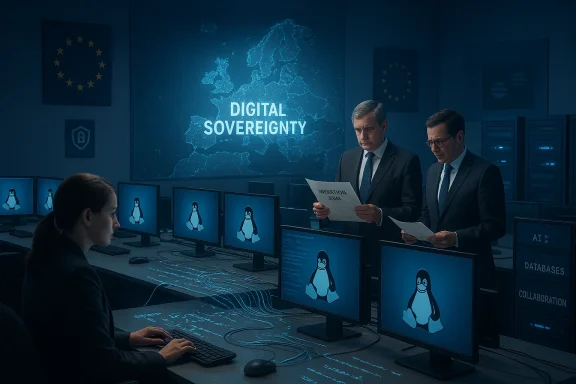
France is no longer treating Windows as an unavoidable default for the public sector. In a newly formalized sovereignty push, the French state has announced that its digital administration will reduce dependence on “extra-European” technologies, with DINUM explicitly saying the government will move its workstation fleet away from Windows and toward Linux-based operating systems. The decision is broader than desktop operating systems, touching collaboration software, antivirus, databases, AI, network gear, and the state’s broader procurement posture. It is also a political signal: France wants to turn digital sovereignty from a slogan into an operating principle.
The headline-grabbing part of the announcement is simple enough: France wants to ditch Windows in government and replace it with Linux on state PCs. But the more important story is that the French government is framing the decision not as a one-off software swap, but as part of a larger campaign to reduce strategic dependence on vendors outside Europe. That means this is about procurement, security, resilience, and industrial policy as much as it is about desktops.
That broader framing matters because the French state is not acting in isolation. Over the past year, Europe has seen a steady rise in digital sovereignty language across public procurement, open-source policy, and platform strategy. The European Commission’s Digital Commons EDIC, launched in late 2025, was designed to help countries build shared open, interoperable digital infrastructure, while France’s own ANSSI updated its open-source policy in early 2026 to formalize a stronger commitment to open source for secure digitalization and supply-chain resilience.
France’s latest move also fits a pattern already visible inside the French state. DINUM has supported Matrix.org, expanded state-controlled collaboration tooling such as Tchap, and pushed “Visio” as a unified videoconferencing option for public employees. The current Linux shift is therefore less of a surprise than the next stage of a multi-year migration away from imported, tightly controlled platforms toward tools the government believes it can govern more directly.
At the same time, the announcement is notable because it does not pretend migration will be easy. The state has said each ministry must produce its own plan by autumn, and the scope includes not just laptops and desktops, but antivirus, database systems, AI, virtualization, and network equipment. That is a serious change-management program, not a press-release pledge.
The procurement implications are substantial. Once a ministry is told to map its dependencies across endpoints, collaboration, security, data platforms, and AI, the question becomes less “Should we buy this product?” and more “How much control does this product leave us with five years from now?” That is a more strategic model of government IT procurement, and it is one that favors open standards, open source, and European-controlled infrastructure.
The French plan appears to be heading in that direction. Each ministry must create its own migration plan by autumn, which suggests central policy with decentralized execution. That is usually the only realistic approach for a state as large and complex as France, because one-size-fits-all desktop standardization tends to fail on the rocks of local process and historic application sprawl.
This is where the policy becomes harder to dismiss as symbolism. A Linux desktop alone is useful, but a sovereign stack is something else entirely. It requires compatible identity, secure document formats, managed endpoints, administration tooling, and a procurement culture that rewards interoperability over convenience.
In practice, the state is acknowledging that a “secure” product can still be strategically constraining if it is proprietary, hard to audit, or expensive to exit. That is why open source and European-controlled digital commons are gaining traction in policy circles. They promise not just fewer vulnerabilities, but more leverage.
The result is likely to be more collaboration with European partners and more support for common building blocks. We are already seeing governments discuss shared identity systems, open source messaging, sovereign cloud, and public-sector digital commons. France’s Linux decision is part of that same convergence.
For European alternatives, the opportunity is obvious but not automatic. They must prove they can deliver enterprise-grade support, security, and interoperability at scale. Public administrations do not migrate because a philosophy is attractive; they migrate because a replacement stack actually works on Monday morning.
Munich’s experience does not mean Linux migrations fail by definition. It means they fail when they are underfunded, politically unstable, or forced to coexist with too many exceptions. France will have to avoid that trap by treating migration as a long-term service transformation rather than a procurement event.
This is why the French announcement is so significant. It suggests the state has decided the strategic benefits outweigh the discomfort of migration. If it succeeds, France could become a reference model for other ministries and municipal governments across Europe. If it stumbles, critics will point to Munich and say the old dependencies were harder to unwind than expected.
User experience will also matter more than policy speeches admit. Civil servants are not trying to make a geopolitical statement when they file a reimbursement form or manage a case file. If Linux-based desktops are clunky, unstable, or incompatible with common productivity tasks, resistance will grow quickly.
For civil servants, the change will be much more immediate and personal. Desktop habits, file formats, meeting tools, and administrative shortcuts may all shift. The real question is whether the state can make the transition feel like modernization rather than disruption.
France seems to be embracing the control logic. The state is effectively saying that some dependencies are too expensive even when the sticker price looks attractive. That is a mature and unromantic way to think about digital infrastructure, and it is likely to resonate with other governments facing similar pressures.
The other thing to watch is whether the state follows the same logic into cloud, identity, collaboration, and database infrastructure. If Linux is merely the first domino, the deeper transformation could reshape how France buys, governs, and exits digital platforms for years to come. If the effort stalls at the workstation layer, the announcement will still matter, but mostly as a symbolic break with the old default.
Source: Neowin France ditches Windows in favor of Linux
 Overview
The headline-grabbing part of the announcement is simple enough: France wants to ditch Windows in government and replace it with Linux on state PCs. But the more important story is that the French government is framing the decision not as a one-off software swap, but as part of a larger campaign to reduce strategic dependence on vendors outside Europe. That means this is about procurement, security, resilience, and industrial policy as much as it is about desktops.That broader framing matters because the French state is not acting in isolation. Over the past year, Europe has seen a steady rise in digital sovereignty language across public procurement, open-source policy, and platform strategy. The European Commission’s Digital Commons EDIC, launched in late 2025, was designed to help countries build shared open, interoperable digital infrastructure, while France’s own ANSSI updated its open-source policy in early 2026 to formalize a stronger commitment to open source for secure digitalization and supply-chain resilience.
France’s latest move also fits a pattern already visible inside the French state. DINUM has supported Matrix.org, expanded state-controlled collaboration tooling such as Tchap, and pushed “Visio” as a unified videoconferencing option for public employees. The current Linux shift is therefore less of a surprise than the next stage of a multi-year migration away from imported, tightly controlled platforms toward tools the government believes it can govern more directly.
At the same time, the announcement is notable because it does not pretend migration will be easy. The state has said each ministry must produce its own plan by autumn, and the scope includes not just laptops and desktops, but antivirus, database systems, AI, virtualization, and network equipment. That is a serious change-management program, not a press-release pledge.
The Announcement in Context
The French government’s language is strikingly direct. Minister David Amiel argued that the state can no longer merely recognize its dependence; it must break free. That messaging tells us the decision is being sold internally as a sovereignty imperative, not as an IT optimization exercise. In other words, the government is preparing ministries to accept disruption in exchange for control.Why “Extra-European” Matters
The phrase “extra-European” is doing a lot of work here. It is not a blanket rejection of foreign technology, but it clearly signals a preference for vendors, standards, and platforms with a stronger European footprint or governance model. That matters because the state is not simply chasing open source for ideological reasons; it is trying to reduce the risk that a critical dependency sits under another jurisdiction’s legal, commercial, or political control.The procurement implications are substantial. Once a ministry is told to map its dependencies across endpoints, collaboration, security, data platforms, and AI, the question becomes less “Should we buy this product?” and more “How much control does this product leave us with five years from now?” That is a more strategic model of government IT procurement, and it is one that favors open standards, open source, and European-controlled infrastructure.
- Windows is no longer treated as the default
- Linux becomes the preferred workstation path
- Sovereignty and supply-chain control are central
- Procurement will likely shift toward European vendors
- The change spans more than desktop operating systems
What the State Is Actually Changing
The immediate headline is “Windows out, Linux in,” but that shorthand can hide the scale of the undertaking. DINUM has said the transition covers workstation operating systems, yet the same plan also extends to collaboration tools, antivirus software, database management, AI, and network equipment. That breadth suggests France is trying to break a bundle of dependencies rather than replace a single product.The Workstation Layer
Replacing Windows on government PCs is the most visible element, and also the one most likely to produce the most friction. End users do not just need a shell and a browser; they need compatibility with legacy line-of-business apps, peripheral drivers, accessibility tools, and identity systems. That is why Linux migrations in the public sector succeed when they are staged, heavily supported, and ruthlessly pragmatic.The French plan appears to be heading in that direction. Each ministry must create its own migration plan by autumn, which suggests central policy with decentralized execution. That is usually the only realistic approach for a state as large and complex as France, because one-size-fits-all desktop standardization tends to fail on the rocks of local process and historic application sprawl.
Beyond the Desktop
The inclusion of antivirus, databases, virtualization, and AI systems is especially telling. Those are not peripheral purchases; they are the plumbing of modern government IT. If France can shift even part of those layers to European or open-source alternatives, the state reduces vendor lock-in far more effectively than it would by simply changing the desktop UI.This is where the policy becomes harder to dismiss as symbolism. A Linux desktop alone is useful, but a sovereign stack is something else entirely. It requires compatible identity, secure document formats, managed endpoints, administration tooling, and a procurement culture that rewards interoperability over convenience.
- Endpoint migration is only one piece of the plan
- Security tooling will need equivalent replacements
- Data platforms may move to “trusted” environments
- AI and database choices could become strategic
- Networking hardware is now in scope
Why France Is Doing This Now
France’s move is happening at a moment when Europe’s dependence on non-European platforms has become a political topic, not just a technical one. Concerns about access, pricing, legal exposure, and strategic autonomy have all intensified in recent years, and public agencies across the continent are increasingly using open source as a way to preserve choice. The French government’s announcement is really a response to that larger mood shift.Security Is Only Part of the Story
Security certainly matters, and ANSSI’s updated open-source policy is a strong clue that French officials see open software as a supply-chain and resilience advantage. But the state’s language goes beyond cybersecurity; it speaks about control over rules, pricing, evolution, and risk. That is a vendor-management problem as much as a security problem.In practice, the state is acknowledging that a “secure” product can still be strategically constraining if it is proprietary, hard to audit, or expensive to exit. That is why open source and European-controlled digital commons are gaining traction in policy circles. They promise not just fewer vulnerabilities, but more leverage.
- Cybersecurity and sovereignty are now intertwined
- Vendor lock-in is treated as a strategic risk
- Open source is increasingly a policy tool
- European control is the core objective
- Control matters as much as cost
The European Sovereignty Angle
One of the most interesting aspects of the French decision is how closely it aligns with pan-European digital strategy. The European Commission’s Digital Commons EDIC exists precisely to help governments share infrastructure, develop reusable components, and reduce dependence on a small number of global platforms. France’s announcement sounds like a national implementation of that philosophy.A Sign of Policy Convergence
In the old model, public-sector IT modernization often meant standardizing on the most dominant commercial stack. In the new model, the goal is to standardize on what can be governed, audited, shared, and exited on reasonable terms. That is a subtle but profound shift, and France is now one of the clearest examples of it.The result is likely to be more collaboration with European partners and more support for common building blocks. We are already seeing governments discuss shared identity systems, open source messaging, sovereign cloud, and public-sector digital commons. France’s Linux decision is part of that same convergence.
What It Means for Rivals
For Microsoft, the obvious risk is not an immediate collapse in government revenue; it is a slow erosion of default status in a politically important market segment. Once the state begins formal migration planning, it creates room for open-source vendors, managed service providers, and European software firms to compete on equal footing. That can shift the long-term economics of public-sector software buying.For European alternatives, the opportunity is obvious but not automatic. They must prove they can deliver enterprise-grade support, security, and interoperability at scale. Public administrations do not migrate because a philosophy is attractive; they migrate because a replacement stack actually works on Monday morning.
- France is aligning with EU sovereignty policy
- Shared digital commons are becoming more credible
- Commercial incumbents face strategic pressure
- European vendors get a larger policy tailwind
- Execution, not ideology, will decide success
Lessons From Other European Migrations
France is not the first public authority to consider walking away from Microsoft’s ecosystem, and Europe has plenty of migration history to study. Amsterdam has just begun a multiyear digital autonomy strategy built around mapping dependencies and moving away from proprietary solutions. Austria’s military has pushed open source in part to strengthen sovereignty and keep data in-house. Those examples show that the French decision sits within an established European pattern, not an isolated outlier.The Munich Cautionary Tale
The obvious counterexample is Munich, which famously reversed part of its Linux experiment and moved back to Microsoft after years of effort. That story still casts a long shadow over any government desktop migration because it proves the hardest part is not ideology; it is sustained operational support, application compatibility, and user satisfaction over the long run.Munich’s experience does not mean Linux migrations fail by definition. It means they fail when they are underfunded, politically unstable, or forced to coexist with too many exceptions. France will have to avoid that trap by treating migration as a long-term service transformation rather than a procurement event.
Denmark, Amsterdam, and the New Normal
The more relevant lesson may come from governments that are still in the early stages and are being brutally honest about the scale of the work. Amsterdam’s plan, for example, openly discusses mapping, classification, and phased migration before major cutovers. That is the kind of operational discipline France will need if it wants the switch to survive budget cycles and ministerial reshuffles.This is why the French announcement is so significant. It suggests the state has decided the strategic benefits outweigh the discomfort of migration. If it succeeds, France could become a reference model for other ministries and municipal governments across Europe. If it stumbles, critics will point to Munich and say the old dependencies were harder to unwind than expected.
The Enterprise Reality Behind a Linux Switch
The public conversation often treats Linux migration as a matter of choosing a different desktop image, but enterprise reality is much more demanding. A modern workstation environment includes device management, patching, identity, endpoint telemetry, software distribution, and helpdesk workflows. If those surrounding layers are not planned carefully, the “free” operating system becomes expensive very quickly.Compatibility and User Experience
The hardest issue will be application compatibility. Ministries depend on specialist software, legacy intranet tools, and workflows that may have evolved over decades around Windows conventions. Replacing the OS without replacing the surrounding application ecosystem would simply push the pain somewhere else.User experience will also matter more than policy speeches admit. Civil servants are not trying to make a geopolitical statement when they file a reimbursement form or manage a case file. If Linux-based desktops are clunky, unstable, or incompatible with common productivity tasks, resistance will grow quickly.
- Application compatibility is the key technical hurdle
- Identity and device management must be redesigned
- Helpdesk readiness will shape user adoption
- Legacy workflows may resist change
- Training costs will be significant
Consumer vs. Civil Service Impact
For ordinary French citizens, the switch should be mostly invisible in the short term. But over time, a more sovereign public IT stack could alter how citizens interact with the state, especially if the transition improves interoperability, digital services, and public-sector transparency. That said, citizens mainly care whether services work, not which kernel runs behind them.For civil servants, the change will be much more immediate and personal. Desktop habits, file formats, meeting tools, and administrative shortcuts may all shift. The real question is whether the state can make the transition feel like modernization rather than disruption.
Why Open Source Becomes the Default Answer
France’s announcement is also part of a larger rehabilitation of open source in government. Ten years ago, open source was often framed as a cost-saving niche. Now it is increasingly framed as a strategic asset that improves control, security, and resilience while keeping public money inside the European digital economy.From Cost Logic to Control Logic
That evolution is important because it changes how public leaders justify migration projects. If the only argument is savings, then every hidden cost becomes a liability. If the argument is strategic control, then the calculus expands to include independence, interoperability, and long-term bargaining power.France seems to be embracing the control logic. The state is effectively saying that some dependencies are too expensive even when the sticker price looks attractive. That is a mature and unromantic way to think about digital infrastructure, and it is likely to resonate with other governments facing similar pressures.
- Open source is now strategic infrastructure
- Control is more important than short-term savings
- Interoperability is a national capability
- Public money can support local ecosystems
- Governments want leverage, not just licenses
Strengths and Opportunities
The French plan has several obvious strengths, especially if it is executed with patience and technical discipline. It could reduce dependence on foreign vendors, improve control over data and update cycles, and give Europe’s open-source ecosystem a valuable public-sector reference customer. Just as importantly, it may force ministries to clean up legacy sprawl and rationalize their digital estate. That kind of forced modernization is painful, but it can be healthy.- Greater digital sovereignty and reduced vendor lock-in
- Stronger alignment with European policy goals
- Potential security and auditability gains
- Better leverage in public procurement
- Opportunities for European software vendors
- More disciplined infrastructure planning
- A chance to modernize legacy workflows
Risks and Concerns
The risks are equally real, and they start with execution. A migration of this size can easily become fragmented across ministries, underfunded in the middle phases, or politically vulnerable if early users encounter friction. The state may also discover that some critical software has no satisfactory non-Windows equivalent, which would force exceptions and weaken the sovereignty story.- Application compatibility problems
- User resistance and training burden
- Hidden migration and support costs
- Fragmentation across ministries
- Procurement complexity and delays
- Possible over-reliance on “sovereignty” branding
- Risk of replacing one dependency with another
Looking Ahead
The next major milestone is the autumn deadline for each ministry’s migration plan. That will be the first real indication of whether this is a clean political gesture or a serious operational program with budgets, owners, and measurable targets. If the plans are detailed, realistic, and funded, France’s move could become one of the most consequential public-sector IT transformations in Europe.The other thing to watch is whether the state follows the same logic into cloud, identity, collaboration, and database infrastructure. If Linux is merely the first domino, the deeper transformation could reshape how France buys, governs, and exits digital platforms for years to come. If the effort stalls at the workstation layer, the announcement will still matter, but mostly as a symbolic break with the old default.
- Ministry migration plans due in autumn
- Budget and staffing commitments will reveal seriousness
- Desktop replacement may trigger broader platform reviews
- European vendors will look for early contract wins
- Public-sector user adoption will be the real test
Source: Neowin France ditches Windows in favor of Linux
