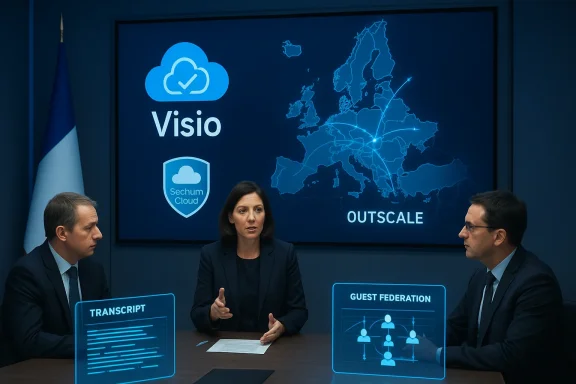
France has announced it will replace a patchwork of U.S. video-conferencing tools used across the public sector with a domestically developed platform called Visio, and has set a target to generalize the service across all state services by 2027.
The decision, announced publicly by David Amiel, Minister Delegate for the Civil Service and State Reform, formalizes a rollout that began as an experiment roughly a year ago and already counts tens of thousands of regular users. The official brief states that Visio has been piloted for more than a year, currently supports about 40,000 regular users, and is being extended in phases to reach roughly 200,000 civil servants as the government accelerates adoption across ministries and major public institutions.
The stated goals are explicit and repeated across government messaging: reduce dependency on non‑European digital providers, guarantee the security and confidentiality of public electronic communications, and capture recurring licensing savings. The government highlights Visio’s hosting on French-certified infrastructure, French AI partners for transcription and speaker separation, and a commitment to oversight by national security agencies.
This move fits into a broader European policy push toward “digital sovereignty,” where public bodies increasingly prioritise local control, regional cloud certifications, and provenance of software and AI systems. For IT professionals, procurement teams and platform vendors, the decision is notable because it signals a high‑profile, real‑world procurement pivot away from mainstream U.S. collaboration platforms.
Key cost categories to weigh beyond licence savings:
At the same time, there are risks of perceived protectionism. Officials will need to make careful legal and diplomatic arguments about procurement transparency and competition to avoid trade friction or claims of unfair advantage for local providers. The government’s framing—framed squarely in security terms—helps mitigate that narrative, but procurement lawyers and trade partners will scrutinize the details.
However, it’s important to stress that a public‑sector pivot does not automatically equate to a repudiation of commercial viability. Large swathes of private-sector enterprise and small businesses will continue to choose tools that deliver the fastest feature development, best integrations, and most competitive pricing. France’s program is narrowly scoped to civil servants for now; general availability or private-sector adoption is not part of the immediate plan.
That said, success will depend on execution. Feature parity, cross‑domain federation, operational resilience at scale, and transparent AI governance are non-trivial problems that require sustained investment and public reporting. The government’s headline fiscal savings and security assurances are promising but must be validated through independent audits, peer-reviewed operational metrics, and careful procurement economics. Stakeholders—both inside and outside France—should watch early adopter reports, published audit results, and the handling of external collaboration scenarios closely.
For WindowsForum readers and IT professionals, the Visio rollout is a reminder that sovereign procurement is now practical at government scale—but it is not a magic bullet. The practical question for CIOs and procurement leads is simple: can a sovereign platform deliver sustained reliability, low friction in real workflows, and transparent governance while remaining cost‑effective? France’s experiment will be a valuable case study for governments and large organizations worldwide about how and when to trade off convenience for control.
Source: Windows Central France to replace US platforms like Microsoft Teams with a Visio by 2027
 Background / Overview
The decision, announced publicly by David Amiel, Minister Delegate for the Civil Service and State Reform, formalizes a rollout that began as an experiment roughly a year ago and already counts tens of thousands of regular users. The official brief states that Visio has been piloted for more than a year, currently supports about 40,000 regular users, and is being extended in phases to reach roughly 200,000 civil servants as the government accelerates adoption across ministries and major public institutions. The stated goals are explicit and repeated across government messaging: reduce dependency on non‑European digital providers, guarantee the security and confidentiality of public electronic communications, and capture recurring licensing savings. The government highlights Visio’s hosting on French-certified infrastructure, French AI partners for transcription and speaker separation, and a commitment to oversight by national security agencies.
This move fits into a broader European policy push toward “digital sovereignty,” where public bodies increasingly prioritise local control, regional cloud certifications, and provenance of software and AI systems. For IT professionals, procurement teams and platform vendors, the decision is notable because it signals a high‑profile, real‑world procurement pivot away from mainstream U.S. collaboration platforms.
What is Visio? — Features, architecture and intended scope
Origins and governance
Visio is developed by the Direction interministérielle du numérique (DINUM), the interministerial digital directorate responsible for shared digital tools in the French state. The platform is part of a larger initiative sometimes referenced as La Suite Numérique, a set of sovereign, open and state-managed tools for public servants that aims to replace reliance on a variety of foreign SaaS offerings. The service is available to civil servants through the ProConnect identity system and is explicitly designed for public-sector use rather than for mass commercial distribution.Core technical pillars
According to government materials, Visio’s technical and security posture rests on three visible pillars:- Sovereign hosting: services hosted on Outscale (a cloud brand of Dassault Systèmes) with the ANSSI SecNumCloud qualification, ensuring French data residency and a well-defined certification baseline.
- French AI components: transcription and speaker‑separation features are built on French research and startups—most notably the Pyannote speaker separation technology—and further subtitling capabilities are planned with national partners.
- DINUM stewardship and ANSSI oversight: the program is framed as a government-controlled platform subject to audits, bug bounties and operational oversight by the national cybersecurity agency.
User-facing features and roadmap
Visio offers the standard staples expected from a modern web conferencing tool: scheduled and ad hoc video meetings, screen sharing, participant management and meeting transcription. The government has publicly announced a roadmap that includes real‑time subtitling by summer 2026 and iterative improvements to match common administrative use cases. While feature parity with mature commercial platforms is ambitious, early deployments are reported to be adequate for the majority of day-to-day internal meetings.Security and sovereignty: strengths and guarantees
Why France frames this as a security imperative
French officials are presenting Visio not merely as a cost-saving measure but as an instrument of state security: preventing sensitive scientific exchanges, healthcare data flows and tactical communications from being exposed to non‑European actors and foreign legal regimes. That concern is rooted in long-standing European debates over cross-border data access, law enforcement requests, and the legal reach of third‑country legislation. The decision is therefore political as much as it is technical.Concrete security controls claimed
The government cites the following operational security guarantees:- Data residency and contractual control: host infrastructure within France under providers that hold ANSSI SecNumCloud certification, enabling mandated logging, contractual audits and clearly defined export controls.
- Designed-for-audit code and open components: DINUM’s approach emphasizes open‑source components, auditability, bug bounties and public‑sector governance to reduce opaque telemetry and clandestine dependencies.
- Local AI stacks for transcription: using French AI models and providers to eliminate the need to send raw audio to foreign AI clouds for processing—though operational details about model updates and retraining cycles remain limited in public statements.
Cost claims, procurement and economics
The government headline figure has been simple and repeatable: Visio will save €1 million per year for every 100,000 users who stop paying commercial conferencing licences. This framing highlights licence cost avoidance as a near‑term fiscal win. However, the government’s estimates represent top‑line licence savings and do not account for the full lifecycle costs that will determine net value.Key cost categories to weigh beyond licence savings:
- Infrastructure and hosting (capacity planning, multi‑region resilience)
- Ongoing development and feature parity investments
- Operational support and 24/7 incident response for a national service
- Migration costs, user training, and productivity losses during transition windows
- Integration work (calendar systems, SSO, federation) and third‑party interoperability engineering
Operational and technical challenges — what will determine success
Feature parity and user experience
Public servants expect reliability, polished UX and integrations (calendar, device management, recording and moderation features). Commercial platforms have spent years iterating against enterprise needs; replicating that depth at national scale requires sustained investment. Short‑term friction will encourage shadow IT unless DINUM prioritizes seamless workflows and responsive help desks. Reports indicate core capabilities exist for many administrative scenarios, but the long tail—large events, cross‑border federation, telephony integrations—are harder and will be the true test.Scale, resilience and operational maturity
Real‑time voice and video at national scale is demanding. Commercial vendors invest heavily in multi‑region edge networks, automated capacity management and chaos‑tested operations. Outscale’s SecNumCloud qualification provides a strong compliance baseline, but operationally this project will need to demonstrate sustained uptime, effective DDoS mitigation, and multi‑region redundancy to match expectations across peak loads. Historical outages in commercial clouds have shown that full resilience comes from layered investments and cross-provider redundancy—challenges that must be faced by any sovereign cloud stack.Interoperability and external collaboration
Government work is rarely strictly internal. Agencies meet with international partners, contractors, NGOs and private vendors. Making a sovereign platform operate smoothly with these external actors requires flexible federation, secure guest access bridges, and a friction-light invitation model. If Visio is too closed or forces cumbersome authentication for external participants, the platform risks reintroducing fragmentation as teams turn to external tools to collaborate with outside parties. DINUM will need to balance strict security with practical usability for mission-critical collaboration.AI features: privacy, governance and model management
The headline AI capabilities—transcription, speaker separation and future real‑time subtitling—are attractive, but they introduce new governance requirements. Important operational questions that have yet to be fully detailed publicly include:- Where are model weights stored and who controls them?
- Are models retrained on aggregated internal data and under what consent and retention policies?
- How are transcripts retained, indexed and made discoverable for records or legal requests?
Political and legal context — why this matters beyond France
Visio is not just an IT procurement; it’s a political statement aligned with European concerns about the legal extraterritorial reach of third‑country laws and the risks posed by concentrated cloud monopolies. The decision coincides with growing EU interest in targeted industrial policy, cloud certification, and a strategic push to develop local digital ecosystems. For EU policymakers and national CIOs, France’s move functions as both proof-of-concept and a nudge: sovereignty‑oriented solutions can be built and scaled, but they will require funding and coordination to match commercial alternatives.At the same time, there are risks of perceived protectionism. Officials will need to make careful legal and diplomatic arguments about procurement transparency and competition to avoid trade friction or claims of unfair advantage for local providers. The government’s framing—framed squarely in security terms—helps mitigate that narrative, but procurement lawyers and trade partners will scrutinize the details.
What this means for Microsoft, Zoom, and U.S. vendors
For major collaboration vendors, France’s decision is a concrete market signal: sovereign procurement criteria are becoming a first‑class requirement in public-sector deals. Vendors seeking government business in Europe may need to provide convincing local hosting, contractual commitments around data access, and transparent model governance for any AI features. We should expect a mix of responses: from technical partnerships and localized hosting offers to lobbying and competitive pricing in government tenders.However, it’s important to stress that a public‑sector pivot does not automatically equate to a repudiation of commercial viability. Large swathes of private-sector enterprise and small businesses will continue to choose tools that deliver the fastest feature development, best integrations, and most competitive pricing. France’s program is narrowly scoped to civil servants for now; general availability or private-sector adoption is not part of the immediate plan.
Practical guidance for IT leaders and procurement teams
- Treat government savings estimates as preliminary: commission a full TCO and migration cost analysis before extrapolating licence savings to net budget impact.
- Inventory dependencies: identify use cases that rely on calendar integrations, meeting recording retention, telephony and federation with external partners; these are the highest-risk migration items.
- Test federation and guest workflows early: run pilots with partner organizations to validate external meeting scenarios.
- Demand operational transparency: require published uptime SLAs, incident reports, pen‑test summaries and evidence of continuous governance for AI models.
- Prepare change management: invest in training, support desks and short‑term overlap licences to avoid productivity dips during migration windows.
Risks and caveats — where public claims need scrutiny
Several government claims are well-supported and technically plausible, but others deserve cautious treatment:- The €1 million per 100,000 users savings estimate is a reasonable headline but omits many TCO variables. Treat it as an indicative figure pending detailed accounting.
- AI governance details have not been fully disclosed. Questions around model retraining, retention of transcripts and access controls must be answered in published governance documents.
- Operational resilience at national scale is achievable but expensive. Expect multi‑year investment to reach parity on large-event performance, cross‑region routing and sophisticated moderation features.
What to watch next — milestones and signals of success
- First quarter 2026 migrations: early adopters named in official materials—CNRS, Assurance Maladie, DGFiP and the Ministry of the Armed Forces—are expected to complete initial migrations; their operational reports will be the first signal of real-world readiness.
- Summer 2026 subtitling rollout: the government has scheduled real‑time subtitling to be available by summer 2026; accuracy, latency and privacy practices around that feature are an important metric.
- Published audits and pen test results: evidence of independent security audits and an active bug‑bounty program will materially increase trust; watch for public disclosures.
- Interoperability and guest‑joining metrics: how easily external participants join meetings without complex credential gymnastics will be an early usability barometer.
Conclusion
France’s decision to generalize Visio across state services by 2027 is a consequential step in translating European digital sovereignty policy into operational infrastructure. The program’s strengths are clear: a focused sovereign design, hosting under a SecNumCloud-certified provider, French AI partners for transcription, and the visible support of DINUM and ANSSI. If executed well, Visio could reduce strategic dependencies, offer a clearer legal boundary for public data, and generate licence-cost savings for the state.That said, success will depend on execution. Feature parity, cross‑domain federation, operational resilience at scale, and transparent AI governance are non-trivial problems that require sustained investment and public reporting. The government’s headline fiscal savings and security assurances are promising but must be validated through independent audits, peer-reviewed operational metrics, and careful procurement economics. Stakeholders—both inside and outside France—should watch early adopter reports, published audit results, and the handling of external collaboration scenarios closely.
For WindowsForum readers and IT professionals, the Visio rollout is a reminder that sovereign procurement is now practical at government scale—but it is not a magic bullet. The practical question for CIOs and procurement leads is simple: can a sovereign platform deliver sustained reliability, low friction in real workflows, and transparent governance while remaining cost‑effective? France’s experiment will be a valuable case study for governments and large organizations worldwide about how and when to trade off convenience for control.
Source: Windows Central France to replace US platforms like Microsoft Teams with a Visio by 2027